
How to Source Carbon Steel from China: A Global Buyer’s Checklist (2025)
Over 50% of the world’s steel is produced in China. For global buyers, that means genuine opportunity — but also a minefield of misrepresented certifications, off-spec material, and intermediaries who never touched the product they’re selling. The buyers who get this right aren’t smarter; they’re just more systematic.
This guide gives you the exact checklist that separates a clean first order from the kind that ends up in a dispute.

Why Source Carbon Steel from China?
Let’s be direct about where China’s steel advantage actually lies, and where it doesn’t.
Genuine advantages:
- Price: Chinese carbon steel is typically 15–35% cheaper than equivalent Western-sourced material at comparable quality tiers, largely due to lower labor and energy costs at scale
- Grade range: Chinese mills produce the full spectrum — low carbon (Q235, 20#), medium carbon (45#/1045), high carbon (T10, 65Mn), plus international equivalents (ASTM, DIN, JIS grades)
- Volume capacity: Large mills can fulfill orders from 1 ton to thousands of tons on consistent spec
- Cut-to-size processing: Many Chinese steel service centers offer cutting, bending, turning, and surface finishing in one order — reducing your supply chain steps
Where it gets complicated:
- Quality consistency varies enormously between tier-1 mills and unverified traders
- Fake or altered mill certificates are a real problem (more on this below)
- Lead times are longer than domestic sourcing (typically 3–8 weeks including transit)
- MOQs at major mills may be higher than small buyers expect
Understanding this honestly means you can use China’s strengths without being blindsided by its risks.
Step 1: Define Your Specification Before You Search for Suppliers
The single most common sourcing failure is approaching suppliers with vague requirements and expecting them to self-select to your needs. Before you contact anyone:
Write a Material Specification Sheet
Include:
- Grade: Be explicit — AISI 1045, Q235B, GB/T 699 45#, DIN C45, etc. Don’t write “medium carbon steel”
- Chemical composition limits: Reference the standard (e.g., ASTM A29 for bars)
- Mechanical properties required: Tensile strength, yield strength, hardness — with the delivery condition (as-rolled, normalized, Q&T)
- Product form and dimensions: Round bar Ø60mm × 3000mm, flat bar 50×10mm, plate 20mm thick, etc.
- Tolerance class: e.g., h9 for precision shafting, H11 for general bar
- Surface condition: Hot-rolled (black), cold-drawn (bright), turned-and-polished
- Test and certification requirements: Mill certificate (chemical + mechanical), third-party inspection (SGS, BV, etc.), ultrasonic testing (if needed)
- Quantity and delivery window: Including packaging requirements
A clear spec protects you legally, makes quotations comparable, and immediately filters out suppliers who can’t meet it.
Step 2: Finding Suppliers — and Knowing What You’re Looking At
Supplier Types in China’s Steel Market
| Type | Who They Are | Risk Level |
|---|---|---|
| Tier-1 Mill | BAOSTEEL, WISCO, HBIS, SHAOSTEEL | Lowest — direct mill certs, consistent quality |
| Authorized distributor | Mill-certified stockist, typically buys in bulk from 1–3 mills | Low-medium — verify authorization |
| Steel service center | Stocks and processes (cuts, machines), may source from multiple mills | Medium — mill traceability essential |
| Trading company | Brokers material from various sources | Higher — verify every shipment independently |
Practical rule: For recurring or large orders, work toward a direct relationship with a service center that has documented mill supply relationships. For small or test orders, a reputable trading company may be more flexible on MOQ.
Where to Find Verified Suppliers
- Alibaba Trade Assurance suppliers: Look for Gold Supplier status (3+ years), Verified badge, and on-site check confirmation — these are real audits, not just payments
- Made-in-China.com and HKTDC: Similar verification tiers
- Industry trade shows: China (Guangzhou, Shanghai) metal trade fairs, or your home country’s steel/metalworking expos
- Referrals from engineers in your industry: The best source — someone who has already vetted the supplier
Green Flags in a Supplier Profile
- ISO 9001:2015 certificate (verify it’s current — check the certifying body’s website directly)
- SGS or Alibaba onsite audit completed
- Clear factory address (use Google Maps Street View — does the facility actually look like a steel service center or mill?)
- Response to technical questions is specific and knowledgeable, not template-generic
- Proactively provides sample mill certificates from previous orders
Step 3: Verifying Mill Certificates — The Most Critical Step
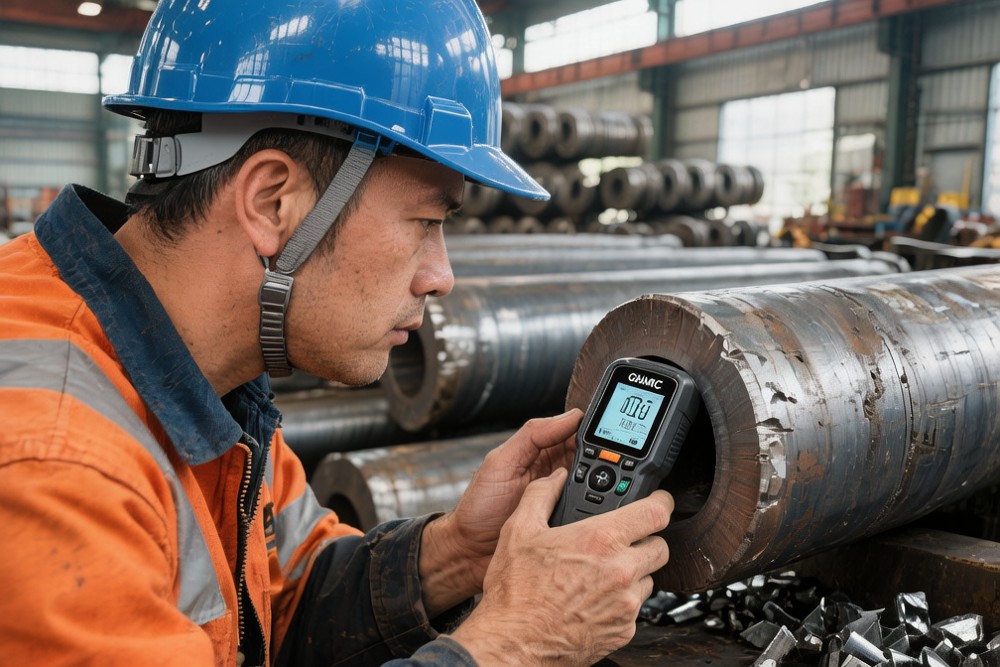
Mill certificates (also called mill test reports or MTRs) are the documentary proof that the steel you receive matches the grade you ordered. In China’s steel market, certificate fraud is real. This is not speculation — it’s documented in multiple industry reports.
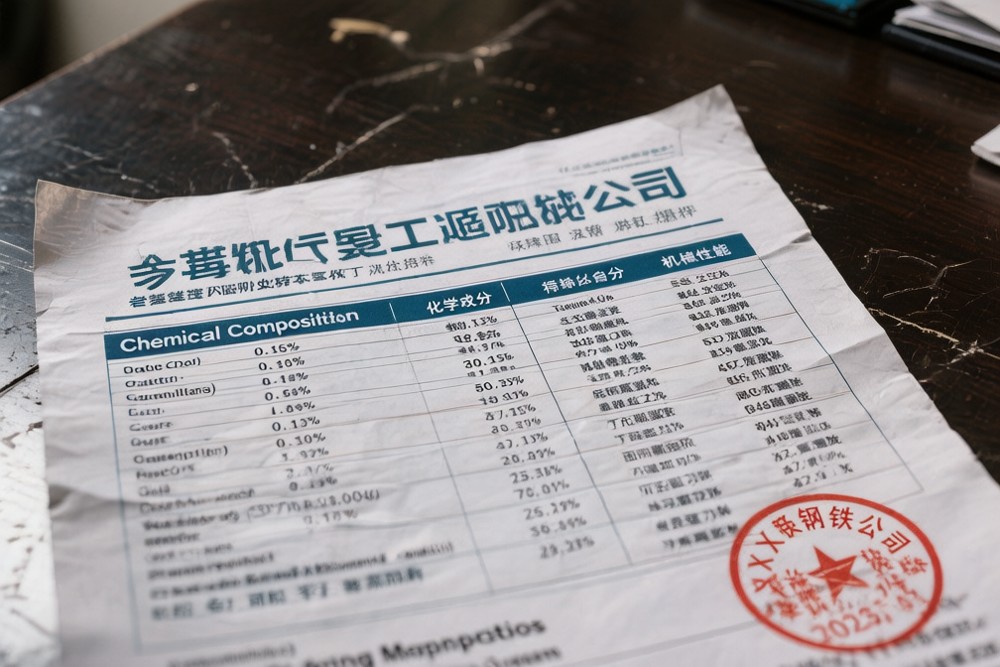
What a Genuine Mill Certificate Contains
- Mill name, address, and certification number
- Heat/cast number (unique identifier linking the material to a specific melting event)
- Chemical analysis (actual ladle analysis values, not just “meets spec”)
- Mechanical test results (with test bar dimensions and heat treatment condition)
- Standard reference (e.g., GB/T 699-2015)
- Inspector signature and date
- Product dimensions and quantity
Red Flags on Mill Certificates
- 🚩 Chemical values that are perfectly centered in the specification range (e.g., C = 0.45% exactly) — real production has measurement scatter
- 🚩 Mechanical values that are identical across multiple certs for different heats
- 🚩 No heat number, or a heat number that doesn’t appear on the physical marking
- 🚩 Certificate from a different mill than the packaging label indicates
- 🚩 Missing tensile or impact test values (especially suspicious for structural grades)
Verification Actions
- Request the original PDF (not a scan of a printout) — forged PDFs exist but are harder to produce consistently
- Cross-check the issuing mill’s certification database if available (BAOSTEEL and some major mills allow online heat number lookup)
- Engage a third-party inspection company (SGS, Bureau Veritas, Intertek) for first orders — cost is typically $200–500 per inspection and eliminates most document fraud
- Request chemical composition testing on the first shipment — send samples to an accredited lab in your country
Step 4: Pricing and Negotiation Realities
How Carbon Steel Is Priced
Chinese steel pricing uses several incoterms and bases:
- EXW (Ex-Works): You handle everything from the factory gate
- FOB (Free on Board): Supplier delivers to named Chinese port (Shanghai, Tianjin, Qingdao); you arrange shipping and insurance from there
- CIF (Cost, Insurance, Freight): Supplier quotes door-to-port at your destination
For most international buyers, FOB Shanghai or FOB Tianjin is the most common and transparent basis. CIF gives less visibility into actual shipping costs.
Price Reference Points (2025 ranges, vary by market conditions)
| Product | Indicative FOB Price Range |
|---|---|
| Carbon steel round bar (1045, Ø20–100mm) | $650–950/ton |
| Carbon steel flat bar (standard grades) | $580–850/ton |
| Carbon steel plate (Q235B, 10–50mm) | $500–750/ton |
| Carbon steel pipe (seamless, standard dims) | $800–1,400/ton |
These are indicative FOB ranges as of mid-2025. Actual prices depend on grade, dimensions, quantity, mill tier, and current raw material costs. Always request formal quotations.
Negotiation Tactics That Actually Work
- Consolidate your order: Even if you need multiple grades, a single larger order with one supplier gives you significantly better pricing
- Be specific about timing: “We will confirm within 48 hours if price is acceptable” signals you’re a real buyer
- Ask for sample mill certs before ordering: Legitimate suppliers send these willingly; reluctance is a signal
- Negotiate payment terms after establishing trust: First order is typically 30% deposit + 70% before shipment; after 2–3 good orders, you can negotiate 30/70 with 70% against documents (LC or CAD)
Step 5: Quality Inspection Before Shipment
For orders above $5,000, pre-shipment inspection almost always pays for itself.
What to Inspect
Dimensional check:
- Measure cross-section dimensions on multiple pieces (not just end pieces — Chinese production mills can have diameter drift across a bundle)
- Weigh the shipment and compare to the theoretical weight (density × dimensions × quantity)
- Check cut lengths if cut-to-size
Visual inspection:
- Surface condition: no seams, laps, cracks, or excessive mill scale flaking
- No visible corrosion beyond light surface rust (acceptable for hot-rolled; not for cold-drawn)
- Markings: heat number, grade, and dimensions should be stenciled or tagged
Chemical verification:
- Portable XRF (X-ray fluorescence) can confirm key elements on-site, especially carbon, manganese
- Send retained samples to an accredited lab for full composition report
Hardness check:
- For Q&T or normalized material, portable hardness tester (Leeb/Equotip) confirms heat treatment compliance on multiple pieces
Hiring an Inspection Company
Reputable inspectors for China sourcing:
- SGS: Widely used, global coverage, well-known to Chinese suppliers
- Bureau Veritas (BV): Strong in structural and marine grades
- Intertek: Good for mechanical and chemical testing
- TÜV SÜD: Strong in European standard certifications
Turnaround is typically 2–5 business days. For standard carbon steel products, inspection costs $250–600.
Step 6: Shipping, Documents, and Customs
Typical Transit Times from China
| Origin Port → Destination | Transit Time |
|---|---|
| Shanghai → Los Angeles | 14–18 days |
| Shanghai → Rotterdam | 28–35 days |
| Shanghai → Dubai | 16–22 days |
| Shanghai → Sydney | 12–16 days |
Add 5–10 days for customs clearance at destination.
Required Import Documents
| Document | Who Provides It |
|---|---|
| Commercial Invoice | Supplier |
| Packing List | Supplier |
| Bill of Lading (B/L) | Shipping line |
| Certificate of Origin | Supplier / Chamber of Commerce |
| Mill Test Certificate | Steel mill |
| Packing Declaration (ISPM15) | Supplier (for wooden packaging) |
| Third-Party Inspection Report | Inspection company (if required) |
For US imports: Check current Section 232 tariff status (25% on most steel from China) and anti-dumping/countervailing duty (AD/CVD) rates by HTS code — these can significantly affect landed cost.
For EU imports: CBAM (Carbon Border Adjustment Mechanism) requirements for steel imports took effect in 2026 — factor in the carbon reporting obligation.
HS Codes for Common Carbon Steel Products
| Product | HS Code (Chapter 72) |
|---|---|
| Carbon steel flat-rolled products | 7208–7212 |
| Carbon steel bars and rods | 7213–7215 |
| Carbon steel angles, shapes, sections | 7216 |
| Carbon steel wire | 7217 |
| Carbon steel tubes and pipes | 7304–7306 |
Always confirm exact HTS code with a licensed customs broker in your country before importing.
Step 7: Building a Long-Term Supplier Relationship
One-off transactions cost more per kilogram and carry more risk than established partnerships. Here’s how buyers who get this right think about it:
After your first successful order:
- Document exactly what worked (which mill, which product form, which cert format, which inspector)
- Schedule a second order within 90 days — maintaining continuity signals you’re a serious buyer and often unlocks better pricing and priority production scheduling
- Request a visit (in-person or virtual) to the service center facility
Communication expectations:
- A responsive supplier should answer technical questions (chemical equivalents, dimension availability, lead times) within 24 hours during business days
- If response times exceed 48 hours consistently, that’s a signal about their service culture on problems too
At Huaxia Steel, our customers typically move from first-order verification to a standing supply relationship within 2–3 orders. Our team is based in Shanghai, ISO 9001 certified, and can source medium carbon, low carbon, and high carbon steel in round bar, flat bar, plate, and pipe — with full mill documentation and flexible cut-to-size.
The Complete Checklist Summary
Before you contact suppliers:
-
Written material specification (grade, form, dimensions, tolerances, delivery condition, certs required)
Quantity and delivery window defined
Incoterms preference (FOB or CIF)
Budget range (so you can evaluate quotes meaningfully)
Supplier evaluation:
-
ISO 9001 certificate verified (current, check certification body website)
Onsite audit confirmation (Alibaba, SGS, or similar)
Sample mill certificate reviewed (check for red flags above)
Technical questions answered specifically (not template responses)
Factory address verified (maps, photo evidence)
Before order confirmation:
-
Formal quotation received (grade, spec, dims, unit price, incoterms, lead time, payment terms)
Mill certificate format confirmed to include heat number, chemical + mechanical values
Third-party inspection scope agreed (if required)
Payment terms and banking details verified
Pre-shipment:
-
Inspection completed and report received
Dimensions, weight, and markings verified
Mill certificate cross-checked against physical heat numbers
Shipping booking confirmed, B/L details reviewed
On arrival:
-
Goods checked against packing list on receipt
Any damage or shortage documented with photos within 24 hours
Retained sample available if composition dispute arises later
Frequently Asked Questions
Q: What is the minimum order quantity (MOQ) for carbon steel from Chinese suppliers?
Mill-direct orders typically start at 5–25 tons for standard grades. Trading companies and service centers can often fulfill 500kg–2 ton orders at a premium. For specialty dimensions or grades, MOQs may be higher.
Q: How do I avoid receiving off-spec steel?
Three-layer protection: (1) clear written specification, (2) pre-shipment third-party inspection including dimensional and hardness check, (3) lab chemical analysis on retained sample. Eliminate any one of these and your risk increases substantially.
Q: Is it safe to buy carbon steel on Alibaba?
Alibaba Trade Assurance transactions provide payment protection, not quality assurance. The Trade Assurance mechanism helps if goods are not shipped, but does not automatically compensate for quality disputes. Pre-shipment inspection is essential regardless of platform.
Q: How long does it take from order placement to delivery?
Typical timeline: mill production 10–20 days + inspection 2–5 days + inland transport to port 2–3 days + ocean freight 14–35 days (depending on destination) + customs clearance 3–7 days. Realistically, budget 6–10 weeks from order to warehouse.
Conclusion
Sourcing carbon steel from China successfully is a repeatable process once you understand the documentation requirements, supplier landscape, and quality risks. The buyers who get burned are almost always skipping the specification step, accepting mill certificates without verification, or skipping pre-shipment inspection on the assumption that “Alibaba Gold Supplier” means quality-guaranteed.
Do the verification. Get the inspection report. Build the relationship.
Need a reliable verified carbon steel supplier in China? Huaxia Steel has supplied global buyers for years from Shanghai, with ISO 9001 certification, full mill documentation, and flexible processing.
Author: Huaxia Steel Sourcing Team | Updated: June 2025 | Category: Steel Sourcing & Procurement