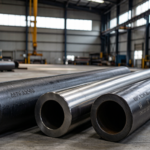
Carbon steel pipe is the backbone of global infrastructure — oil and gas transmission, structural construction, mechanical engineering, and water systems all rely on it. For international buyers sourcing from China, understanding pipe types, grades, standards, and quality control is essential to getting the right product at the right price.
This guide covers everything you need to know: from seamless vs. welded classification, to API/ASTM/EN/JIS grade comparisons, to manufacturing processes, inspection standards, and a practical sourcing checklist.
1. Carbon Steel Pipe Types: Seamless vs. Welded
The first decision in sourcing carbon steel pipe is choosing between seamless and welded. Each has distinct manufacturing processes, pressure ratings, and price points.
Seamless Carbon Steel Pipe
Seamless pipe is manufactured by piercing a solid steel billet and rolling it into a hollow tube — no weld seam. This gives it superior pressure capacity and structural integrity.
- **Manufacturing**: Hot rolling or cold drawing from solid billet
- **Pressure rating**: Up to 20,000+ PSI (depending on grade and wall thickness)
- **Common standards**: ASTM A106, ASTM A333, API 5L, EN 10216
- **Best for**: High-pressure applications, oil/gas transmission, boiler tubes, hydraulic systems
- **Price premium**: 15-30% higher than welded equivalents
Welded Carbon Steel Pipe
Welded pipe is formed by rolling a steel plate or strip into a cylindrical shape and welding the seam. It’s more cost-effective and available in larger diameters.
- **Manufacturing**: ERW (Electric Resistance Welded), LSAW (Longitudinal Submerged Arc Welded), SSAW (Spiral Submerged Arc Welded)
- **Pressure rating**: Generally up to 3,000 PSI (ERW), higher for LSAW
- **Common standards**: ASTM A53, API 5L PSL1/PSL2, EN 10217
- **Best for**: Low/medium pressure applications, structural use, water/gas distribution, piling
- **Cost advantage**: 15-30% cheaper than seamless
Quick Comparison Table
| Feature | Seamless | ERW Welded | LSAW Welded | SSAW Welded |
|---|---|---|---|---|
| Max Diameter | 24″ (610mm) | 24″ (610mm) | 120″ (3048mm) | 120″ (3048mm) |
| Wall Thickness | Sch 10 – Sch 160 | Sch 10 – Sch 80 | 6-50mm | 6-25mm |
| Pressure Rating | Highest | Medium | High | Medium |
| Weld Seam | None | Straight | Straight | Spiral |
| Length | 5.8-12m | 6-12m | 6-12m | 6-12m |
| Relative Cost | Highest | Lowest | Medium | Low-Medium |
2. Key Carbon Steel Pipe Grades and Standards
ASTM Standards
| Standard | Description | Common Grades | Typical Application |
|---|---|---|---|
| ASTM A53 | Welded & seamless steel pipe | Type E, S, F (Gr. A/B) | Mechanical, pressure, structural |
| ASTM A106 | Seamless carbon steel pipe | Gr. A, B, C | High-temperature service |
| ASTM A333 | Seamless/welded for low-temp | Gr. 1, 3, 6 | Cryogenic, low-temp service |
| ASTM A335 | Seamless alloy steel pipe | P5, P9, P11, P22 | High-temp refinery service |
| ASTM A500 | Welded structural tubing | Gr. A, B, C, D | Structural, round/Square/rectangular |
API 5L Pipeline Standard
API 5L is the most widely used standard for pipeline transportation in the oil and gas industry.
| Specification Level | Grade | Yield Strength (MPa) | Tensile Strength (MPa) | Application |
|---|---|---|---|---|
| PSL1 | A25 | 172 | 310 | Low-pressure gas/water |
| PSL1 | X42 | 290 | 415 | Medium-pressure pipeline |
| PSL1/PSL2 | X52 | 358 | 455 | Standard oil/gas pipeline |
| PSL1/PSL2 | X60 | 415 | 520 | High-pressure pipeline |
| PSL2 | X70 | 485 | 570 | Large-diameter transmission |
PSL1 vs PSL2: PSL2 requires mandatory impact testing, stricter chemical composition, and traceability — always specify PSL2 for critical pipeline projects.
EN and JIS Equivalents
| ASTM | EN (DIN) | JIS | GB (China) |
|---|---|---|---|
| A53 Gr.B | EN 10217-1 P265TR1 | STPG370 | Q235 |
| A106 Gr.B | EN 10216-2 P265GH | STPT370 | 20# |
| A333 Gr.6 | EN 10216-4 P215NL | STPL380 | 16Mn |
| API 5L X52 | EN 10208-2 L360MB | STS370 | L360 |
3. Manufacturing Process Overview
Seamless Pipe Manufacturing
1. Billet heating: Solid round billet heated to 1,200-1,300°C
2. Piercing: Mandrel pierces the billet to create a hollow shell
3. Rolling: Plug mill or mandrel mill rolls the shell to target OD and wall thickness
4. Sizing: Sizing mill achieves precise diameter
5. Cooling & cutting: Controlled cooling, then cut to length
6. Heat treatment: Normalizing, quenching & tempering as required
ERW Pipe Manufacturing
1. Uncoiling: Steel coil unrolled and flattened
2. Forming: Roll-forming machine shapes strip into a tube
3. Welding: High-frequency current fuses the edges (no filler metal)
4. Deburring: Internal and external weld bead removed
5. Sizing: Sizing rolls achieve final dimensions
6. Cutting: Flying cut-off saw cuts to length
7. Testing: Hydrostatic or ultrasonic testing per standard
LSAW Pipe Manufacturing
1. Plate forming: Steel plate pressed into U-shape, then O-shape
2. Inner weld: SAW (Submerged Arc Welding) from inside
3. Outer weld: SAW from outside
4. Expanding: Mechanical expansion to precise roundness
5. Hydrostatic test: 100% hydro testing per API 5L
4. Sizing System: Nominal Pipe Size (NPS) and Schedule
Carbon steel pipe dimensions follow the ASME B36.10M standard.
Common Sizes for Export
| NPS | OD (mm) | Sch 40 Wall (mm) | Sch 80 Wall (mm) | Sch 160 Wall (mm) |
|---|---|---|---|---|
| 1/2″ | 21.3 | 2.77 | 3.73 | 7.47 |
| 1″ | 33.4 | 3.38 | 4.55 | 9.09 |
| 2″ | 60.3 | 3.91 | 5.54 | 11.07 |
| 4″ | 114.3 | 6.02 | 8.56 | 17.12 |
| 6″ | 168.3 | 7.11 | 10.97 | 21.95 |
| 8″ | 219.1 | 8.18 | 12.70 | 23.01 |
| 12″ | 323.9 | 10.31 | 17.48 | 25.40 |
| 16″ | 406.4 | 12.70 | 21.44 | — |
| 24″ | 609.6 | 17.48 | 30.96 | — |
Tip for buyers: Always specify both NPS and Schedule (e.g., “8\” Sch 40 A106 Gr.B Seamless”). Vague specs like “8 inch steel pipe” lead to incorrect quotes.
5. Quality Inspection and Testing Requirements
Mandatory Tests (per ASTM/API)
| Test | Standard | Purpose |
|---|---|---|
| Chemical Composition | ASTM A751 | Verify element percentages (C, Mn, Si, P, S) |
| Tensile Test | ASTM A370 | Yield strength, tensile strength, elongation |
| Hydrostatic Test | ASTM E1003 | 100% pressure test, no leakage |
| Ultrasonic Test | ASTM E213 | Detect longitudinal/transverse defects |
| Bend Test | ASTM A53 | Ductility and weld integrity |
| Flattening Test | ASTM A999 | Weld seam quality for welded pipe |
| Impact Test | ASTM A333/A350 | Charpy V-notch at design temperature |
| Dimensional Check | ASME B36.10M | OD, wall thickness, length, straightness |
Third-Party Inspection (TPI)
For international orders, always insist on third-party inspection by recognized agencies:
- **SGS** — Most widely accepted globally
- **BV (Bureau Veritas)** — Strong in oil & gas sector
- **TUV** — Preferred for European markets
- **Intertek** — Good for Middle East and Asia
A typical TPI scope includes: document review (MTC, heat number traceability), visual inspection, dimensional check, witness of hydrostatic/NDT testing, and marking verification.
6. Surface Treatment and Coating Options
| Coating Type | Standard | Service Life | Best For |
|---|---|---|---|
| Black (bare) | — | Indoor/dry | Indoor structural, further processing |
| Anti-rust oil | — | 3-6 months | Temporary transit protection |
| Galvanized (zinc) | ASTM A123/A780 | 25-50 years | Water/gas distribution, outdoor |
| FBE (Fusion Bonded Epoxy) | AWWA C213 | 30-50 years | Buried pipeline, corrosion protection |
| 3LPE/3LPP | API 5L / DIN 30670 | 50+ years | Oil/gas buried pipeline |
| Varnish/clear coat | — | 1-3 years | Decorative, light indoor |
7. Packing and Shipping for Export
Standard Export Packing
- **Bundled**: Pipes bundled with steel straps, each bundle 2-5 tons
- **Plastic caps**: Threaded ends protected with plastic or steel caps
- **End protection**: Beveled ends wrapped in plastic film
- **Container loading**: 20ft container (max 28 tons), 40ft container (max 28 tons)
- **Marks**: Standard mark includes: heat number, size, grade, standard, manufacturer name
Shipping Terms Comparison
| Term | Seller Responsibility | Buyer Responsibility | Best For |
|---|---|---|---|
| EXW | Factory handover | All transport, export clearance | Buyers with own logistics |
| FOB | Deliver to vessel at port | Ocean freight, insurance | Standard B2B export |
| CIF | Deliver to destination port | Customs clearance, local transport | Buyers wanting door-to-port |
| DDP | Deliver to buyer’s warehouse | Unloading only | Hassle-free, highest cost |
8. Practical Sourcing Checklist
Before placing your carbon steel pipe order, use this checklist:
Pre-Order
- Confirm pipe type (seamless/ERW/LSAW/SSAW)
- Specify exact grade and standard (e.g., ASTM A106 Gr.B)
- State NPS, Schedule, and wall thickness tolerance
- Specify end type (plain, beveled, threaded)
- Request Mill Test Certificate (MTC) per EN 10204 3.1 or 3.2
- Confirm coating/finish requirements
- Verify manufacturer has relevant certifications (API 5L monogram, ISO 9001)
Production
- Arrange third-party pre-production inspection
- Witness hydrostatic testing (or require video evidence)
- Review chemical composition and mechanical test reports
- Confirm heat number traceability system
Pre-Shipment
- Conduct final random inspection (5-10% of bundle count)
- Verify marking and stamping matches MTC
- Check packing: bundles strapped, ends protected, marks legible
- Confirm container weight within limits
- Receive draft B/L and packing list for review
9. Common Quality Issues and How to Avoid Them
| Issue | Root Cause | Prevention |
|---|---|---|
| Wall thickness under-tolerance | Mill calibration, cost-cutting | Specify tolerance (±10% or ±12.5%), TPI check |
| Weld seam defects (ERW) | Insufficient weld power, speed | Require ultrasonic test results, TPI witness |
| Out-of-roundness | Improper sizing or transport damage | Specify ovality tolerance, check on arrival |
| Surface defects (laps, cracks) | Billet quality, rolling defects | Visual + UT inspection, reject rate clause in contract |
| Incorrect chemistry | Using non-certified raw material | Require EN 10204 3.2 MTC with third-party stamp |
| Mixed heat numbers | Poor traceability in mill | Require heat number on every pipe + MTC cross-reference |
10. FAQ
What is the difference between ASTM A53 and A106?
A53 covers both welded and seamless pipe for general use (mechanical, structural). A106 is seamless only, designed for high-temperature service with stricter chemistry and tensile requirements. For boiler or high-temp applications, always choose A106.
Can ERW pipe be used for oil and gas pipelines?
Yes, but only for low to medium pressure lines. API 5L PSL2 ERW pipe is accepted for many pipeline projects, but for high-pressure transmission (X60 and above), seamless or LSAW is preferred.
What is the minimum order quantity (MOQ) for carbon steel pipe from China?
Typically 1-5 tons per size for stock items, and 5-25 tons for custom production. Some suppliers offer trial orders of 500kg-1 ton for new customers.
How long does production take?
Stock items: 7-15 days. Custom production: 25-45 days depending on quantity, grade, and coating requirements. Add 7-10 days for third-party inspection and 15-30 days for ocean shipping.
What documents should I receive with my order?
At minimum: Mill Test Certificate (EN 10204 3.1), packing list, commercial invoice, bill of lading, certificate of origin. For critical applications: EN 10204 3.2 MTC (stamped by third party), NDT reports, hydrostatic test reports.
Conclusion
Sourcing carbon steel pipe doesn’t have to be complicated — but it does require precise specifications and rigorous quality control. By understanding pipe types, grades, standards, and inspection requirements, you can avoid costly mistakes and ensure your project gets exactly the right material.
Ready to source carbon steel pipe from a trusted manufacturer? Contact Huaxia Steel today for a free quote. We provide seamless and welded carbon steel pipe to API 5L, ASTM A53, A106, and EN standards — with full MTC documentation, third-party inspection support, and global shipping.