Carbon Steel Mill Test Certificate Guide: MTC, EN 10204 3.1 vs 3.2

A mill test certificate (MTC) is the single most important document when importing carbon steel. It links the material on your dock to the heat produced at the mill, confirms the chemical composition, and proves that mechanical tests were performed. Without a valid MTC, you have no reliable way to know whether your 1045 round bar is actually 1045, or whether your A36 plate meets the claimed yield strength. This guide explains what an MTC contains, how EN 10204 3.1 and 3.2 differ, and how to verify the certificate before paying your supplier.
What Is a Carbon Steel Mill Test Certificate?
A mill test certificate is a document issued by the steel manufacturer or an authorized testing laboratory. It records the results of chemical analysis, mechanical testing, and dimensional inspection for a specific heat or batch of steel. For exported carbon steel, the MTC is often required by the buyer’s quality system, the customs authority, and the end user’s project specification.
5 Key Sections Every MTC Should Include
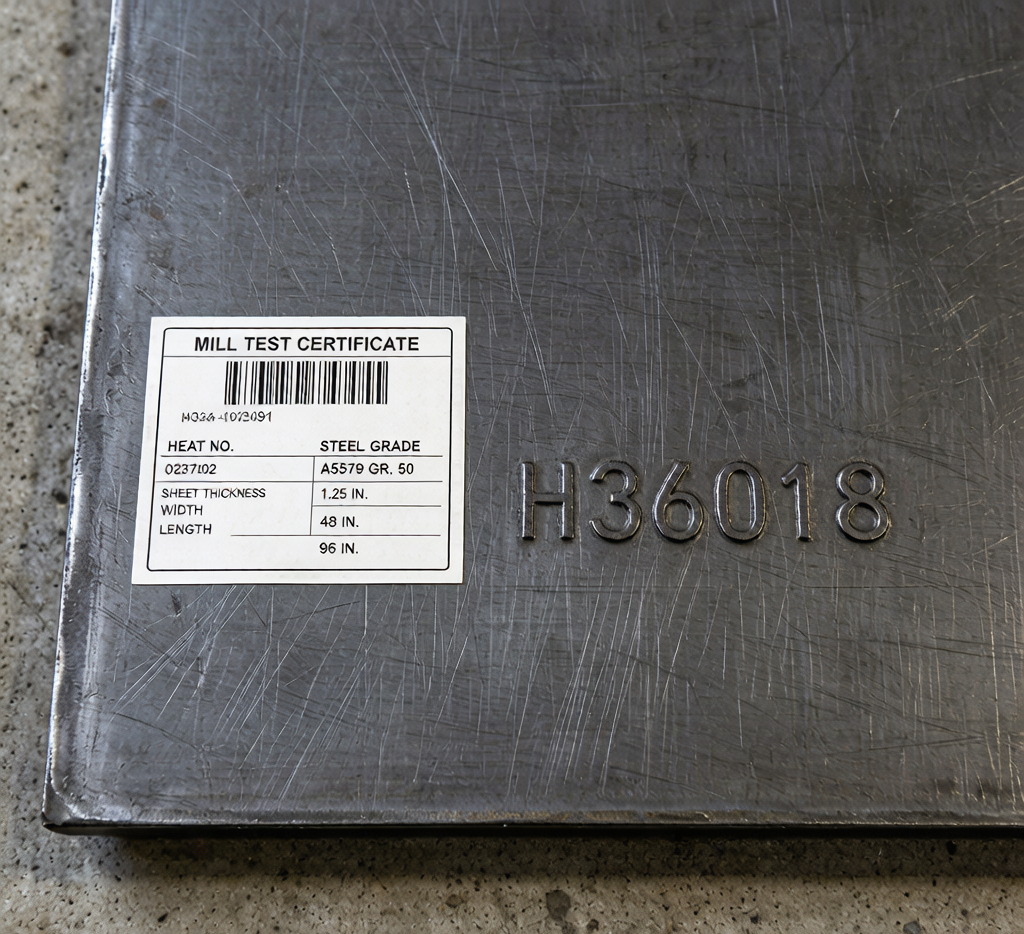
- Heat number and batch number: These trace the steel back to the melt. Every piece of steel should be marked with the heat number.
- Chemical composition: Shows percentages of C, Mn, Si, P, S, and any other specified elements. Compare these against the grade standard.
- Mechanical properties: Includes yield strength, tensile strength, elongation, hardness, and impact values when required.
- Dimensional results: Lists thickness, width, length, diameter, or wall thickness and how they compare to the tolerance standard.
- Test method and standard: States whether testing followed ASTM, EN, JIS, GB/T, or ISO procedures and the acceptance criteria.
EN 10204 3.1 vs 3.2: The Critical Difference
EN 10204 is the European standard for metallic product inspection documents. The two most common types are 3.1 and 3.2.
| Feature | EN 10204 3.1 | EN 10204 3.2 |
|---|---|---|
| Issued by | Manufacturer’s authorized inspector | Independent inspector |
| Independence | Not independent of production | Independent third party |
| Witnessing | No external witness required | Tests witnessed by third party |
| Typical use | Standard commercial orders | Critical projects, oil & gas, nuclear |
| Cost | Lower | Higher (inspector time + travel) |
| Trust level | Good | Highest |
Choose 3.1 when the buyer has a long-standing relationship with the mill and the project is not safety-critical. Choose 3.2 when the material is for pressure equipment, offshore structures, or when the end client requires independent verification.
Common Certificate Types by Standard
- ASTM: Mill test reports (MTR) follow ASTM A370 for mechanical testing and ASTM E415 for chemical analysis. No formal 3.1/3.2 classification, but buyers often request a certificate of compliance.
- EN 10204: 2.1, 2.2, 3.1, and 3.2 certificates are recognized globally. 3.1 is the default for most steel exports.
- JIS: Japanese mills issue inspection certificates (JIS G 0415) with test reports. Content is similar to EN 3.1.
- GB/T: Chinese mills issue quality certificates (质量证明书) with chemical and mechanical data. For export, these are often translated and formatted to match EN 10204 3.1.
How to Verify a Carbon Steel MTC
- Cross-check the heat number: The heat number on the MTC must match the marking on the steel. If they differ, reject the shipment.
- Compare chemistry to the grade standard: Use the ASTM, EN, JIS, or GB/T specification for the grade to confirm every element is within limits.
- Check mechanical properties: Yield strength and tensile strength must meet the minimum values. Elongation should be within the specified range.
- Confirm test dates: Tests should be recent and correspond to the production date. Old certificates reused for new heats are a red flag.
- Validate the issuing body: For 3.2 certificates, the inspector must be accredited and independent. Search the inspector’s name and organization online.
Red Flags and Fraud Prevention
- Generic certificates: A legitimate MTC names the buyer, order number, heat number, and product description.
- Missing signatures or stamps: Official certificates carry the mill’s stamp and the authorized signatory.
- Copied data: If the values look identical across unrelated heats, ask for raw test data.
- PDF-only without traceability: PDFs can be edited. Ask for a scanned original or a digital certificate from the mill’s system.
- Wrong grade references: Ensure the standard listed on the MTC matches the grade you ordered.
When to Request Third-Party Certification
Third-party inspection is recommended when order value is high, the material is for critical infrastructure, or you are working with a new supplier. Services such as SGS, Bureau Veritas, TÜV, and Lloyd’s Register can witness testing, verify marking, and sample the cargo before shipment. The cost is small compared to the risk of receiving non-conforming material.
FAQ
What does an MTC prove?
An MTC proves that the steel was tested by the mill and that the results meet the specified grade standard. It is not a guarantee of fitness for every purpose, but it is the foundation of material traceability.
Can a supplier issue a 3.2 certificate themselves?
No. EN 10204 3.2 must be issued by an independent, accredited third-party inspector who witnesses the tests or reviews the production records.
Do I need an MTC for every heat?
Yes. Each heat of steel has different chemistry and properties. The MTC must correspond to the heat number of the material you received.
What is the difference between a certificate of compliance and an MTC?
A certificate of compliance states that the product meets the standard but does not include test results. An MTC includes actual test data from the heat or batch.
How long should I keep MTC records?
Keep MTCs for at least the lifetime of the project or as required by your quality management system. Many industries require 10+ years of traceability.
Get Certified Carbon Steel with Full Traceability
Huaxia-Steel provides carbon steel with full mill test certificates, including EN 10204 3.1 and 3.2 options. We can arrange SGS, BV, or TÜV third-party inspection and translate Chinese quality certificates into English for your records. Contact us for a quotation and let us know your certification requirements.