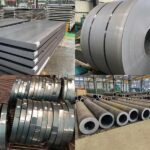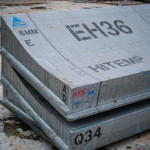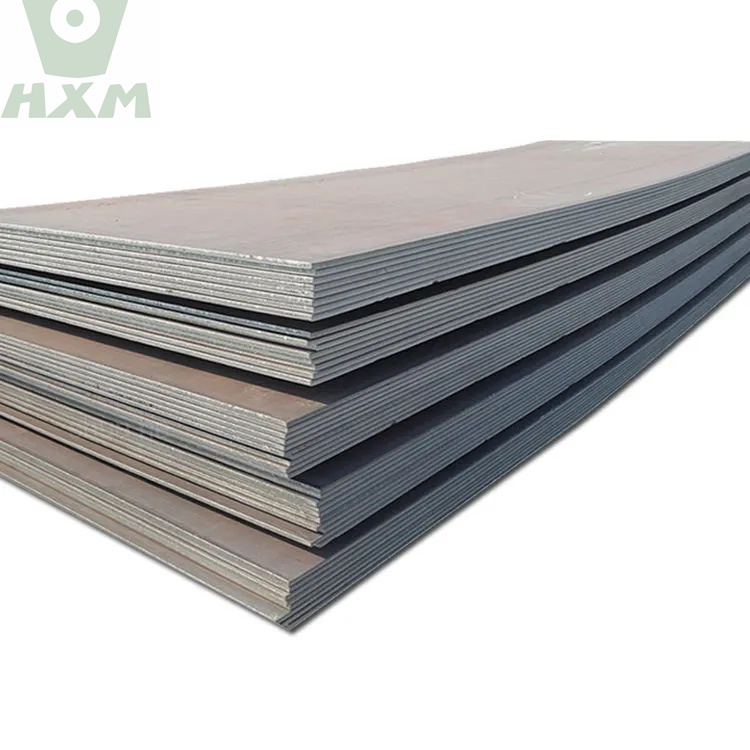
Carbon steel plate is one of the most versatile and widely used steel products in construction, shipbuilding, pressure vessel fabrication, and heavy machinery. For international buyers, navigating the dozens of grades, multiple international standards, and varying mill capabilities can be challenging.
This guide breaks down everything you need: grade selection, standard comparisons, thickness tolerances, cutting and processing services, quality inspection, and a practical sourcing checklist.
1. Carbon Steel Plate Grades at a Glance
Different grades serve different applications. Here’s a quick reference:
| Grade | Standard | Yield Strength (MPa) | Tensile Strength (MPa) | Primary Application |
|---|---|---|---|---|
| A36 | ASTM | 250 | 400-550 | General structural, bridges, buildings |
| A283 Gr.C | ASTM | 205 | 380-515 | Light structural, general fabrication |
| A516 Gr.70 | ASTM | 260 | 485-620 | Pressure vessels, boilers |
| A572 Gr.50 | ASTM | 345 | 450+ | High-strength structural, bridges |
| ST37-2 | DIN EN | 235 | 360-510 | General structural (Europe) |
| ST52-3 | DIN EN | 355 | 490-630 | High-strength structural (Europe) |
| SS400 | JIS | 245 | 400-510 | General structural (Japan/Asia) |
| Q235B | GB | 235 | 375-500 | General structural (China) |
| Q345B | GB | 345 | 470-630 | High-strength structural (China) |
2. International Standard Cross-Reference
One of the most common questions from buyers: “Is Q235B equivalent to A36?” The short answer is yes — they’re functionally equivalent for most applications. Here’s the detailed comparison:
Full Equivalence Table
| ASTM | EN (DIN) | JIS | GB | Category |
|---|---|---|---|---|
| A36 | S235JR (ST37-2) | SS400 | Q235B | General structural |
| A572 Gr.50 | S355JR (ST52-3) | SM490 | Q345B | High-strength structural |
| A516 Gr.70 | P355GH | SBV2B | Q345R | Pressure vessel |
| A283 Gr.C | S235JR | SS400 | Q235B | Light structural |
| A131 Gr.A | S235 | SM400A | — | Shipbuilding |
Important: While grades are functionally equivalent, project specifications often require specific standards. If your client requires ASTM A36, substituting Q235B may require engineering approval. Always confirm acceptable alternatives before ordering.
3. Thickness Ranges and Tolerances
Standard Thickness Categories
| Category | Thickness Range | Common Application |
|---|---|---|
| Thin plate | 1.2-3.0mm | Automotive, ducting, light fabrication |
| Medium plate | 3.0-25mm | Structural, general fabrication |
| Heavy plate | 25-80mm | Pressure vessels, bridges, offshore |
| Extra heavy | 80-300mm | Nuclear, penstocks, heavy machinery |
Thickness Tolerance (EN 10029 Class B)
| Nominal Thickness | Tolerance (mm) |
|---|---|
| 3-5mm | ±0.40 |
| 5-8mm | ±0.45 |
| 8-15mm | ±0.55 |
| 15-25mm | ±0.65 |
| 25-40mm | ±0.80 |
| 40-60mm | ±1.00 |
| 60-100mm | ±1.30 |
Buyer tip: Always specify tolerance class in your PO. Class B is standard, but for precision fabrication, Class C (tighter) or Class D (asymmetric) may be required.
4. Manufacturing Process: From Slab to Plate
Hot Rolling Process
1. Slab casting: Liquid steel cast into slabs (200-300mm thick)
2. Reheating: Slab heated to 1,200-1,300°C in reheating furnace
3. Descaling: High-pressure water removes oxide scale
4. Rough rolling: Reduce thickness to 30-50mm on roughing mill
5. Finish rolling: Precision rolling to target thickness
6. Cooling: Accelerated cooling (ACL) or air cooling to control microstructure
7. Leveling: Roller leveler removes plate flatness deviations
8. Cutting: Flame or plasma cutting to ordered dimensions
9. Inspection: Surface, dimensional, and mechanical testing
10. Marking: Heat number, grade, size, standard stamped on each plate
Normalized vs. As-Rolled
| Condition | Process | Effect | When Required |
|---|---|---|---|
| As-rolled | No heat treatment after rolling | Most economical | General structural, non-critical |
| Normalized | Heated above Ac3, air cooled | Uniform grain, improved toughness | Pressure vessels, low-temp service |
| TMCP | Thermo-mechanical controlled processing | Fine grain, high strength at lower carbon | API 2W/2Y, offshore, high-strength |
| Quenched & Tempered | Water quench + temper | Maximum strength/toughness | Armor, wear-resistant, high-strength |
5. Cutting and Processing Services
Most Chinese plate suppliers offer value-added processing:
| Service | Method | Tolerance | Best For |
|---|---|---|---|
| Flame cutting | Oxy-fuel | ±1.5mm | Thick plate (25mm+), large parts |
| Plasma cutting | Plasma arc | ±0.5mm | Medium plate (3-50mm), complex shapes |
| Laser cutting | Fiber laser | ±0.1mm | Thin plate (1-20mm), precision parts |
| Waterjet | Abrasive waterjet | ±0.15mm | All thicknesses, no heat-affected zone |
| Beveling | Flame/milling | ±1.0mm | Weld preparation |
| Drilling | CNC drilling | ±0.2mm | Bolt holes, connections |
Cost-Effective Processing Tips
- Order plate in standard mill sizes (e.g., 1500×6000mm, 2000×8000mm, 2500×12000mm) to minimize cutting waste
- Nest multiple parts on one plate to maximize material utilization
- Specify cut-to-size if your fabricator doesn’t have heavy cutting equipment
- Ask for beveling service if welding is required — saves on-site preparation time
6. Surface Quality and Defect Classification
Common Surface Defects
| Defect | Description | Acceptance Criteria |
|---|---|---|
| Scabs | Flaky surface metal | Remove by grinding, verify thickness remains in tolerance |
| Scratches | Linear surface marks | Depth < 0.3mm acceptable for most grades |
| Pitting | Small depressions | Not acceptable for pressure vessel plate |
| Lamination | Internal separation | 100% reject — ultrasonic test required |
| Roll marks | Periodic surface indentations | Affects appearance only, usually acceptable |
| Edge cracks | Cracks at plate edges | Remove by trimming, verify no extension |
Surface Finish Options
| Finish | Description | Application |
|---|---|---|
| Hot rolled (black) | Blue-black oxide scale | Structural, further processing |
| Pickled & oiled | Scale removed, oiled for rust prevention | Fabrication, painting prep |
| Shot blasted | Sa 2.5, uniform gray finish | Painting/coating preparation |
| Primed | Shop primer applied (15-25μm) | Marine, bridge, structural |
7. Quality Inspection and Certification
Required Test Documentation
Every plate shipment should include:
1. Mill Test Certificate (MTC) — EN 10204 3.1 minimum
- Heat number, chemical composition, mechanical properties
- Standard reference, grade, dimensions
- Manufacturer name and authorized signature
2. Mechanical Test Reports
- Tensile test (yield, tensile, elongation)
- Impact test (Charpy V-notch, if specified)
- Bend test (if required by standard)
3. Dimensional Inspection Report
- Thickness measurements (minimum 5 points per plate)
- Width and length
- Flatness measurement
- Edge straightness
Ultrasonic Testing (UT)
For critical applications (pressure vessels, offshore), ultrasonic testing per ASTM A435, A578, or EN 10160 is mandatory:
| Standard | Class | Sensitivity | Application |
|---|---|---|---|
| ASTM A435 | — | Standard | General purpose |
| ASTM A578 | Level A/B/C | Progressive | Pressure vessel, nuclear |
| EN 10160 | S0-S3 | Zone-based | European pressure equipment |
8. Packing and Shipping
Export Packing Options
| Method | Description | Cost | Protection Level |
|---|---|---|---|
| Loose bundle | Steel straps only, no wood | Lowest | Minimal |
| Wooden pallet | Plate on pallet, strapped | Low | Good |
| Wooden case | Enclosed wooden box | High | Maximum |
| Steel frame | Custom steel rack | Medium | Excellent for large plates |
Container Loading
- **20ft container**: Max 28 tons, plate width up to 2,200mm
- **40ft container**: Max 28 tons, plate width up to 2,500mm, length up to 12,000mm
- **40ft flat rack**: For plates exceeding container dimensions (width >2,500mm or length >12,000mm)
- **Bulk vessel**: For orders >500 tons, more cost-effective than containers
9. Practical Sourcing Checklist
Specification Phase
- Confirm grade and standard (e.g., ASTM A516 Gr.70)
- Specify thickness, width, length (and tolerance class)
- State delivery condition (as-rolled, normalized, TMCP)
- Specify surface finish (black, pickled, shot blasted, primed)
- Include any testing requirements (UT, impact, specific temperature)
- Confirm acceptance standard for defects (e.g., ASTM A6)
Supplier Qualification
- Verify manufacturer has relevant certifications
- ISO 9001 (quality management)
- API monogram (if oil/gas grades)
- PED 2014/68/EU (if pressure equipment for Europe)
- ABS/DNV/LR/BV approval (if shipbuilding grades)
- Request recent MTC samples for the same grade
- Ask for reference customers in your industry
- Confirm production capacity and lead time
Pre-Shipment
- Third-party inspection (SGS, BV, TUV)
- Witness mechanical testing at mill
- Verify heat number traceability on every plate
- Check dimensional compliance (5+ points per plate)
- Inspect packing for export adequacy
- Review draft shipping documents
10. Common Pitfalls and How to Avoid Them
| Pitfall | Consequence | Prevention |
|---|---|---|
| Substituting grades without approval | Project rejection, safety risk | Get written engineering approval for any substitution |
| Ignoring delivery condition | Plate fails impact test on-site | Specify normalized for pressure vessel grades |
| No UT testing on thick plate | Hidden laminations cause welding failure | Require UT per ASTM A578 Level B for plate >25mm |
| Accepting Class B tolerance when Class C needed | Fabrication fit-up problems | Specify tolerance class in PO |
| Not verifying MTC authenticity | Counterfeit certificates | Cross-reference heat numbers with mill records |
| Insufficient packing for long transit | Rust, scratches, edge damage | Specify export packing with wooden pallets |
11. FAQ
What is the difference between A36 and A516 Gr.70 plate?
A36 is a general structural grade with lower carbon content, suitable for construction and fabrication. A516 Gr.70 is a pressure vessel quality plate with controlled chemistry for improved notch toughness — required for boilers, pressure vessels, and low-to-moderate temperature applications.
Can Q235B replace A36 for my project?
For most general structural applications, Q235B is functionally equivalent to A36. However, if your project specification or client requires ASTM A36 specifically, you’ll need written approval for substitution. The chemistry and mechanical properties are similar but not identical.
What thickness tolerance should I specify?
For general fabrication, EN 10029 Class B (±0.4 to ±1.3mm depending on thickness) is standard. For precision fabrication or machining, specify Class C (tighter tolerances) or order custom-rolled plate with special tolerance agreements.
How is plate priced?
Carbon steel plate is typically priced per metric ton, based on: base steel price + thickness surcharge (heavier plate costs more per ton) + grade surcharge + processing (cutting, beveling) + coating + packing + shipping. Always request a detailed quote breakdown.
What is the typical lead time for carbon steel plate from China?
Stock plate (common grades/sizes): 7-10 days. Rolling production: 30-45 days for standard grades, 45-60 days for specialized grades (pressure vessel, low-temp). Add 7-10 days for processing (cutting, UT) and 15-30 days for ocean shipping.
Conclusion
Carbon steel plate sourcing is all about precision — the right grade, the right standard, the right tolerance, and the right inspection. By following this guide, you’ll be equipped to specify exactly what you need, verify what you receive, and avoid the costly mistakes that plague uninformed buyers.
Looking for a reliable carbon steel plate supplier? Huaxia Steel supplies A36, A516, A572, SS400, Q235B, and Q345B plate in thicknesses from 3mm to 300mm — with full MTC documentation, cutting services, third-party inspection, and global shipping.