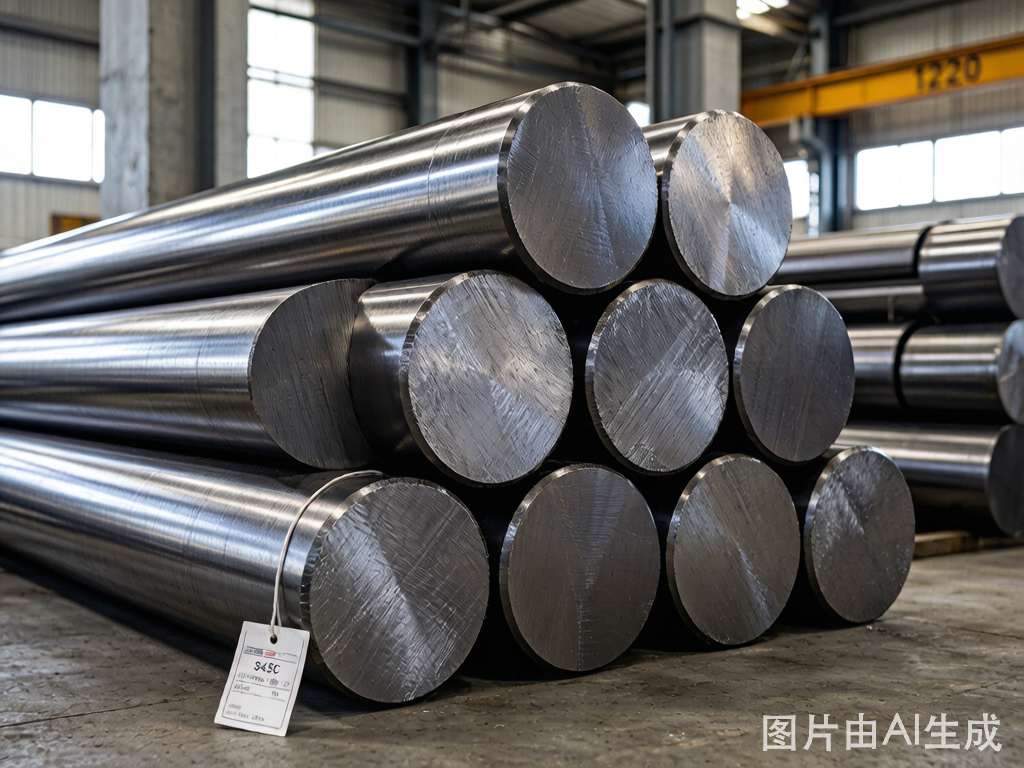
Walk into any machine shop in Asia, North America, or Europe and the same medium-carbon steel goes by three different names: S45C, 1045, and C45E. To the machinist, they’re the same shaft material. To the buyer, the slight differences in sulfur, phosphorus, and mill tolerance can change the price, the lead time, and the quality of the finished part.
This guide gives you a direct comparison, identifies where S45C and 1045 are interchangeable, and flags the cases where they aren’t.
The Three Names, One Steel
Each designation is governed by a different national standard, but the underlying specification is remarkably consistent.
| Standard | Grade | Governing Body | Common Region |
|---|---|---|---|
| JIS G4051 | S45C | Japanese Industrial Standards | Japan, Korea, Taiwan, SE Asia |
| AISI / SAE | 1045 | American Iron and Steel Institute | North America, global export |
| EN 10083-2 | C45E | European Committee for Standardization | EU, UK, Turkey, Russia |
| GB/T 699 | 45# (45) | Standardization Administration of China | China, SE Asia |
All four are medium-carbon steels with 0.42–0.50% carbon and similar mechanical properties. Most procurement confusion comes from assuming these are identical when they aren’t — and from assuming they are different when they functionally are.
Chemical Composition: Where the Standards Diverge
Here’s the full chemistry comparison. Look at the rightmost column — that’s where the practical differences appear.
| Element | JIS S45C (%) | AISI 1045 (%) | EN C45E (%) | Practical Impact |
|---|---|---|---|---|
| Carbon (C) | 0.42–0.48 | 0.43–0.50 | 0.42–0.50 | 1045 is slightly higher — adds hardness, reduces weldability |
| Manganese (Mn) | 0.60–0.90 | 0.60–0.90 | 0.50–0.80 | S45C / 1045 have a small edge over C45E |
| Phosphorus (P) | ≤ 0.030 | ≤ 0.040 | ≤ 0.030 | 1045 is less strict — matters for impact toughness |
| Sulfur (S) | ≤ 0.035 | ≤ 0.050 | ≤ 0.035 | 1045 is significantly less strict — affects machinability |
| Silicon (Si) | 0.15–0.35 | — | 0.10–0.40 | Similar range |
Key takeaway: AISI 1045 allows up to 0.050% sulfur, while S45C and C45E cap it at 0.035%. This single difference explains most of the behavior gap:
- Higher S = better machinability (sulfur forms manganese sulfide inclusions that break chips and reduce tool wear)
- Higher S = lower impact toughness (sulfide inclusions are stress concentrators)
- Higher S = worse transverse properties (through-thickness ductility suffers)
So if you need high-volume CNC turning, 1045 may actually machine better. If your part sees shock loading, S45C or C45E is the safer choice.
Mechanical Properties Compared
As-Rolled Condition (Hot Rolled Round Bar)
| Property | S45C | 1045 | C45E |
|---|---|---|---|
| Tensile Strength (MPa) | 570–700 | 565–700 | 580–700 |
| Yield Strength (MPa) | ≥ 345 | ≥ 310 | ≥ 340 |
| Elongation (%) | ≥ 20 | ≥ 16 | ≥ 19 |
| Reduction of Area (%) | ≥ 45 | ≥ 40 | ≥ 45 |
| Hardness (HB) | 167–229 | 163–229 | 170–230 |
| Impact Energy (J) | ≥ 30 (typical) | Not specified | ≥ 25 (KV at 20 °C) |
After Quenching and Tempering (Q&T)
| Property | S45C (Q&T) | 1045 (Q&T) |
|---|---|---|
| Tensile Strength (MPa) | 700–850 | 700–850 |
| Yield Strength (MPa) | 500–650 | 500–650 |
| Elongation (%) | 14–18 | 14–18 |
| Hardness (HRC) | 20–30 | 20–30 |
| Impact Energy (J) | 40–60 (longitudinal) | 30–50 (longitudinal) |
Note on Q&T range: Medium-carbon steels like S45C/1045 are limited to about 30 HRC for practical applications. Beyond that, ductility drops sharply. For higher hardness requirements, step up to alloy steels (4140, 4340).
Delivery Condition Options
All three grades are available in multiple delivery conditions:
- Hot Rolled (HR) — As-rolled, surface scale, looser tolerances
- Cold Drawn (CD) — Better surface finish, tighter tolerances, higher strength from work hardening
- Turned / Peeled — Bright surface, precise diameter, suitable for direct machining
- Ground — Tightest tolerances, used for shafts and pins
- Annealed — Softest condition for machining before heat treatment
- Q&T (Quenched & Tempered) — Pre-hardened for direct use
Heat Treatment Parameters
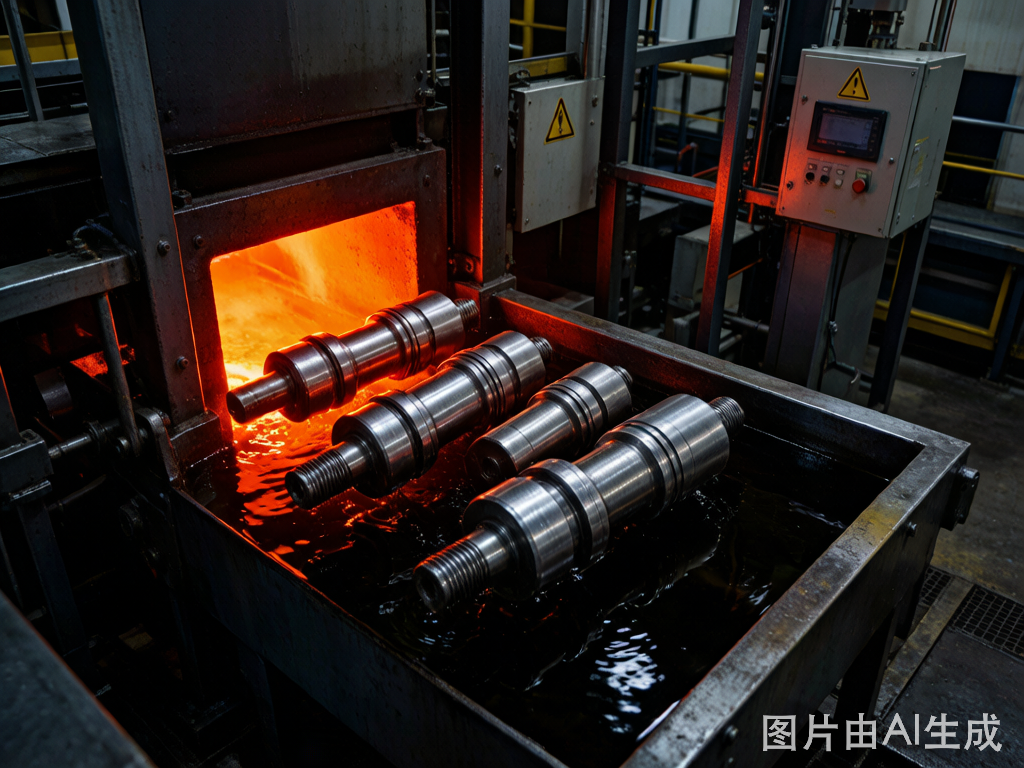
S45C and 1045 follow nearly identical heat treatment cycles. The differences are small but worth knowing.
| Process | S45C | 1045 | Notes |
|---|---|---|---|
| Forging Temperature | 850–1200 °C | 850–1200 °C | Identical |
| Normalizing | 840–880 °C, air cool | 845–900 °C, air cool | Similar |
| Annealing | 790–830 °C, furnace cool | 790–830 °C, furnace cool | Identical |
| Austenitizing | 800–850 °C | 800–845 °C | Avoid exceeding 870 °C to prevent grain growth |
| Quench Medium | Water or oil (small sections) | Water or oil (small sections) | Water for simple shapes, oil for complex geometries |
| Tempering | 400–650 °C | 400–650 °C | Temper immediately after quench to relieve stress |
Critical warning: Both S45C and 1045 are highly susceptible to quench cracking due to their carbon content. Avoid sharp corners and abrupt section changes in part design. Pre-machined parts should be stress-relieved before hardening.
Tempering Temperature vs Hardness (Typical Curve)
| Tempering Temperature | Hardness (HRC) | Application |
|---|---|---|
| As-quenched | 55–60 HRC | Brittle — not recommended for service |
| 200 °C | 56–58 HRC | Maximum hardness, low toughness |
| 300 °C | 50–53 HRC | High hardness with moderate toughness |
| 400 °C | 44–47 HRC | Balanced for wear + impact |
| 500 °C | 38–42 HRC | Tough, ductile — common for shafts |
| 600 °C | 30–35 HRC | High toughness, lower wear resistance |
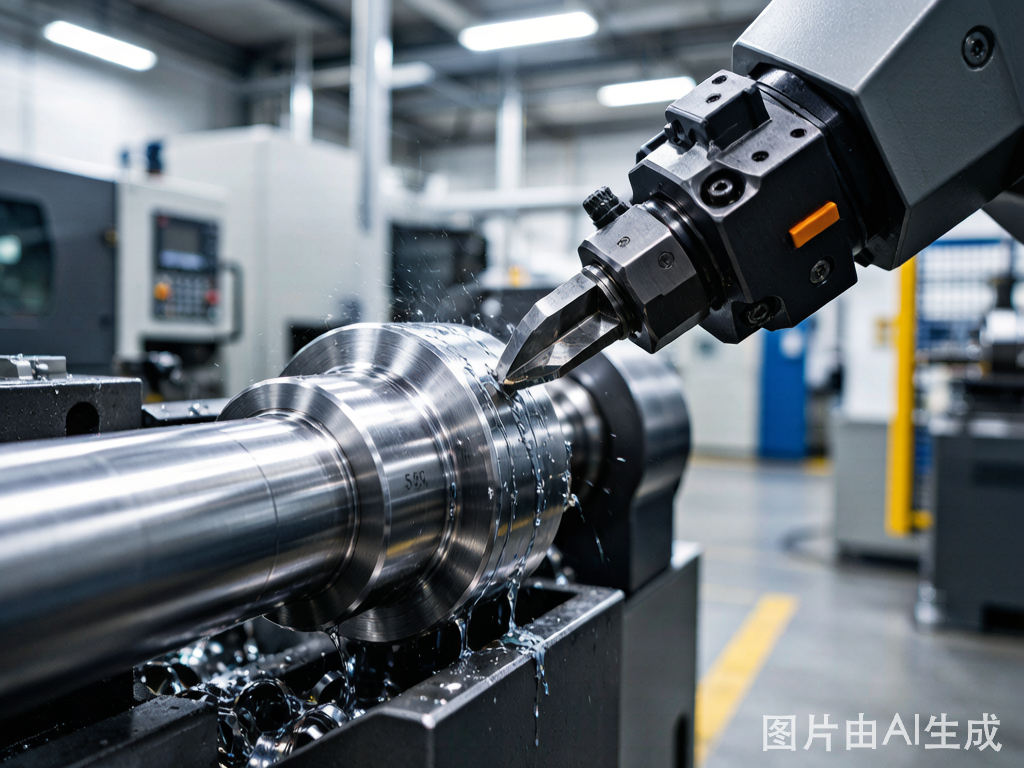
Machinability
This is where sourcing decisions often come down to opinion, but the data is clear.
| Condition | S45C | 1045 | C45E |
|---|---|---|---|
| Annealed (relative to 1212 = 100%) | 55% | 55% | 55% |
| Cold Drawn | 60% | 65% | 60% |
| Q&T (28 HRC) | 40% | 42% | 40% |
Why 1045 machines slightly better in CD condition: The higher allowable sulfur content (≤ 0.050% vs ≤ 0.035%) creates more manganese sulfide inclusions. These act as chip breakers and reduce built-up edge on cutting tools. For high-volume screw machine work, 1045 can offer 10–15% longer tool life compared to S45C.
Trade-off: The same inclusions that aid machinability reduce impact toughness by 15–25% in the transverse direction. For shafts, gears, and components that see cyclic or shock loading, specify S45C or C45E.
Weldability
Both S45C and 1045 are poor candidates for welding. The 0.42–0.50% carbon content pushes the carbon equivalent well above 0.60%, putting them in the “preheat and PWHT required” category.
| Parameter | S45C | 1045 |
|---|---|---|
| Preheat Required | 200–300 °C | 200–300 °C |
| Interpass Temperature | ≤ 300 °C | ≤ 300 °C |
| Post-Weld Heat Treatment | 600–650 °C | 600–650 °C |
| Hardness in HAZ | Can exceed 60 HRC | Can exceed 60 HRC |
| Cracking Risk | High | High |
| Recommended Process | Low-hydrogen electrodes (E7018) | Low-hydrogen electrodes (E7018) |
Practical advice: Welding S45C or 1045 is rarely a good idea. If your design requires welding, consider:
- Using a lower-carbon grade (1020, S20C, A36) for the welded section
- Using arc stud welding with controlled heat input (sometimes acceptable for attachments)
- Using mechanical fastening instead of welding
If you must weld, stress relief at 600 °C for 1 hour is not optional — it’s required to prevent hydrogen-assisted cracking days or weeks after the weld is completed.
Dimensional Standards and Tolerances
Tolerance differences between S45C, 1045, and C45E can be the source of subtle but expensive problems.
| Parameter | JIS G4051 (S45C) | ASTM A29 (1045) | EN 10060 (C45E) |
|---|---|---|---|
| Diameter Tolerance (HR) | ±0.5 mm to ±1.5 mm (size dependent) | Similar to JIS | EN 10060 tolerances |
| Straightness | ≤ 2 mm/m | ≤ 2.5 mm/m (typical) | ≤ 2 mm/m |
| Out-of-roundness | ≤ 70% of tolerance band | Similar | Similar |
Practical impact: For most applications, the tolerances are close enough that direct substitution doesn’t cause fitment issues. However:
- If your drawing calls out a JIS tolerance band (e.g., “h9”), check that the 1045 you’re buying meets h9 per ISO, not just the looser ASTM default
- Cold drawn bars from all three standards are typically held to ISO h9 or h10 — but always specify it on the PO
- For precision shaft applications, require a straightness certificate — straightness claims vary more than diameter claims across mills
Global Sourcing and Pricing
As of mid-2026, approximate FOB prices for hot-rolled round bar in standard mill lengths (China export):
| Grade | FOB Price (USD/ton) | Diameter 50 mm | Diameter 100 mm |
|---|---|---|---|
| S45C (JIS, Chinese mill) | $560–$680 | $560–$640 | $580–$680 |
| 1045 (AISI, Chinese mill) | $550–$670 | $550–$630 | $570–$670 |
| C45E (EN, Chinese mill) | $590–$720 | $590–$680 | $610–$720 |
| 1045 (US mill) | $850–$1,100 | $850–$1,000 | $900–$1,100 |
| S45C (Japanese mill) | $900–$1,200 | $900–$1,100 | $950–$1,200 |
Premium drivers:
- EN C45E carries a 5–8% premium for stricter chemistry controls and impact testing
- Japanese S45C carries a 40–60% premium over Chinese S45C for the brand and tighter consistency
- US domestic 1045 is priced 50–70% higher than Chinese 1045 for labor, energy, and domestic market premiums
Sourcing reality: Many Chinese mills produce S45C and 1045 from the same heat, then issue a certificate for whichever standard the customer ordered. The material is functionally identical. The only real differences are (a) the sulfur/phosphorus limits on the certificate and (b) the audit trail.
When to Specify S45C vs 1045
Choose **S45C** when:
- The part will see shock, impact, or cyclic loading
- You need guaranteed transverse ductility
- Your design follows JIS conventions (machinery for Japan, Korea, Taiwan export)
- You want the tightest sulfur limit (≤ 0.035%) for fatigue-critical applications
- Welding is involved (still difficult, but slightly more forgiving than 1045)
Choose **1045** when:
- The part is high-volume screw-machine work (shafts, pins, spacers)
- Maximum machinability is the priority
- Your design follows US/SAE conventions
- The application is static or mildly loaded (bushings, spacers, low-stress brackets)
- AISI/SAE designation is required by your customer or end-market
Choose **C45E (EN 10083-2)** when:
- The project is European and requires CE-marked components
- You need guaranteed impact energy (KV ≥ 25 J at 20 °C as a baseline)
- The end-product is exported to EU markets and must comply with EN standards
- Tighter chemistry and traceable certification are required
Practical Procurement Checklist
Before ordering S45C, 1045, or C45E, confirm these details with your supplier:
- Standard designation is explicitly stated (S45C per JIS G4051, 1045 per ASTM A29, C45E per EN 10083-2)
- Sulfur and phosphorus content is within the standard’s allowed range — and matches your requirements
- Mill certificate (EN 10204 3.1) includes heat number, full chemistry, and mechanical properties
- Delivery condition is specified (HR, CD, peeled, turned, Q&T, annealed)
- Dimensional tolerances are agreed (ISO h9/h10/h11 for cold drawn, standard mill tolerance for HR)
- Straightness is specified (≤ 2 mm/m is typical for HR bar)
- Surface condition is agreed (black scale, shot-blasted, peeled, polished)
- For Q&T orders, hardness test location and test method are defined
- Country of origin and remelting practice (basic oxygen, EAF) are stated
- The substitution (S45C ↔ 1045 ↔ C45E ↔ 45#) is documented in writing if used
FAQ
Is S45C the same as 1045?
Not exactly, but they’re very close. S45C and 1045 are both medium-carbon steels with 0.42–0.50% carbon. The main difference is sulfur: 1045 allows up to 0.050%, S45C caps it at 0.035%. This affects machinability and impact toughness, but for most applications they can be substituted.
Can I use 1045 in place of S45C?
Usually yes, if the higher sulfur content doesn’t compromise your application. For high-volume machining, 1045 may actually perform better. For shock-loaded or fatigue-critical parts, S45C’s lower sulfur is preferable. Always get engineering sign-off on substitutions.
What is the difference between S45C and C45E?
S45C is governed by JIS G4051 (Japan), C45E is governed by EN 10083-2 (Europe). C45E has stricter chemistry and requires impact testing. For CE-marked machinery exported to the EU, C45E is the appropriate choice. For other applications, S45C is functionally equivalent and often cheaper.
Is S45C weldable?
Technically yes, with preheat (200–300 °C) and post-weld heat treatment (600–650 °C). In practice, S45C should not be welded if there’s any alternative. Use a lower-carbon grade (S20C, 1020) for parts that need to be welded.
What is the hardness of S45C after heat treatment?
Quenched and untempered: up to 60 HRC (but too brittle for service). After tempering at 500–600 °C: typically 30–40 HRC, which is the practical working range for shafts and gears.
Which is cheaper: S45C or 1045?
From Chinese mills, the prices are nearly identical. From Japanese mills, S45C commands a 40–60% premium over Chinese 1045. From US mills, 1045 carries a 50–70% premium over Chinese equivalents.
Conclusion
S45C and 1045 are functionally the same medium-carbon steel with a few percentage points of difference in sulfur and phosphorus limits. For 80% of procurement scenarios — general machining, shafts, pins, low-stress components — direct substitution is perfectly safe. For the 20% where it matters — fatigue-critical parts, high-impact service, fatigue-loaded shafts — the lower sulfur of S45C (or C45E) is worth specifying.
The smartest move is to standardize your drawings to the grade that’s most commonly available in your supply chain, and accept the other as an alternative with written engineering approval. Don’t over-specify S45C for parts that would work fine in 1045 — and don’t substitute 1045 blindly into designs that depend on the tighter S45C chemistry.
Whichever grade you order, verify the mill certificate, specify the delivery condition, and test the actual material on incoming inspection.
Need certified S45C or 1045 steel with full documentation? Request a quote from Huaxia Steel — we supply both grades in HR, CD, peeled, and Q&T conditions with EN 10204 3.1 certificates, full traceability, and competitive FOB pricing.