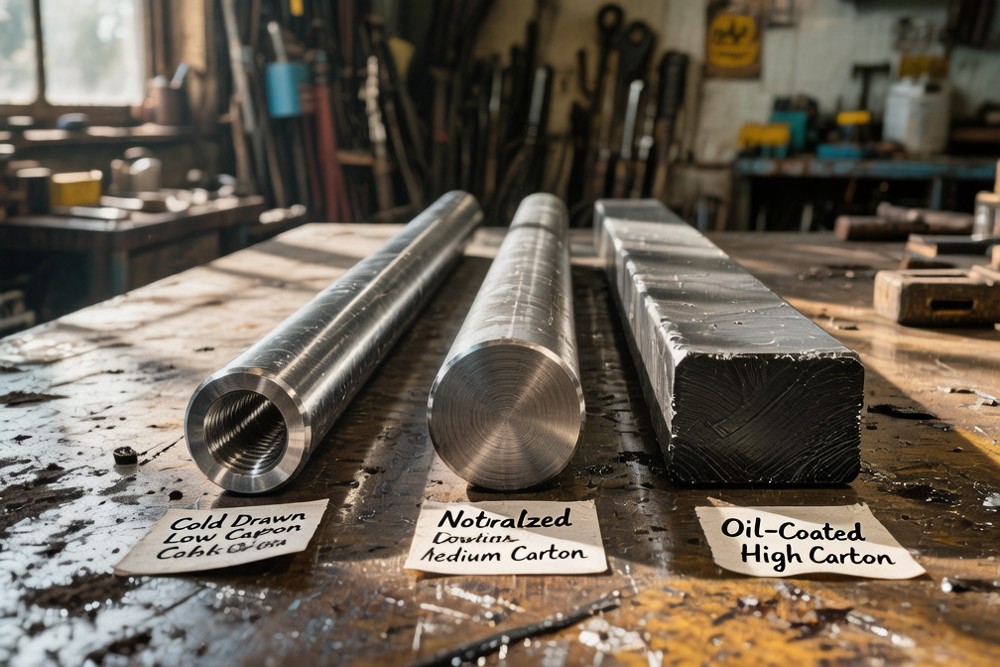
Carbon steel isn’t one material. It’s a family of materials that range from the mild, bendable sheet steel in your car door to the hard, spring-tempered wire that holds a suspension bridge in tension. The carbon content — typically 0.05% to 1.00% — drives nearly every difference in behavior between grades.
Choose the wrong carbon level and you’re either over-engineering an expensive solution or watching a component fail under load. This guide gives you a practical, application-focused decision framework without unnecessary complexity.
The Carbon Content Spectrum
Before the detailed comparison, here’s the broad layout:
| Category | Carbon Range | Common Grades | Core Characteristic |
|---|---|---|---|
| Low Carbon (Mild Steel) | 0.05–0.30% | A36, 1018, Q235, S235 | Soft, formable, highly weldable |
| Medium Carbon | 0.30–0.60% | 1045, C45, 45# (GB), S45C | Balanced strength and toughness |
| High Carbon | 0.60–1.00% | 1075, 1095, T8, 65Mn | Hard, wear-resistant, less ductile |
| Ultra-High Carbon | 1.00–2.14% | D2, 1.2379, T10 | Extreme hardness (technically: tool/die steel) |
The story of carbon in steel is essentially a tradeoff story: more carbon → more strength and hardness, less ductility and weldability. Every engineering application lives somewhere on this tradeoff curve.
Low Carbon Steel (Mild Steel): The Workhorse
What “Low Carbon” Actually Means
With carbon content below 0.30%, these steels cannot be effectively hardened by heat treatment. Their strength comes entirely from the as-manufactured microstructure (ferrite + small amounts of pearlite) and any cold-working applied during processing.
What they lack in strength ceiling, they more than compensate for in versatility: low carbon steel welds easily, bends without cracking, is cheap to produce, and is available in almost every conceivable product form.
Key Properties
| Property | Typical Low Carbon (1018, A36) |
|---|---|
| Tensile Strength | 400–550 MPa |
| Yield Strength | 220–350 MPa |
| Elongation | 20–35% |
| Hardness | 110–140 HB |
| Weldability | Excellent — no preheat required |
| Machinability | Good (cold-drawn grades better than hot-rolled) |
| Hardenability | Cannot be through-hardened; surface carburization possible |
| Relative Cost | Lowest |
When to Choose Low Carbon Steel
Structural and construction applications — Building frames, I-beams, bridge components, rebar. ASTM A36 (US) and Q235B (China) are the global default structural grades for a reason: they’re weldable, reliably available in any dimension, and priced to work at scale.
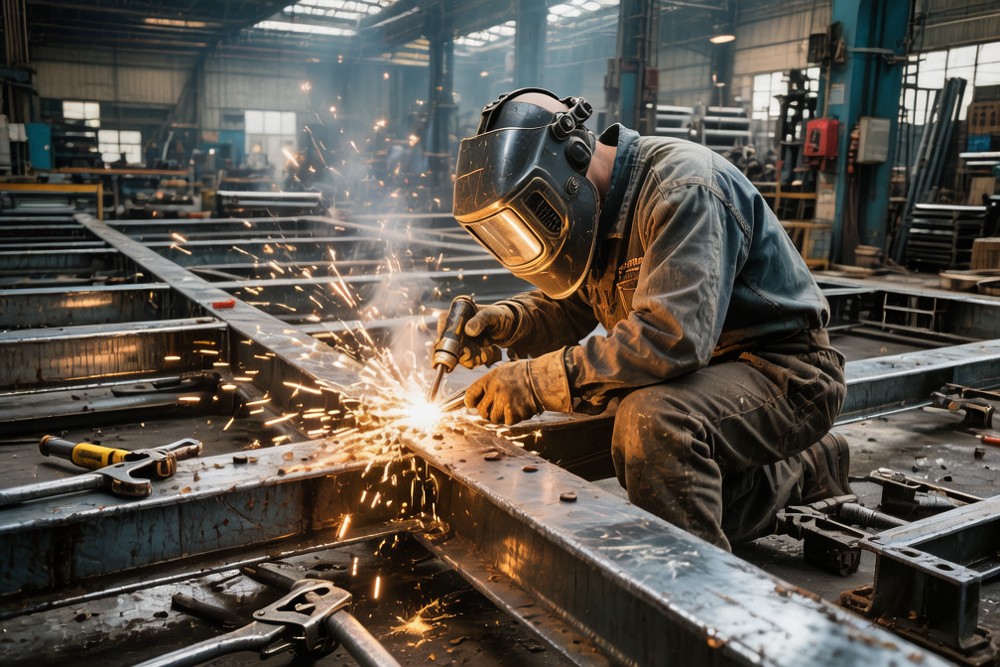
Sheet metal and fabrication — Automotive body panels, appliance housing, HVAC ductwork, enclosures. The combination of cold-formability and weldability makes low carbon the obvious choice. Attempting this with 1045 would result in cracking during bending.
Tubes and pipes for low-pressure service — Hydraulic and pneumatic lines at moderate pressure, agricultural equipment, furniture tubes. ASTM A513 (mechanical tubing in low carbon) is the standard workhorse here.
Wire and fasteners — Standard bolts, wire fencing, binding wire, nails. Low carbon wire draws easily to fine gauges without requiring annealing between draws.
Case-hardening applications — When you need a hard surface with a soft, tough core, start with a low carbon grade and apply carburizing or carbonitriding. This is how transmission gears in high-volume automotive applications are made: the base is economical 1018 or 8620, and the case is hardened by carbon diffusion.
Where Low Carbon Steel Fails
Don’t use mild steel where:
- Hardness and wear resistance are needed: It simply cannot develop meaningful bulk hardness. Under abrasion or contact stress, it will wear rapidly.
- High strength-to-weight ratio matters: For load-bearing structural members where weight is critical, mild steel’s strength ceiling forces excessive cross-sections.
- Spring properties are required: Low carbon cannot develop the yield strength needed for spring function — it will permanently deform.
Medium Carbon Steel: The Engineer’s Favorite
The Balance Point
Medium carbon steel, typically 0.30–0.60% carbon, is where things get interesting. At this carbon level, the steel can be meaningfully strengthened by heat treatment (particularly quenching and tempering), while still being machinable and — with care — weldable.
AISI 1045 is the most widely used grade in this range and often the default specification when an engineer writes “medium carbon steel.”
Key Properties
| Property | Typical Medium Carbon (1045, Q&T condition) |
|---|---|
| Tensile Strength | 750–900 MPa (Q&T) |
| Yield Strength | 600–750 MPa (Q&T) |
| Elongation | 14–20% |
| Hardness | 220–280 HB (Q&T); 55–62 HRC surface (induction hardened) |
| Weldability | Fair — requires preheat (100–200°C for 1045) |
| Machinability | Good in normalized condition |
| Hardenability | Moderate (limited for sections >50mm without alloying) |
| Relative Cost | Medium — 10–25% premium over mild steel |
When to Choose Medium Carbon Steel
Power transmission components — Shafts, gears, axles, couplings, and sprockets. This is where medium carbon steel dominates. The combination of adequate bulk strength and good response to induction hardening for wear surfaces is exactly what mechanical power transmission demands.
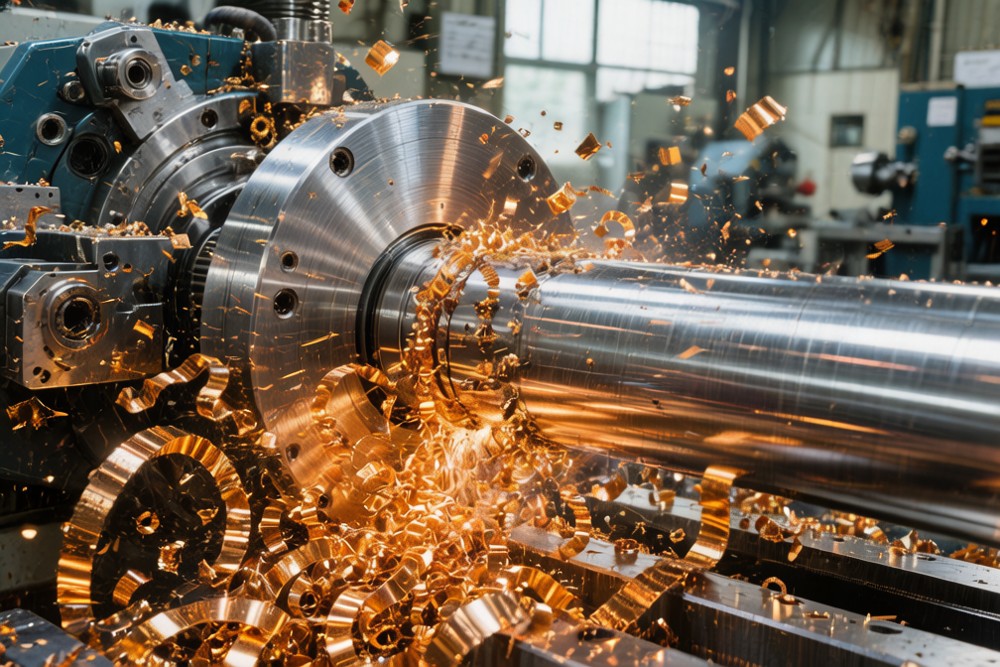
Machine tool components — Spindles, arbors, mandrels, chuck bodies. These parts need dimensional stability, moderate strength, and surface hardness for wear resistance — 1045 normalized and surface-ground is a standard solution.
Agricultural equipment — Plow shanks, cultivator tines, hay baler components. These need strength against cyclic loading in the field and some hardness for soil abrasion resistance.
Hydraulic cylinder rods — 1045 turned, ground, and chrome-plated is the global standard for industrial cylinder rods. The base strength supports the hoop stress from hydraulic pressure; the chrome layer provides the hardness and surface finish for sealing.
Automotive drivetrain — Crankshafts (induction hardened at journals), connecting rods, wheel hubs, steering knuckles. The entire load-bearing mechanical structure of an internal combustion engine relies on medium carbon grades.
Forged tooling and fixtures — Clamps, vises, toolholders. Forged medium carbon is more reliable than cast iron where shock loading is a concern.
Weldability Note
Medium carbon steel requires pre-heating before welding, and the carbon equivalent (typically 0.60–0.70 for 1045) puts it in the “preheat mandatory” zone. Bypass this in a fabrication shop and you risk hydrogen-assisted cracking in the heat-affected zone. Use low-hydrogen electrodes (E7018) and stress-relieve the weldment after.
For structures requiring extensive welding with no preheat capability, step down to low carbon (A36 or S275JR) or use a medium-tensile structural grade with lower carbon equivalent.
High Carbon Steel: When Hardness Is Non-Negotiable
The Hard Edge
At 0.60–1.00% carbon, steel can develop very high hardness after quenching — typically 60–65 HRC with proper heat treatment. But the price is paid in ductility and toughness: high carbon steel is significantly more brittle than its lower-carbon cousins, and weldability is poor enough that it’s generally avoided as a design choice in welded structures.
Key Properties
| Property | Typical High Carbon (1095, oil quenched and tempered) |
|---|---|
| Tensile Strength | 1000–1300 MPa |
| Yield Strength | 820–1100 MPa |
| Elongation | 6–12% |
| Hardness (untempered) | 62–66 HRC |
| Hardness (tempered 200°C) | 58–62 HRC |
| Weldability | Poor — not recommended for structural welds |
| Machinability | Difficult in hardened condition; moderate when annealed |
| Relative Cost | Medium-high |
When to Choose High Carbon Steel
Cutting tools (non-high-speed applications) — Woodworking chisels, plane irons, cold chisels, and stone-cutting tools. High carbon steel in the 1080–1095 range, properly hardened and tempered, holds an edge acceptably for many applications where HSS or carbide would be overkill.
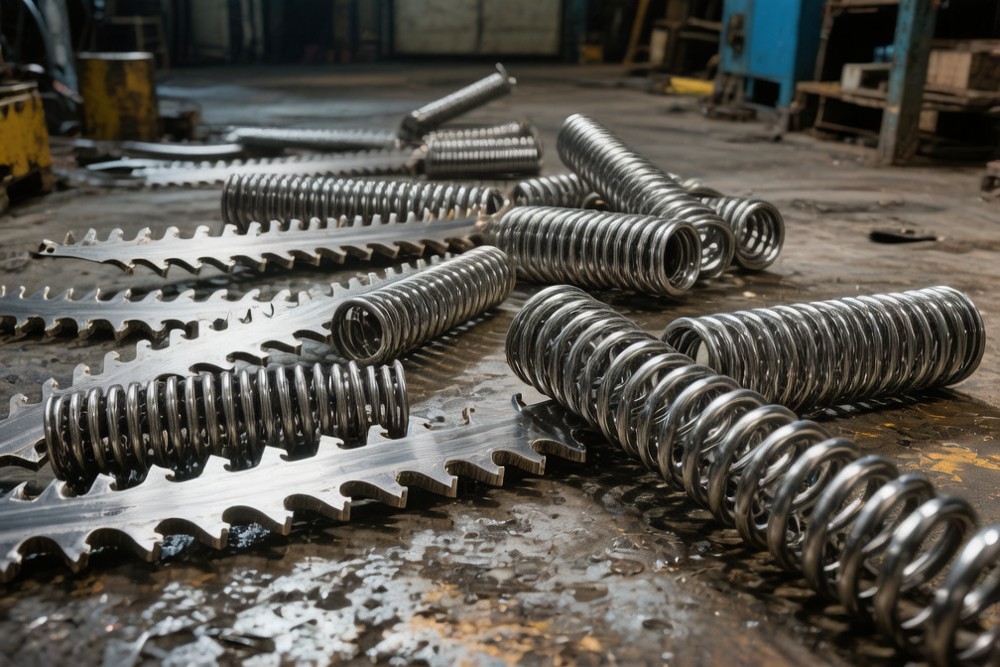
Springs — Flat springs, coil springs, torsion bars. High carbon steel (65Mn in Chinese standards is particularly common) combines the high yield strength needed for spring function with good fatigue resistance. Automotive valve springs, clock springs, and industrial flat springs are classic applications.
Wire rope and music wire — 1080–1095 grades are used for high-strength wire rope, piano/guitar strings (“music wire”), and suspension/tension cables. The drawing process work-hardens the wire significantly beyond the already-high heat-treated strength.
Agricultural cutting elements — Mowing blades, disc harrow blades, tillage tools where wear resistance against soil abrasion is the primary requirement.
Saw blades — Bandsaw blades, hacksaw blades, and circular saw blades for metal cutting. The combination of edge retention and slight flexibility (from controlled tempering) requires high carbon grades.
Bearing races (in some applications) — Although most precision bearing rings use 52100 steel (a bearing-grade high-carbon chromium alloy), plain high carbon is used in economy bearing applications.
What High Carbon Steel Can’t Do
High carbon steel shatters under shock loading. A 1095 chisel improperly tempered will snap rather than deform when struck hard at the edge. This brittleness rules it out for:
- Structural applications with impact loads
- Any application requiring significant bending or forming
- Welded fabrications (weld HAZ embrittlement is severe)
- Thick sections where full heat treatment cannot be achieved
Side-by-Side Comparison
| Criterion | Low Carbon | Medium Carbon | High Carbon |
|---|---|---|---|
| Carbon range | 0.05–0.30% | 0.30–0.60% | 0.60–1.00% |
| Max hardness | ~20 HRC (case-hardened) | 58–62 HRC (surface) | 62–66 HRC |
| Tensile strength (max, treated) | ~550 MPa | ~950 MPa | ~1,300 MPa |
| Weldability | Excellent | Needs preheat | Poor |
| Formability | Excellent | Moderate | Poor |
| Machinability | Good | Good (annealed) | Difficult (hardened) |
| Heat treatment benefit | None (bulk) | High | High |
| Shock resistance | High | Medium | Low |
| Wear resistance | Low | Medium | High |
| Relative material cost | $ | $$ | $$–$$$ |
| Typical applications | Frames, panels, pipes, fasteners | Shafts, gears, cylinders | Springs, blades, wire, cutting tools |
Decision Framework: How to Choose Your Carbon Steel Grade
Use this logic sequence:
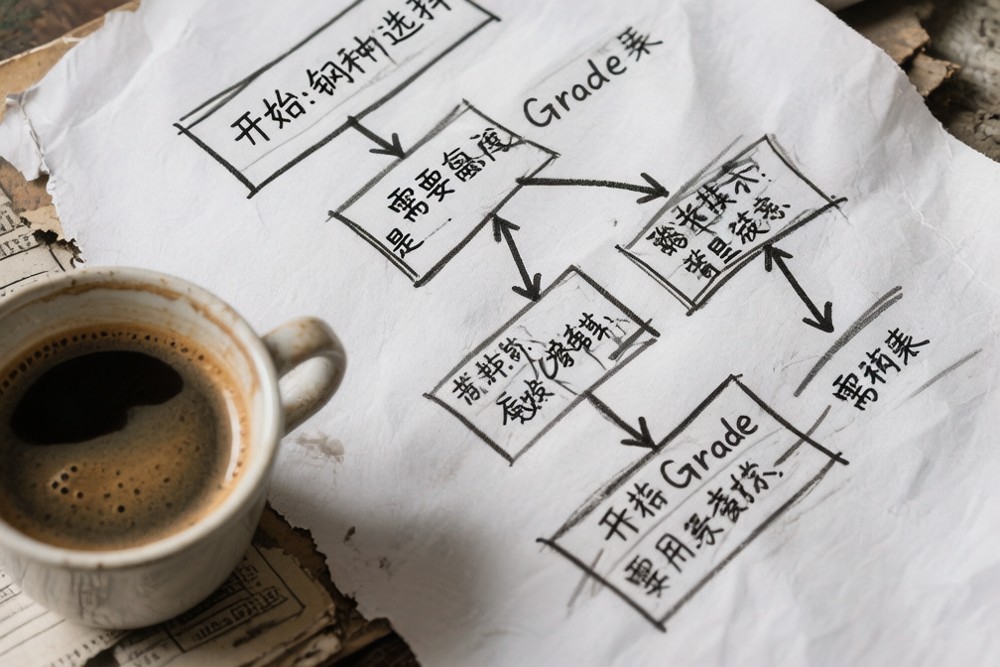
1. Does your application require welding?
- Yes, extensively with no preheat: → Low carbon (A36, Q235, 1018)
- Yes, but preheat is feasible: → Low or medium carbon (evaluate strength need)
- No (or minimal): → Any grade is on the table
2. Is hardness or wear resistance the primary requirement?
- Yes — need 50+ HRC: → High carbon (1080, 1095, 65Mn)
- Yes — need 25–50 HRC, some toughness too: → Medium carbon with Q&T (1045, C45)
- No — hardness is not critical: → Low carbon or normalized medium carbon
3. Is the part formed, bent, or deep-drawn during manufacturing?
- Yes: → Low carbon only (high ductility required)
- No: → Any grade
4. Will the part experience shock or impact loading in service?
- High impact (hammers, impact sockets, crash-worthy structures): → Low or medium carbon; if hardness also needed, medium carbon Q&T at high tempering temperature for toughness
- Moderate cyclic loading: → Medium carbon, normalized or Q&T
- Primarily static or compressive loads: → Any grade, select on strength and cost
5. What section size are you working with?
- Thin sections (<10mm) needing hardness: → High carbon is effective (small section hardens fully)
- Medium sections (10–50mm): → Medium carbon with induction hardening is optimal
- Large sections (>50mm) needing bulk hardness: → Medium carbon alone is insufficient; consider alloy steel (4140, 4340)
Quick Reference: Application-to-Grade Map
| Application | Recommended Grade |
|---|---|
| Structural frame, beam, bracket | Low carbon — A36, Q235B |
| Sheet metal body panels | Low carbon — DC01, SPCC |
| General-purpose shaft ≤50mm | Medium carbon — 1045 (normalized) |
| Heavily loaded shaft with wear surfaces | Medium carbon — 1045 (induction hardened) |
| High-strength bolt (Grade 8 / 10.9) | Medium carbon — 1040 or 10B38 |
| Industrial coil spring | High carbon — 60Si2Mn, 65Mn |
| Saw blade / mower blade | High carbon — 1075, 1095 |
| Music wire / cable wire | High carbon — 1080 |
| Hydraulic cylinder rod | Medium carbon — 1045 (ground & chrome plated) |
| Rebar, concrete reinforcement | Low carbon — A615 / HRB400 |
| Agricultural disc blade | High carbon — 65Mn |
| Gear (moderate load) | Medium carbon — 1045 or 4140 |
| Gear (high load, large section) | Alloy steel — 4340, 18CrNiMo7-6 |
A Note on Alloy Steel: When Carbon Steel Isn’t Enough
If you’ve worked through the decision framework and find that medium carbon steel’s hardenability isn’t adequate for your section size, or that high carbon steel’s brittleness is a concern for a tough application, alloy steel is the next step — not a completely different category.
Alloy steel adds elements like chromium, molybdenum, nickel, or vanadium to improve specific properties:
- 4140 (Cr-Mo): Better hardenability than 1045 at the same carbon level — suitable for sections to 100mm+
- 4340 (Ni-Cr-Mo): High toughness + high hardenability — aerospace and critical structural applications
- 52100 (High-carbon + Cr): Bearing steel — best fatigue life under contact stress
Alloy steel costs 40–150% more per kilogram, so the decision should be specific: use alloy steel where plain carbon genuinely can’t meet the spec, not as a default upgrade.
Sourcing the Right Grade from a Reliable Supplier
Understanding the grade is half the work; getting material that matches the spec is the other half.
Across all three carbon tiers, your purchase order should specify:
- Exact grade designation (e.g., AISI 1045, not just “medium carbon steel”)
- Delivery condition (hot-rolled, normalized, Q&T — including hardness range if Q&T)
- Mill certificate with chemical analysis and mechanical test values
- Third-party inspection for first orders from new suppliers
At Huaxia Steel, we supply all three carbon tiers — low carbon (mild steel), medium carbon (1045 and equivalents), and high carbon — in bars, flat bar, plate, pipe, and tube. All orders include mill certification, and we can process to your dimensions.
Not sure which grade fits your application? Contact our technical team — we’ll review your spec and make a recommendation.
Frequently Asked Questions
Q: Is mild steel the same as low carbon steel?
Yes. “Mild steel” is the common name for low carbon steel (typically <0.30% carbon). The terms are interchangeable in most industrial contexts.
Q: Can I use high carbon steel for structural applications?
Generally no. High carbon steel’s brittleness makes it unsuitable for structural applications that may experience shock, impact, or earthquake loads. Structural grades are always low or medium-low carbon.
Q: What’s the difference between 1018 and 1045?
1018 is low carbon (~0.18% C): soft, highly weldable, excellent for forming and carburizing. 1045 is medium carbon (~0.45% C): significantly stronger, heat-treatable for surface hardness, requires preheat for welding. Choose 1045 when strength or hardness matters; 1018 when formability and weldability are the priority.
Q: Does high carbon steel rust faster than low carbon steel?
Slightly yes — the carbide microstructure in high carbon steel can create micro-galvanic cells that accelerate surface corrosion, but the difference is minor in practice. Both need proper surface protection (painting, plating, or oil coating) in exposed environments.
Q: What is the highest hardness achievable in plain carbon steel?
1095 (or equivalent 1.00% carbon grade) can reach approximately 65–67 HRC in the as-quenched condition. In practice, tempering to reduce brittleness brings working hardness to 58–62 HRC for cutting tools and 50–55 HRC for springs and structural wear components.
Conclusion
The choice between low, medium, and high carbon steel comes down to answering three questions: How hard does it need to be? How much will it be welded or formed? And what section size is involved?
Low carbon steel excels where formability and weldability matter most. Medium carbon steel is the practical choice for the vast majority of load-bearing mechanical components. High carbon steel owns the narrow band of applications where hardness and wear resistance are worth trading against toughness and weldability.
Get the grade right at the specification stage and the rest of the engineering and sourcing process becomes straightforward.
Need any of these grades for your next project? Huaxia Steel supplies low, medium, and high carbon steel from Shanghai, with full mill documentation and global shipping.
Get a free quote →
Author: Huaxia Steel Technical Team | Updated: June 2025 | Category: Carbon Steel Selection