Carbon Steel Heat Treatment: Annealing, Quenching & Tempering Parameters Guide

Carbon steel heat treatment is one of the most critical decisions in any procurement specification. Whether you are sourcing round bars, plates, or coils from a Chinese mill, the heat treatment condition directly determines mechanical properties, machining behavior, and — ultimately — your total cost of ownership.
This guide translates the technical jargon of annealing, normalizing, quenching, and tempering into practical parameters that steel buyers can specify on purchase orders, verify on Mill Test Certificates (MTCs), and negotiate with suppliers.

Why Heat Treatment Matters for Steel Buyers
Every carbon steel product ships in a specific heat treatment condition. The most common delivery conditions are:
| Condition | Typical Hardness (HB) | Key Benefit | Cost Impact |
|---|---|---|---|
| As-rolled | 150–260 | Lowest cost, fast delivery | Base price |
| Annealed | 120–180 | Improved machinability, uniform structure | +5–8% |
| Normalized | 140–210 | Consistent grain structure, better toughness | +3–6% |
| Quenched + Tempered (QT) | 250–450 | Maximum strength and wear resistance | +10–20% |
Choosing the wrong condition can mean you pay for QT material when annealed would suffice, or — worse — you receive as-rolled stock that cannot meet your machining tolerances.

Annealing Carbon Steel: Full Process & Parameter Table
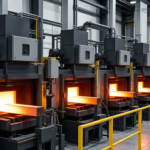
Annealing heats carbon steel above its upper critical temperature (Ac3), holds it there to dissolve carbides, then cools it slowly inside the furnace. The result is a soft, uniform microstructure ideal for subsequent machining or cold forming.
Annealing Temperature Ranges by Grade
| Grade | Ac3 Temperature (°C) | Annealing Temp (°C) | Hold Time (min/mm) | Cooling Rate | Target Hardness (HB) |
|---|---|---|---|---|---|
| AISI 1018 | 870 | 870–920 | 1–2 | ≤20 °C/h to 500 °C | 120–150 |
| AISI 1045 | 770 | 780–830 | 1–2 | ≤30 °C/h to 500 °C | 150–180 |
| AISI 4140 | 800 | 840–870 | 2–3 | ≤25 °C/h to 500 °C | 170–210 |
| AISI 4340 | 750 | 810–850 | 2–3 | ≤20 °C/h to 500 °C | 200–240 |
| Q235B | 880 | 880–920 | 1–2 | ≤25 °C/h to 500 °C | 120–160 |
| 65Mn | 760 | 780–830 | 1.5–2 | ≤20 °C/h to 500 °C | 180–220 |
Procurement Tip: Specify Annealing on Your PO
Many Chinese mills default to as-rolled delivery unless you explicitly request annealed condition. Add the following clause to your purchase order:
“Material shall be delivered in fully annealed condition per ASTM A29/A29M. Hardness shall not exceed [XX] HB as verified on MTC.”
The MTC will list the heat treatment condition and the measured hardness. If hardness exceeds your spec, you have grounds for rejection under most commercial contracts.
Normalizing: The Balance Between Cost and Consistency
Normalizing heats steel above Ac3 and cools it in still air. It is cheaper than annealing (no furnace slow-cool cycle) but produces a more refined grain structure than as-rolled material.
Normalizing Parameters
| Grade | Normalizing Temp (°C) | Hold Time | Air Cooling | Resulting Hardness (HB) |
|---|---|---|---|---|
| AISI 1020 | 900–930 | 30–60 min | Still air | 130–160 |
| AISI 1045 | 840–870 | 30–45 min | Still air | 170–210 |
| AISI 4140 | 860–900 | 45–60 min | Still air | 210–260 |
| ASTM A36 | 880–920 | 30–45 min | Still air | 140–180 |
| SS400 | 870–910 | 30–45 min | Still air | 130–170 |
When to Choose Normalized Over Annealed
- **Structural applications** where toughness matters more than maximum machinability
- **Large forgings or castings** where as-rolled microstructure is inconsistent
- **Budget-sensitive orders** where the 3–6% cost premium of annealing is hard to justify
Normalized material is the default delivery condition for many ASTM A105 flanges and A350 forgings. If your spec references these standards, normalizing is already implied.
Quenching and Tempering (QT): Maximum Strength Parameters
Quenching rapidly cools steel from above Ac3 in water, oil, or polymer solution, forming martensite — a hard but brittle microstructure. Tempering then reheats the quenched steel to a lower temperature to trade some hardness for toughness.
Quenching Media Selection
| Media | Cooling Speed | Typical Application | Risk |
|---|---|---|---|
| Water | Very fast (≈600 °C/s) | Low-carbon flat bars, plates | Cracking on medium/high-carbon grades |
| Oil | Moderate (≈150 °C/s) | Medium-carbon rounds, forgings | Lower hardness than water quench |
| Polymer solution | Tunable | Mixed orders, complex shapes | Requires concentration control |
**Buyer’s note:** Water quenching on grades above ~0.40% C (like 1045, 4140) carries a significant cracking risk, especially on thick sections (>50 mm). Oil quenching is safer but achieves lower hardness. Specify the quenching medium on your PO when ordering QT material.
Tempering Temperature vs. Hardness Trade-off
For AISI 1045 (quenched from 830 °C in oil):
| Tempering Temp (°C) | Hold Time (min) | Resulting Hardness (HRC) | Tensile Strength (MPa) | Elongation (%) |
|---|---|---|---|---|
| 200 | 60 | 50–55 | 1800+ | <5 |
| 300 | 60 | 45–50 | 1500–1700 | 6–8 |
| 400 | 60 | 35–42 | 1100–1300 | 10–14 |
| 500 | 60 | 25–32 | 800–1000 | 16–20 |
| 600 | 60 | 20–28 | 650–850 | 20–25 |
For AISI 4140 (quenched from 850 °C in oil):
| Tempering Temp (°C) | Hold Time (min) | Resulting Hardness (HRC) | Tensile Strength (MPa) | Elongation (%) |
|---|---|---|---|---|
| 200 | 60 | 52–56 | 1900+ | <5 |
| 400 | 60 | 42–48 | 1400–1600 | 8–12 |
| 550 | 60 | 30–36 | 1000–1200 | 14–18 |
| 650 | 60 | 22–28 | 750–900 | 18–22 |
How to Specify QT on a Purchase Order
Include these parameters:
- **Quenching temperature** (e.g., “Quench from 830 °C in oil”)
- **Tempering temperature and hold time** (e.g., “Temper at 550 °C for 60 min”)
- **Target hardness range** (e.g., “HRC 30–36 or HB 280–340”)
- **MTC verification** (e.g., “MTC shall report actual hardness at two locations per ASTM E18”)
Spheroidize Annealing: Specialized Softening for High-Carbon Steels
For steels above 0.60% C (like 65Mn, SK5, 1095), spheroidize annealing creates a microstructure of spherical carbides in a soft ferrite matrix. This is essential before cold heading, stamping, or fine machining.
| Grade | Spheroidize Temp (°C) | Hold Time | Cool Rate | Target Hardness (HB) |
|---|---|---|---|---|
| 65Mn | 700–740 | 4–6 hours | ≤20 °C/h to 500 °C | 160–190 |
| SK5 | 740–770 | 4–8 hours | ≤15 °C/h | 150–180 |
| 1095 | 700–720 | 6–8 hours | ≤20 °C/h | 170–200 |
**Cost note:** Spheroidize annealing is the most time-consuming (and expensive) heat treatment. Expect a 12–18% price premium over as-rolled delivery on high-carbon grades.
Reading Heat Treatment Data on a Mill Test Certificate
An MTC for heat-treated carbon steel should include:
| MTC Field | What to Check | Red Flag |
|---|---|---|
| Heat treatment condition | Matches your PO spec | “As-rolled” when you ordered “Annealed” |
| Hardness (HB or HRC) | Within your specified range | Values at or above max spec |
| Tempering temperature | Consistent with your requirement | Absent or lower than spec |
| Quenching medium | Water/oil as specified | “Air” when you ordered QT |
| Heat number traceability | Matches certificate chain | Multiple heat numbers on one cert |
If any of these fields are missing or inconsistent, request a supplementary test certificate before accepting delivery.
Heat Treatment Cost Comparison for a 100-Ton Order
| Condition | Price Premium | Lead Time Impact | Best Use Case |
|---|---|---|---|
| As-rolled | Base | Standard (7–15 days) | Structural plates, simple shapes |
| Normalized | +3–6% | +2–3 days | Consistent-toughness structural parts |
| Annealed | +5–8% | +3–5 days | Machining-intensive components |
| QT | +10–20% | +5–10 days | High-strength shafts, gears, wear parts |
| Spheroidize annealed | +12–18% | +7–14 days | Cold-formed high-carbon parts |
FAQ
**Q: Can I specify a hardness range instead of a heat treatment process on my PO?**
A: Yes, but it is riskier. If you only specify “HB 170–210,” the mill may achieve this through an uncontrolled process. Specifying both the process and the hardness range gives you a verifiable process and a measurable outcome.
**Q: Does as-rolled carbon steel meet the same mechanical properties as normalized?**
A: No. As-rolled properties vary with rolling temperature, section size, and cooling rate on the mill floor. Normalized properties are more consistent and typically 10–15% higher in toughness.
**Q: What is the difference between sub-critical annealing and full annealing?**
A: Sub-critical annealing heats below Ac1 (typically 650–700 °C) and only relieves residual stress. Full annealing heats above Ac3 and transforms the entire microstructure. Full annealing produces lower hardness and better machinability.
**Q: How do I verify QT material was actually quenched and tempered?**
A: Check the MTC for tempering temperature and hold time. If those fields are blank, request a microstructure examination report — QT material shows tempered martensite, while normalized material shows pearlite + ferrite.
**Q: Is water quenching always better than oil quenching for hardness?**
A: Water quenching produces higher hardness but carries a cracking risk on medium and high-carbon steels, especially thick sections. Oil quenching is safer and more commonly used in Chinese mills for grades like 1045 and 4140.
Source Your Heat-Treated Carbon Steel from Huaxia Steel
Specifying the right heat treatment condition on your purchase order is the difference between material that machines cleanly and material that fights every cut. At **Huaxia Steel**, we deliver carbon steel round bars, plates, coils, and angle bars in annealed, normalized, QT, or as-rolled condition — with full MTC documentation and third-party inspection support.
**[Request a quote today →](https://www.huaxia-steel.com/contact/)** and specify your preferred heat treatment condition. We will confirm parameters, provide a detailed MTC, and ship on schedule.