Carbon Steel Stress Relieving vs Spheroidizing Annealing Process Comparison
Carbon Steel Stress Relieving vs Spheroidizing Annealing Process Comparison
Heat treatment is the single most important process step that determines whether a carbon steel component will survive in service without distortion, cracking or premature fatigue failure. Among the dozens of thermal cycles available to metallurgists, stress relieving and spheroidizing annealing are two treatments that procurement engineers frequently encounter on mill test certificates — yet the differences between them are poorly understood by buyers who lack a metallurgical background.
This article explains stress relieving and spheroidizing annealing from a purchasing perspective. We compare process temperatures, holding times, cooling rates, microstructural outcomes, hardness changes and typical applications. We also provide decision rules for when to specify each treatment in a purchase order, what to look for on a mill certificate and how much each process adds to the delivered cost of carbon steel plate, bar and forged components.
1. What Is Stress Relieving?
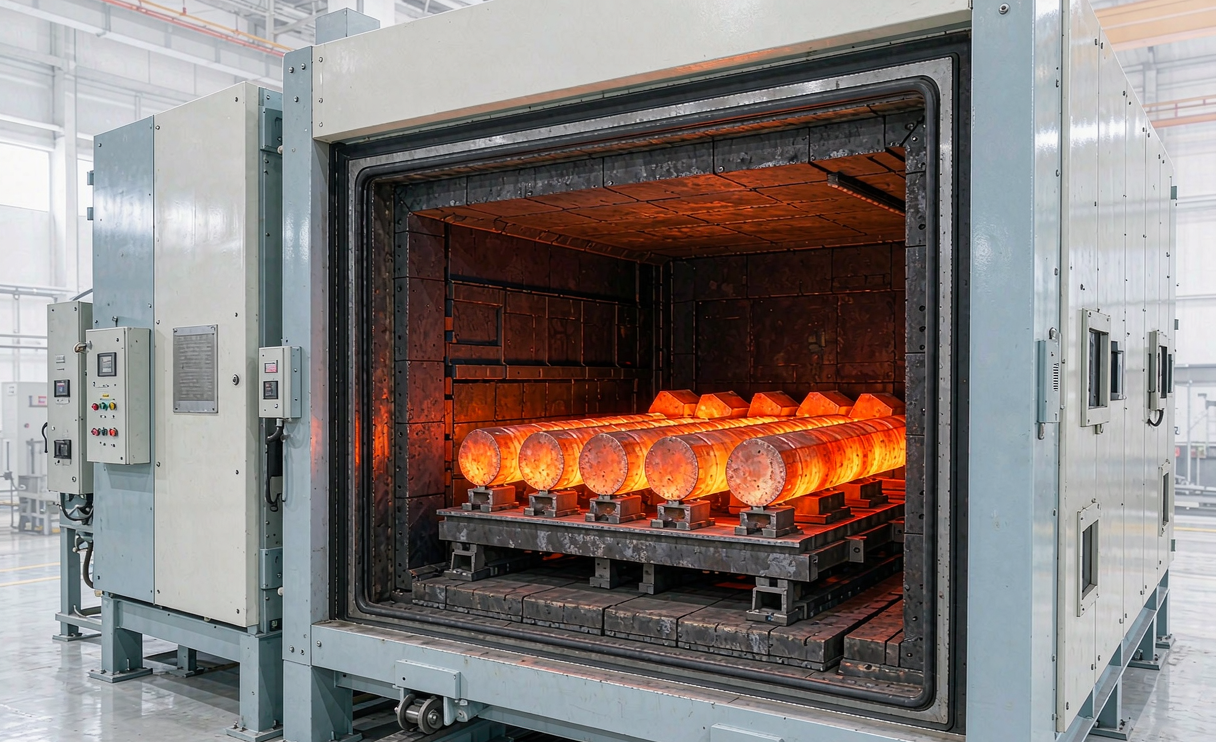
Stress relieving is a sub-critical heat treatment performed at temperatures below the lower critical temperature (A1) of the steel — typically 550°C–650°C (1,022°F–1,202°F) for plain carbon steels. The purpose is not to change microstructure but to reduce residual stresses introduced by prior manufacturing steps such as welding, cold forming, machining or straightening.
During stress relieving, dislocations in the ferrite matrix acquire enough thermal energy to rearrange into lower-energy configurations. Grain boundaries relax, and locked-in elastic strains are converted to plastic flow without phase transformation. Because the temperature stays below A1, the ferrite-pearlite microstructure remains unchanged, and hardness drops by only 5–15 HRB.
Standard process parameters for carbon steel stress relieving:
Heating rate: ≤ 150°C per hour for sections > 50 mm; ≤ 220°C per hour for thinner sections
Soaking temperature: 550°C–650°C (target = 600°C for most grades)
Holding time: 1 hour per 25 mm of maximum section thickness, minimum 1 hour
Cooling rate: Furnace cool to 300°C, then air cool (fast cooling can reintroduce thermal stresses)
2. What Is Spheroidizing Annealing?
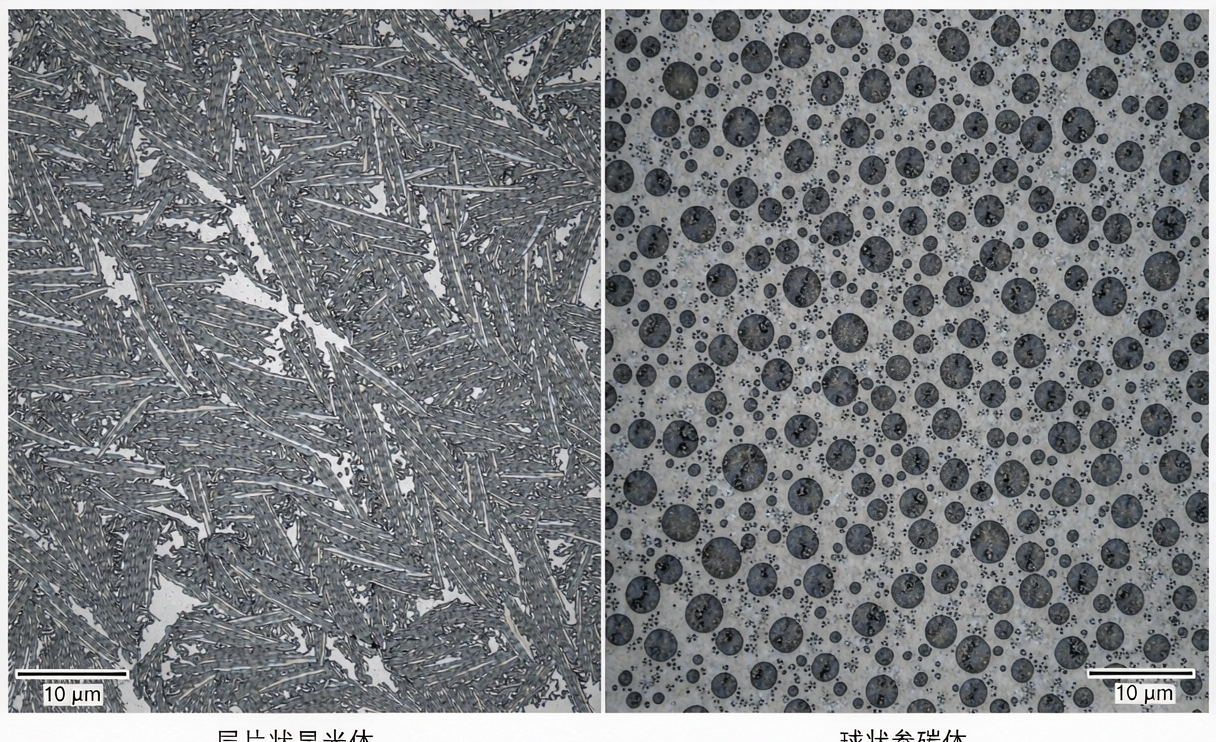
Spheroidizing annealing is a microstructure-modifying heat treatment designed to convert lamellar pearlite into spheroidized cementite particles dispersed in a ferrite matrix. The resulting microstructure has the lowest possible hardness for a given carbon content and exhibits exceptional machinability and cold-forming ductility.
The process works by heating the steel to just below A1 (typically 680°C–720°C for hypoeutectoid steels) and holding for an extended period — 8–24 hours depending on carbon content and initial microstructure. During this long soak, cementite lamellae in pearlite break down into isolated particles through a combination of surface-energy-driven spheroidization and carbon diffusion. The ferrite matrix recrystallises, producing a soft, equiaxed grain structure.
Standard process parameters for carbon steel spheroidizing annealing:
Heating rate: ≤ 100°C per hour to avoid thermal cracking in large forgings
Soaking temperature: 680°C–720°C (just below A1; confirm A1 from the mill’s TTT diagram)
Holding time: 8–24 hours; higher carbon grades require longer times
Cooling rate: Furnace cool to 500°C at ≤ 50°C per hour, then air cool
3. Side-by-Side Process Comparison
Parameter
Stress Relieving
Spheroidizing Annealing
Primary purpose
Reduce residual stress
Soften for machining/forming
Temperature range
550°C–650°C
680°C–720°C
Phase transformation
None (sub-critical)
Partial (cementite spheroidization)
Holding time
1–4 hours typical
8–24 hours typical
Hardness change
−5 to −15 HRB
−30 to −50 HRB
Tensile strength change
Minimal (< 3 %)
Significant (−15 to −25 %)
Machinability improvement
Negligible
Dramatic (tool life ×2–3)
Dimensional stability
Excellent
Good (some growth in large sections)
Cost adder (per tonne)
$30–$60
$120–$250
Typical furnace occupancy
4–8 hours
24–48 hours
4. Microstructural Outcomes Explained
After stress relieving, a 0.35 % carbon steel plate still displays the familiar ferrite-pearlite microstructure seen in the as-rolled condition. The only difference is that pearlite colonies may appear slightly rounded at the edges and dislocation density in ferrite grains drops by 60–80 %. Optical microscopy at 400× magnification cannot reliably distinguish stress-relieved steel from as-rolled steel — confirmation requires X-ray diffraction residual-stress measurement or transmission electron microscopy.
After spheroidizing annealing, the same steel looks completely different under the microscope. Lamellar pearlite has disappeared, replaced by spherical cementite particles (0.5–2.0 μm diameter) sitting in a continuous ferrite matrix. The grain boundaries are clean and equiaxed. Hardness drops from 85 HRB to 55–65 HRB, allowing drilling speeds to increase by 40 % and tool insert life to double in CNC turning operations.
Procurement engineers should note that spheroidized microstructures are thermodynamically metastable. If a spheroidized bar is subsequently heated above A1 — for example during induction hardening or welding — the cementite spheres dissolve and lamellar pearlite re-forms on cooling. The spheroidizing benefit is lost permanently. For components requiring both soft machinability and localised hardening, specify induction hardening from a normalised bar rather than from a spheroidized bar.
5. When to Specify Stress Relieving in a Purchase Order
Stress relieving should be specified whenever a carbon steel component will be subjected to one or more of the following conditions:
Welded fabrications: Multi-pass welded structures such as pressure vessels, pipe spools and structural frames accumulate tensile residual stresses of 200–400 MPa in the heat-affected zone. Stress relieving reduces these to < 50 MPa, preventing stress-corrosion cracking in sour service.
Precision-machined components: Heavy machining removes material asymmetrically, creating bending stresses that cause warping during final grinding or during temperature cycling in service. Stress relieve after rough machining and before finish machining.
Cold-formed sections: Roll-formed Z-purlins, press-brake-bent brackets and cold-swaged fittings retain springback stresses that reduce fatigue life. Stress relieving after forming restores dimensional stability.
Thick plates (> 50 mm): As-rolled heavy plate cools non-uniformly through the thickness, generating centreline tensile stresses. Stress relieving normalises the through-thickness stress profile and improves ultrasonic test reliability.
6. When to Specify Spheroidizing Annealing
Spheroidizing annealing is the correct specification when the primary requirement is extreme softness, either for subsequent cold working or for high-speed machining of complex geometries:
Cold-heading fasteners: Bolts, screws and rivets produced on multi-die cold headers require spheroidized wire rod to prevent central bursting and to achieve the 60–70 % reduction ratios typical of modern header tooling.
Deep-drawn stampings: Automotive clutch plates, transmission synchroniser hubs and appliance housings drawn from 0.15–0.35 % carbon sheet must have spheroidized microstructure to avoid shear-band formation and orange-peel surface defects.
Intricate CNC machining: Valve bodies, pump housings and hydraulic manifold blocks with internal galleries, thin webs and tight tolerances are machined from spheroidized bar stock to minimise tool deflection and part distortion.
Cold extrusion preforms: Gear blanks, spline shafts and bearing races extruded at room temperature from medium-carbon steel require spheroidized billets to achieve the 70–80 % area reductions possible in backward extrusion.
7. Certification and Inspection Requirements
Mill test certificates for stress-relieved or spheroidized material must contain specific evidence beyond the standard tensile and chemical reports. Procurement teams should verify the following fields before accepting delivery:
Required Evidence
Stress Relieving
Spheroidizing Annealing
Furnace chart (time-temperature)
Required
Required
Hardness before/after
Recommended
Required
Micrograph (400×)
Optional
Required
Residual-stress report (XRD or hole-drill)
Required for weldments
Not applicable
Grain-size measurement
Optional
Required (ASTM 5–8)
Cementite spheroidization rating
Not applicable
Required (GOST 8233 or internal standard)
Third-party inspection bodies such as SGS, Bureau Veritas and TÜV Rheinland offer witness-point services where an inspector verifies furnace calibration, reviews the time-temperature chart and takes duplicate hardness readings. For critical nuclear or pressure-equipment applications, specify EN 10204 3.2 certification with heat-treatment witnessing.
8. FAQ
Q1: Can I stress relieve after spheroidizing annealing?
Yes, but it is unnecessary. Spheroidizing annealing is performed at a higher temperature for a longer time, so any residual stresses from prior operations are already eliminated. Additional stress relieving adds cost without benefit and may cause unwanted grain growth if the furnace temperature drifts above 720°C.
Q2: Does stress relieving improve corrosion resistance?
Indirectly, yes. By reducing residual tensile stresses, stress relieving lowers the driving force for stress-corrosion cracking (SCC) in H2S-containing environments. However, it does not change the chemical composition or form a protective oxide film. For direct corrosion protection, specify a surface treatment such as hot-dip galvanizing or epoxy coating.
Q3: How much does spheroidizing annealing add to lead time?
Spheroidizing typically adds 3–5 days to the mill schedule for batch furnace operations and 1–2 days for continuous belt furnaces. Because furnace capacity is limited, Chinese mills often queue spheroidizing orders during peak season (September–November). Order 2–3 weeks earlier than you would for as-rolled material.
Q4: Can stress relieving be done on-site instead of at the mill?
Yes. Portable ceramic-pad heaters and induction coils allow local stress relieving of welds in the field. However, on-site stress relieving requires qualified technicians, calibrated thermocouples and controlled heating/cooling rates. For large fabrications, mill stress relieving in a walk-in furnace produces more uniform results and is usually cheaper per tonne.
Q5: What hardness should I expect after spheroidizing S45C / 1045 steel?
S45C (AISI 1045) in the spheroidized condition should measure 55–65 HRB or 120–150 HV10. If the hardness exceeds 75 HRB, the spheroidization cycle was either too short or the cooling rate was too fast, indicating incomplete cementite spheroidization. Reject the batch or demand re-annealing.
Conclusion
Stress relieving and spheroidizing annealing serve fundamentally different purposes in the carbon steel supply chain. Stress relieving is a low-temperature, short-duration treatment that preserves strength while eliminating residual stresses from welding, machining and forming. Spheroidizing annealing is a high-temperature, long-duration treatment that sacrifices strength for extreme softness and machinability.
At Huaxia-Steel, we supply carbon steel plate, bar and forged components with both stress relieving and spheroidizing annealing from ISO-certified heat-treatment facilities. Every batch is accompanied by complete furnace charts, hardness reports and microstructural photographs. Contact our technical sales team for material-selection guidance and competitive quotations tailored to your machining or fabrication requirements.
If you require further information about our metal sheet products or architectural projects, please don’t hesitate to leave your contact details and message here.
Our team of experts will respond within 24 hours to continue the discussion and provide you with any additional information you requires.