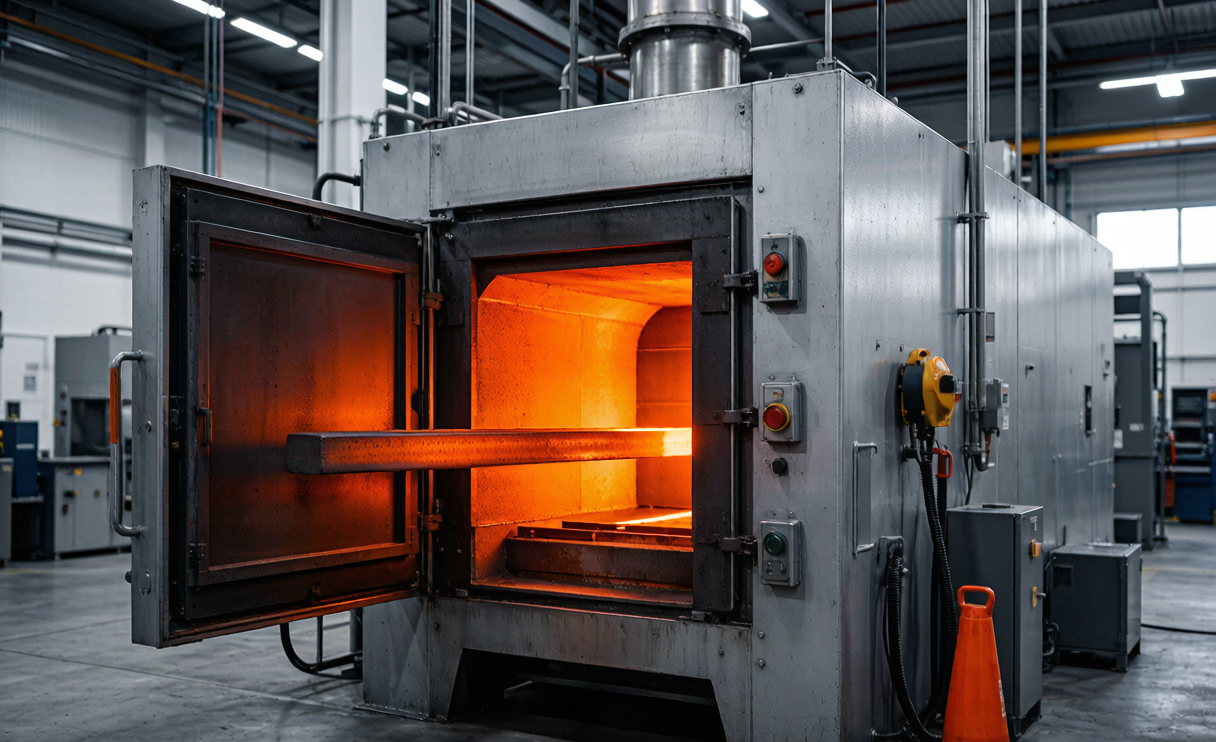
Heat treatment transforms ordinary carbon steel into an engineered material with precisely controlled mechanical properties. Whether you need maximum hardness for wear-resistant tooling, optimized machinability for high-volume production, or refined grain structure for critical structural applications — the right heat treatment process makes it possible.
This guide covers the four fundamental carbon steel heat treatment processes — annealing, normalizing, quenching, and tempering — with practical temperature ranges, cooling methods, equipment considerations, and quality control checkpoints that steel buyers and fabricators need to know.
1. Why Heat Treat Carbon Steel? The Metallurgical Foundation
Carbon steel’s microstructure consists primarily of ferrite and pearlite at room temperature. Heating transforms this structure — ferrite dissolves, pearlite converts to austenite, and carbon redistributes throughout the iron matrix. Cooling rate then determines the final microstructure: slow cooling produces coarse pearlite (soft), moderate cooling produces fine pearlite (balanced), and rapid cooling produces martensite (hard but brittle).
The critical temperature range for carbon steel is 723–910°C (the A1 to A3 transformation range), varying by carbon content. Below 723°C, no phase transformation occurs — this is the stress-relief temperature zone. Above 910°C, carbon steel is fully austenitic and ready for transformation.
2. Full Annealing: Maximum Softness and Stress Relief
2.1 Process Overview
Full annealing heats the steel to 30–50°C above the upper critical temperature (A3), holds until the entire cross-section reaches uniform temperature, then cools very slowly — typically 10–30°C per hour — inside the furnace. Total cycle time can range from 12 hours for small parts to 72+ hours for large castings or forgings.
Carbon Content
Annealing Temperature
Soak Time (per 25mm thickness)
Cooling Method
Low carbon (0.05–0.25%)
875–925°C
1 hour
Furnace cool to 500°C, then air
Medium carbon (0.25–0.55%)
800–850°C
1 hour
Furnace cool to 500°C, then air
High carbon (0.55–1.00%)
760–790°C
1.5 hours
Furnace cool to 500°C, then air
Tool steel (1.00%+)
750–780°C
2 hours
Furnace cool to 500°C, then air
2.2 Applications and Results
Full annealing produces a microstructure of coarse pearlite in a ferrite matrix — the softest possible condition for a given carbon steel grade. Typical hardness after full annealing:
AISI 1018 (0.18% C): 110–130 HBW
AISI 1045 (0.45% C): 155–170 HBW
AISI 1095 (0.95% C): 190–210 HBW
Use full annealing when you need maximum machinability, cold-forming readiness (wire drawing, deep drawing, heading), or complete stress relief after welding or casting. The trade-off is cost — full annealing is the most expensive heat treatment due to long furnace time.
Normalizing heats steel to 30–50°C above the upper critical temperature (A3 or Acm), holds for sufficient soak time, then cools in still air. Air cooling is faster than furnace cooling but slower than quenching — typically 50–200°C per minute depending on section size and ambient conditions.
The result is a fine, uniform pearlitic structure with grain refinement — hence the name “normalizing,” as it returns the steel to its “normal” equilibrium condition after prior processing (forging, rolling, welding) has disrupted it.
3.2 Normalizing vs. Annealing: When to Choose Which
Factor
Normalizing
Full Annealing
Hardness
Harder (finer pearlite)
Softer (coarser pearlite)
Grain size
Fine, uniform
Coarse
Machinability
Good for low-carbon; fair for high-carbon
Excellent for all carbon levels
Cycle time
2–6 hours
12–72 hours
Cost
Moderate
High (furnace time)
Best for
Structural sections, forgings, castings before machining
Severe cold forming, deep drawing, maximum softness
For structural steel plates, shapes, and bars destined for general fabrication, normalizing is the workhorse treatment. At Huaxia-Steel, we recommend normalizing for all ASTM A36 plates over 40mm and all S235JR sections specified for dynamic loading to ensure consistent through-thickness properties.
4. Quenching: Maximum Hardness Through Rapid Cooling
4.1 Process Overview
Quenching heats steel to the austenitizing temperature (typically 800–870°C for medium-carbon steel), holds for through-heating, then immerses in a quenching medium to achieve critical cooling rates that transform austenite to martensite rather than pearlite.
Quenching Medium
Cooling Rate
Best For
Risk
Brine (10% NaCl)
Fastest
Low-carbon, large sections
High distortion, cracking
Water
Fast
Plain carbon steels 0.30–0.50% C
Moderate distortion
Oil (mineral)
Moderate
Medium/high carbon, alloy steels
Fire hazard, smoke
Polymer (PAG)
Adjustable
Induction-hardened parts
Concentration control needed
Forced air / gas
Slowest
High-hardenability alloy steels
May not reach critical rate
4.2 Hardenability: Why Carbon Content Matters
Not all carbon steels can be effectively hardened by quenching. The maximum achievable hardness depends primarily on carbon content:
Below 0.20% C: Essentially non-hardenable by quenching. Martensite cannot form in useful quantities. These steels (A36, S235JR, SS400, 1018) are typically used in the as-rolled or normalized condition.
0.25–0.45% C: Partially hardenable. Water quenching can achieve 35–50 HRC in thin sections. Suitable for moderate-wear applications.
0.45–0.65% C: Fully hardenable. Water or oil quenching achieves 55–62 HRC. This is the sweet spot for shafts, gears, and hand tools (AISI 1045, 1060, C45, S45C).
Above 0.65% C: Very hard, very brittle in as-quenched condition. Oil quenching preferred. Always requires tempering. Used for springs, cutting tools, wear plates (AISI 1095, 65Mn, SK5).
5. Tempering: Trading Hardness for Toughness
5.1 The Tempering Temperature Spectrum
Tempering is mandatory after quenching — as-quenched martensite is too brittle for any practical application. Tempering reheats the steel to a temperature below the lower critical point (A1, 723°C) and holds to allow controlled transformation of martensite into tempered martensite (ferrite + fine carbides).
Tempering Range
Resulting Hardness (1045 steel)
Application
150–200°C (low temp)
55–60 HRC
Cutting tools, bearings, case-hardened parts
200–350°C
50–55 HRC
Cold work tools, springs
350–500°C
35–50 HRC
Shafts, gears, structural parts needing moderate toughness
A critical caution: tempering carbon steels in the 250–400°C range can induce temper embrittlement — a paradoxical loss of toughness despite decreasing hardness. This is particularly severe in steels with elevated manganese or phosphorus. When toughness is the priority, either temper below 250°C or above 450°C — never in the danger zone.
6. Process Selection Guide: What Treatment Does Your Project Need?
Starting Condition
Desired Outcome
Recommended Process
As-rolled plate, needs machining
Softer, machinable
Full annealing (if heavy machining) or normalizing (if light machining)
As-forged, irregular grain
Refined, uniform properties
Normalizing
Welded fabrication
Stress relief, softened HAZ
Stress-relief anneal (550–650°C, furnace cool)
Medium-carbon bar, needs wear resistance
Hard surface, tough core
Quench + temper (450–550°C)
Cold-worked (drawn, rolled)
Recrystallized, ductile
Process anneal (550–700°C)
Cast carbon steel
Homogenized, weldable
Normalize + temper (if thick section)
7. Quality Control and Verification
Heat treatment quality must be verified — never assume the furnace did its job. Three verification methods should be part of every purchase specification:
Hardness testing: Portable Brinell or Rockwell testers provide immediate field verification. Test at multiple locations across each piece or batch — surface hardness can vary with decarburization.
Microstructure examination: A small coupon (25mm × 25mm) from each heat treatment batch, polished and etched, reveals grain size, phase distribution, and any anomalies (decarburization depth, Widmanstatten structure, banding).
Furnace chart review: Every industrial heat treatment furnace records time-temperature data. Review the charts against the specified cycle — soak temperature, soak duration, and cooling rate — before accepting the batch.
Frequently Asked Questions
Can I heat treat carbon steel myself without industrial equipment?
For small parts, a propane forge or oxy-acetylene torch can achieve hardening temperatures. However, temperature control is inconsistent, and results are unpredictable. For any production application or structural component, use an industrial heat treatment facility with calibrated furnaces and certified procedures.
What is the difference between normalizing and stress-relief annealing?
Normalizing involves heating above the transformation range (typically 850–950°C) to recrystallize the steel with a new grain structure. Stress-relief annealing operates below the transformation range (550–650°C) — it relieves internal stresses without changing the existing microstructure. Both have their place, but they are not interchangeable.
Does heat treatment affect dimensions?
Yes — quenching causes the most distortion due to thermal shock and martensitic volume expansion (up to 4%). Annealing and normalizing produce minimal distortion (typically 0.1–0.3% dimensional change). Always include a machining allowance if the final part requires tight tolerances after heat treatment.
How do I specify heat treatment on a purchase order?
Be specific: “Normalize per ASTM A941 at 900 ±15°C, air cool. Hardness 130–170 HBW. Provide furnace chart and one hardness reading per plate.” Avoid vague terms like “heat treat” or “soften” — they mean different things to different mills and will lead to disputes.
Source Heat-Treated Carbon Steel with Certified Quality
Huaxia-Steel supplies carbon steel plates, bars, and sections in as-rolled, normalized, annealed, and quench-and-tempered conditions — all with full furnace charts and mechanical test reports. Our partner heat treatment facilities are ISO 9001 certified and regularly audited by third-party inspectors.
If you require further information about our metal sheet products or architectural projects, please don’t hesitate to leave your contact details and message here.
Our team of experts will respond within 24 hours to continue the discussion and provide you with any additional information you requires.