Product Overview
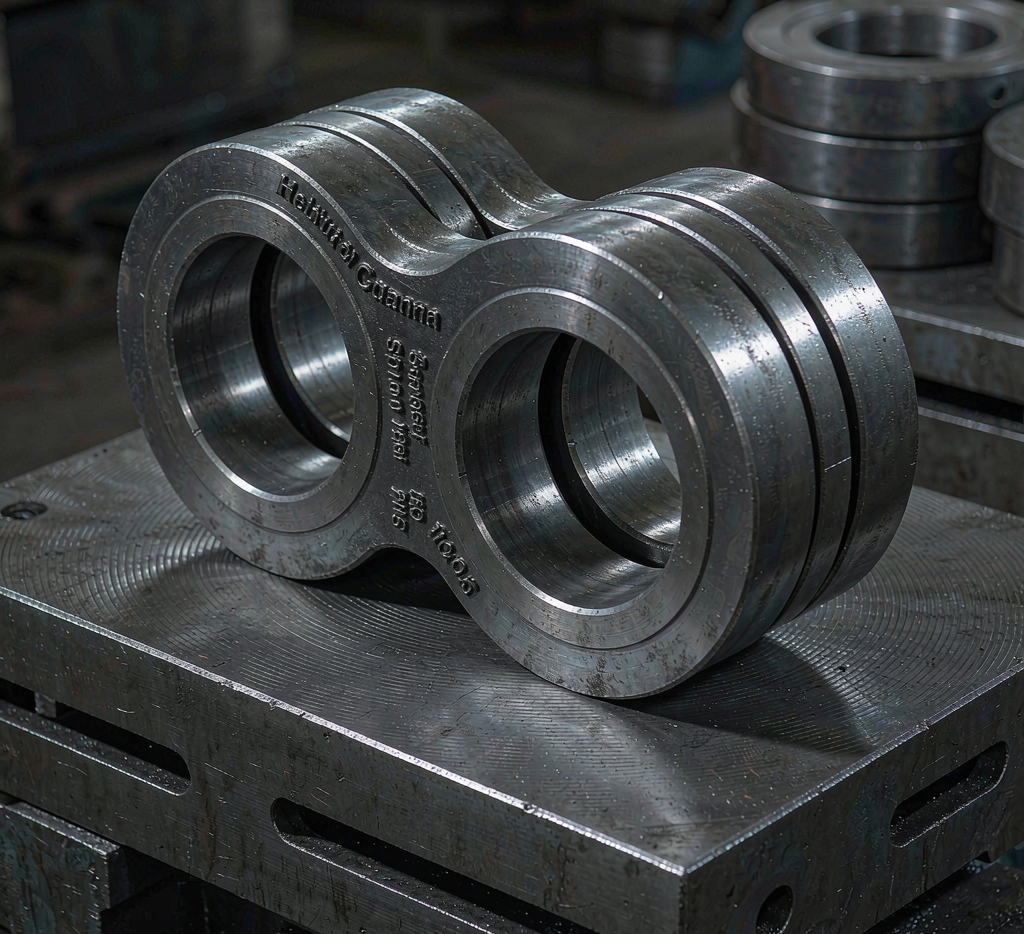
A carbon steel spectacle blind flange (figure-8 blind, spade and spacer) is a single forged unit combining a solid blind plate and an open spacer connected by a web, looking like a pair of spectacles. Rotating it 90° in the bolted joint either blocks the line (blind section in flow path) or opens it (spacer in flow path) — making it the standard isolation device for lines that must be switched without cutting pipe or changing gaskets. Huaxia-Steel supplies spectacle blinds in A105, A105N, and A350 LF2 carbon steel from 1/2″ to 24″, class 150–1500, per ASME B16.48, with EN 10204 3.1 certification.
Specifications
| Parameter | Range | Standard / Tolerance |
|---|---|---|
| Nominal size | 1/2″ – 24″ (larger on request) | ASME B16.48 |
| Pressure class | 150, 300, 600, 900, 1500 | Rating per ASME B16.5 flange dimensions |
| Blind thickness | Per B16.48 table by class & size | −0 mm / +10% typical |
| Facing | Raised Face (RF), Flat Face (FF), RTJ | RF serration 125–250 AARH |
| Spacer length | Matches mating flange gap per B16.48 | ± 1.5 mm |
| Marking | Size, class, material, heat no., “FIG 8” | Hard stamp or electro-etch |
Available Grades
| Standard | Grades | Typical Service |
|---|---|---|
| ASTM A105 / A105N | Forged carbon steel, normalized | General oil, gas, water, steam ≤ 425°C |
| ASTM A350 LF2 | Low-temp carbon steel, impact tested | Service to −46°C |
| EN 10222-2 | P250GH, P280GH | European pressure piping |
| Stainless options | A182 F304/F316 (on request) | Corrosive service |
Manufacturing Standards
- Design standard: ASME B16.48 governs dimensions of line blanks and spectacle blinds; flange bolt-hole and facing dimensions follow ASME B16.5 (or EN 1092-1 for PN designations).
- Forging: plate is cut or disc is die-forged from A105 bar/billet, then normalized (A105N) for uniform grain structure.
- Machining: OD/ID turned, web thickness milled to spec, facing serrated with spiral groove per facing finish; bolt holes drilled and numerically positioned to match mating flanges.
- Identification: blind and spacer sections are permanently marked so operators can confirm line state at a glance (blind = closed, spacer = open).
Applications
- Pump and compressor discharge lines requiring positive isolation during maintenance
- Bypass and standby equipment isolation in refineries and petrochemical plants
- Storage tank inlet/outlet isolation
- Spare line tie-ins kept “blinded” until commissioned
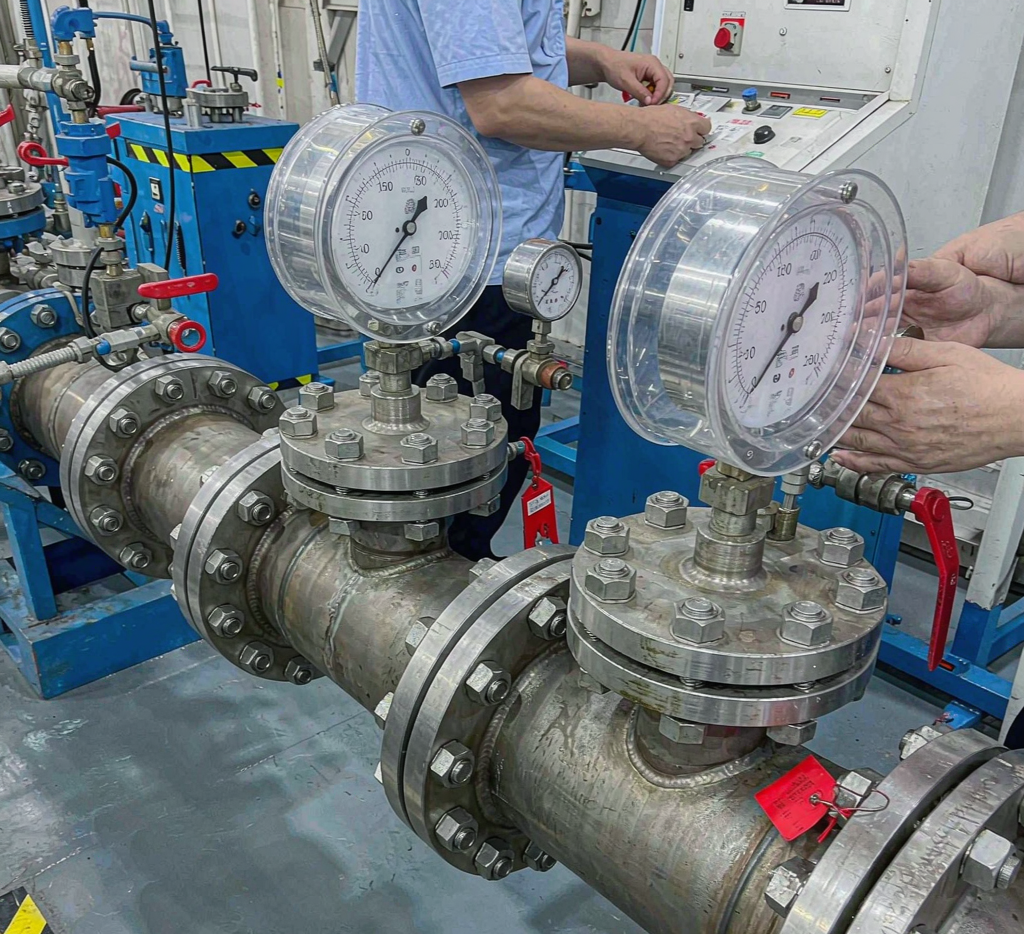
- Hydrostatic test isolation points
Quality Assurance
- EN 10204 3.1 MTC: chemistry, tensile, hardness, and heat treatment record per heat
- UT examination of plate/web on request (for thicker class 600+ units)
- Dimensional report: thickness at 4 points, facing flatness, bolt-hole circle
- PMI (positive material identification) on request
- Surface: machined faces coated with rust preventative; edges deburred
- Optional third-party inspection (SGS/BV) and pressure-rating documentation
Packaging & Shipping
- Individually wrapped faces with plastic covers; crated or palletized
- Protective separators between facing surfaces
- Marked per item: size, class, material, heat number, figure type
- Seaworthy export crates with desiccant for sea freight
Why Buy Spectacle Blinds from Huaxia-Steel?
- Forged A105/A105N units machined in-house — one-piece integrity, no welded web
- Matched to your existing flange drilling (ASME B16.5 or EN 1092-1 PN)
- Blind and spacer thickness certified per class so both states meet the rating
- Mixed-size containers with gaskets and stud bolts bundled for installation
FAQ
1. What is the difference between a spectacle blind and a spade + spacer?
Functionally identical. A spectacle blind is one forged piece (web connects the two discs); a spade and spacer are two separate items held together by the flange bolts. Spectacle blinds are preferred where the pair must not be separated.
2. How do I choose the blind thickness?
ASME B16.48 tabulates minimum blind thickness by size and class. Do not substitute thinner plate — the thickness carries the pressure rating when the blind is in the flow path.
3. Can the unit be used with ring joint (RTJ) flanges?
Yes — RTJ facings with the appropriate ring groove are machined per B16.5 dimensions for both blind and spacer sides.
4. Is A105N different from A105?
Same chemistry; the N indicates normalized heat treatment, improving toughness and often required above 1″ thickness or for low-temperature and critical service.
5. What is the lead time?
Standard sizes class 150–300: 2–4 weeks. Larger or RTJ/LF2 specials: 4–7 weeks depending on forging schedule.
Get a Quote
Send size, class, facing, and material — factory-direct forged carbon steel spectacle blind flanges with EN 10204 3.1 certification, quotation within 24 hours.