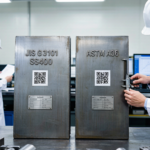
Introduction: What JIS G3101 Defines
JIS G3101 is the Japanese Industrial Standard for rolled steels for general structure — the standard behind the ubiquitous SS400 grade found on drawings across Asia, the Middle East, and Japanese-funded projects worldwide. Unlike European and American structural standards that organize grades by yield strength, JIS G3101 classifies by tensile strength: SS330, SS400, SS490, and SS540 — the number being the minimum tensile strength in MPa.
SS400 remains one of the highest-volume steel grades traded internationally. This guide covers the standard’s grade system, chemical and mechanical requirements, testing rules, equivalents across other standards, and the buying details that trip up export purchasers — from mill certificate formats to the no-suffix impact testing philosophy.

The Grade System: SS330 to SS540
| Grade | Min Tensile (MPa) | Min Yield (≤ 16 mm) | Typical Products |
|---|---|---|---|
| SS330 | 330 – 430 | ≥ 205 MPa | Thin sheet, light sections, furniture tube |
| SS400 | 400 – 510 | ≥ 245 MPa | Plates, sections, bars — the workhorse |
| SS490 | 490 – 610 | ≥ 285 MPa | Heavy sections, higher-strength structural parts |
| SS540 | ≥ 540 | ≥ 400 MPa | Heavy structural members, thick sections |
SS400 is the volume grade — roughly the position A36 holds in the US and S235JR in Europe. When a Japanese standard drawing says “SS400 t=9,” the mill must deliver a plate with tensile between 400 – 510 MPa and yield at least 245 MPa in the thin bands.
Chemical Requirements: Deliberately Loose
| Element | SS400 Limit (%) | Note |
|---|---|---|
| Carbon (C) | Not specified for rolled products ≤ 50 mm* | Controlled indirectly via tensile/CE for weldability |
| Manganese (Mn) | Not individually specified* | — |
| Phosphorus (P) | ≤ 0.050 | Higher than EN/ASTM structural grades |
| Sulfur (S) | ≤ 0.050 | Higher than EN/ASTM structural grades |
* JIS G3101 does not set fixed C/Mn windows for as-rolled general structure steel — mills optimize chemistry to hit the mechanical table. This is the key philosophical difference from EN 10025 and ASTM: JIS G3101 is a mechanical-property standard, not a chemistry standard.
Buyer consequence 1: the P/S limits (0.050%) are looser than S235JR (0.035%) or A36 (0.035% P, 0.035% S on profiles). If your project spec carries EN or ASTM chemistry limits, do not order “SS400 equivalent” — order the EN/ASTM grade itself.
Buyer consequence 2: for welded structures, specify SM400/SM490 (JIS G3106, rolled steel for welded structure) instead — that standard adds carbon equivalence control (CE ≤ 0.36 – 0.46 range depending on thickness) precisely because SS400’s unspecified chemistry makes weldability unguaranteed.
Mechanical Properties in Detail
| Property | SS400 Requirement |
|---|---|
| Tensile strength | 400 – 510 MPa |
| Yield (plate/bar ≤ 16 mm) | ≥ 245 MPa |
| Yield (16 – 40 mm) | ≥ 235 MPa |
| Yield (40 – 100 mm) | ≥ 215 – 225 MPa (by thickness band) |
| Elongation (plates, t ≤ 5 mm) | ≥ 13 – 17% (by thickness) |
| Elongation (plates, t > 5 mm) | ≥ 17 – 21% (by thickness) |
| Bend test | 180° bend, 1.5D mandrel (plates) — no cracks |

Impact Testing: The Quiet Gap vs Western Standards
JIS G3101 does not require Charpy impact testing for SS400 — the grades are intended for general structures where dynamic toughness is not a design criterion. There is no JR/J0/J2-style suffix system.
This is the single most important technical difference from S235JR (27 J at +20°C) and A36 (CVN by supplementary requirement). For projects in seismic zones, cold climates, or with dynamic loading, engineers typically either:
- Require impact testing as a special order (“SS400 with CVN 27 J at 0°C” — most mills can comply, but it must be written before production), or
- Switch the order to SN400A/B (JIS G3136, steel for building structure), which adds impact and through-thickness (Z) requirements, or
- Order the equivalent Western grade with documented impact values.

Equivalents: The Comparison Buyers Actually Need
| Standard | Closest Grade | Key Differences vs SS400 |
|---|---|---|
| ASTM A36 | A36 | Yield 250 MPa basis; CVN optional; P/S ≤ 0.035/0.035 |
| EN 10025-2 | S235JR (S275 closer on strength) | Fixed chemistry, impact tested, tighter P/S |
| GB/T 700 | Q235B | Impact 27 J at +20°C; chemistry specified |
| GB/T 1591 | — | Q235B is the practical substitute; Q345 is a strength class above |
| ISO 630 | S235 / E235 | Impact tested, chemistry specified |
Strength honesty: SS400’s 245 MPa yield sits between S235 (225 – 235 MPa) and S275 (265 – 275 MPa). “SS400 = A36” is the common commercial shorthand and works for most static structures; “SS400 = S235JR” is common but quietly loses yield strength — engineers reconciling European designs should check the calculations, not just the equivalence tables.
Product Forms and Dimensional Standards
- Plates and sheets: JIS G3101 covers the material; dimensions per JIS G3193 (hot-rolled plate/sheet tolerances).
- Sections (H-beams, channels, angles): dimensions per JIS G3192; material SS400 by agreement (many Japanese H-section drawings specify SN490 for welded buildings).
- Bars: flats, rounds, squares — the most common export form for SS400.
- SS400 in pipe: note JIS G3452 (SPP) and G3454 (STPG) are separate pipe standards — “SS400 pipe” is a loose commercial term; always move to the pipe standard for pressure use.
Testing and Certification: What to Demand for Export
- Tensile + bend test per heat/batch — the core G3101 test set; results on the mill certificate.
- Certificate format: Chinese mills routinely supply EN 10204 3.1-format certificates for SS400 shipments; ask explicitly — some small mills default to internal reports without authorized sign-off.
- Chemistry on certificate: even though G3101 doesn’t fix C/Mn, demand full ladle analysis — it is your only weldability evidence.
- Impact testing: only if ordered — write “CVN 27 J at 0°C, per lot” into the PO if your engineer requires it.
- Third-party inspection: SGS/BV/TÜV witnessing tensile and bend tests before shipment is inexpensive insurance for Japanese-spec projects with strict document review.
Where SS400 Shines — and Where It Doesn’t
| Use Case | Verdict |
|---|---|
| Static structures in temperate climates (frames, supports, platforms) | Excellent — cheapest option that meets strength |
| Japanese-standard projects and documentation | Correct default — matches drawing callouts |
| Welded structural frames with fatigue loading | Use SM490 / SN490 instead — guaranteed weldability |
| Cold climate or impact-loaded structures | Insufficient — need impact-tested grade |
| Pressure equipment | Not applicable — use JIS G3103 / ASME materials |
Frequently Asked Questions
1. Is SS400 equivalent to A36?
For most static structural purposes, yes — comparable yield and tensile bands. A36 specifies chemistry (C ≤ 0.25 – 0.29% by product) while SS400 does not, and A36’s elongation rules differ. For export documentation requiring strict equivalence, request mill testing to both standards or use the drawing-specified grade.
2. What does “SS” and “400” mean?
SS = Steel Structure (general structure rolled steel); 400 = minimum tensile strength in MPa. The numbering follows tensile, not yield — unlike Q235/S235/A36 systems.
3. Can SS400 be welded?
Yes, and it welds routinely in practice, but the standard does not guarantee weldability because chemistry is unspecified. For code-governed welded structures, use JIS G3106 SM400/SM490 which adds carbon-equivalent control.
4. Why is there no impact suffix like S235JR?
G3101 is a general-structure standard without Charpy requirements. If your application needs toughness documentation, order impact testing as a special requirement or move to SN400 (G3136) or an EN/ASTM grade.
5. Is Chinese-made SS400 acceptable on Japanese-standard projects?
Routinely yes — Chinese mills produce SS400 to JIS dimensional and mechanical requirements with EN 10204 3.1 certification and can add CVN or chemistry tightening on request. Confirm the project’s inspection protocol (some Japanese clients require specific witness testing) before placing the order.
Conclusion
JIS G3101 SS400 is a mechanical-property workhorse: strong enough, cheap, available in every product form, and accepted across Japanese-standard markets. Its philosophy — properties first, chemistry unspecified, no impact testing — is exactly right for general structures and exactly wrong for welded, cold-climate, or fatigue-critical work. Buyers who know which side of that line their project sits on will never pay for steel they don’t need, or receive steel their design can’t accept.
Huaxia-Steel supplies SS400 plate, sections, and bars to JIS G3101 with EN 10204 3.1 certification, optional CVN testing, and full chemistry reporting. Send us your drawing callouts and project standard for a compliant quotation within 24 hours.