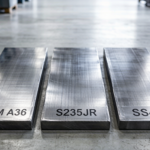
Two specifications dominate the global structural carbon steel plate market: JIS G3101 SS400 from Japan and ASTM A36 from the United States. Both are general-purpose structural plate grades with 400 MPa-class tensile strength, both are ubiquitous in international trade, and both appear interchangeably on mill test certificates from Chinese mills. Yet project engineers often need to know: are they truly equivalent? Which should I specify for cross-border procurement? When does one of them not meet the design intent of the other?
This guide provides a complete cross-reference between JIS G3101 SS400 and ASTM A36: chemistry, mechanical properties, dimensional tolerances, certification, and the engineering decisions that depend on knowing the difference.
Quick Cross-Reference Table
| Attribute | JIS G3101 SS400 | ASTM A36 |
|---|---|---|
| Region of Origin | Japan (JIS) | United States (ASTM) |
| Latest Revision | JIS G3101:2020 (or 2015) | ASTM A36/A36M-19 |
| Product Form | Hot-rolled plate, sheet, strip, flat bar, section | Hot-rolled plate, bar, structural shape |
| Yield Strength (min, ≤16 mm) | 245 MPa | 250 MPa |
| Tensile Strength (range) | 400 – 510 MPa | 400 – 550 MPa |
| Elongation (min, 50 mm gauge) | 17 – 23% (thickness dependent) | 20% (typical) |
| Carbon (max %) | — (no upper limit in standard) | 0.26 (for plate to 19 mm) |
| Manganese (typical) | — (no upper limit in standard) | — (no minimum specified) |
| Sulfur (max) | 0.050 | 0.035 (improved since 2008) |
| Phosphorus (max) | 0.050 | 0.035 |
| Silicon (typical) | — (residual) | ≤0.40 (typical) |
| Copper (min) | 0.20 (when specified, for atmospheric corrosion) | 0.20 (when specified, atmospheric) |
| Thickness Range (typical) | 1.6 – 100 mm plate; 1.0 – 6.0 mm sheet | 5 – 100 mm plate; shapes to indefinite |
| Charpy Impact (default) | Not required by G3101 | Not required by A36 |
| Atmospheric Corrosion Variant | None within G3101 (use SMA400 for that) | None within A36 (use A588 / A242) |
Standard Background
JIS G3101 SS400
JIS G3101 (“Rolled steel for general structure”) is the Japanese Industrial Standard for hot-rolled carbon steel used in general structural applications. SS400 is the most common grade in this family, where “SS” stands for “Steel, Structural” and “400” indicates the minimum tensile strength of 400 MPa. The standard was first published in 1952 and has been updated several times; the current edition is 2015 / 2020. It covers plate, sheet, strip, flat bar, and some sections.
The SS-grade family includes SS330 (235 MPa min yield), SS400 (245 MPa min yield), SS490 (285 MPa min yield), and SS540 (400 MPa min yield). SS400 is by far the most widely specified for general building frames, brackets, base plates, and non-critical structural applications.
ASTM A36
ASTM A36/A36M (“Standard Specification for Carbon Structural Steel”) is the US standard for hot-rolled carbon steel used in bolted, riveted, or welded building structures. First published in 1960, A36 has been the workhorse structural grade for bridges, buildings, transmission towers, and equipment frames throughout the Americas and increasingly in international projects. The latest version is ASTM A36/A36M-19.
A36 covers plate, bar, and structural shapes (W, S, HP, C, MC, L, T shapes) up to a maximum thickness of 200 mm (8 in.).
Chemistry Comparison
| Element | SS400 (per JIS G3101) | A36 (per ASTM A36/A36M) |
|---|---|---|
| Carbon (max %) | — (no explicit limit) | 0.26 for plate ≤19 mm; 0.25 for 19-40 mm; 0.26 for 40-65 mm; 0.27 for 65-100 mm |
| Manganese | — (no explicit limit) | — (no minimum or maximum; 0.80 – 1.20 typical) |
| Phosphorus (max) | 0.050 | 0.035 |
| Sulfur (max) | 0.050 | 0.035 |
| Silicon | — (residual) | ≤0.40 typical, but not limited in the standard |
| Copper (when specified) | ≥0.20 | ≥0.20 when “Cu” suffix is ordered |
| CEV (typical) | ~0.30 – 0.40 | ~0.30 – 0.40 |
The most important practical difference: ASTM A36 has explicit limits on sulfur and phosphorus (each ≤0.035%), whereas JIS G3101 allows up to 0.050% each. This means A36 typically has better notch toughness and better weldability than SS400 produced by less stringent processes, although top-tier Japanese SS400 also achieves low S and P through steelmaking control.
Carbon also differs: JIS G3101 imposes no maximum carbon limit on SS400 (within reason), while ASTM A36 imposes a sliding maximum based on thickness. For procurement, this means A36 is more predictable in formability and weldability, while SS400 chemistry can vary more widely between mills.
Mechanical Properties
| Property | SS400 | A36 |
|---|---|---|
| Yield Strength (≤16 mm) | ≥245 MPa | ≥250 MPa |
| Yield Strength (16 – 40 mm) | ≥235 MPa | ≥250 MPa |
| Yield Strength (>40 mm) | ≥215 MPa (40 – 100 mm) | ≥220 MPa (40 – 100 mm) |
| Tensile Strength | 400 – 510 MPa | 400 – 550 MPa |
| Elongation (50 mm gauge, ≥1.6 mm) | ≥17% (3 mm thickness); ≥21% (≥6 mm) | ≥20% (typical) |
| Bend Test (180°, mandrel diameter) | 1.5 × thickness for ≤25 mm | 1.5 × thickness (typical) |
In practice, SS400 typically delivers 245 – 280 MPa yield and 410 – 510 MPa tensile, while A36 typically delivers 250 – 290 MPa yield and 410 – 550 MPa tensile. The differences are small and well within the same engineering design envelope.
Dimensional Tolerances and Form Availability
| Form | SS400 (per G3101) | A36 (per A36 / A6 / A568) |
|---|---|---|
| Plate Thickness Tolerance | JIS G3193 (rolled plate) | ASTM A6 for plate; tighter for strip / sheet |
| Plate Thickness Range | 1.6 – 100 mm | 5 – 200 mm |
| Sheet / Strip | Yes (1.0 – 6.0 mm typically) | Rare (A36 is plate-dominant); cold-rolled sheet usually 1008/1011 |
| Structural Sections | JIS G3192 (H-beams, I-beams, channels, angles) | ASTM A36 also covers W, S, C, L, T shapes per ASTM A6 |
| Bar Stock | Flat bar per JIS G3194 | Bar per ASTM A36 / A6 |
| Length Tolerance | ±0 / +50 mm (cut-to-length) | ±0 / +50 mm typical (mill practice) |
For thin sheet and strip, SS400 is far more commonly specified internationally than A36, because A36 is fundamentally a plate / heavy-bar standard in North American practice. If you order cold-rolled sheet for stamping, JIS G3101 SS400 or JIS G3131 SPHC / SPCC are the typical Japanese references.
Welding Behavior
Both SS400 and A36 are readily weldable by all standard arc-welding processes (SMAW, GMAW, GTAW, FCAW). With both, preheating is rarely needed for thin sections, and low-hydrogen electrodes (E7018, ER70S-6) are appropriate.
| Welding Aspect | SS400 | A36 |
|---|---|---|
| Carbon Range | No upper limit (typically 0.16 – 0.25%) | ≤0.26 – 0.27% |
| CEV (typical) | ~0.30 – 0.40 | ~0.30 – 0.40 |
| Preheat (typical, ≤25 mm) | Not required | Not required |
| Preheat (thick, ≥50 mm) | 100 – 150 °C recommended | 100 – 150 °C recommended |
| Welding Electrode (stick) | E7018 / E6013 | E7018 / E6013 |
| Welding Wire (GMAW) | ER70S-6 / ER70S-3 | ER70S-6 / ER70S-3 |
| Post-Weld Heat Treatment | 595 – 650 °C if specified (rarely) | 595 – 650 °C if specified (rarely) |
Cross-Naming in Mill Test Certificates
Many Chinese, Korean, and Turkish mills can dual-certify plate as SS400 / A36 or supply either grade interchangeably for the same heat. Typical dual-certified plate from these mills has a chemistry that simultaneously satisfies:
- C ≤0.25%, Mn 0.80 – 1.20%, P ≤0.035%, S ≤0.035% (A36 envelope)
- Yield ≥245 MPa, Tensile 400 – 510 MPa, Elongation ≥21% (SS400 envelope)
When purchasing, ask the mill whether the MTC will state “SS400 / A36 dual cert” with both standards listed. This is increasingly the international default for general structural plate from Asian mills.
Atmospheric Corrosion Variants
Neither base SS400 nor base A36 includes atmospheric corrosion resistance. For unpainted outdoor structural applications, the appropriate choices are:
- Equivalent to SS400 with weathering: JIS G3114 SMA400AW / SMA400BW / SMA400CW
- Equivalent to A36 with weathering: ASTM A242 / A588 (Kupferstein / Corten-type)
- GB/T (China) equivalent: GB/T 4171 Q355NH
All of these add Cu (≥0.20%), often Ni, Cr, or P, and form a stable oxide layer that protects against further atmospheric corrosion.
Procurement Considerations
When to Specify SS400
- The project is in Asia-Pacific (Japan, Southeast Asia, Korea, China) where SS400 is the domestic reference.
- Thin sheet / strip is needed (cold forming applications).
- Cost optimization is paramount — SS400 is widely stocked and often slightly cheaper than A36 in Asian markets.
When to Specify A36
- The project is in North America or follows US standards (AISC, AISI, AWS D1.1).
- The structural shapes (W, C, L) need to match AISC steel manual profiles.
- Engineering drawings or specifications explicitly reference ASTM A36.
- Weld procedure specifications (WPS) are pre-qualified to A36.
When to Specify Both (Dual Certification)
- The plate is being sold internationally or to a buyer who may resell to different markets.
- Cross-border supply chain — production in one country, fabrication in another.
- Stocking decision — SS400/A36 dual cert is the most versatile inventory material for general structural use.
Dual-Certification: SS400 / A36 in International Trade
In the export market, plate is increasingly dual-certified to meet the requirements of both the producer’s domestic standard and the buyer’s reference standard. For Chinese, Korean, and Turkish mills exporting to multiple regions, dual certification to JIS + ASTM (and often also EN) is standard. The chemistry envelope that satisfies all three reference standards simultaneously is:
- C: 0.16 – 0.22%
- Mn: 0.80 – 1.20%
- P: ≤0.035%
- S: ≤0.035%
- Si: 0.15 – 0.35%
- Yield: ≥245 MPa
- Tensile: 400 – 510 MPa
- Elongation: ≥21%
This common envelope (sometimes called “JIS-ASTM common plate”) is the default in many Chinese mills producing for export. MTCs list all referenced standards, with the actual heat chemistry and mechanical results stated once.
Mechanical Property Trends with Thickness
Both SS400 and A36 show a clear decrease in yield and tensile strength as plate thickness increases, due to reduced rolling compression per unit volume:
| Thickness (mm) | SS400 Yield (MPa, min) | A36 Yield (MPa, min) | SS400 Tensile (MPa) | A36 Tensile (MPa) |
|---|---|---|---|---|
| ≤16 | 245 | 250 | 400 – 510 | 400 – 550 |
| 16 – 40 | 235 | 250 | 400 – 510 | 400 – 550 |
| 40 – 65 | 215 | 240 | 400 – 510 | 400 – 550 |
| 65 – 100 | 205 | 220 | 400 – 510 | 400 – 550 |
| 100 – 150 | — (not specified) | 210 | — | 400 – 550 |
For thick plate applications, the engineer must consider the reduced yield at higher thickness. Structural design typically calculates a design stress that accounts for the strength at the actual plate thickness.
Form and Section Availability
Both SS400 and A36 extend beyond plate into other structural shapes, with different naming conventions but similar (sometimes identical) chemistry:
| Form | JIS Reference | ASTM Reference | Strength Class |
|---|---|---|---|
| H-Beam (Wide Flange) | JIS G3192 (H-section, e.g., 100×100, 200×200) | ASTM A36 (W-shapes per A6) | A36 → SS400 equivalent |
| I-Beam | JIS G3192 (I-section) | ASTM A36 (S-shapes per A6) | A36 → SS400 equivalent |
| Channel | JIS G3192 (C-section) | ASTM A36 (C-shapes per A6) | A36 → SS400 equivalent |
| Angle (L) | JIS G3192 (L-section) | ASTM A36 (L-shapes per A6) | A36 → SS400 equivalent |
| Flat bar | JIS G3194 (mill flat bar) | ASTM A36 (per A6) | A36 → SS400 equivalent |
| Plate | JIS G3193 (plate) | ASTM A36 (plate per A6) | A36 → SS400 equivalent |
A structural engineer specifying A36 W-shapes in a US design code (AISC 360) should verify that the W-shape’s profile and dimensional tolerances match AISC, not JIS G3192. The chemistry may be dual-certified, but the profile and bolt-hole standards differ.
Examples: Same Mill Produces Both Grades
To illustrate the practical interchangeability, here is a worked example for a 10 mm × 1,500 mm × 6,000 mm plate from a Chinese dual-certified mill:
| Attribute | Value |
|---|---|
| Heat Number | SS-A36-DUAL-26XX2 |
| Standard (dual-listed on MTC) | JIS G3101 SS400 / ASTM A36 / EN 10025 S275JR |
| Carbon (max %) | 0.20 |
| Manganese | 0.85 |
| Phosphorus (max) | 0.030 |
| Sulfur (max) | 0.030 |
| Yield Strength (MPa) | 265 (typical) |
| Tensile Strength (MPa) | 440 |
| Elongation (%) | 26 |
| Charpy @ 0°C (optional) | 27J |
This single plate meets all three standards’ chemistry and mechanical requirements, and the MTC clearly states dual or triple certification. Most Asian mills exporting to multiple regions now ship this kind of cross-certified plate as standard.
Considerations for Re-Drawing Legacy Designs
Some older engineering drawings specify materials that have since been superseded. Two common patterns:
- SS400 specified in 1970s Japanese design → still valid today; standard was updated but the chemistry and strength envelope remain.
- A36 specified in 1970s US design → current A36 envelope is similar (one of the few grades that has retained essentially the same composition over decades).
- S275JR specified in early EN 10025 days → cross-list with SS400 and A36 for global sourcing.
If a drawing has been legacy for decades, verify the actual grade specified against the latest version of the standard. Some properties tightened over revisions (e.g., A36’s S content dropped from ≤0.05 to ≤0.035 in 2008). For long-life projects (bridges, infrastructure), the legacy version must be matched exactly, or the equivalent grade by updated standard must be reviewed with the engineer of record.
FAQ
Are SS400 and A36 plate sizes the same?
For hot-rolled plate, the available size ranges overlap substantially: 5 – 100 mm thickness, 1,500 – 3,500 mm width, 3,000 – 18,000 mm length. However, A36 plate in North American practice often comes in imperial dimensions (4′, 5′, 6′, 8′ widths, 10′, 20′, 40′ lengths), while SS400 plate from Japanese mills comes in metric dimensions (1,524 mm × 3,048 mm / 4,572 mm / 6,096 mm, or 1,219 mm in some mills). If you need imperial dimensions, verify with the mill before ordering; otherwise specify metric and accept a small conversion factor.
Can I weld SS400 to A36 with the same procedure?
Yes — since the chemistry and mechanical envelope are essentially identical, a weld procedure qualified to one will work for the other. The joint is a “similar-metal weld” with matching filler metal (E7018 / ER70S-6). Charpy impact tests at the HAZ, if required by your WPS, should be acceptable across both grades. Document the substitution in the welding procedure specification record (WPSR) if you swap mid-project.
Is SS400 suitable for pressure vessel service?
No. Neither SS400 nor A36 is approved by ASME Section VIII Div. 1 for pressure vessels. Their impact toughness and traceability are not guaranteed at the level required. For pressure vessels, use SA-285 Grade C, SA-516 Grade 70, or higher grade plates. SS400 / A36 are designed for atmospheric, non-pressure structural service.
What about JIS G3131 SPHC / SPCC for sheet?
JIS G3131 covers hot-rolled and cold-rolled sheet for general forming: SPHC (hot-rolled commercial), SPHD (hot-rolled deep draw), SPHE (hot-rolled extra-deep draw), and SPCC / SPCD / SPCE (cold-rolled versions of similar drawing grades). These are used for stamping, bending, and deep drawing, not for structural applications. If you need a thin sheet for a structure, use SS400 to G3101; if you need a forming sheet, use SPHC / SPCC.
How does A36 compare with EN 10025 S275JR?
Very close — S275JR has 275 MPa minimum yield and EN 10025-2 chemistry roughly equivalent to A36 / SS400. S275JR also adds a guaranteed 27J Charpy impact at +20 °C, which neither A36 nor SS400 requires. In European projects, S275JR is the standard reference, and most European mills can dual-cert S275JR / SS400 / A36 plate.
Get a Quote
Need SS400, A36, or SS400/A36 dual-certified structural plate? Huaxia-Steel supplies both grades (and dual-cert) in plate from 5 – 100 mm thickness, sheet from 1.0 – 6.0 mm, and structural sections per JIS / ASTM. EN 10204 3.1 mill certificate, third-party inspection on request, global shipping. Send your specification (standard, thickness, width, length, quantity, delivery port) to [email protected] for a mill-direct quotation.