Q235 vs A36 Steel: Chemistry, Strength, Buying Notes
Q235 and A36 are the two structural carbon steels that appear on more purchase enquiries than any other pair, and the question is always the same: can I use one where the drawing says the other? Q235 is the Chinese GB/T 700 general structural steel; A36 is the American ASTM A36 / ASME SA-36 structural steel. Both are mild, weldable, cheap and available in plate, bar, angle, channel and beam. Both deliver a 235–250 MPa yield range. On a warehouse floor in Shanghai or a fabrication shop in Texas they look identical, cut the same, and weld with the same electrodes. But the two standards control different things, and the differences decide whether a substitution is a paperwork formality or a rejected shipment. This guide compares Q235 vs A36 on chemistry, mechanical properties, impact rules, welding, price and MTC content, with the substitution traps that catch buyers most often.
Quick Answer: Is Q235 the Same as A36?
No, they are not the same steel, but they are close enough that cross-substitution is routine in non-critical structures — and risky in anything that carries a design code, a pressure rating or a third-party inspection regime. Q235 controls chemistry tightly by grade (A, B, C, D) and ties each grade to a charpy impact test temperature, but it does not control tensile strength as an acceptance criterion. A36 controls tensile strength and yield strength as the acceptance criteria, but leaves chemistry loose, with only a maximum carbon and manganese limit. In other words, Q235 is a composition-first standard and A36 is a property-first standard. That single structural difference explains almost every practical conflict between them.
The table below gives the headline numbers so you can see the overlap immediately; the sections after it unpack where the two diverge.
Property
Q235 (GB/T 700-2006)
A36 (ASTM A36/A36M)
Yield strength, min
235 MPa (≤16 mm)
250 MPa
Tensile strength
370–500 MPa
400–550 MPa
Elongation, min
21–26 % (by grade/thickness)
20 % (200 mm gauge), 23 % (50 mm)
Carbon, max
0.22 % (A/B), 0.20 % (C), 0.18 % (D)
0.26 % (≤ 20 mm plate), 0.25 % (shapes)
Manganese
0.30–0.65 % (A/B)
No minimum; 0.80–1.20 % if carbon exceeds 0.26 % by agreement
Impact test
Required for C (+20 °C) and D (0 °C) grades only
Not required by default
Silicon
≤ 0.35 %
0.40 % max (0.15–0.40 % if fully killed)
Delivery condition
Hot rolled, normalized on request
As-rolled; normalizing not required
1. What Q235 Actually Specifies
GB/T 700 divides Q235 into four quality grades — Q235A, Q235B, Q235C and Q235D — where the letter marks the impact toughness regime. Grade A carries no impact requirement at all. Grade B requires a +20 °C charpy test on 27 J minimum. Grade C requires 0 °C, and grade D requires −20 °C. The full chemistry table also tightens as you climb: carbon drops from 0.22 % at A/B to 0.20 % at C and 0.18 % at D, and sulphur and phosphorus limits fall from 0.050 % to 0.035 % and then to 0.030 %. That progression is the whole point of the standard — Q235A is a cheap general-purpose steel, and Q235D is a genuinely tough low-temperature structural steel that has very little in common with A36 in metallurgical terms.
Two details trip up first-time buyers. First, the yield strength requirement of 235 MPa applies to thicknesses from 16 mm down; above 16 mm the required minimum steps down to 225 MPa and then to 215 MPa at 40 mm and beyond. Second, Q235 is a “steel grade designation” that can be delivered as plate, bar, shape, strip or seamless tube under the same grade name, so the MTC must state the product form and the corresponding dimensional standard — GB/T 3274 for plate, GB/T 706 for shapes, GB/T 702 for bar, for example. An MTC quoting only “Q235B” without a product standard is incomplete and often rejected by a careful buyer.
2. What A36 Actually Specifies
ASTM A36 works from the opposite direction. It sets minimum yield at 250 MPa, tensile at 400–550 MPa, and elongation at 20 % or 23 % depending on the gauge length used, and then asks only that carbon stay at or below 0.26 % (0.25 % for shapes) and manganese at or below 1.20 %. There is no mandatory impact test, no chemistry window for alloying elements beyond residual limits agreed at order, and no grade ladder. A heat of A36 can be produced from a very wide range of chemistries and still be fully compliant, which is exactly why A36 is cheap and widely stocked — and also why its weldability and toughness vary more from heat to heat than Q235B does.
The American standard does add one useful clause: where A36 is used in primary tension members of bridges or buildings under certain design codes, the steel must be made to a fine-grain practice and reported as such. Buyers who need that clause must state it on the purchase order, because the base A36 designation does not carry it. Similarly, ASME SA-36 — the boiler and pressure vessel variant — adds a silicon reporting requirement and a tension test frequency that the plain ASTM version does not, and vessel fabricators who buy “A36” without the SA prefix often find the MTC is not accepted by their AI.
3. Chemistry Compared Line by Line
The chemistry table is where the substitution risk becomes visible. A36’s carbon ceiling of 0.26 % sits above every Q235 grade, so any Q235 heat will pass the A36 carbon limit — but the reverse is not true. An A36 heat with 0.24 % carbon cannot be sold as Q235B, whose limit is 0.22 %, and it certainly cannot be sold as Q235D. Manganese is the second divergence: Q235A/B requires a manganese range of 0.30–0.65 %, a narrow window that some A36 heats miss on the high side, since A36 permits up to 1.20 %.
Element (%)
Q235A
Q235B
Q235C
Q235D
A36
C max
0.22
0.20
0.20
0.18
0.26
Mn
0.30–0.65
0.30–0.65
0.30–0.70
0.30–0.70
≤ 1.20
Si max
0.35
0.35
0.35
0.35
0.40
P max
0.045
0.045
0.040
0.035
0.04
S max
0.050
0.050
0.040
0.035
0.05
Impact
none
+20 °C / 27 J
0 °C / 27 J
−20 °C / 27 J
none
A practical reading of this table: Q235B is roughly “A36 with a guaranteed +20 °C impact test and a tighter carbon ceiling”; Q235D is a different animal and should never be treated as interchangeable with A36 in cold-climate structures. When a European or American engineer writes A36 on a drawing and the mill ships Q235B, the steel is usually stronger in toughness terms than required, which is a safe direction. When the reverse happens — A36 supplied against a Q235C or Q235D requirement — the shipment is technically non-conforming even if the tensile test passes.
4. Mechanical Properties and What They Mean in Design
A36’s 250 MPa minimum yield is 15 MPa higher than Q235’s 235 MPa, and its tensile floor is 30 MPa higher. Those small gaps matter to designers because the two codes use different safety factors and different load combinations; a member sized to Q235 at 235 MPa will normally be conservative if rebuilt in A36, but a member sized to A36 is not automatically acceptable when re-detailed in Q235, particularly at thicknesses above 16 mm where the Q235 yield requirement relaxes. Fabricators who routinely swap the two should verify the thickness-dependent yield table rather than the headline number.
Thickness
Q235 min yield
A36 min yield
Comment
≤ 16 mm
235 MPa
250 MPa
Design-critical range
16–40 mm
225 MPa
250 MPa
Q235 loses 10 MPa
40–60 mm
215 MPa
250 MPa
Gap now 35 MPa
60–100 mm
215 MPa
250 MPa
Heavy plate, check UT
Elongation tells a similar story. Q235A in thicknesses under 16 mm requires 26 % minimum elongation on a 50 mm gauge; A36 requires 23 % on the same gauge. Q235 is therefore a slightly more ductile steel at the low end and a slightly weaker one at the high end. Neither difference is large enough to change a general fabrication decision, but both are large enough to matter in a seismic or fatigue-sensitive design review.
5. Five Substitution Traps Buyers Hit
Treating Q235A as equivalent to A36 in cold weather. Q235A has no impact requirement and can be brittle at 0 °C. If the structure sees sub-zero service, specify Q235C or Q235D, or insist on A36 with a supplementary charpy test.
Ignoring the manganese window. Q235A/B requires 0.30–0.65 % Mn; a high-manganese A36 heat at 1.05 % Mn fails Q235 chemistry even though it is a better steel. Mills will not re-certify it.
Accepting an incomplete MTC. A Q235 MTC without the applicable product standard (GB/T 3274, GB/T 706, GB/T 702) is not traceable to a dimensional specification, and third-party inspectors reject it more often than buyers expect.
Using A36 where SA-36 was specified. Pressure vessel work needs the ASME designation, silicon reporting and the correct tension test frequency. The chemistry is the same; the paperwork is not.
Assuming thickness-independent yield. Both standards reduce or hold yield differently as plate thickens; a 50 mm substitution is not the same decision as a 10 mm one.
6. Equivalence Tables and How Much to Trust Them
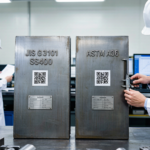
Cross-reference tables in mill catalogs and steel databases list Q235 ≈ A36 ≈ SS400 ≈ S235JR ≈ ST37-2. All five are “235-class mild steels” and all five will generally weld to each other without trouble. But every one of them controls a different property: SS400 (JIS G3101) sets no impact requirement and a 400–510 MPa tensile range; S235JR (EN 10025-2) requires a +20 °C impact test at 27 J and caps carbon at 0.17 % for the JR grade; ST37-2 is the withdrawn DIN designation. Treat equivalence tables as a starting point for a conversation, never as a release document. If a substitution needs to be defensible, ask the mill for a dual-certified MTC — many Chinese mills will dual-certify Q235B to S235JR or A36 at the melting stage, which converts a judgement call into a documented fact.
7. Welding, Cutting and Forming Notes
Both steels weld with rutile or basic electrodes in the E43xx class, no preheat below 25 mm in normal shop conditions, and both machine and flame-cut predictably. The practical differences are small but worth stating. A36 heats with carbon near the 0.26 % limit and manganese near 1.20 % have a carbon equivalent around 0.40, which is still weldable without preheat at moderate thickness but needs a 100 °C preheat once section thickness passes roughly 38 mm or when ambient temperature drops below 5 °C. Q235B, with carbon at or below 0.20 % and manganese capped at 0.65 %, lands nearer CE 0.32 and is more forgiving. Q235D, with 0.18 % carbon and low sulphur, is the easiest of the group to weld crack-free in thick sections and cold weather.
On forming, A36’s higher manganese content gives slightly better through-thickness ductility in tight bends, while Q235’s lower strength means marginally less springback. Neither difference justifies changing a bend radius. What does justify attention is surface condition: Q235 plate is commonly supplied hot rolled with mill scale and is often pickled and oiled for downstream coating, while A36 plate frequently arrives as-rolled with heavier scale. If the parts are to be painted or galvanized, specify the surface condition explicitly rather than assuming it.
8. Price, Availability and Lead Time Logic
In China, Q235B is the default structural steel and prices at or slightly below the domestic rebar and plate benchmark; it is available ex-stock in every thickness from 1.5 mm to 200 mm and in every shape. A36 is produced mostly for export orders and typically carries a small premium — usually in the range of 10–30 USD per tonne over Q235B — because it requires separate heat identification, a different MTC template and often a third-party inspection. A36 in shapes (angles, channels, wide-flange beams) is less consistently stocked than Q235 in the same forms, so lead times for A36 shapes can run two to three weeks longer than the Q235 equivalent.
For buyers in North America, the logic inverts: A36 is the commodity grade, Q235 is the import specialty and may attract anti-dumping scrutiny depending on origin and product form. Either way, the cheapest compliant answer is usually to buy the grade the local design code names, and to reserve cross-substitution for non-structural work such as pallets, guards, frames and temporary steel.
9. Plate Tolerances and Arrival Inspection
Tolerance is the silent cost driver in both grades. GB/T 709 defines thickness tolerance classes N, A, B and C for Q235 plate, and the difference between class N and class C at 12 mm nominal is roughly a factor of two in the permitted minus tolerance — which translates directly into kilos of steel you are paying for and not receiving. ASTM A6/A6M applies a single set of thickness tolerances to A36 plate, but permits a “restricted” tolerance by agreement, and many mills ship to the unrestricted table by default. If your parts are weight-critical, state the tolerance class in the purchase order; if they are not, take the default and accept that a 10 mm plate may arrive at 9.3 mm.
On arrival, inspect four things before signing the receiving report. Measure thickness at five points per plate rather than one, because crown and wedge are common on wide plate. Check width and length against the ordered dimensions, since some mills ship “mill edge” plate with 20–30 mm of unusable edge. Look for laminations and edge cracks on flame-cut faces — a light tap test and a visual scan of every cut edge catches most of them. Finally, match heat numbers on the plate stamps to the MTC before the material is issued to production; once plates are cut, traceability is gone and a documentation gap becomes a credibility problem with your own customer.
10. Ordering Checklist and MTC Items
Item to state on the PO
Q235 example
A36 example
Grade and standard year
Q235B, GB/T 700-2006
A36, ASTM A36/A36M-19
Product standard
GB/T 3274 (plate) / GB/T 706 (shapes)
A6/A6M (general requirements)
Dimensions and tolerances
Thickness tolerance class N or A
Thickness tolerance per A6/A6M
Impact requirement
+20 °C / 27 J (grade B)
Supplementary charpy if needed
Surface / delivery condition
Hot rolled, pickled and oiled optional
As-rolled, blast cleaned optional
MTC language and format
EN 10204 3.1, English
EN 10204 3.1 or mill cert
Inspection
Third-party witness, UT on plate > 40 mm
Same, plus heat traceability
11. FAQ
Can Q235B replace A36 without engineering approval? In non-structural fabrications and general workshop steel, yes. In anything governed by a design code, no — the substitution must be approved in writing because the yield and tensile floors differ and the impact regime changes.
Is Q235 stronger than A36? No. Q235’s minimum yield of 235 MPa is lower than A36’s 250 MPa, and its tensile range of 370–500 MPa sits below A36’s 400–550 MPa. Actual mill values often overlap, but the guaranteed floors do not.
Which one is better for galvanizing? Both galvanize well. Q235D with its lower carbon and silicon is slightly easier to get a uniform zinc coating on, and if the part has a thick section, low-silicon steel avoids the grey, over-thick coating that reactive steels produce.
Can I get one MTC that covers both? Ask for a dual-certified MTC. Many mills will certify a single heat to Q235B and A36 simultaneously provided the chemistry satisfies both windows — carbon under 0.20 %, manganese between 0.30 and 0.65 % and impact tested at +20 °C.
What about Q235 vs SS400? SS400 is the Japanese equivalent with a wider tensile band (400–510 MPa) and no impact requirement in the base grade, and it is arguably closer to A36 in philosophy than Q235 is. If your buyer accepts SS400, it is usually the cheapest 400-class option in Asia.
Source Q235 and A36 With Documented Traceability
Huaxia-Steel supplies Q235A/B/C/D plate, bar, angle, channel and beam alongside ASTM A36 and dual-certified Q235B/A36 stock, with EN 10204 3.1 mill certificates, third-party inspection support and pre-shipment dimensional checks. Tell us the grade, thickness, quantity and the code your project is designed to, and we will quote the cheapest compliant route — including a dual-certification option where the substitution needs to hold up in an audit. Send your specification to our export team and receive a technical proposal with tolerances, MTC format and loading plan within one working day.
If you require further information about our metal sheet products or architectural projects, please don’t hesitate to leave your contact details and message here.
Our team of experts will respond within 24 hours to continue the discussion and provide you with any additional information you requires.