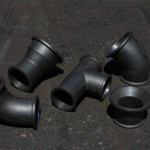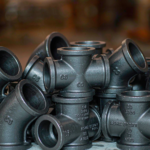

Carbon steel pipe fittings are essential components in industrial piping systems, connecting, redirecting, and controlling flow in oil and gas, chemical processing, power generation, and construction applications. For buyers sourcing carbon steel pipe fittings from China, understanding fitting types, manufacturing standards, and quality requirements is critical to ensuring system integrity and compliance.
This comprehensive guide covers the 8 main fitting types, key standards, material grades, manufacturing processes, and practical sourcing tips.
Types of Carbon Steel Pipe Fittings: 8 Main Categories
| Fitting Type | Function | Common Angles/Sizes |
|---|---|---|
| Elbow | Changes flow direction | 45°, 90°, 180° (SR/LR) |
| Tee | Splits or combines flow | Equal, Reducing |
| Reducer | Connects different pipe sizes | Concentric, Eccentric |
| Cap | Closes pipe end | Threaded, Welded |
| Cross | 4-way junction | Equal, Reducing |
| Bend | Long-radius direction change | 1.5D, 3D, 5D, 10D |
| Stub End | For lap joint flange | Short, Long pattern |
| Nipple | Short connector | Hex, Barrel, Swage |
Elbow Details
Elbows are the most common fitting. They come in two radius types:
- Short Radius (SR): Center-to-end = 1× NPS. Used where space is limited.
- Long Radius (LR): Center-to-end = 1.5× NPS. Lower pressure drop, standard choice.

Manufacturing Standards: ASME B16.9, B16.11 & More
Carbon steel pipe fittings are governed by several international standards. The most important ones for buyers:
| Standard | Scope | Size Range |
|---|---|---|
| ASME B16.9 | Butt-weld fittings | NPS 1/2 – 48 |
| ASME B16.11 | Socket-weld & threaded | NPS 1/8 – 4 |
| MSS SP-43 | Lightweight butt-weld ( stainless) | NPS 1/2 – 12 |
| MSS SP-79 | Butt-weld reducer inserts | NPS 3/4 – 6 |
| EN 10253 | Butt-weld (European) | DN 6 – 1200 |
| GB/T 12459 | Butt-weld (Chinese) | DN 15 – 1200 |
For most international projects, ASME B16.9 is the default specification for butt-weld fittings. Chinese mills produce to both GB/T 12459 and ASME B16.9, often dual-certifying for export.
Material Grades for Carbon Steel Pipe Fittings
The most common material specification for carbon steel butt-weld fittings is ASTM A234, with grades:
| Grade | Yield (MPa) | Tensile (MPa) | Application |
|---|---|---|---|
| WPB | 240 | 415–585 | General purpose, most common |
| WPL6 | 240 | 415–585 | Low-temperature (-46°C) |
| WPHY 42/52/60/65/70 | 290–485 | 415–585 | High-strength pipeline |
| WP1 | 205 | 380–550 | Carbon-molybdenum alloy |
ASTM A234 WPB accounts for over 80% of carbon steel fitting production. It is compatible with A106 Grade B pipe—the most common seamless carbon steel pipe grade.
Manufacturing Processes: Seamless vs Welded

Carbon steel pipe fittings are manufactured by two main methods:
1. Seamless (Hot Forming):
- Seamless pipe or bar is heated and pushed/hydraulically formed into the fitting shape
- Processes: extrusion, pressing, forging
- Advantages: No weld seam, higher pressure rating, better for critical service
- Typical size range: NPS 1/2 – 24
2. Welded (Plate Forming):
- Steel plate is cut, rolled, and welded into fitting shape
- Weld seams are 100% radiographed for critical applications
- Advantages: Lower cost, available in larger sizes (NPS 24–48+)
- Typical size range: NPS 12 – 80
Dimensions & Pressure Ratings
Butt-weld fittings are dimensioned per ASME B16.9, with wall thickness designated by “schedule”:
| Schedule | NPS 4 Wall (mm) | NPS 8 Wall (mm) | Pressure Rating (bar) |
|---|---|---|---|
| SCH 20 | 3.96 | 6.35 | ~60 |
| SCH 40 (STD) | 6.02 | 7.04 | ~100 |
| SCH 80 (XS) | 7.93 | 12.70 | ~180 |
| SCH 160 | 11.13 | 18.26 | ~280 |
| XXS | 17.12 | 22.23 | ~350+ |
Quality Testing & Inspection
Quality assurance for carbon steel pipe fittings should include:
- Dimensional inspection: Verify OD, ID, wall thickness, center-to-face dimensions per ASME B16.9 tolerances (±1.5 mm)
- Visual inspection: Check for surface defects, cracks, laps, undercuts
- Non-destructive testing: Magnetic particle inspection (MT) for surface defects; ultrasonic testing (UT) for internal flaws
- Hardness testing: HBW ≤ 197 for WPB grade
- Hydrostatic testing: Test pressure = 1.5× design pressure, held for minimum 10 seconds
- Mill test certificate: EN 10204 3.1 MTC with chemistry, mechanical properties, and heat number traceability
Sourcing Pipe Fittings from China
- Specify the standard: Clearly state ASME B16.9, GB/T 12459, or EN 10253 on your purchase order.
- Request MTC: Always require EN 10204 3.1 (or 3.2 for critical service) with actual heat analysis.
- Verify bevel ends: Butt-weld fittings should have bevel ends per ASME B16.25 (37.5° ± 2.5°).
- Check coating: For corrosive environments, specify anti-corrosion coating (FBE, epoxy, or black painting).
- Consider third-party inspection: SGS, BV, or TÜV inspection for high-value or critical-service orders.
- Confirm packaging: Fittings should be palletized or crated with end caps protecting bevels, especially for sea freight.
FAQ: Carbon Steel Pipe Fittings
What is the difference between butt-weld and socket-weld fittings?
Butt-weld fittings are welded directly to the pipe bevel end, creating a smooth bore. Socket-weld fittings have a socket that the pipe slips into before welding. Butt-weld is preferred for larger sizes (NPS 2+) and higher pressures; socket-weld for small sizes (NPS 2 and below).
What is ASTM A234 WPB?
WPB is the most common grade of carbon steel butt-weld fitting, equivalent in chemistry and properties to A106 Grade B pipe. “WP” means wrought pipe fitting, “B” indicates the grade.
What is the difference between concentric and eccentric reducers?
Concentric reducers are symmetrical (cone-shaped), used for vertical pipes. Eccentric reducers have one flat side, used in horizontal piping to prevent air accumulation (flat-on-top) or liquid drainage (flat-on-bottom).
How are pipe fittings pressure-rated?
Fittings are rated by schedule (wall thickness) and material grade. The pressure rating depends on the fitting’s wall thickness, material yield strength, and temperature. ASME B16.9 fittings match the pressure rating of the same-schedule pipe.
Source Quality Carbon Steel Pipe Fittings
Huaxia-Steel supplies a full range of carbon steel pipe fittings—elbows, tees, reducers, caps, and more—to ASME, EN, and GB standards. All fittings come with EN 10204 3.1 mill test certificates. Contact us for pricing or browse our carbon steel product catalog.