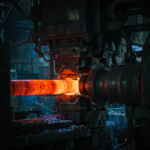
Carbon Steel Flat Bar Manufacturing Process: Hot Rolled vs Cold Drawn
Carbon steel flat bar is one of the most versatile shapes in construction, machinery, and fabrication. Before it reaches your warehouse, it passes through one of two primary manufacturing routes: hot rolling or cold drawing. Each method creates different tolerances, surface finishes, mechanical properties, and price points.
Understanding the carbon steel flat bar manufacturing process helps buyers write clearer specifications, avoid tolerance disputes, and choose the right supply chain partner. This article breaks down both processes step by step.
1. What Is Carbon Steel Flat Bar?
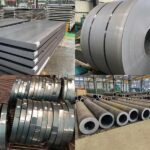
Flat bar is a long product with a rectangular cross-section. Common widths range from 10 mm to 300 mm, while thicknesses range from 3 mm to 50 mm. Grades include Q235, Q275, A36, SS400, S235JR, S275JR, 1045, and S45C depending on the target market and application.
Flat bar is used in frames, brackets, supports, rails, machine bases, gates, fencing, and general structural fabrication. The manufacturing process selected affects dimensional accuracy, straightness, surface scale, and internal stress.
2. Hot Rolled Flat Bar Manufacturing Process
Hot rolling is the dominant carbon steel flat bar manufacturing method. It produces large volumes at low unit cost and is suitable for applications where tight tolerances are not critical.
Step 1: Steelmaking and Casting
Steel is produced in an electric arc furnace (EAF) or basic oxygen furnace (BOF), then continuously cast into rectangular billets or blooms. The billet cross-section determines the final flat bar size after rolling.
Step 2: Reheating
Billets are reheated in a walking-beam furnace to approximately 1,100–1,250°C. This temperature makes the steel plastic enough for deformation without cracking.
Step 3: Roughing and Finishing Rolling
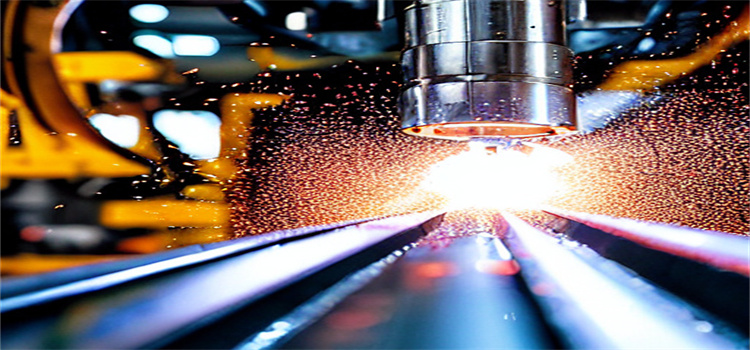
The heated billet passes through a series of horizontal and vertical rolling stands. Each stand reduces thickness and shapes the width. Roughing mills reduce the section quickly, while finishing mills bring the bar to final dimensions.
Step 4: Cooling and Straightening
The bar is cooled on a cooling bed, often under controlled conditions to achieve the desired metallurgical structure. After cooling, straightening machines remove bow and twist.
Step 5: Cutting and Inspection
Bars are cut to commercial length, inspected for surface defects, and bundled for shipment. Mill test certificates record chemical composition, mechanical properties, and dimensions.
3. Cold Drawn Flat Bar Manufacturing Process
Cold drawing starts with hot-rolled bar and improves it through plastic deformation at room temperature. This method produces tighter tolerances, brighter surfaces, and higher tensile strength.
Step 1: Pickling
The hot-rolled bar is immersed in acid to remove mill scale and surface oxides. This prepares the surface for drawing lubricant.
Step 2: Lubrication and Pointing
The end of the bar is swaged to a point so it can pass through the drawing die. A soap or phosphate coating acts as a lubricant.
Step 3: Drawing Through a Die
The bar is pulled through a carbide or diamond die that is slightly smaller than the incoming section. This reduces cross-sectional area by 5–25% in one pass. Multiple passes achieve the final size.
Step 4: Straightening and Cutting
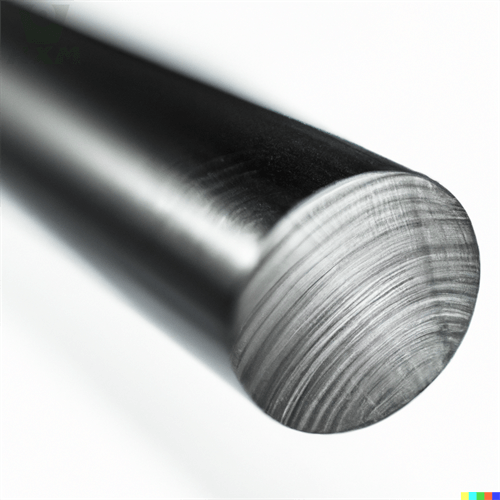
The drawn bar is stress-relieved, straightened by roller straighteners, and cut to length. The result is a bright, smooth bar with consistent dimensions.
4. Hot Rolled vs Cold Drawn: Side-by-Side Comparison
| Attribute | Hot Rolled | Cold Drawn |
|---|---|---|
| Dimensional tolerance | Looser (e.g., ±0.5 mm or more) | Tighter (e.g., ±0.1 mm) |
| Surface finish | Dark, scaled, rough | Bright, smooth, clean |
| Corner profile | Rounded corners | Sharp, well-defined corners |
| Internal stress | Lower residual stress | Higher residual stress; may require stress relief |
| Strength | Lower tensile strength | Up to 20% higher tensile strength |
| Machinability | Requires scale removal | Excellent; ready for machining |
| Price | Lower | Higher (10–30% premium) |
| Lead time | Shorter for standard sizes | Longer; often made to order |
5. How to Specify Flat Bar in Your RFQ
Clear specifications reduce back-and-forth and help the mill quote faster. Include the following details:
- Steel grade and standard (e.g., Q235B/GB/T 700, A36/ASTM A36)
- Width × Thickness × Length
- Tolerance class or standard (e.g., EN 10058, JIS G 3191, ASTM A29)
- Surface condition: black/scaled, pickled, cold drawn, peeled, ground
- Straightness requirement
- Quantity and delivery term (FOB, CIF, DAP)
- Required certificates: MTC, third-party inspection, SGS/BV
6. Common Quality Issues and How to Avoid Them
- Out-of-tolerance dimensions: Require pre-shipment dimensional inspection and accept only AQL 1.0 or tighter.
- Excessive scale: Specify pickled or shot-blasted surface if the bar will be painted or welded.
- Twist and bow: Set a straightness limit, e.g., 3 mm per meter.
- Decarburization: For cold-drawn bars used in heat-treated parts, limit surface decarburization depth.
7. Applications by Process Type
Hot rolled flat bar is preferred for structural frames, general fabrication, shipbuilding, truck bodies, and construction where surface finish is secondary to cost.
Cold drawn flat bar is preferred for precision machinery, shafts, guides, keys, fixtures, and parts that will be machined to tight tolerances without prior surface preparation.
8. Sustainability and Yield Considerations
Hot rolling consumes more energy per ton due to reheating, but it produces near-net-shape sections with minimal scrap. Cold drawing uses less heat but may generate more machining scrap downstream. Buyers focused on carbon footprint should request EAF-produced material where possible.
FAQ
Q1: What is the main difference between hot rolled and cold drawn flat bar?
A: Hot rolled bar is formed at high temperature with looser tolerances and scaled surface. Cold drawn bar is pulled through a die at room temperature for tighter tolerances and brighter finish.
Q2: Is cold drawn flat bar stronger than hot rolled?
A: Yes. Cold drawing increases tensile strength and yield strength through work hardening.
Q3: Can hot rolled flat bar be machined?
A: It can, but surface scale must be removed first to protect cutting tools and achieve good surface finish.
Q4: What tolerance can I expect from cold drawn flat bar?
A: Tolerances of h11 or better are common for cold-drawn bars, depending on size and standard.
Q5: Does Huaxia-Steel supply both hot rolled and cold drawn flat bar?
A: Yes. We supply Q235, A36, SS400, S45C, and custom-grade flat bar in hot rolled, pickled, and cold drawn conditions.
Source Carbon Steel Flat Bar from Huaxia-Steel
Our mill network produces carbon steel flat bar in black, pickled, and cold-drawn finishes with full certification and third-party inspection support. Tell us your grade, size, quantity, and destination port, and we will return a competitive quotation within 24 hours.