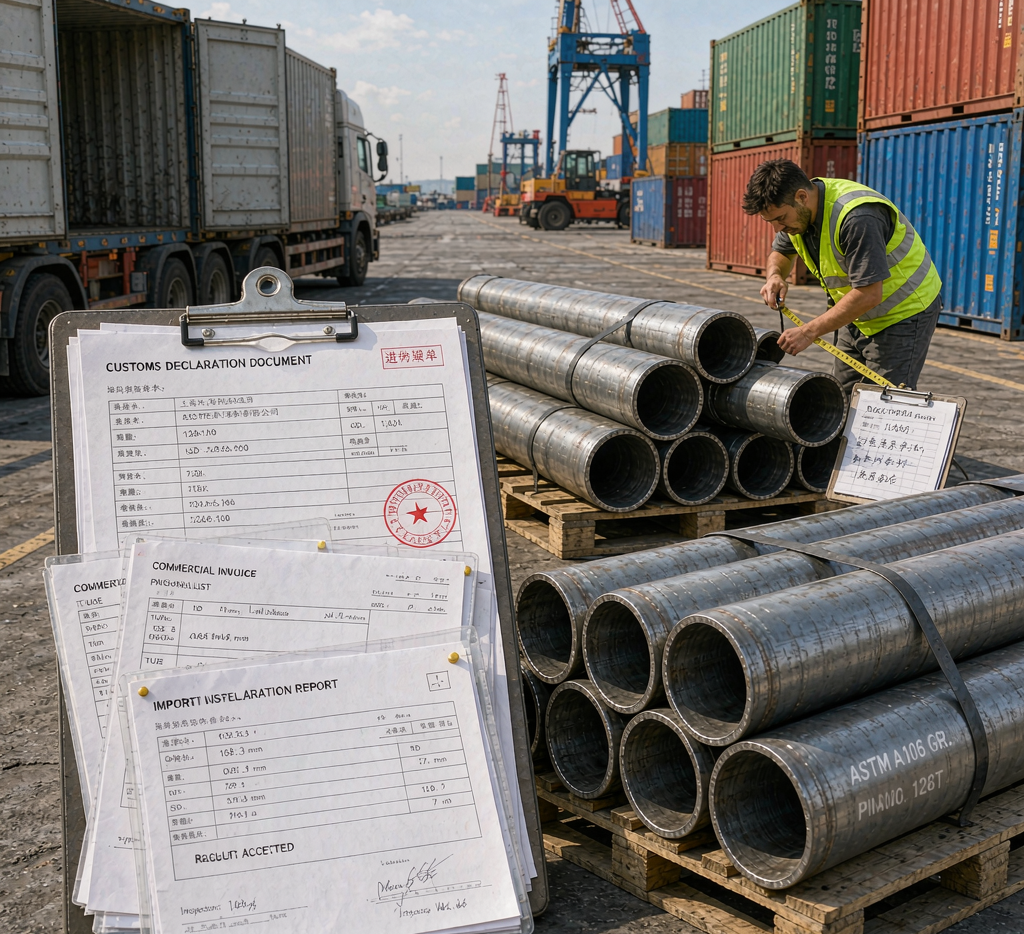
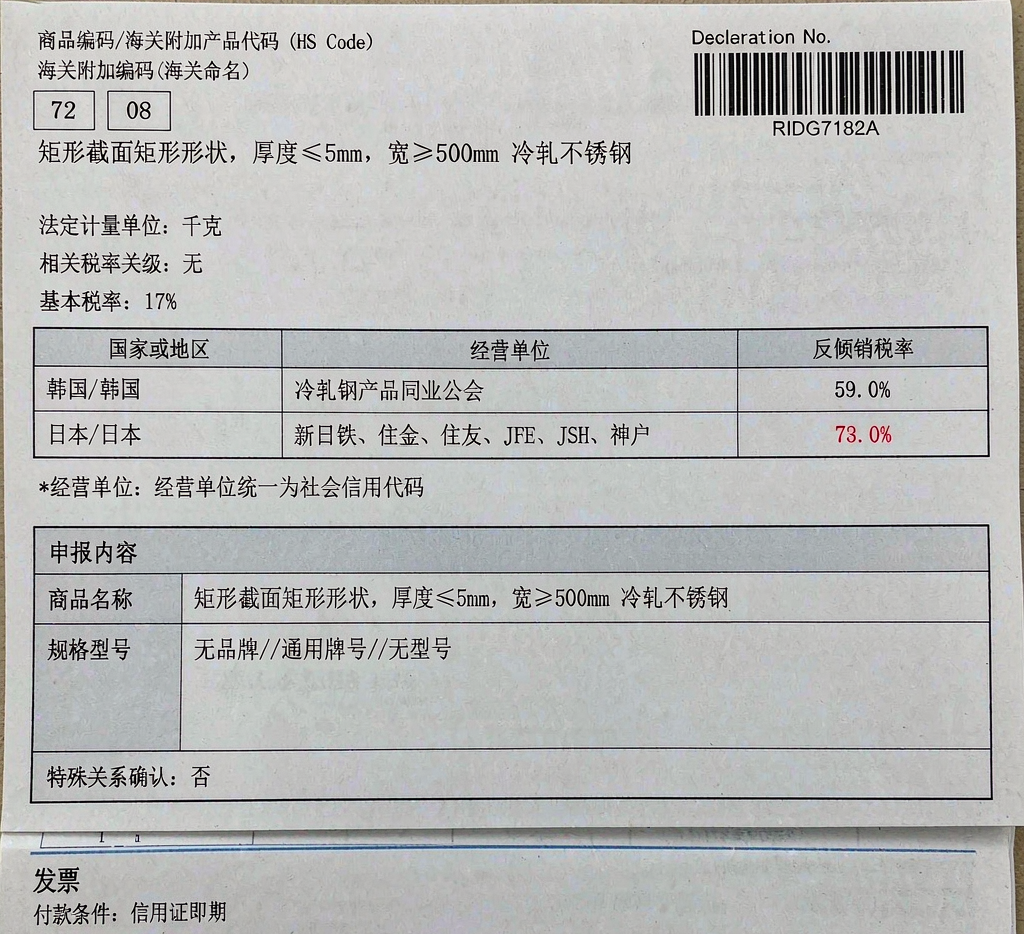
Anti-dumping duties (ADD) and countervailing duties (CVD) are among the most disruptive trade barriers that carbon steel importers face. When a country’s trade authority determines that imported carbon steel is being sold below fair market value, or that the exporting country provides illegal subsidies, it imposes additional duties that can range from 5% to over 200% of the customs value. This guide explains how ADD and CVD work, which products are affected, how to check current rates and strategies to manage or mitigate their impact on your procurement cost.
We cover the legal framework, investigation process, product scope determination, duty calculation, country-specific cases (USA, EU, India, Canada, Australia), circumvention rules and compliance best practices. Whether you import carbon steel pipe, plate, bar, coil or fittings, understanding ADD is essential for accurate landed-cost calculation and supplier selection.
1. What Are Anti-Dumping and Countervailing Duties?
Anti-dumping duty is a tariff imposed on imports that are priced below the “normal value” (usually the home-market price or a constructed cost-of-production plus profit) in the exporting country. Countervailing duty offsets subsidies provided by the exporting country’s government to its steel producers. Both are governed by the WTO Anti-Dumping Agreement and the Agreement on Subsidies and Countervailing Measures.
Aspect
Anti-Dumping Duty (ADD)
Countervailing Duty (CVD)
Trigger
Selling below fair value
Government subsidies
Legal basis
WTO ADA + national law
WTO SCM Agreement + national law
Duty rate basis
Dumping margin (normal value − export price)
Subsidy amount per unit
Typical range
5% – 150%
2% – 50%
Investigation duration
12 – 18 months
12 – 18 months
Duration of order
5 years (sunset review)
5 years (sunset review)
2. Affected Carbon Steel Products
Anti-dumping orders on carbon steel are product-specific and country-specific. The most commonly affected products include:
Product Category
Typical HS Codes
Common ADD Countries
Hot-rolled carbon steel flat products
7208
China, India, Russia, Ukraine
Cold-rolled carbon steel flat products
7209
China, India, Vietnam
Carbon steel pipe & tube (seamless)
7304
China, India, Russia
Carbon steel pipe & tube (welded)
7306
China, India, Taiwan, Vietnam
Carbon steel bar & light sections
7213, 7214
China, India, Brazil
Carbon steel angles & sections
7216
China, India, Taiwan
Carbon steel flanges & fittings
7307
China, India, Thailand
3. How to Check Current Duty Rates
United States (USITC / CBP)
The US International Trade Commission (USITC) publishes the current ADD/CVD orders at access.usitc.gov. Search by product name or HS code to find the case number, then look up the current cash deposit rate for the specific exporter. US duties are case-specific: each named exporter has an individual rate, while “all other” producers pay a country-wide rate. The Customs and Border Protection (CBP) enforces collection at the time of entry.
European Union (DG TRADE)
The European Commission’s DG TRADE maintains the Trade Defence Instruments (TDI) database at trade.ec.europa.eu/tdi. Search by product or country to find the regulation number, duty rate and product scope description. EU anti-dumping duties are ad valorem percentages applied to the CIF value at EU border customs.
India (DGTR / CBIC)
India’s Directorate General of Trade Remedies (DGTR) publishes investigation results and recommended duties at dgtr.gov.in. The Central Board of Indirect Taxes and Customs (CBIC) issues the notification implementing the duty. India imposes ADD on many carbon steel products from China, making it critical for Indian buyers to verify before placing orders.
Canada (CBSA / CITT)
The Canada Border Services Agency (CBSA) and the Canadian International Trade Tribunal (CITT) jointly administer ADD/CVD. Current rates are at cbsa-asfc.gc.ca/agency-cb(ad)/menu-eng.html. Duties are assessed on the normal value minus export price, not on a simple percentage basis.
4. Calculating Landed Cost with ADD
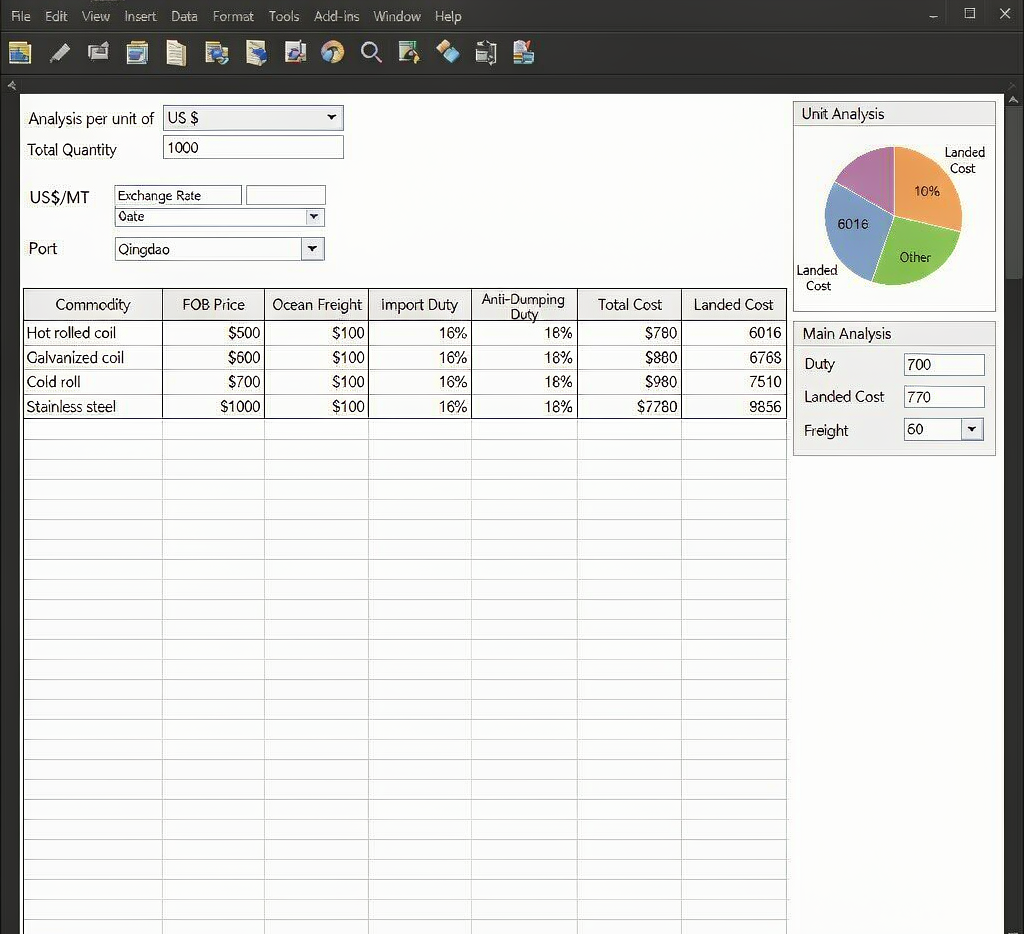
When ADD applies, the landed cost formula changes significantly. Here is a worked example for cold-rolled carbon steel coil imported from China into the USA with a 100% ADD rate:
Cost Component
Amount (USD)
Notes
FOB price (Shanghai)
$600 / MT
Ex-works or FOB from mill
Ocean freight + insurance
$80 / MT
CIF addition
CIF value
$680 / MT
Base for duty calculation
Import duty (MFN 2.5%)
$17 / MT
Standard Most-Favoured-Nation tariff
Merchandise Processing Fee
$0.34 / MT
0.3465% of CIF (US)
Anti-dumping duty (100%)
$680 / MT
Applied on CIF value
Countervailing duty (assumed 20%)
$136 / MT
Applied on CIF value
Total landed cost
$1,513 / MT
FOB was $600 but actual cost is 152% higher
In this example, the ADD and CVD together add $816/MT — more than the original steel price. This is why verifying ADD status before placing an order is critical for cost control.
5. Strategies to Manage or Mitigate ADD Impact
Source from non-subject countries — If ADD applies to Chinese-origin carbon steel pipe, consider sourcing from Turkey, South Korea, Brazil or domestic producers. Verify that the alternative country does not also have an ADD order in force.
Request exclusion under product scope — Some ADD orders exclude specific dimensions, grades or applications. For example, certain ADD orders on welded pipe exclude line pipe to API 5L specification. If your product falls under an excluded category, file a scope ruling request with the investigating authority.
Use a non-subject exporter — Even within a subject country, individual exporters may have a 0% or low rate if they were not investigated or if they demonstrated no dumping. Check the “all others” rate and named-exporter rates.
Apply for new shipper review — If you are a new exporter from a subject country, you can request a new shipper review to obtain an individual rate. This is available in the USA and some other jurisdictions.
Participate in sunset reviews — Every 5 years, ADD orders are subject to sunset review. Importers and domestic producers can participate; if the authority finds that revocation would likely lead to continuation of dumping, the order is renewed for another 5 years.
Reclassify product — Legitimate product reclassification (where the product genuinely falls under a different HS code not subject to ADD) can be effective but requires careful customs classification analysis. Do not misclassify products — this is customs fraud.
6. Circumvention and Transhipment Risks
Trade authorities actively investigate circumvention — where subject merchandise is processed in a third country to disguise its origin. Common circumvention patterns include minor processing (drilling, threading, cutting to length) in a non-subject country, followed by re-export with a non-subject country certificate of origin. If circumvention is found, the ADD order is extended to cover imports from the third country.
Buyers should never participate in transhipment schemes. If customs determines that the true origin of the goods is a subject country, the importer becomes liable for the ADD plus penalties, and the goods may be seized. Always require the supplier to provide authentic certificates of origin and ensure that the goods genuinely originate from the certified country.
7. Compliance Checklist for Importers
Before ordering: check ADD/CVD status for the exact product HS code and origin country on the relevant authority website.
Request a certificate of origin (Form A, EUR.1, or standard COO) from the supplier and verify its authenticity with the issuing chamber of commerce.
Obtain the exporter’s individual ADD rate from the investigating authority’s website, not from the supplier’s verbal assurance.
Calculate landed cost including ADD and CVD before placing the order — do not assume the FOB price reflects your final cost.
If using a customs broker, provide a complete product description and the specific ADD case number to ensure correct duty assessment.
Retain all documentation (commercial invoice, packing list, B/L, COO, MTC, customs entry summary) for at least 5 years for audit.
Monitor sunset review schedules and new investigation filings that may affect your product or country of origin.
FAQ
Does ADD apply to sample orders or small quantities?
Yes, ADD applies regardless of quantity. Even a 100 kg sample of subject carbon steel pipe from a subject country is liable for the full duty rate. However, some countries have a de minimis threshold (typically $2,500 or less in value for the USA) below which entry is exempt from formal entry requirements — but the duty still technically applies.
If I buy from a trading company in a non-subject country, am I safe?
Only if the goods genuinely originate from that non-subject country. If the trading company merely trans-ships goods manufactured in a subject country, customs can determine the true origin and assess the duty plus penalties. Always verify that the goods were melted and poured in the certified country of origin.
How often do ADD rates change?
Individual exporter rates can change during administrative reviews (annually in the USA). Country-wide “all others” rates are more stable but can change during sunset reviews (every 5 years). Always check the current rate at the time of import, not at the time of the original order.
Need Help Sourcing Carbon Steel Globally?
Huaxia-Steel helps buyers navigate carbon steel sourcing with full compliance documentation, authentic certificates of origin and transparent pricing. We supply pipe, plate, bar, coil, fittings and flanges from our Chinese mills and can coordinate with your customs broker on ADD classification. Contact us to discuss your sourcing requirements.
If you require further information about our metal sheet products or architectural projects, please don’t hesitate to leave your contact details and message here.
Our team of experts will respond within 24 hours to continue the discussion and provide you with any additional information you requires.