Carbon Steel HS Code Classification Differences for Export
HS Code (Harmonized System Code) classification is the foundation of international steel trade. A single wrong digit can mean the difference between a 0 percent duty rate and a 25 percent anti-dumping duty, or between smooth customs clearance and a container stuck at the border for weeks. For carbon steel exporters shipping from China, understanding HS Code classification differences across destination markets is not optional — it is the difference between profit and loss.
This guide explains how carbon steel products are classified under the Harmonized System, where the classification diverges by country, how anti-dumping duties attach to specific HS codes, and what documentation buyers need to ensure correct classification and duty minimization.
1. Harmonized System Structure for Carbon Steel
The Harmonized System (HS) is administered by the World Customs Organization (WCO). The first 6 digits are internationally standardized. Countries add digits (7-10) for national tariff lines. Carbon steel products fall primarily in Chapter 72 (iron and steel) and Chapter 73 (articles of iron and steel).
| HS Code (6-digit) | Product category | Typical carbon steel products |
|---|---|---|
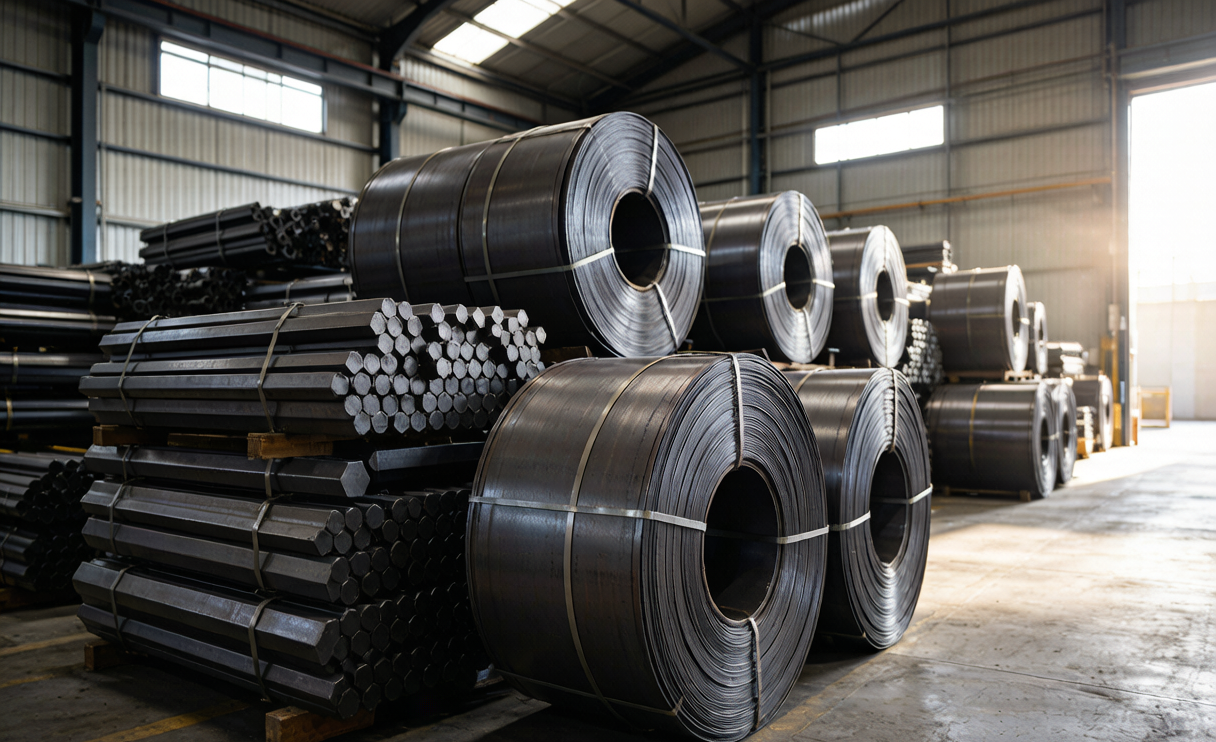
| 7208 | Hot-rolled flat, width >= 600 mm | HR plate, HR coil, HR sheet |
| 7209 | Cold-rolled flat, width >= 600 mm | CR coil, CR sheet |
| 7210 | Coated flat, width >= 600 mm | Galvanized coil/sheet, PPGI |
| 7213 | Wire rod | Carbon steel wire rod (5.5-22 mm) |
| 7214 | Bars (other than free-cutting) | Round bar, square bar, hex bar |
| 7216 | Angles, shapes, sections | Angle bar, H-beam, I-beam, channel |
| 7217 | Wire | Carbon steel wire |
| 7218 | Stainless steel semi-finished | (Not carbon steel) |
| 7225 | Alloy steel flat, width >= 600 mm | Alloy steel plate |
| 7228 | Bars/rods of alloy steel | Alloy steel round bar |
| 7304 | Tubes, pipes, hollow profiles | Seamless pipe, ERW pipe, LSAW pipe |
| 7306 | Other tubes and pipes | Welded pipe, structural hollow sections |
| 7307 | Tubes, pipes, fittings | Carbon steel flanges, elbows, tees, reducers |
| 7308 | Structures and parts | Steel structures, fabricated sections |
2. Where Classification Diverges: 6-Digit to 10-Digit
The first 6 digits are standardized worldwide. Divergence starts at digit 7 (country-specific tariff lines). Here are common divergence points for carbon steel:
Hot-Rolled Plate (HS 7208)
| Country | 10-digit HS | Description | MFN duty |
|---|---|---|---|
| USA | 7208.51.0000 | HR plate, thickness > 10 mm | 0% (AD duty may apply) |
| EU | 7208.51.00 | HR plate, thickness > 10 mm | 0% (AD duty may apply) |
| India | 7208.51.00 | HR plate, thickness > 10 mm | 7.5% BCD |
| Brazil | 7208.51.00 | HR plate, thickness > 10 mm | 10-14% (MERCOSUR) |
| ASEAN | 7208.51.00 | HR plate, thickness > 10 mm | 0% (under ACFTA) |
Seamless Pipe (HS 7304)
| Country | 10-digit HS | Description | MFN duty |
|---|---|---|---|
| USA | 7304.59.1500 | Seamless pipe, other alloy steel | 0% + AD duty (up to 148%) |
| EU | 7304.59.10 | Seamless pipe, line pipe | 0% + AD duty |
| India | 7304.59.10 | Seamless pipe, other | 7.5% BCD + AD duty |
| Saudi Arabia | 7304.59.00 | Seamless pipe, other | 5% (GCC tariff) |
3. Anti-Dumping Duties and HS Code Sensitivity
Anti-dumping (AD) and countervailing (CVD) duties are the most HS-code-sensitive aspect of carbon steel trade. These duties apply to specific 10-digit HS codes from specific countries. Missing or misclassifying the HS code can result in retroactive duty assessment plus penalties.
| Product | Destination | HS Code | AD/CVD range | Notes |
|---|---|---|---|---|
| HR plate | USA | 7208.51.0000 | 0-12% (CVD) + 0-100% (AD) | Varies by Chinese mill |
| CR coil | USA | 7209.18.0000 | 0-300% (AD) | Most Chinese mills excluded |
| Seamless pipe | USA | 7304.59.1500 | 27-148% (AD) | Oil country tubular goods |
| Wire rod | EU | 7213.91.00 | 0-25% (AD) | Some mills excluded |
| HR plate | EU | 7208.51.00 | 0-42% (AD) | Varies by exporter |
| Non-alloy bars | India | 7214.20.00 | 0-35% (AD) | Bar and wire rod |
Critical note: AD duty rates are exporter-specific. Each Chinese mill has its own rate, which may be 0 percent (if individually examined and excluded) or the “all others” country rate. Always check the latest AD order on the destination country’s trade remedy website before quoting.
4. Classification Edge Cases for Carbon Steel
Edge Case 1: Carbon vs Alloy Steel
The line between carbon steel (Chapter 72) and alloy steel (Chapter 72, subheadings 7225-7228) is defined by the chemical composition thresholds in Section XV, Note 1(d) of the Harmonized System. Key thresholds:
- Boron: >= 0.0008 percent → alloy steel
- Chromium: >= 0.30 percent → alloy steel
- Molybdenum: >= 0.08 percent → alloy steel
- Nickel: >= 0.30 percent → alloy steel
- Vanadium: >= 0.10 percent → alloy steel
- Other elements (Si, Mn, Cu): Specific thresholds apply
A steel that tests as “carbon steel” by AISI/SAE definitions may be classified as “alloy steel” by HS criteria if it contains trace amounts of Cr or Ni above the thresholds. This reclassification can change the HS code from 7208 to 7225, potentially avoiding or triggering AD duties.
Edge Case 2: Pipe vs Tube vs Hollow Section
| Product | HS Code | Key criteria |
|---|---|---|
| Seamless line pipe | 7304.10 | For oil/gas pipelines |
| Seamless casing/tubing | 7304.20 | OCTG for drilling |
| ERW pipe (general) | 7306.19/7306.30 | Other welded pipe |
| Structural hollow section | 7306.61 | Square/rectangular for structures |
| Welded line pipe | 7306.11 | For oil/gas pipelines |
The distinction between “pipe for pipelines” (7304.10/7306.11) and “other welded pipe” (7306.19/7306.30) depends on the intended end use, which must be documented. If the buyer intends to use the pipe for oil/gas pipelines, it must be classified under 7304.10 or 7306.11, even if the specification (e.g., ASTM A53) is general-purpose.
Edge Case 3: Coated vs Uncoated Flat Products
| Product | HS Code | Coating |
|---|---|---|
| Hot-rolled coil | 7208.39/7208.51 | Uncoated |
| Cold-rolled coil | 7209.18 | Uncoated |
| Galvanized (HDG) | 7210.41/7210.49 | Zinc coated |
| Electrogalvanized | 7210.30 | Electrolytically zinc coated |
| PPGI/PPGL | 7210.70 | Painted/coated |
| Tin plated | 7210.11/7210.12 | Tin coated |
5. Documentation for Correct Classification
To ensure smooth customs clearance and correct duty assessment, exporters should prepare:
- Mill Test Certificate (EN 10204 3.1 or 3.2): The MTC must list the chemical composition so customs can verify carbon vs alloy classification. Ensure all elements are reported to sufficient decimal places (e.g., Cr 0.02 percent, not “trace”).
- Commercial Invoice: Must include the HS code, product description matching the HS code wording, and the end-use statement (e.g., “for structural use” vs “for oil and gas pipeline”).
- Packing List: Must show dimensions (outer diameter, wall thickness, width, thickness, length) that match the HS code subheading criteria.
- Form E (ASEAN-China FTA): Required for ASEAN destinations to claim 0 percent duty under ACFTA. The HS code on Form E must match the commercial invoice exactly.
- Form A (GSP): Required for developing countries that still offer GSP preferences. Check current GSP status, as many countries have graduated China from GSP.
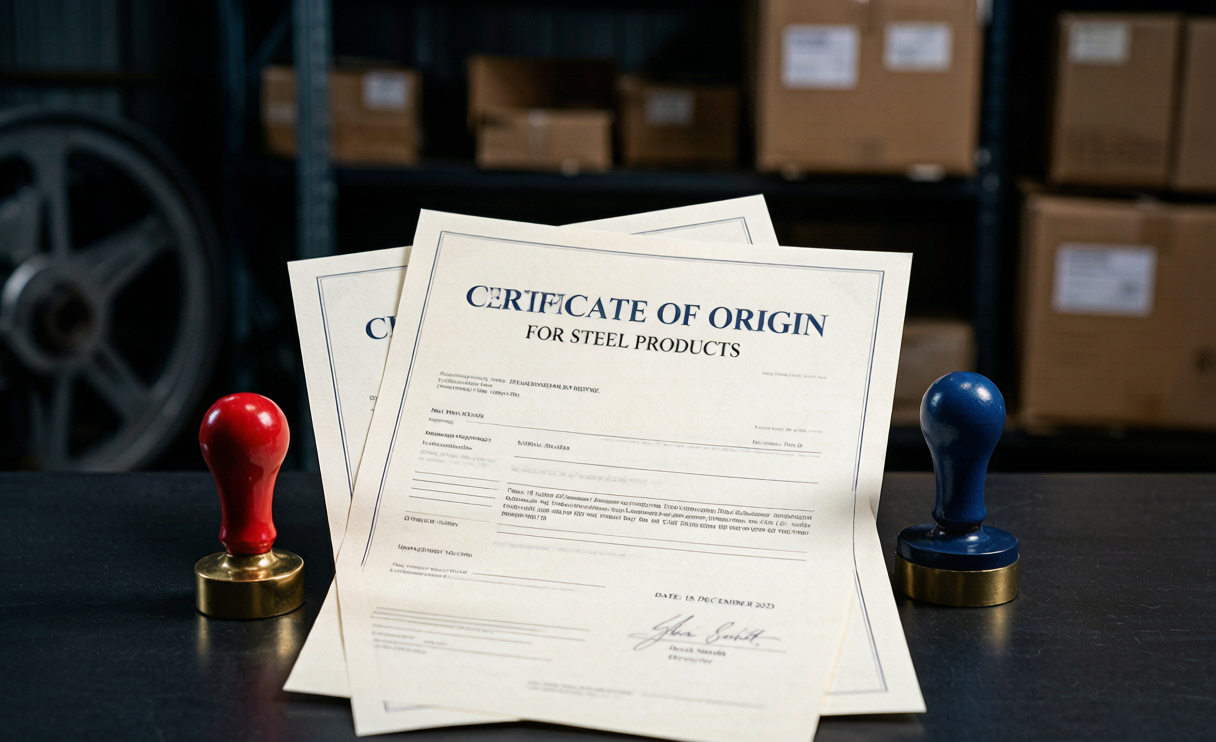
- Certificate of Origin (COO): Standard COO from CCPIT or CIQ. Required for all destinations to verify country of origin.
6. Duty Minimization Strategies
Strategy 1: FTA Utilization
China has free trade agreements with ASEAN (ACFTA), South Korea (CKFTA), Australia (ChAFTA), Pakistan (CPFTA), and others. Under these FTAs, carbon steel products can enter at 0 percent duty if the HS code is eligible and the product meets the rules of origin (typically regional value content >= 40 percent or change in tariff heading).
| FTA | Destination | Carbon steel duty | Requirement |
|---|---|---|---|
| ACFTA | ASEAN-10 | 0% | Form E + RVC >= 40% |
| CKFTA | South Korea | 0% | Form K + RVC >= 40% |
| ChAFTA | Australia | 0% | COO + RVC >= 40% |
| RCEP | 15 countries | 0-5% | RCEP COO |
Strategy 2: AD Duty Exclusion
Many AD orders list specific Chinese mills with 0 percent individual rates. If the supplier mill has an individual exclusion, the product can enter at 0 percent AD duty. Always check the latest AD order on the destination customs website.
Strategy 3: Product Reclassification
If the product can be legitimately classified under a non-AD HS code (e.g., a structural hollow section classified under 7306.61 instead of welded pipe under 7306.30), AD duties may not apply. However, this requires careful documentation and should be verified with a customs broker.
7. Common Classification Errors and How to Avoid Them
| Error | Consequence | Prevention |
|---|---|---|
| Classifying alloy steel as carbon steel | Wrong HS code, possible penalty | Check Cr/Ni/Mo/V/B in MTC against Section XV Note 1(d) |
| Missing AD duty on subject HS code | Retroactive assessment + penalty | Check AD orders before quoting; get AD rate for specific mill |
| Wrong pipe classification (7304 vs 7306) | Different duty rates, clearance delay | Specify end use on invoice; classify by manufacturing method (seamless=7304, welded=7306) |
| Form E HS code mismatch | FTA preference denied, full duty | Verify HS code on Form E matches invoice exactly before shipment |
| Coating not declared | Reclassification from 7208 to 7210, back duty | Declare surface condition (uncoated/galvanized/painted) on all documents |
FAQ
What is the difference between HS code and HTS code?
HS (Harmonized System) is the international 6-digit code administered by WCO. HTS (Harmonized Tariff Schedule) is the US 10-digit code that extends the HS code with US-specific tariff lines. Other countries use similar national extensions (e.g., CN codes in the EU, ITC-HS in India).
How do I know if my carbon steel product has an anti-dumping duty?
Check the destination country’s trade remedy authority website: US (ITC/Commerce Department), EU (European Commission DG Trade), India (DGTR), Brazil (DECOM). Search by HS code and country of origin. AD orders are updated regularly, so check before every shipment.
Can I choose a different HS code to avoid AD duties?
You must classify the product based on its actual characteristics (composition, dimensions, manufacturing method, end use). Intentional misclassification to avoid AD duties is customs fraud and carries severe penalties. However, if a product legitimately qualifies for a non-AD code, that classification is valid.
Does the HS code affect freight cost?
No. Freight cost is based on weight/volume, not HS code. However, certain HS codes may require additional documentation (e.g., pressure vessel certification for pipe classified as line pipe) that can add processing time.
What is the penalty for HS code misclassification?
Penalties vary by country. In the US, negligence penalties start at 2 times the loss of duty; fraud penalties can reach the full value of the goods plus 100 percent penalty. In the EU, penalties are set by member states and range from 10-100 percent of the duty. In India, penalties can include confiscation of goods plus fine.
Conclusion
HS Code classification is a critical but often overlooked aspect of carbon steel export. The 6-digit international code is standardized, but national tariff lines (digits 7-10) and anti-dumping duties create significant variation across destinations. By understanding the classification rules, checking AD orders before quoting, preparing accurate documentation, and working with experienced customs brokers, exporters can minimize duties and avoid costly clearance delays.
Contact Huaxia-Steel for carbon steel products with complete export documentation, including HS code advisory, COO, Form E, and MTC. We ship to 60+ countries with experienced logistics partners.
Related Images