How to Handle Force Majeure Clauses in International Steel Purchase Contracts
If you have imported steel from Asia, the Middle East or Europe in the last five years, you have probably had at least one shipment delayed, short-shipped or cancelled by something neither party planned for — a port lockdown, a typhoon, a war, a pandemic, a sudden export ban. When buyers and suppliers disagree about who pays for the delay and who bears the cost, the dispute almost always ends at the same article of the contract: the force majeure clause. A poorly drafted force majeure clause can cost a buyer 100% of a paid deposit, leave a fabricator without steel for three months, or trigger penalty clauses on a downstream project. A well-drafted clause does the opposite — it allocates risk clearly, defines the notification procedure, and gives both sides a roadmap back to performance once the event is over. This guide explains how to read, negotiate and operate a force majeure clause when you buy steel internationally.
1. What Is Force Majeure in a Steel Contract?
Force majeure (literally “superior force”) is a contract law doctrine that releases both parties from their obligations when an extraordinary event beyond their control makes performance impossible or fundamentally uneconomic. In international steel trade, the clause typically excuses the supplier from delivering on time — and excuses the buyer from accepting late delivery or paying cancellation fees — when the event is:
- An act of God: typhoon, hurricane, flood, earthquake, severe storm.
- War, invasion, riot, embargo, sanction or trade restriction imposed after contract signing.
- Pandemic, epidemic or government-mandated lockdown that prevents production, transport or customs clearance.
- Strike, labour dispute, lockout at the mill, port or shipping line (but usually not a labour dispute specific to the supplier’s own workforce).
- Government order, export ban, import ban, port closure or sudden change in tariff regime.
- Major accident at the mill (furnace breakdown, gas supply failure, blast-furnace reline accident) — though this is usually disputed.
Force majeure is not the same as commercial hardship. A buyer who simply no longer needs the steel cannot claim force majeure. A supplier who sold at the wrong price cannot claim force majeure. The event must be external, unforeseeable, and must actually prevent performance — not merely make it inconvenient.
2. What a Good Force Majeure Clause Should Contain
The strongest force majeure clauses in international steel contracts contain five elements:
- Definitive list of events. A clear enumeration, usually closed (numbered list) or partially closed (numbered list plus a catch-all). Closed lists limit disputes; open lists give flexibility but create ambiguity.
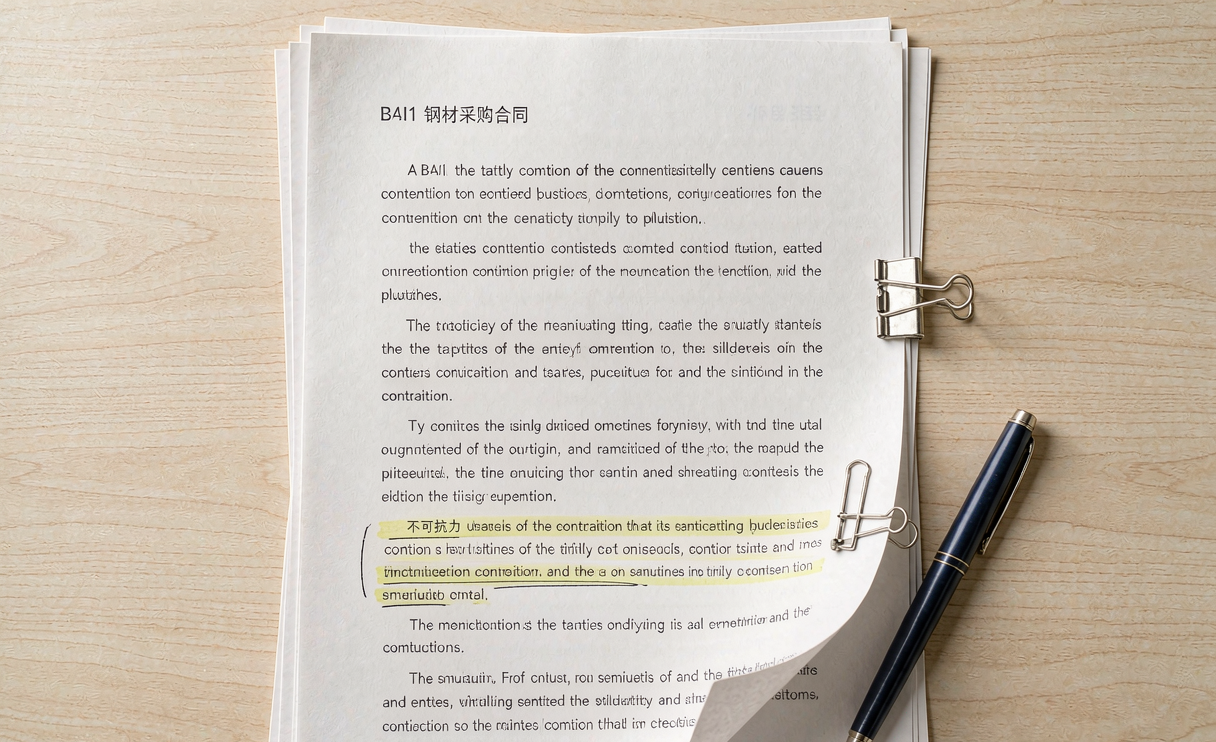
- Notification procedure. The affected party must notify the other side in writing (email is now standard) within a defined window — typically 5, 7 or 14 days from the date the event occurred or became known. Late notification often extinguishes the right to invoke force majeure.
- Evidence requirement. A government notice, port authority circular, Lloyd’s Stop List publication, or chamber-of-commerce certificate is usually required to substantiate the claim. Verbal claims are routinely rejected.
- Duration threshold and termination right. If the force majeure event continues for more than a defined period (often 30, 60 or 90 days), the non-affected party may terminate the contract without penalty. This protects the buyer from being locked into a contract that may never perform.
- Allocation of costs already incurred. Who pays for raw material already purchased, who keeps the deposit, who pays for demurrage at the port of discharge. A clause silent on this point is a dispute waiting to happen.
3. The Three Common Triggers in Steel Trade
Three categories account for almost every force majeure claim in international steel trade:
3.1 Port and Shipping Disruption
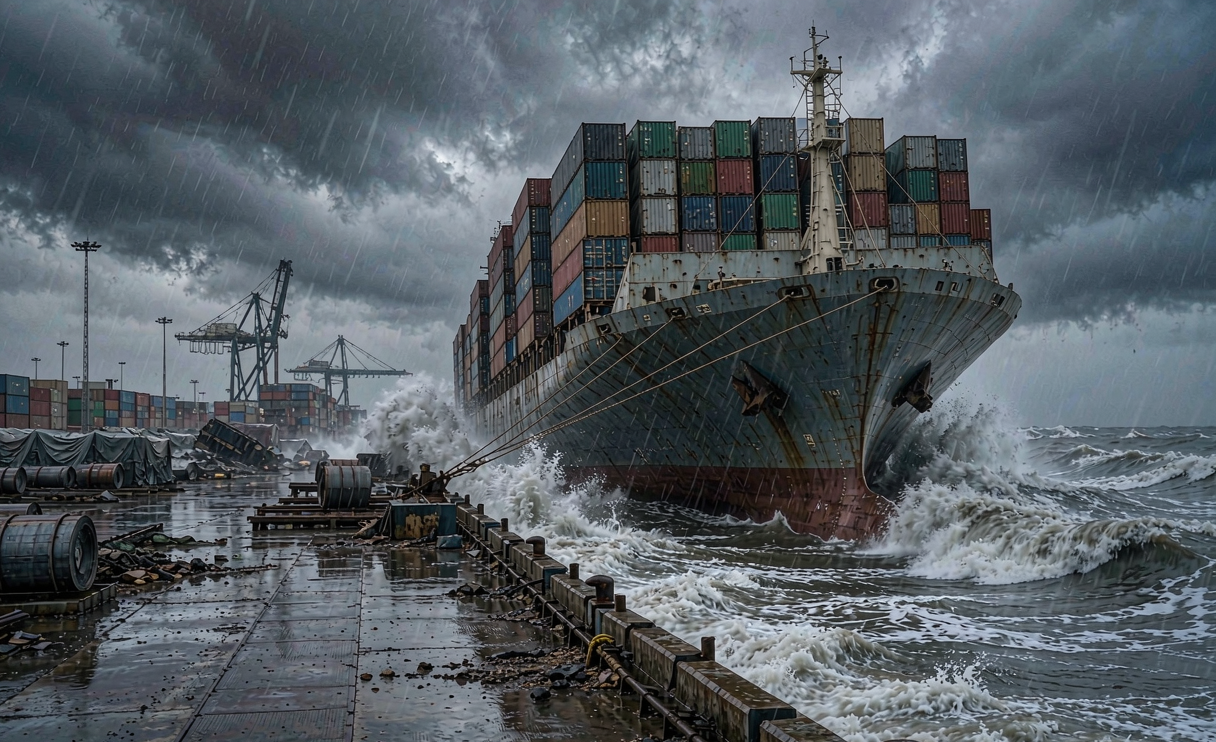
Container shipping has been disrupted repeatedly since the 2020 pandemic, from the Suez Canal blockage (2021) to the Red Sea attacks (2024) to typhoon-related port closures in China and the Philippines. A force majeure clause that ties the supplier’s delivery obligation to a specific vessel, route or transit time can backfire badly. The better wording ties delivery to “the contract shipment period, extended by any event of force majeure affecting port operation, shipping, customs clearance or inland transport”.
3.2 Government Action
Export tax changes, safeguard duties, anti-dumping duties, EU carbon-border adjustments, sanctions on Russian steel — these are all classic force majeure triggers when imposed after contract signing. The clause should explicitly name “any change in export licensing, export tax, export duty, anti-dumping duty, safeguard duty or any other government measure imposed after the contract date” as a covered event.
3.3 Mill-Level Events
This is the most disputed category. A blast-furnace reline, a rolling-mill gearbox failure, a labour strike at the mill — most buyers expect these to be the supplier’s own commercial risk, not force majeure. A well-drafted buyer contract limits mill-level force majeure to events that are sudden, external and unforeseeable (a regional power outage, an upstream raw material shortage, a government-mandated environmental shutdown). Routine maintenance, commercial decisions to allocate output to higher-margin customers, and ordinary equipment failure should not be force majeure.
4. The Buyer-Side Negotiation Checklist
When you receive a steel-mill proforma invoice or sales contract, push back on the force majeure clause before signing. Six points to negotiate:
- Limit the event list. Replace open-ended “any event beyond the supplier’s control” with a numbered list that includes the events you care about and excludes events that the supplier should bear commercially.
- Shorten the notification window. 5 days is better than 14. The longer the supplier has to notify, the longer you sit without a clear answer on whether your order will ship.
- Require documentary evidence. Demand that the supplier attach a government notice, port circular, classification society publication or chamber-of-commerce certificate. Without it, the notice is not effective.
- Set a termination threshold. 60 days from the date of the force majeure notice is a reasonable threshold. After that, you may cancel without penalty and recover the deposit.
- Allocate costs of goods in transit. If steel has already been produced and is at the port, name who pays for storage, demurrage, return freight and any deterioration. A fair rule is: the supplier pays until the goods are loaded on the vessel; the buyer pays from that point onward, except where the force majeure event is at the discharge port.
- Reserve a quantity right. In a multi-delivery contract, the supplier should still deliver the unaffected portion of the order. The clause should not let the supplier cancel the entire contract when only part of it is affected.

5. The Supplier-Side Negotiation Checklist
If you are the supplier, the mirror-image list applies. Push for:
- An open or hybrid event list with a catch-all phrase.
- A longer notification window (14 – 30 days).
- Right to allocate available output among contracted buyers at supplier’s discretion.
- Right to extend the delivery window by the duration of the force majeure plus a reasonable buffer (typically 30 days).
- Exclusion of buyer’s obligation to pay deposit or progress payments during the force majeure event.
- Exclusion of any penalty or liquidated-damages claim during the force majeure event.
6. Operating the Clause — Step by Step
When a force majeure event actually happens, follow this sequence on both sides:
- Day 0. The event occurs (port closure, government notice, typhoon landfall). The affected party collects all documentary evidence — official notices, photographs, news reports, port circulars, chamber-of-commerce statements.
- Day 1 – 5. The affected party issues a written force majeure notice to the counterparty, attaching the evidence. The notice should specify the event, the date it occurred, the goods or shipments affected, and the expected duration.
- Day 5 – 30. Both parties enter negotiations on the impact — delivery extension, partial performance, price adjustment, cost allocation. Communication should be in writing, by email, with timestamps.
- Day 30 – 60. If the event continues, the non-affected party may issue a termination notice if the threshold is reached. Goods already produced and paid for must be dealt with in line with the clause.
- After the event ends. The affected party issues a “force majeure ceased” notice, and the contract resumes. Both sides should agree in writing on the revised delivery schedule.
7. Governing Law and Dispute Resolution
The force majeure clause does not stand alone — it sits within a contract that also specifies the governing law and the dispute-resolution forum. In international steel trade, three combinations dominate:
- English law, London arbitration (LCIA / ICC). Common for European, Middle Eastern and African buyers.
- Chinese law, CIETAC arbitration in Beijing or Shanghai. Common for buyers of Chinese steel.
- Singapore law, SIAC arbitration. Increasingly common for ASEAN buyers.
The choice matters because the force majeure clause will be interpreted under the chosen law. English law treats force majeure as a creature of contract — what the clause says is what the law applies. Chinese law (Article 180 of the Civil Code) recognises force majeure but with judicial interpretation that may fill gaps differently. Singapore law sits between the two. Always specify the law and the forum in the same clause as the force majeure article.
8. Five Real-World Scenarios
Below are five anonymised examples drawn from real disputes in the steel trade:
- Scenario 1: typhoon port closure. Supplier’s vessel was due to load at Qingdao when a typhoon closed the port for 9 days. The clause (English law) named “natural disasters” and the supplier notified the buyer within 3 days with the port authority’s closure notice. The buyer was entitled to a 9-day extension; no penalty was due.
- Scenario 2: anti-dumping duty. The EU imposed a definitive anti-dumping duty on Chinese HRC two weeks after the contract was signed. The clause (Chinese law) named “changes in trade defence measures after contract date”. The supplier invoked force majeure and the contract was terminated without penalty. The deposit was returned in full.
- Scenario 3: planned reline. A Brazilian mill tried to invoke force majeure for a 60-day planned blast-furnace reline. The clause (English law) excluded “scheduled maintenance, planned shutdown or routine overhaul”. The buyer’s arbitration panel rejected the notice and awarded damages for non-delivery.
- Scenario 4: pandemic lockdown. During the 2020 Shanghai lockdown, a supplier could not move containers out of the port. The clause (English law) named “government-mandated lockdown” and the supplier provided the official lockdown notice within 5 days. The buyer extended the delivery window by 60 days; no penalty was due.
- Scenario 5: war zone reroute. Red Sea attacks in early 2024 forced rerouting around the Cape of Good Hope, adding 14 days to transit. The clause (English law) named “disruption of named shipping routes” and the buyer was entitled to the extension. The supplier covered the extra fuel cost; the buyer accepted the late arrival.
Frequently Asked Questions
Q1: Can I claim force majeure if my customer cancelled the order because of price?
Generally no. A buyer’s cancellation because the market price has fallen is a commercial decision, not a force majeure event. The buyer remains liable for the contract price, less any mitigation by resale. To escape the contract, the buyer usually has to point to a named event of force majeure in the contract.
Q2: What happens to a deposit paid under a force majeure contract?
It depends entirely on the wording of the clause and the governing law. Under most well-drafted contracts, the deposit is refunded if the force majeure event continues past the termination threshold. Under Chinese law and CIETAC practice, the supplier may be entitled to retain a portion of the deposit as compensation for actual costs incurred. Under English law, the deposit is normally returned in full if the contract is terminated for force majeure. Always clarify this in the contract before paying.
Q3: Can a steel mill claim force majeure because of a planned blast-furnace reline?
No. A planned shutdown, even a long one, is a foreseeable operational event and is not force majeure. Most contracts exclude “scheduled maintenance, planned shutdown, or routine equipment overhaul” from the force majeure definition. If a mill tries to invoke force majeure for a planned reline, the buyer should dispute the notice immediately.
Q4: Does a tariff change qualify as force majeure?
It depends on the wording of the clause and the timing. A tariff that takes effect after the contract date and makes export uneconomic may qualify as a government action. A tariff that was already in force when the contract was signed is part of the commercial assumption and is not force majeure. The clause should explicitly state whether tariff changes after the contract date are included.
Work with Huaxia Steel
Huaxia Steel uses a balanced force majeure clause in its standard sales terms, with a 7-day notification window, a 60-day termination threshold, and a documentary-evidence requirement. We honour the clause in good faith and work with our customers to extend, partially perform or terminate contracts when an unexpected event occurs. For new contracts, our legal team is happy to walk you through the force majeure article before signature.