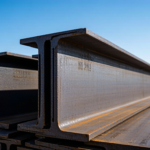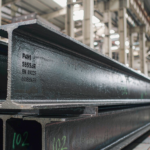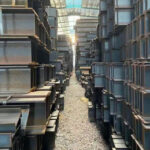
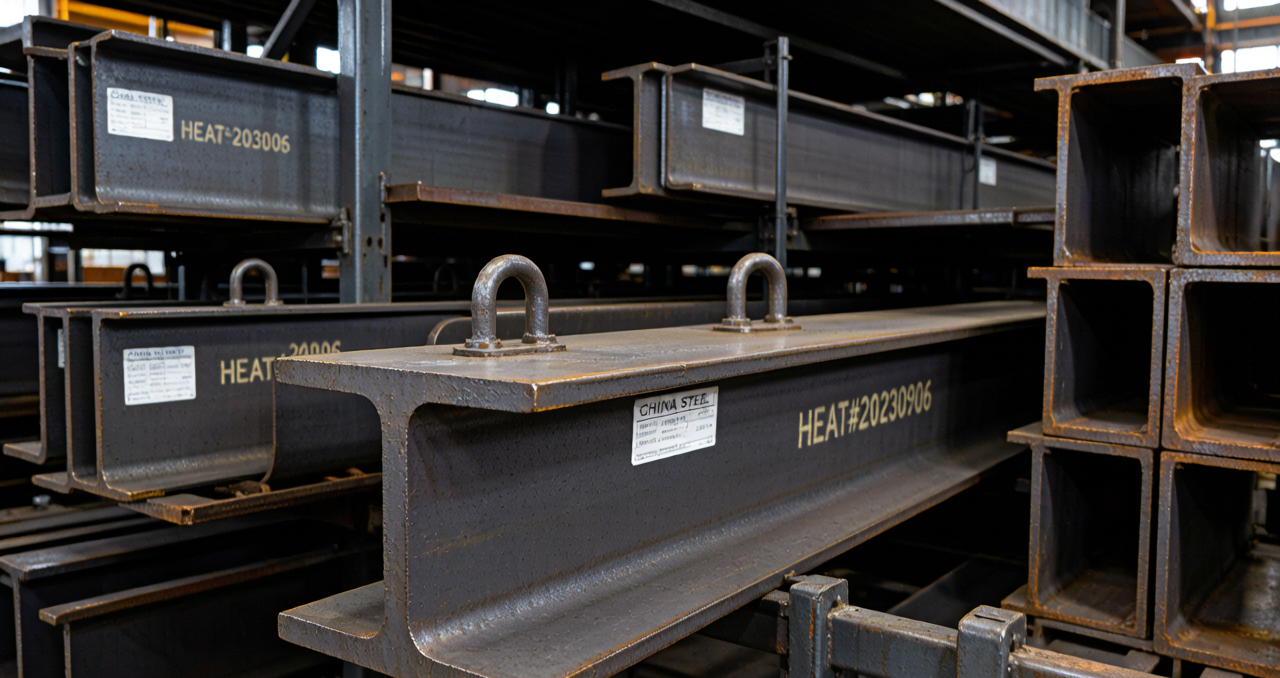
ASTM A36 I-beam (also called “S-shape”, “W-shape”, or “wide-flange beam” depending on profile geometry) is the default carbon steel section for primary building framing, mezzanines, equipment supports, walkways, conveyor trusses, and trailer cross-members. The classic H or I cross-section pairs long flanges with a thinner web to deliver bending efficiency for a given weight of steel, so the structural engineer specifies it for beams where deflection and stiffness control the design. Huaxia-Steel ships A36 I-beams mill-direct in standard sizes, with the MTC chain your QA team expects and the documentation your EPC review will accept.
Product Overview
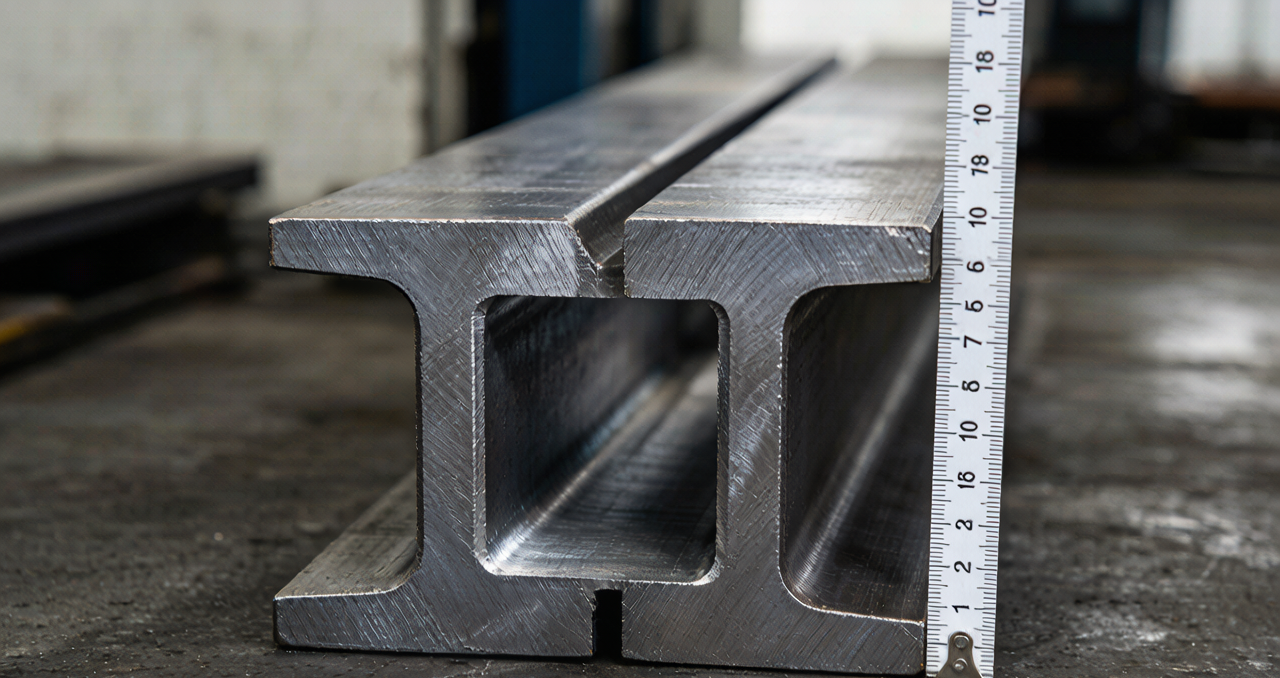
I-beams are hot-rolled from continuously cast billets through a series of universal-mill stands that shape the flange and web simultaneously. The resulting section is symmetric (in many sizes) with thick flanges tapering slightly toward the edge and a thinner web at mid-height. A36 is the most common domestic grade because of its 250 MPa minimum yield, weld-friendly chemistry, and wide commercial availability; higher-strength alternatives (A572 Gr.50, A992) are routinely dual-certified or substituted on engineering request.
Common applications include:
- Primary building frames in low- and mid-rise construction (beam, column, girder).
- Mezzanine floors, equipment platforms, walkways, catwalks.
- Conveyor trusses and supports for material-handling systems.
- Bridge girders (A36 historically, A572/A992 in modern design).
- Equipment skids and machinery supports.
- Trailer and truck frame rails.
- Crane runway beams (smaller cranes, lower duty cycle).
- Solar tracker torque tubes and pile caps.
Specifications
| Attribute | Typical Range |
|---|---|
| Section nomenclature | S-shape (American Standard I-beam), W-shape (wide-flange), HP-shape (bearing pile), M-shape (miscellaneous) |
| Depth (overall) | 3 in (76 mm) to 36 in (914 mm) standard; up to 40 in by agreement |
| Flange width | 2.33 in (59 mm) to 16.5 in (419 mm) standard |
| Flange thickness | 0.133 in to 1.94 in; average 0.25-1.0 in for typical sizes |
| Web thickness | 0.170 in to 1.16 in for typical sizes |
| Length | 20-60 ft (6.1-18.3 m) standard; custom cut-to-length on request |
| Steel grade | ASTM A36, ASTM A572 Gr.50, ASTM A992, dual-cert; Q235, Q345, SS400 on equivalent requests |
| Surface condition | Hot-rolled black (mill scale), shot-blasted, primed (red oxide or zinc-rich primer) |
| Camber tolerance | 1/8 in x length (in feet) / 10 = max camber in inches, per ASTM A6 |
| Sweep tolerance | 1/8 in x length (in feet) / 5 = max sweep in inches, per ASTM A6 |
| Mill test certificate | ASTM A6 supplementary test report; EN 10204 3.1 or 3.2 on request |
| Bundle packaging | Strapped bundles, lifting lugs, containerized or break-bulk; 4-corner protection |
Standard Sizes We Stock
The table captures the most common S-shapes (American Standard I-beams) and a selection of W-shapes (wide-flange beams) we ship from stock. Custom sizes and mill-direct orders run on a 30-45 days FOB schedule.
| Designation | Depth (in) | Flange Width (in) | Web Thickness (in) | Weight (lb/ft) | Stock Status |
|---|---|---|---|---|---|
| S3 x 5.7 | 3.00 | 2.330 | 0.170 | 5.7 | Mill-direct |
| S4 x 7.7 | 4.00 | 2.660 | 0.190 | 7.7 | Mill-direct |
| S5 x 10.0 | 5.00 | 3.000 | 0.210 | 10.0 | Mill-direct |
| S6 x 12.5 | 6.00 | 3.330 | 0.230 | 12.5 | Ex-stock |
| S6 x 17.25 | 6.00 | 3.565 | 0.350 | 17.25 | Mill-direct |
| S8 x 18.4 | 8.00 | 4.000 | 0.270 | 18.4 | Ex-stock |
| S10 x 25.4 | 10.00 | 4.660 | 0.310 | 25.4 | Mill-direct |
| S10 x 35.0 | 10.00 | 4.940 | 0.590 | 35.0 | Mill-direct |
| S12 x 31.8 | 12.00 | 5.000 | 0.350 | 31.8 | Ex-stock |
| S12 x 40.8 | 12.00 | 5.250 | 0.460 | 40.8 | Mill-direct |
| W4 x 13 | 4.16 | 4.060 | 0.280 | 13.0 | Ex-stock |
| W5 x 16 | 5.01 | 5.000 | 0.240 | 16.0 | Ex-stock |
| W6 x 9 | 5.90 | 3.940 | 0.170 | 9.0 | Ex-stock |
| W6 x 12 | 6.03 | 4.000 | 0.230 | 12.0 | Ex-stock |
| W6 x 16 | 6.28 | 4.030 | 0.260 | 16.0 | Ex-stock |
| W8 x 10 | 7.89 | 3.940 | 0.170 | 10.0 | Ex-stock |
| W8 x 18 | 8.11 | 5.250 | 0.230 | 18.0 | Ex-stock |
| W8 x 28 | 8.22 | 6.535 | 0.285 | 28.0 | Mill-direct |
| W10 x 22 | 10.17 | 5.750 | 0.240 | 22.0 | Ex-stock |
| W10 x 30 | 10.47 | 5.810 | 0.300 | 30.0 | Mill-direct |
| W12 x 26 | 12.22 | 6.490 | 0.230 | 26.0 | Mill-direct |
| W12 x 40 | 11.94 | 8.005 | 0.295 | 40.0 | Mill-direct |
| W14 x 30 | 13.84 | 6.730 | 0.270 | 30.0 | Mill-direct |
| W16 x 36 | 15.86 | 6.985 | 0.295 | 36.0 | Mill-direct |
| W18 x 40 | 17.71 | 7.495 | 0.315 | 40.0 | Mill-direct |
| W21 x 50 | 20.83 | 8.485 | 0.380 | 50.0 | Mill-direct |
| W24 x 68 | 23.73 | 8.965 | 0.415 | 68.0 | Mill-direct |
Standards and Grade Equivalence
| Standard | Grade | Yield (MPa) | Tensile (MPa) | Elongation | Typical Use |
|---|---|---|---|---|---|
| ASTM A36 | A36 | 250 | 400-550 | 23 % | General structural, beams and columns |
| ASTM A572 | Gr.50 | 345 | 450 min | 21 % | High-strength low-alloy beam |
| ASTM A992 | A992 | 345-450 | 450-620 | 18 % | Modern wide-flange standard |
| GB/T 706 | Q235 | 235 | 370-500 | 26 % | Chinese equivalent |
| GB/T 706 | Q345 | 345 | 470-630 | 21 % | Chinese high-strength |
| EN 10034 | S235JR/S275JR | 235/275 | 360-510 / 410-560 | 26 % / 23 % | European equivalent |
| JIS G3192 | SS400 | 245 | 400-510 | 21 % | Japanese equivalent |
| JIS G3192 | SM490 | 325 | 490-610 | 23 % | Japanese high-strength |
Why A36 for I-Beam
A36 has been the U.S. structural workhorse since the 1960s because it pairs a minimum 250 MPa yield with a relatively low carbon (0.25 % max in heat, 0.29 % in product). That gives good weldability, good formability, and the ductility to absorb overload without brittle fracture in non-seismic applications. The engineering community has shifted some wide-flange sections to A992 (45-65 ksi yield) for buildings because A992 specifies a tighter yield range that allows more consistent design margin, but A36 remains the go-to for non-building structures, equipment frames, and light commercial construction.
The A572 Gr.50 route is the upgrade path for higher-strength requirements. Yield rises to 345 MPa, thickness range tightens, and Columbium-Vanadium alloying (where used) gives better toughness at cold temperatures.
Quality Assurance
Each heat is sampled at the mill; tensile, chemistry, and dimensional check. Each beam is shipped with a mill stamp or label tied to the heat test report.
- Chemistry: C, Mn, Si, P, S verified per heat per ASTM A36 chemistry window.
- Tensile: yield (ReH or Rp0.2), ultimate, elongation per ASTM A370 / A6.
- Dimensional: depth, flange width, flange thickness, web thickness, length, camber, sweep per ASTM A6.
- Visual: surface defects, flange and web alignment.
- Optional tests: Charpy impact (for cold-service applications), ultrasonic examination for special acceptance criteria, plate-into-beam welding procedure verification.
Heat marking is required by ASTM A6 and appears as a permanent stamp or paint marking on each beam end. The marking identifies the producer, the heat number, and the section designation so QA can trace each beam back to its heat test report.
Applications and Engineering Notes
Building beams and columns: W-shapes from W8x18 to W36x300 dominate primary building frame design in U.S. commercial construction. A36 (legacy) or A992 (current) with bolted end-plate or welded flange connections.
Equipment supports: Light cranes, conveyor trusses, machine bases, and HVAC supports typically use W6 through W14 sections in A36 or A572 Gr.50.
Bridge girders (low-traffic, short span): W-shapes with cover plates welded to the flanges are a classic rolled-beam bridge design. A36 is sufficient for short-span, non-seismic applications; A572 Gr.50 is required when additional capacity is needed.
Solar tracker torque tubes: W-shapes with the web horizontal have been used as ramming posts and torque tubes in utility-scale solar PV. Hot-dip galvanizing is common.
Trailer and chassis frames: S-shapes from S6x12.5 to S12x31.8 form the longitudinal rails of trailers, truck frames, and agricultural machinery. A36 is the standard grade.
Crane runways: W-shapes carry the runway beams for indoor bridge cranes and jib cranes. For higher-capacity cranes, A572 Gr.50 or A992 is preferred.
Ordering Information
When requesting a quotation, please specify:
- Section designation (S-shape or W-shape, with full designation, e.g., “W12x26” or “S6x17.25”).
- Length in feet or meters.
- Steel grade (ASTM A36 / A572 Gr.50 / A992 / dual-certified).
- Surface condition: hot-rolled black, shot-blasted, primed, or galvanized.
- End preparation: standard mill end, cropped square, miter cut, drilled/coped.
- Tolerances (ASTM A6 standard or tighter for special applications).
- Special tests: Charpy impact, ultrasonic, fracture-critical (FCAW requirements).
- Mill test certificate level (A6 supplementary test report, EN 10204 3.1 or 3.2).
- Bundle packaging and marking: bundle size, lifting lugs, container vs. break-bulk, heat markings.
- Quantity in tons or pieces per size.
- Destination port and Incoterm.
Packaging and Shipment
- Container: 20-ft container limits beam length to about 6 m; 40-ft HC extends to about 12 m for many W-shapes. Long beams usually go break-bulk.
- Break-bulk: strapped bundles with steel banding, sling points, corner protection, and pine dunnage at the bottom. Containerized beams for export typically use steel-framed wooden bunk beds.
- Lead time: ex-stock W-shapes ship in 10-20 working days. Mill-direct shapes ship 25-45 working days.
- Documents: commercial invoice, packing list, MTC, country of origin, B/L, insurance, and any FTA certificate you need.
Frequently Asked Questions
What is the difference between S-shape and W-shape?
S-shape (American Standard) is the older I-beam with narrower flanges relative to depth, with the inside flange surfaces sloped at roughly 16 2/3 %. W-shape is the modern wide-flange with parallel inside flange surfaces and equal width across the flange thickness. W-shapes are the dominant beam type today.
Is A36 still allowed in modern U.S. building design?
Yes. A36 is referenced by AISC 360 for general structural shapes. A992 is preferred for W-shapes because of its tighter yield window (345-450 MPa), which gives design engineers more consistent values. A36 remains common for plates and angles, and for some older specified structures.
How do I cross an A36 W-shape to a European project?
Map A36 W-shapes to EN 10034 IPE / HEA / HEB / HEM sections; chemistry maps to S235JR for A36 S-shapes and to S275JR or S355JR for higher strength. Cross-reference the moment of inertia rather than the section designation; the design capacities differ. We can ship to both EN and ASTM standards on the same heat if your project is bi-standard.
Can beams be hot-dip galvanized?
Yes. We regularly supply hot-dip galvanized beams to ASTM A123 / ISO 1461 specification. Zinc mass 75-150 micrometers (550-1075 g/m2) is typical. Pre-galvanized handling and venting design matter for long enclosed sections to avoid trapped-acid boilover during pickling.
Can you cut beams to length and ship them ready to install?
Yes. Saw cutting, miter cutting, coped ends, and drilled hole patterns are available through our downstream services. We ship from the mill with the fabrication complete, ready for site erection.
Request a Quotation
Send your section designations, lengths, grade, end-prep requirements, and destination port to [email protected]. We return a mill-direct offer with MTC, packaging, and the lead time you can schedule into your project’s procurement plan.
Browse Huaxia-Steel for additional structural sections, channels, angles, and mill-direct plate and bar products.
Related Images