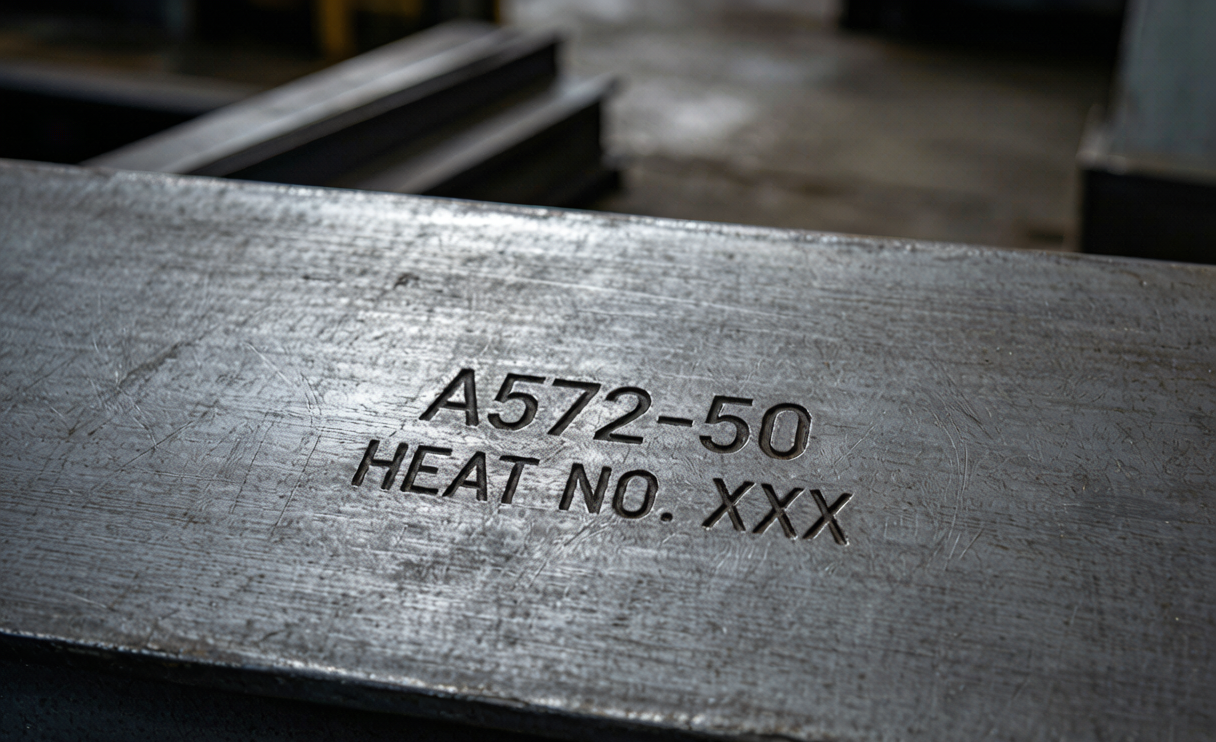
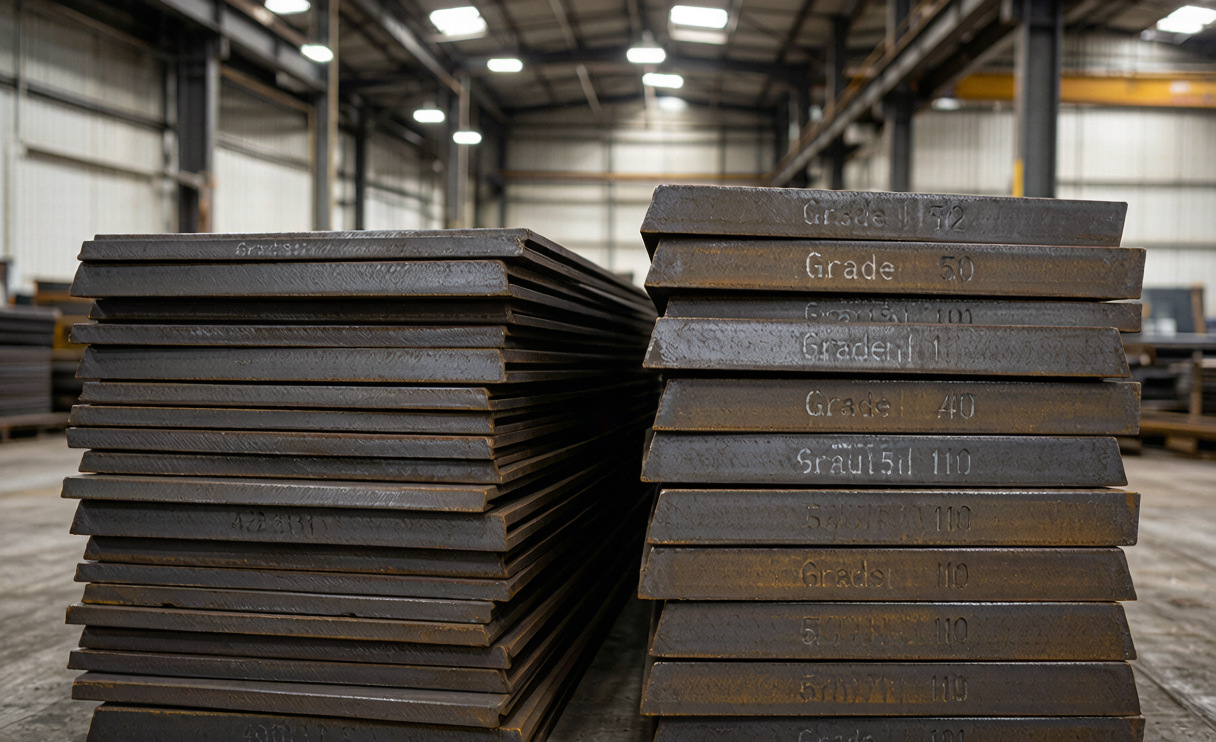
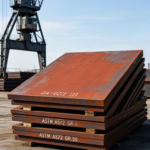
ASTM A572 Grade 42 vs Grade 50 Carbon Steel Plate Comparison
The structural engineer spec writing for a building, bridge, or transmission tower almost always lands on ASTM A572 plate. But “A572” alone is incomplete – the grade number drives the strength, the chemistry, and the price. Picking the wrong grade either over-specifies the steel (and inflates cost) or under-specifies it (and forces a redesign at the worst moment).
This guide compares ASTM A572 Grade 42 and Grade 50 by chemistry, mechanical properties, weldability, applications, price, and RFQ tips so you can size the plate correctly for your project and source it efficiently from Chinese mills.
1. What ASTM A572 Covers
ASTM A572/A572M is the standard specification for high-strength low-alloy columbium-vanadium structural steel plates. It defines five strength grades by minimum yield point:
- Grade 42 – minimum yield 290 MPa (42 ksi)
- Grade 50 – minimum yield 345 MPa (50 ksi)
- Grade 55 – minimum yield 380 MPa (55 ksi)
- Grade 60 – minimum yield 415 MPa (60 ksi)
- Grade 65 – minimum yield 450 MPa (65 ksi)
Grades 42 and 50 are the most specified worldwide for buildings, bridges, and general construction. Grades 60 and 65 are reserved for high-stress applications and are less common in Chinese mill stock.
2. Why Grades 42 and 50 Matter Most
Around 70 percent of the structural plate bought internationally each year falls in the A572 Gr.42 to Gr.50 range. That is because:
- Gr.42 is the lowest-cost A572 grade and replaces ASTM A36 in many weight-critical designs.
- Gr.50 hits the sweet spot of strength, weldability, and availability for buildings, bridges, and heavy equipment.
- Chinese mills keep both grades in standard stock up to 100 mm thickness with 1-3 week lead times.
3. Chemical Composition Side-by-Side
| Element | Gr.42 max % | Gr.50 max % | Notes |
|---|---|---|---|
| C | 0.21 | 0.23 | Higher carbon in Gr.50 raises strength but lowers weldability slightly |
| Mn | 1.35 | 1.35 | Same manganese ceiling, typically 1.0-1.2% in practice |
| P | 0.030 | 0.030 | Tight phosphorus limit for improved through-thickness ductility |
| S | 0.030 | 0.030 | Tight sulfur limit for clean steel |
| Si | 0.30-0.50 | 0.30-0.50 | Same silicon range, killed steel |
| V | 0.01-0.15 | 0.01-0.15 | Vanadium is the primary microalloy |
| Nb (Cb) | 0.005-0.05 | 0.005-0.05 | Columbium is the secondary microalloy |
The two grades are very similar chemically. The strength gap comes mainly from thermomechanical rolling and the response of the columbium-vanadium microalloys to grain refinement.
4. Mechanical Properties
| Property | Grade 42 | Grade 50 |
|---|---|---|
| Minimum yield strength | 290 MPa (42 ksi) | 345 MPa (50 ksi) |
| Tensile strength | 415-585 MPa (60-85 ksi) | 450-620 MPa (65-90 ksi) |
| Elongation in 200 mm | 20% | 18% |
| Elongation in 50 mm | 24% | 21% |
| Impact requirement (default) | Not specified | Not specified |
| Brinell hardness | Typically 130-160 HB | Typically 140-180 HB |
Gr.50 is roughly 19 percent stronger than Gr.42 in yield. For a fixed load, the plate thickness can typically be reduced by 12-15 percent, saving 10-15 percent of steel tonnage in heavy fabrications.
5. Weldability Comparison
Both grades are readily welded using common arc-welding processes (SMAW, GMAW, FCAW, SAW). The carbon equivalent (CEV) typically sits in the 0.38-0.45 range for both grades, well below the 0.50 threshold where preheat becomes mandatory in most codes. In practice:
- Up to 19 mm thickness: No preheat required for either grade when ambient temperature is above 10 degrees C.
- 20-38 mm thickness: Preheat to 65-95 degrees C recommended for Gr.50 in cold weather.
- Above 38 mm: Preheat 95-150 degrees C for both grades, especially under high restraint.
Because the chemistry is so close, both grades respond similarly to heat input. Avoid excessive heat input above 2.0 kJ/mm that can coarsen the heat-affected zone (HAZ) and reduce toughness.
6. Formability and Forming
| Forming operation | Grade 42 | Grade 50 |
|---|---|---|
| Minimum inside bend radius (cold, t = plate thickness) | 2t through 25 mm | 2t through 25 mm; 3t above 25 mm |
| Hot forming | Recommended above 950 degrees C | Recommended above 980 degrees C |
| Stamping / punching | Easy below 16 mm | Easy below 12 mm; preheat above |
| Roller bending | Standard | Slightly higher springback |
Gr.42 cold-forms more easily. Gr.50 has marginally higher springback – the fabricator should expect a 5-10 percent greater bend allowance when planning cold rolling of thick plate.
7. Typical Applications
- Grade 42: Light structural members, transmission towers, light roof trusses, storage tank shells, highway sign supports, agricultural equipment frames, mining skips.
- Grade 50: Building columns and beams, bridge girders, cellular beams, heavy equipment platforms, mobile crane booms, offshore jackets (above splash zone), wind tower flanges and base plates, high-rise buildings, large pipe racks.
8. Weight and Cost Savings with Grade 50
Take a 50-metre span of a building column receiving 12 MN of axial load:
- Gr.42 plate: Would use a 32 mm thick plate sized by 290 MPa allowable stress.
- Gr.50 plate: The same load can be carried by a 28 mm thick plate – saving roughly 14 percent of plate weight.
In mid-2026 Chinese mill pricing:
- A572 Gr.42 plate: USD 540-620 per tonne FOB for 6-50 mm.
- A572 Gr.50 plate: USD 580-680 per tonne FOB for 6-50 mm.
Spread per tonne is small – usually USD 30-60 – but the thinner plate brings material savings that often beat the premium. For heavy tonnage orders, Gr.50 is almost always the lower life-cycle cost.
9. Substitutions and Equivalents
| ASTM A572 grade | EN equivalent | JIS equivalent | Chinese GB |
|---|---|---|---|
| Gr.42 | S275JR / S275J0 (275 MPa yield) | SM400A / SM400B | Q275 |
| Gr.50 | S355JR / S355J0 (355 MPa yield) | SM490A / SM490B | Q345 |
| Gr.55 | S420 | SM520 | Q420 |
| Gr.60 | S460 | SM570 | Q460 |
Many mills offer dual certification. A572 Gr.50 typically meets S355JR/J0 by chemistry and mechanical values. Always confirm the MTC for both standards when bidding to international projects.
10. Standards Referenced in A572
- ASTM A572/A572M – Standard specification for HSLA columbium-vanadium steel plates
- ASTM A6/A6M – General requirements for rolled structural plates
- ASTM A20/A20M – General requirements for pressure vessel plates (often dual-certified)
- EN 10025-2 – Hot-rolled products of structural steels (S275, S355)
- JIS G3106 – Rolled steels for welded structures (SM400, SM490)
- GB/T 1591 – High-strength low-alloy structural steels (Q345, Q420)
11. RFQ Tips for Chinese Mills
- State the grade exactly – “ASTM A572 Gr.50” not “A572 high-strength”.
- Specify thickness range and the tolerance per ASTM A6 or EN 10029.
- State the impact requirement if any (default is none; cold-service codes may add Charpy tests at -20 degrees C or -40 degrees C).
- Confirm dual or multi-standard certification requested.
- Ask for MTC to EN 10204 3.1 (the most common mill certificate type for A572 plate).
- For welded structures, specify the maximum heat input and the CVN requirement on the heat-affected zone.
12. Common Mistakes to Avoid
- Specifying “A572” without the grade number – the mill will default to Gr.50 if not told.
- Confusing Gr.50 with Gr.50S (a higher-strength variant sometimes referenced in bridge codes).
- Using A572 for pressure vessel duty – this is a structural plate, not a boiler plate (use A516 for that).
- Ignoring the supplementary requirements (S1, S2, S3, S5) when impact, vacuum, or through-thickness testing is needed.
FAQ
Is ASTM A572 the same as A36?
No. A36 has a minimum yield of 250 MPa; A572 Gr.42 is 290 MPa and Gr.50 is 345 MPa. A572 also has tighter chemistry and is microalloyed.
Can A572 Gr.42 replace A36?
Usually yes – the strength is higher, the chemistry tighter, and A36 is no longer widely stocked in many markets. Many mills now produce A572 Gr.42 as the A36 replacement.
Does A572 plate need normalizing?
No. A572 plate is supplied in the as-rolled condition or thermomechanical-rolled. Normalizing is reserved for special supplementary requirements.
Is Gr.50 weldable to Gr.42?
Yes. The two grades have very similar chemistry and CEV, so they can be welded together with standard procedures. Use a matching low-hydrogen electrode such as E7018.
Which grade costs more: Gr.42 or Gr.50?
Gr.50 typically costs USD 30-60 per tonne more than Gr.42 in mid-2026. The higher price is offset by thinner plate required for the same load.
Conclusion
The ASTM A572 Gr.42 vs Gr.50 decision is about strength per tonne, with Gr.42 the low-cost option for light structures and Gr.50 the workhorse grade for high-load buildings, bridges, and heavy equipment. State the grade by number, dual-list any equivalent standards, ask for EN 10204 3.1 certification, and the mill will quote accurately.
Sourcing ASTM A572 plate from China? Huaxia-Steel supplies Gr.42, Gr.50, and dual-standard structural plate with mill test certificates, third-party inspection, and project packing. Send the project specification, plate quantity, and the delivery window, and our team will deliver a full offer within one working day.
Related Images