Q345B vs S355JR Carbon Steel Cross-Reference: Chemistry, Mechanical, and Procurement
Q345B and S355JR are the most widely specified structural carbon steels in China and Europe respectively. They overlap in tensile strength, are routinely treated as equivalents, and show up in cross-border tenders where buyers expect interchangeable supply. However, Q345B (per GB/T 1591) and S355JR (per EN 10025-2) are not identical. Differences in impact test temperature, delivery condition, CEV limits, and document format (China’s MTC GB/T 19001 vs EN 10204 3.1) can derail procurement, mix-ups in welding procedure qualification, or rejection at port of discharge.
This guide compares Q345B and S355JR side-by-side and explains when substitution is acceptable, when it is not, and how to avoid costly substitutions in plate, sheet, H-beam, channel, and pipe.
1. Standards and Grade Definitions
Both designations cover hot-rolled structural carbon-manganese steel products but originate from different national standards.
- Q345B – GB/T 1591-2018 “High strength structural steels in quenched and tempered (or normalized) state.” Letter “Q” stands for yield strength in MPa; “345” means minimum 345 MPa yield; “B” is the impact test grade at +20 degrees C.
- S355JR – EN 10025-2:2019 “Hot rolled products of structural steels – Part 2: Technical delivery conditions for non-alloy structural steels.” “S” stands for structural steel; “355” means minimum 355 MPa yield for thickness up to 16 mm; “JR” is the impact grade at +20 degrees C (>=27 J).
Both are non-alloy structural steels. Both can be supplied in as-rolled (AR), normalized (N), or thermomechanical (TMCP) delivery conditions. The naming convention is closer than the chemistry envelope.
2. Chemical Composition Comparison
Carbon and manganese ranges overlap significantly; the most notable differences are silicon, phosphorus, and sulfur ceilings, plus CEV (carbon equivalent value) limits.
| Element | Q345B (GB/T 1591) % | S355JR (EN 10025-2) % | Notes |
|---|---|---|---|
| C (max) | 0.20 (≤16 mm) / 0.20 (>16 mm) | 0.24 (≤40 mm nominal) | S355JR allows slightly higher C in heavier plate. |
| Si | 0.50 | 0.55 (higher allowed with agreement) | Comparable. |
| Mn | 1.20-1.70 | 1.60 max (typical 1.0-1.6) | Q345B has a tighter Mn floor. |
| P (max) | 0.035 | 0.030 (for product analysis 0.040) | S355JR slightly cleaner for P. |
| S (max) | 0.035 | 0.030 (for product analysis 0.040) | S355JR slightly cleaner for S. |
| Cu (max) | 0.40 | 0.55 | Both allow residual Cu from scrap. |
| Nb / V / Ti | Microalloyed: Nb 0.07 max; V 0.15 max; Ti 0.20 max | Microalloyed: Nb 0.05 max; V 0.02-0.15; Ti 0.05 max | Q345B typically allows higher Ti for grain refinement. |
| CEV (max, typical) | 0.45 (≤16 mm); 0.47 (>16 mm) | 0.45 (≤30 mm); 0.47 (>30 mm) | Comparable. CEV drives weldability. |
For most structural sections the heats will analyze inside either envelope, especially when both are produced by modern ArcelorMittal/Tangsteel-type mills using TMCP routes.
3. Mechanical Property Comparison
Mechanical minima are close but not identical across thickness:
| Property | Q345B (≤16 mm) | S355JR (≤16 mm) | S355JR (16-40 mm) |
|---|---|---|---|
| Yield Strength ReH (min, MPa) | 345 | 355 | 345 |
| Tensile Strength Rm (MPa) | 470-630 | 470-630 | 470-630 |
| Elongation A5 (min, %) | 21 (for thickness class) | 22 | 22 |
| Impact Energy KV (min, J) at +20 degrees C | 34 (longitudinal, 10x10x55 mm) | 27 (longitudinal) | 27 |
| Impact Test Temperature | +20 degrees C (Grade B) | +20 degrees C (Grade JR) | +20 degrees C |
| Item | Q345B | S355JR | Direct Substitution? |
|---|---|---|---|
| Yield (≤16 mm) | 345 MPa | 355 MPa | Yes (S355JR is slightly higher). |
| Yield (16-40 mm) | 345 MPa | 345 MPa | Yes. |
| Impact at +20 degrees C | 34 J min | 27 J min | Q345B is more conservative; meets S355JR. |
| Weldability (CEV) | 0.45 max | 0.45 max | Yes. |
| Document standard | GB/T 1591 + GB/T 19001 MTC | EN 10025-2 + EN 10204 MTC | MTC may need translation for cross-border customs. |
| H-beam section per standard | GB/T 706 (Q345) | EN 10034 (S355JR) | Dimensions differ; check section index. |
| Plate per standard | GB/T 3274 (Q345) | EN 10029 or EN 10051 (S355JR) | Thickness tolerance will vary slightly. |
6. Weldability and CEV Considerations
Both grades have a CEV around 0.45 max, which puts them in the “readily weldable” category without preheating for thin sections. For thicker plate (> 25 mm), preheating to 100-150 degrees C is recommended for both grades. Carbon equivalent (CEV) is calculated by:
CEV = C + Mn/6 + (Cr+Mo+V)/5 + (Ni+Cu)/15
Heat input must be controlled per ISO 13916 or AWS D1.1 to stay below 1.5 kJ/mm for both. For procedures where Europe and Chinese materials meet on the same weld joint, match weld procedure to the higher CEV of the assembly.
7. Forms and Products Available
Q345B and S355JR cover a wide range of structural products. Common offerings:
- Plate: 3 mm to 200 mm, widths 1500-4000 mm.
- Sheet: 1.5 mm to 6 mm cold-formed downstream.
- H-beam: 100 x 100 to 1100 x 400 sections.
- Channel: C5 to C30 sections, UPE/UPN.
- Angle: 50 x 50 to 200 x 200 equal leg, unequal leg on request.
- Pipe (ERW / seamless): OD 21.3 mm to 610 mm, wall 2 mm to 30 mm.
- RHS / SHS: square and rectangular hollow sections for columns and trusses.
8. Typical Applications
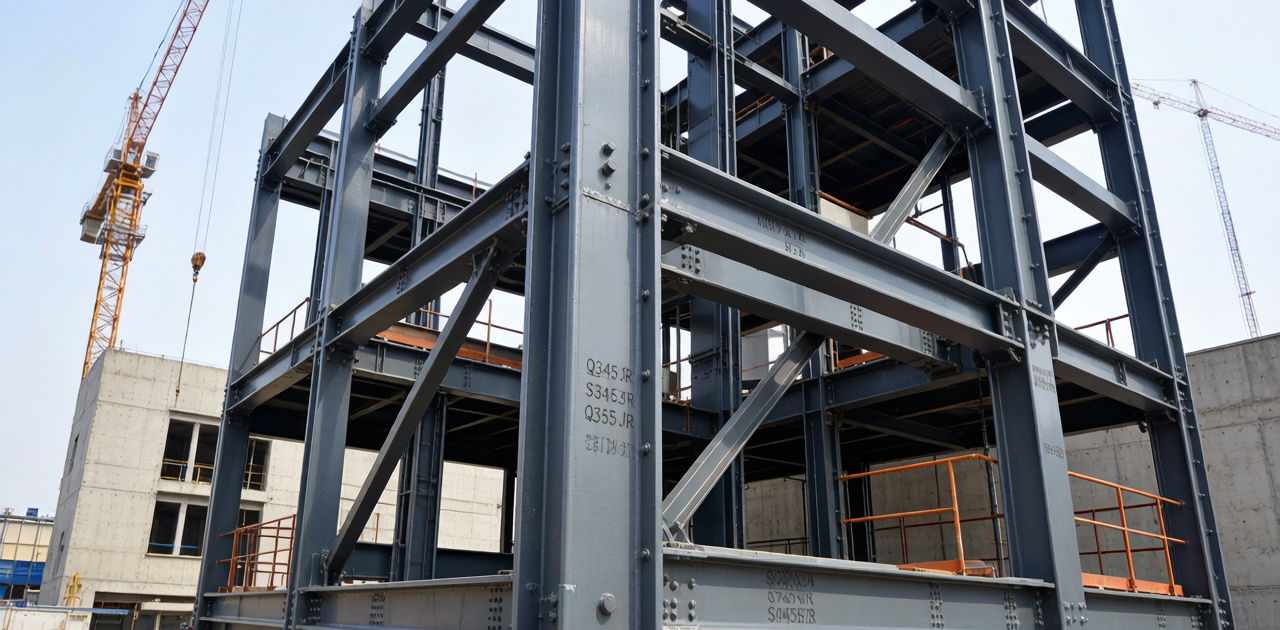
- Building frames for high-rise (Q345B / S355JR columns and beams).
- Industrial plant structures, warehouses, hangars.
- Bridge girders, crane booms, truck frames.
- Offshore modules – the JR / B grade is acceptable for non-Arctic service; for low temperature see Q345D, Q355NH, S355NL, or S355ML.
- Railway wagon fabrication, mining truck bodies.
- Tower masts for wind turbines (with specific fatigue and through-thickness requirements).
9. Procurement and Documentation Differences
| Aspect | Q345B (China) | S355JR (Europe) |
|---|---|---|
| Mill Test Certificate standard | GB/T 19001 (Chinese) or EN 10204 3.1 (also issued by Chinese mills on request) | EN 10204 3.1 mandatory; 3.2 available |
| Standard marking | “Q345B” or grade + heat number (Chinese style) | “EN 10025-2 S355JR” or “1.0045” + heat number |
| Traceability | Standard 3.1 with Chinese text + English translation common | EN 10204 3.1 in English / German / French standard |
| Inspection agency | China CCS, CGC, SGS, BV | TUV, SGS, BV, Bureau Veritas |
| Lead time | 10-25 days from mill | 15-40 days from European mills |
| Typical price (2026, FOB) | USD 520-580 per ton plate 10 mm (China) | USD 600-680 per ton plate 10 mm (EU mills) |
The price gap is real and predictable. For mega projects where thousands of tons are tendered, importers prefer to source Q345B from China and have it dual-certified – meaning EN 10204 3.1 MTC is issued alongside the GB/T 1591 certificate. Many Chinese mills comply when this is requested in the RFQ.
10. When to Substitute and When Not to
You can specify either grade in place of the other for the following cases:
- Hot-rolled plate up to 40 mm for non-critical structural use.
- H-beam and channel sections for building columns and beams.
- Welded steel structures where the welding procedure controls CEV; not the steel.
- Standard fabrication tolerances and test temperatures +20 degrees C or higher.
You cannot simply substitute when:
- The design calls for sub-grade impact at -20 degrees C or colder (need Q345D, Q345E, S355J0, S355J2, S355K2).
- The design code (EN 1993, AISC 360, GB 50017) requires specific impact grade variants.
- Through-thickness (Z-direction) testing is required, often with a higher sulfur control limit.
- The pressure equipment directive (PED 2014/68/EU) requires CE marking; in that case EN 10025 + EN 10204 is mandatory.
- Project is bound to ASME / ASTM specifications (e.g., ASTM A572 Grade 50 is the U.S. equivalent; check before mixing).
11. Pre-Shipment Inspection Tips
Before accepting a shipment of either grade, run a quick pre-shipment inspection:
- Visual check: heat number on each plate / beam should match the MTC.
- Sample dimension: thickness, width, flatness, camber within tolerance.
- MTC verification: ask the mill to issue EN 10204 3.1 (rather than only GB/T 19001) if you need European compliance.
- Random impact test on selected samples if your project is high-liability (e.g., bridges).
- Surface check: no cracks, scabs, or excessive scale.
12. Frequently Asked Questions
Q1: Are Q345B and S355JR exactly the same?
Not exactly. Yield strength differs by 10 MPa at thickness ≤16 mm; impact test minimums differ (34 J vs 27 J); and the documentation standards differ. For most general structures, mechanical properties overlap. Standards documentation needs cross-translation.
Q2: Can I use Q345B in place of S355JR in an EU-certified weld?
Only if the Q345B material is delivered with EN 10204 3.1 (or 3.2) MTC and complies with EN 10025-2 mechanical minima. Most Chinese mills can issue dual-certified 3.1 MTC if requested in the RFQ.
Q3: Which is cheaper in 2026?
Q345B from China is typically 10-15% cheaper than S355JR from European mills on FOB terms. The gap widens with thicker plate and special impact grades.
Q4: Does S355JR corrode slower than Q345B?
No. Both are non-alloy carbon-manganese steels with similar atmospheric corrosion rates. For improved corrosion resistance, choose Q355NH, Q355GNH, S355J0WP, or S355J2W (weathering grades).
Q5: Is Q345B weldable without preheating?
For thin sections (≤10 mm) and CEV around 0.40, preheating is usually not required. For thicker sections or high heat-input welds, preheat to 100-150 degrees C per EN 1011-2 or AWS D1.1 Table 3.2.
Q6: What thickness is each grade practical for?
Q345B is widely available 3-200 mm plate and up to 1100 x 400 H-beams. S355JR from European mills typically covers 5-100 mm plate for stock items; thicker on order.
13. Conclusion
Q345B and S355JR are practical equivalents for general structural use, with a small yield strength gap at thin sections and matching impact toughness at +20 degrees C. The decision between them typically comes down to project location, code compliance, documentation language, and price. When in doubt, request dual-certified EN 10204 3.1 MTC from your Chinese mill, and verify dimensions to the regional standard (GB vs EN) before fabrication.
Huaxia-Steel supplies both Q345B and S355JR in plate, H-beam, channel, angle, and pipe, with dual GB/T and EN 10204 certification available on request. Request a quotation with project specifications, required thickness range, and destination.
Related Images
Related Posts: