Forged Carbon Steel vs Cast Steel: A Buyer’s Guide
Introduction: Forging or Casting — Does the Process Matter?
When a buyer sends a drawing for a carbon steel component — a valve body, a gear blank, a shaft, a flange — the supplier’s first question is often: forged or cast? The answer changes the price by 30 – 200%, the lead time by weeks, and the failure behavior of the part in service. Yet many purchase orders simply say “carbon steel, per drawing” and let the factory choose.
This guide explains how forged and cast carbon steel are made, how their properties and defects differ, what each process costs, and how buyers should decide — with the vocabulary to specify the right process on the purchase order.
How Each Process Works
Forging shapes solid metal by compressive force — hammer, press, or rolled rings — at 1,100 – 1,250°C. The steel never melts. Grain flow follows the part’s shape, producing a continuous fibrous structure aligned with the geometry. Forging comes in two families: open-die (blocks, shafts, discs up to hundreds of tonnes) and closed-die (repetitive near-net shapes like crankshafts and connecting rods).
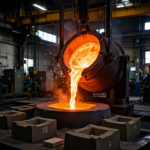
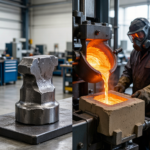
Casting pours liquid steel at about 1,600°C into a mold — sand, investment, or permanent die — and lets it solidify into the final shape. Casting produces complex internal passages and hollow geometries that forging cannot reach, but the metal solidifies from liquid with all the metallurgical risks that implies.
Mechanical Properties: The Data
Representative values for a 0.25 – 0.35% C carbon steel, same chemistry, both processes:
Property
Forged (normalized)
Cast (normalized)
Why
Yield strength
≥ 275 MPa
≥ 240 MPa
Cast dendritic structure is coarser
Tensile strength
500 – 620 MPa
450 – 590 MPa
Forging consolidates the structure
Elongation
≥ 22%
≥ 18%
Casting porosity reduces ductility
Impact energy (KV)
35 – 60 J
20 – 40 J
Grain flow and denser structure
Fatigue limit
High
15 – 25% lower
Casting defects act as crack starters
Internal soundness
Dense, defect-free
Porosity and shrinkage possible
Liquid-to-solid shrinkage
The headline: forging gives higher toughness and fatigue life; casting gives shape freedom. Neither is “better” — they solve different problems.
Defects: What Can Go Wrong in Each
Process
Typical Defects
Detection
Forging
Laps and cold shuts (folded surface), incomplete fill, decarburization, inclusion stringers
Magnetic particle / penetrant on surfaces; UT for internal soundness
Casting
Gas porosity, shrinkage cavities, hot tears, sand inclusions, centerline segregation
Radiography (RT) is the gold standard; UT for heavy sections
Buyer note: castings demand a defined NDE acceptance level. Specify RT per ASME B16.34 or MSS SP-55 for valves and fittings, and state the acceptance class (e.g., “Class II per MSS SP-55”). An order that says “cast steel, no NDE specified” invites the lowest-cost foundry practice.
Cost and Lead Time Reality
Factor
Forging
Casting
Tooling cost
High for closed-die (dies); low for open-die
Pattern/tooling cost moderate; lower for one-offs
Unit cost at volume
Low once dies amortized (closed-die)
Flat across volumes; best for complex one-offs
Machining allowance
Larger (2 – 10 mm)
Small (1.5 – 4 mm); near-net possible
Lead time
4 – 10 weeks (open-die); 12+ weeks with new dies
4 – 8 weeks
Weight range
0.5 kg – 300+ tonnes
0.1 kg – 200 tonnes
When Buyers Should Choose Forging
Shafts, spindles, axles, and any part loaded in rotating bending — fatigue governs.
High-pressure flanges, blocks, and pressure-retaining bodies where internal soundness is critical (per ASME B16.5, most Class 1500+ flanges are forged).
Parts that will be heat-treated to high hardness — forged structures respond more uniformly.
Components where the drawing says “no internal defects” or specifies UT acceptance.
When Buyers Should Choose Casting
Complex geometry: internal passages, hollow valve bodies, pump casings, housings with ribs and bosses.
Parts where welding a fabricated alternative would be more expensive than casting.
Low-stress housings and frames where cost dominates and loads are static.
Artistic or irregular shapes impossible to forge or machine economically.
How to Specify on a Purchase Order
Forging: “Open-die forged per ASTM A668 Class F, normalized, EN 10204 3.1, UT per ASTM A388 acceptance level agreed.”
Casting: “Cast per ASTM A216 WCB (or A352 LCB for low temp), normalized, RT per MSS SP-55 Class II, EN 10204 3.1.”
Never write only “carbon steel body” — that phrasing lets the factory pick whichever scrap-bin process is cheapest that week.
Reference Standards Quick Table
Use
Forging Standard
Casting Standard
General carbon steel
ASTM A668 / EN 10250
ASTM A216 / EN 10213
Pressure parts
ASME B16.5 flanges (forged)
ASME B16.34 valves (cast)
Low temperature
ASTM A350 LF2
ASTM A352 LCB
Gears
ASTM A29 (1045/4140)
Rarely cast (tooth strength)
Frequently Asked Questions
1. Is forged steel always stronger than cast steel?
For the same chemistry and heat treatment, forged is stronger in ductility, impact toughness, and fatigue — typically 10 – 30% better on those metrics. Tensile strength differences are smaller. For static, low-load parts, cast is entirely adequate.
2. Why are valve bodies cast but flanges forged?
Valve bodies need internal flow passages only casting can form; flanges are simple shapes loaded in bending and pressure, where forged soundness and low cost win. The standards (B16.34 cast, B16.5 forged) reflect this division.
3. Can I use a casting to replace a failed forging?
Only with engineering review. If the part failed by fatigue, a casting will likely fail sooner. Check the failure mode first: fatigue → stay forged; wear or corrosion → casting with better alloy may actually last longer.
4. What inspection should I require for castings from a new supplier?
Minimum: chemical analysis + mechanical test coupons + RT of critical sections per MSS SP-55 Class II + dimensional report. For pressure service, add hydrostatic testing of the assembly and a PMI spot check.
5. How much cheaper is casting?
For simple solid shapes, forging is often competitive or cheaper. For complex hollow parts, casting is typically 30 – 60% cheaper than machining the same shape from a forged block — the block alone can cost more than the finished casting.
Conclusion
Forging and casting are different tools, not competing quality tiers. Forging buys toughness, fatigue life, and internal soundness; casting buys geometry and cost efficiency on complex parts. The expensive mistakes happen when buyers leave the process unspecified — the factory optimizes for its own capability, not your duty cycle.
If you require further information about our metal sheet products or architectural projects, please don’t hesitate to leave your contact details and message here.
Our team of experts will respond within 24 hours to continue the discussion and provide you with any additional information you requires.