Introduction: The Workhorse Forged Carbon Steel Grade
ASTM A105 is the most widely specified carbon steel forging grade for pressure piping components. It covers forged flanges, fittings, valves, and similar parts used in ambient and elevated-temperature service. If you buy carbon steel weld neck flanges, slip-on flanges, blinds, or high-pressure fittings in North America or on export projects, you will encounter ASTM A105 on almost every mill test certificate.
This guide explains the ASTM A105 carbon steel forging specification in plain language: what it covers, its chemistry and mechanical requirements, the difference between A105 and A105N, heat treatment, dimensional standards, and what buyers should verify before accepting delivery.
1. Scope and Product Forms
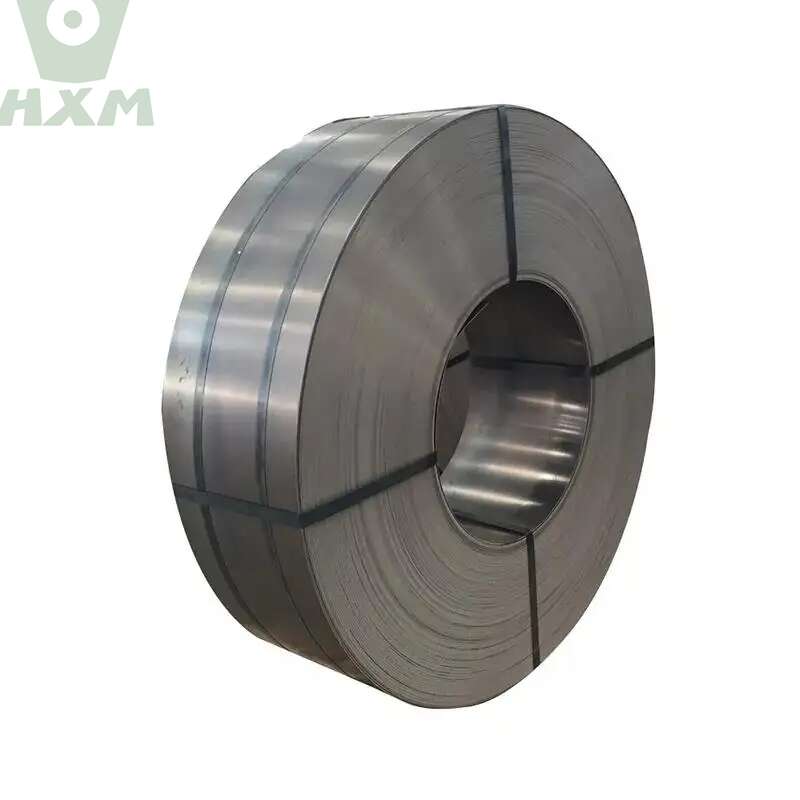
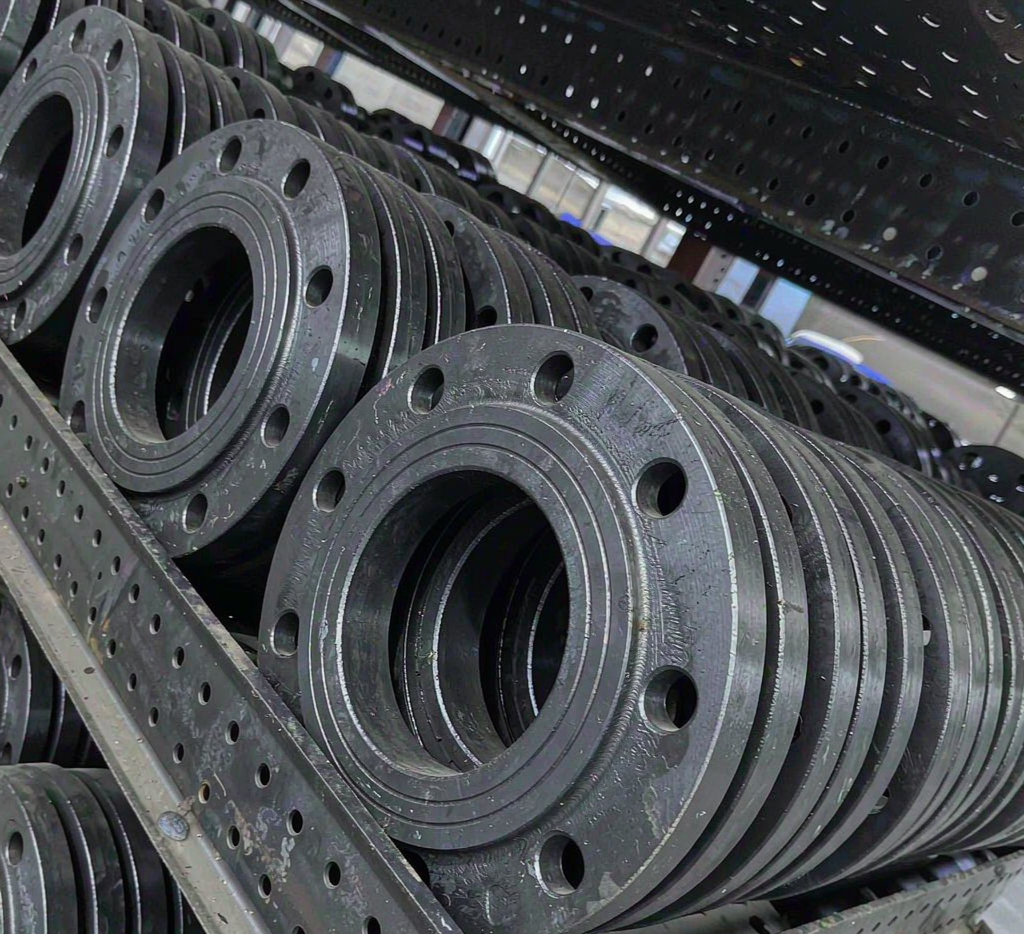
ASTM A105 / A105M applies to forged carbon steel piping components for use in pressure systems at ambient and high temperatures. Typical products include:
- Flanges: weld neck, slip-on, blind, socket weld, threaded, lap joint
- Fittings: elbows, tees, reducers, caps in forged construction
- Valve bodies, bonnets, and stems
- Plugs and bushings
It is not a bar, plate, or casting specification. If a component is machined from bar or plate, it should be ordered to ASTM A350 LF2, A694, or the applicable product specification, not A105.
2. Chemical Composition Requirements
| Element | Composition Limits |
|---|---|
| Carbon (C) | ≤ 0.35% |
| Manganese (Mn) | 0.60 – 1.05% |
| Phosphorus (P) | ≤ 0.035% |
| Sulfur (S) | ≤ 0.040% |
| Silicon (Si) | ≤ 0.10 – 0.35% |
| Copper (Cu) | ≤ 0.40% |
| Nickel (Ni) | ≤ 0.40% |
| Chromium (Cr) | ≤ 0.30% |
| Molybdenum (Mo) | ≤ 0.12% |
| Vanadium (V) | ≤ 0.08% |
The chemistry is essentially a normalized carbon-manganese steel with low residuals. A105 is not an alloy steel, but the specification caps each residual element to avoid unexpected toughness or weldability problems.
3. Mechanical Properties
| Property | Minimum Requirement |
|---|---|
| Tensile strength | ≥ 485 MPa (70 ksi) |
| Yield strength | ≥ 250 MPa (36 ksi) |
| Elongation | ≥ 22% in 50 mm |
| Reduction of area | ≥ 30% |
| Hardness | ≤ 187 HBW |
These values apply to the heat-treated condition as defined by the standard. The 187 HBW hardness limit is important for NACE MR0175 / ISO 15156 sour service when A105 is qualified for such use.
4. A105 vs A105N: The Normalization Difference
ASTM A105 permits two heat-treatment conditions:
- A105 (as-forged or annealed): component is forged and may be supplied in the as-forged condition, or it may be annealed, normalized, or normalized and tempered.
- A105N: the “N” stands for normalized. The forging is normalized after forging to refine grain size and improve toughness and consistency.
For critical or low-temperature service, buyers usually specify A105N because normalization produces a more uniform microstructure. Many large projects now simply require A105N as the default for all forged carbon steel flanges and fittings.
5. Dimensional and Pressure Standards
A105 is a material specification only; it does not define dimensions. Dimensions and pressure classes come from complementary standards:
- ASME B16.5: pipe flanges and flanged fittings, NPS 1/2 through 24, classes 150 – 2500.
- ASME B16.9: factory-made wrought butt-welding fittings.
- ASME B16.11: forged fittings, socket-welding and threaded.
- API 6A: wellhead and christmas tree equipment (when specified).
A purchase order should cite both the material spec (ASTM A105) and the dimensional standard (e.g., ASME B16.5 CL150 weld-neck flange).
6. Temperature Limits and Service Suitability
| Service Condition | A105 / A105N Guidance |
|---|---|
| Ambient to 538°C | Standard service per ASTM A105 |
| Below −29°C | Use A350 LF2 or LF3 for low-temperature toughness |
| Sour service (H₂S) | Requires hardness ≤ 187 HBW and NACE qualification |
| High-pressure hydrocarbon | Verify project-specific NDT and traceability rules |
For temperatures below −29°C, ASTM A105 is not the right grade. Specify A350 LF2, which has explicit Charpy impact requirements.
7. Buyer Verification Checklist
- Confirm material designation: A105 or A105N, and heat-treatment condition.
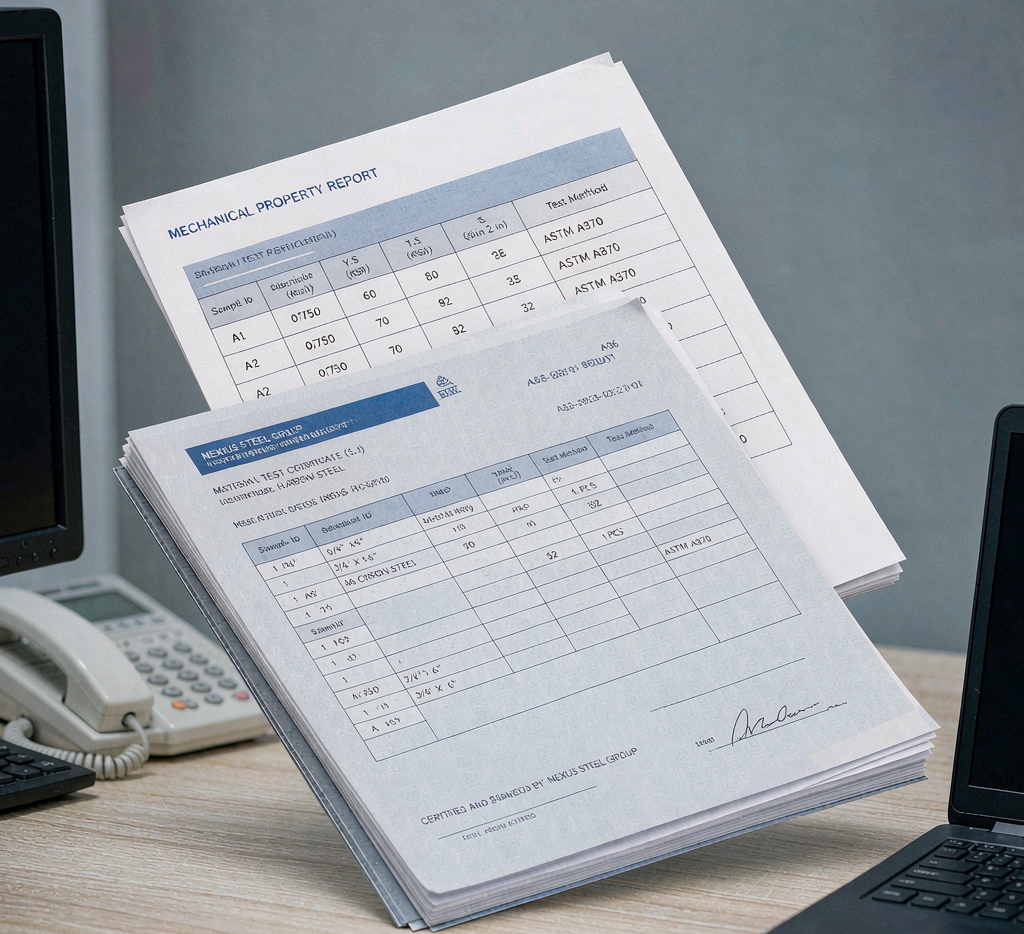
- Check MTC for tensile, yield, elongation, reduction of area, and hardness.
- Verify chemistry within ASTM A105 limits.
- Confirm dimensional standard (ASME B16.5, B16.9, B16.11).
- Review pressure class, facing type, and bore schedule.
- For low-temperature service, verify impact test results or switch to A350 LF2.
- Request third-party inspection (SGS, BV, TÜV) for critical orders.
Frequently Asked Questions
1. What is ASTM A105 used for?
ASTM A105 is used for forged carbon steel pressure piping components such as flanges, fittings, valves, plugs, and bushings in ambient to moderately high-temperature service.
2. What is the difference between A105 and A105N?
A105N is the normalized condition of A105. Normalization refines grain structure and improves toughness, making A105N the preferred choice for critical applications and low-temperature service.
3. Can ASTM A105 be used below −29°C?
No. A105 has no mandatory impact testing requirements and is not rated for low-temperature service below −29°C. Use ASTM A350 LF2 or LF3 for such conditions.
4. What is the hardness limit for A105?
The ASTM A105 specification sets a maximum hardness of 187 HBW. This limit is also the threshold commonly referenced for NACE MR0175 sour-service qualification.
5. Does A105 include dimensions and pressure classes?
No. A105 is a material specification only. Dimensions, pressure classes, and facing details come from standards such as ASME B16.5, B16.9, and B16.11.
Conclusion
ASTM A105 carbon steel forging is the default material for a huge range of pressure piping components. The key to buying it correctly is to specify not just “A105” but also the heat-treatment condition, dimensional standard, pressure class, and any low-temperature or sour-service requirements.
Huaxia-Steel supplies ASTM A105 and A105N forged carbon steel flanges and fittings to ASME B16.5, B16.9, and B16.11, with EN 10204 3.1 mill certification and optional third-party inspection. Send us your flange or fitting list for a 24-hour factory-direct quotation.