AISI 4340 vs 4140 Alloy Steel: Which Grade Should You Specify?
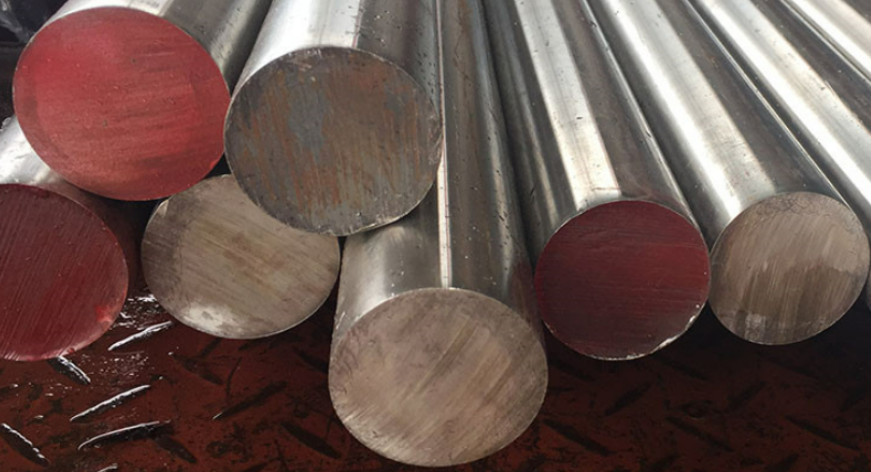
AISI 4140 and AISI 4340 are the two workhorse chromium-molybdenum alloy steels in the global forging and machining market. Buyers reach for 4140 by default because it is cheaper and more available, but 4340 exists for a reason: it delivers substantially higher hardenability and toughness, which matters once section sizes grow or impact loading appears in the duty cycle. Choosing the wrong one usually shows up not at the purchase order stage, but in the field — as cracked shafts, failed gears, or brittle fractures in thick sections. This guide compares 4340 vs 4140 across chemistry, hardenability, mechanical properties, heat treatment behavior, weldability, machinability, availability, and price, so you can specify with confidence.
1. Quick Answer: When to Use Which Grade
- Choose 4140 for bars, forgings, and machined parts up to roughly 75–100 mm section size where the required core hardness is moderate (typically 28–32 HRC after Q&T) and cost matters.
- Choose 4340 when section thickness exceeds ~75 mm, when core hardness above 36 HRC is required through the section, or when the part sees impact, fatigue, and low-temperature service — crankshafts, heavy gearbox shafts, aircraft landing gear components, high-load gears.
- Nickel is the difference. 4340 adds 1.65–2.00% Ni, which pushes the ideal diameter (DI) hardenability from roughly 100 mm for 4140 to 150 mm+ for 4340.
- Price gap: 4340 typically carries a 15–30% premium over 4140 in bar form, more in forgings, driven by nickel content and tighter mill scheduling.
- Standard coverage: Both grades appear in ASTM A29/A29M (general requirements), SAE J404, and equivalents such as DIN 42CrMo4 (≈4140) and DIN 34CrNiMo6 / EN24 (≈4340).
2. Chemical Composition: The Nickel Difference
Both grades share the same Cr-Mo backbone. The decisive addition in 4340 is nickel, which improves toughness and deep-hardening response without raising carbon:
| Element | AISI 4140 (%) | AISI 4340 (%) |
|---|---|---|
| Carbon | 0.38–0.43 | 0.38–0.43 |
| Manganese | 0.75–1.00 | 0.60–0.80 |
| Silicon | 0.15–0.35 | 0.15–0.35 |
| Chromium | 0.80–1.10 | 0.70–0.90 |
| Molybdenum | 0.15–0.25 | 0.20–0.30 |
| Nickel | — | 1.65–2.00 |
| Phosphorus max | 0.035 | 0.035 |
| Sulfur max | 0.040 | 0.040 |
Why nickel matters: Ni delays the formation of ferrite and pearlite during cooling, effectively shifting the TTT curve to the right. That means the same quench severity hardens 4340 to a greater depth. Nickel also lowers the ductile-to-brittle transition temperature, so 4340 retains useful Charpy energy at -20°C to -40°C where 4140 becomes marginal. For buyers sourcing from China, always ask for an actual hardenability band (Jominy test per ASTM A255) rather than relying on chemistry alone — two heats of “4140” with identical chemistry can still differ in DI by 10–15 mm.
3. Hardenability: The Core Selection Criterion
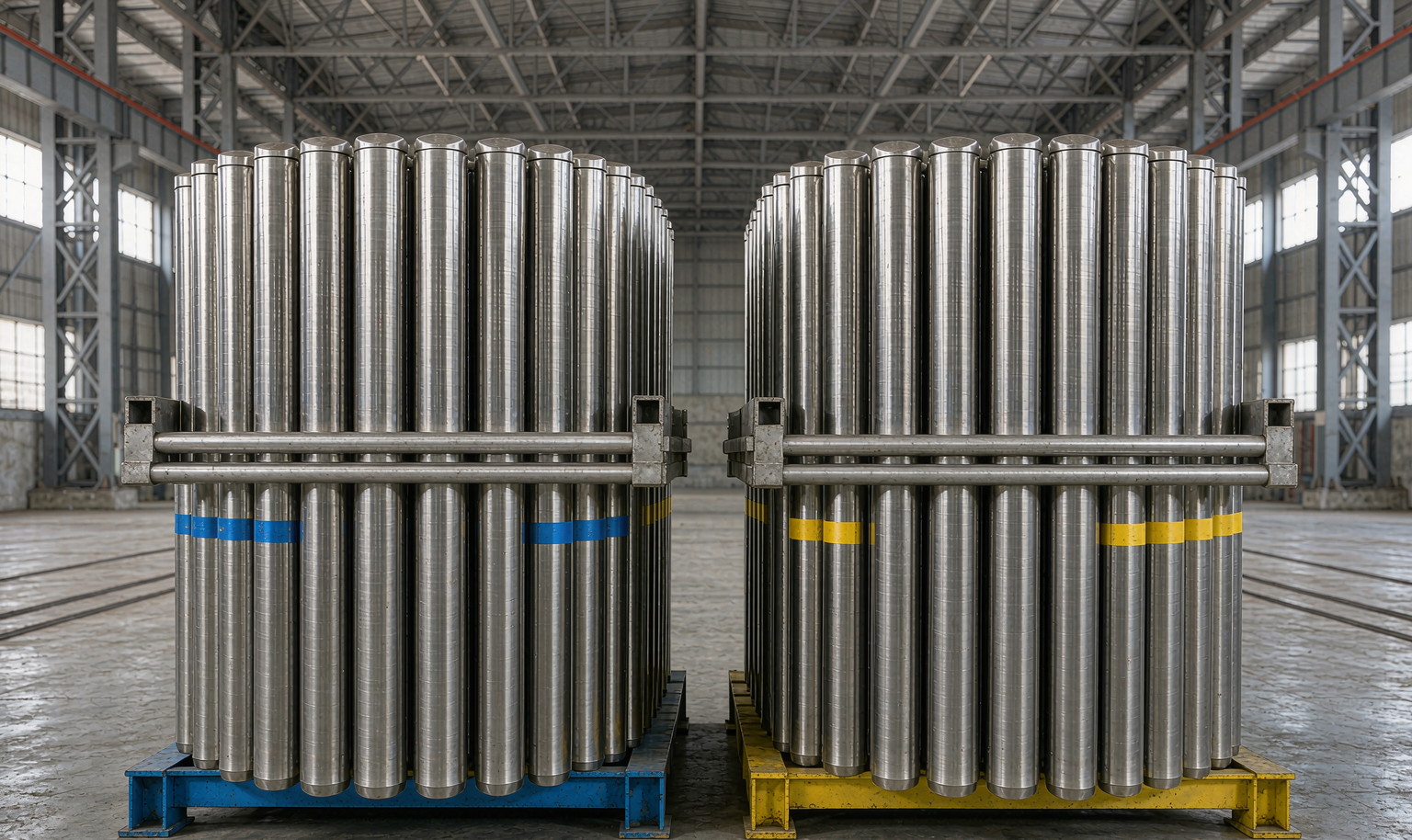
Hardenability — not hardness — is where these grades separate. Both reach the same surface hardness when quenched properly; the question is how deep that hardness penetrates:
| Bar Diameter | 4140 Q&T Core Hardness (HRC) | 4340 Q&T Core Hardness (HRC) |
|---|---|---|
| 25 mm (1 in) | 49–53 | 53–56 |
| 50 mm (2 in) | 38–45 | 50–53 |
| 75 mm (3 in) | 30–36 | 45–50 |
| 100 mm (4 in) | 25–30 | 40–46 |
| 150 mm (6 in) | <25 (ferrite risk) | 33–40 |
Typical values for oil quench from 845°C and temper at 540–650°C; actual results depend on the mill’s DI and quench tank practice. The takeaway: a 150 mm 4140 shaft tempered to 28–32 HRC at the surface will have a soft, mixed-transformed core. The same shaft in 4340 transforms to martensite (or fine bainite) through most of the section. If your part’s performance depends on core strength — splines that see torsional fatigue, or gear teeth loaded in bending — this table is the whole argument.
4. Mechanical Properties After Q&T
| Property | 4140 (25 mm, Q&T) | 4340 (25 mm, Q&T) |
|---|---|---|
| Tensile strength | 1,020–1,200 MPa | 1,080–1,280 MPa |
| Yield strength | 900–1,050 MPa | 980–1,170 MPa |
| Elongation | 15–18% | 12–15% |
| Reduction of area | 50–55% | 45–50% |
| Charpy V-notch, room temp | 40–60 J | 55–80 J |
| Charpy V-notch, -40°C | 10–20 J | 35–55 J |
| Typical as-Q&T hardness | 28–32 HRC (300–340 HB) | 32–38 HRC (320–380 HB) |
Note the Charpy numbers at -40°C — the gap widens dramatically in cold service. Note also that 4340 gives up a little elongation and reduction of area to gain its strength: it is the more highly stressed design choice, and that is acceptable because its fracture toughness (KIC around 60–90 MPa√m at 35 HRC) is superior. For fatigue-limited designs, 4340’s higher endurance limit (roughly 670 MPa vs 620 MPa polished rotating-bend) extends component life meaningfully.
5. Heat Treatment Windows
Both grades follow a similar thermal cycle, but 4340 demands tighter control because of two metallurgical risks: temper embrittlement and hydrogen embrittlement.
- Normalizing: 4140 at 870–900°C; 4340 at 845–870°C, air cool. Refines forged structure before machining.
- Austenitizing: 830–860°C for 4140; 800–845°C for 4340. Soak 30 min per 25 mm after equalization.
- Quench: Oil for both grades. 4340 sections over 75 mm may need interrupted quench or polymer to control cracking risk around sharp features.
- Tempering: 4140: 540–680°C for 28–32 HRC. 4340: 400–600°C, but avoid the 375–575°C window for prolonged holds — this is the temper embrittlement range for Ni-Cr steels; temper above 575°C and cool rapidly past the critical range.
- Stress relief after machining: 480–550°C for heavily machined or straightened parts of both grades.
Induction hardening works well on both grades for wear surfaces (54–60 HRC case). For carburizing applications, neither grade is ideal — buyers should move to 8620 or 18CrMo4 instead.
6. Machinability and Weldability
Machinability: In the annealed state, 4140 rates about 65% of B1112 (reference 100%), while 4340 is similar at 60–65%. The nickel addition barely hurts cutting speed. Both machines best at 180–250 HB in the normalized or annealed condition. In Q&T condition above 300 HB, expect 30–40% lower tool life with carbide tooling; use negative-rake inserts, rigid setups, and abundant coolant. Calcium-treated “free-machining” versions of 4140 are common in Chinese mill programs and improve carbide life by 20–30%.
Weldability: Both grades are weldable but require preheat and post-weld heat treatment. 4140 (CEV ≈ 0.80): preheat 260–320°C for sections over 25 mm, use low-hydrogen E12018 or ER80S-B2 filler, and post-weld temper at 600–650°C. 4340 (CEV ≈ 0.85 with Ni): preheat 320–370°C, use E11018 or 4340-matching filler, and post-weld stress relieve immediately — never let a 4340 weldment cool to room temperature untreated, because hydrogen-induced cracking can appear hours or days later. For structural weldments, honestly, neither grade is the right choice; prefer 42CrMo4 only when the strength genuinely requires it.
7. Availability and Price in the Export Market
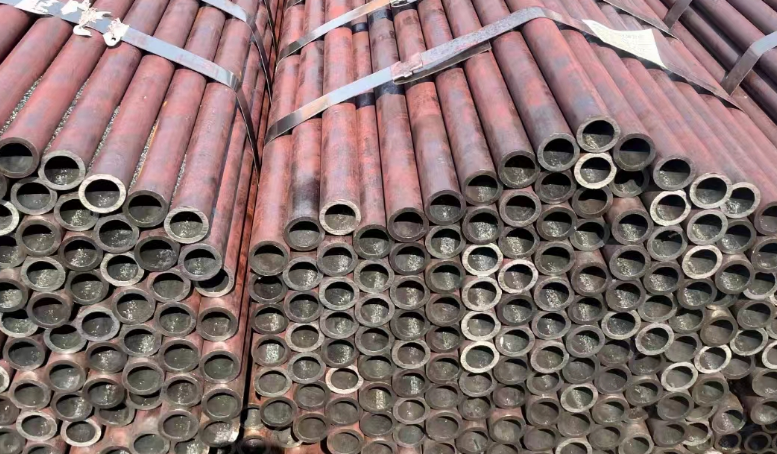
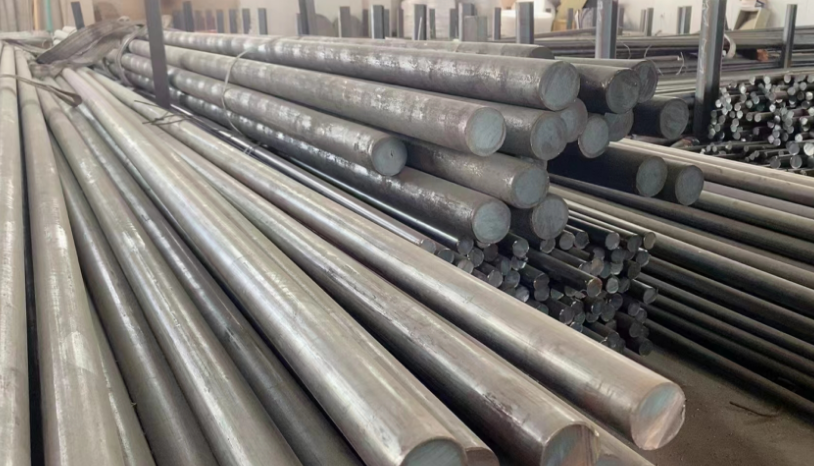
From Chinese export mills and forgers, 4140 is stocked in nearly every form: hot-rolled bar 12–300 mm, bright bar, block, plate (to 200 mm), and open-die forgings. 4340 stock is thinner — most mills roll it to order in 30–60 days, though major forgers keep billet on the floor. Equivalent grade mapping helps when your supplier offers alternatives:
| AISI | DIN/EN | JIS | GB (China) |
|---|---|---|---|
| 4140 | 42CrMo4 (1.7225) | SCM440 | 42CrMo |
| 4340 | 34CrNiMo6 (1.6582) | SNCM447 | 40CrNiMoA |
Price guidance: expect 4340 bar at roughly 1.15–1.30× the 4140 price, and 4340 forgings at 1.2–1.4×, reflecting nickel surcharge and longer mill lead times. When nickel index prices spike, the gap can widen temporarily — for large campaigns, consider fixing the nickel surcharge in the contract rather than accepting “price at delivery.”
8. Specification Checklist Before You Order
- State the grade with its standard (AISI 4340 per SAE J404, or EN 34CrNiMo6 per EN 10083-3) — “4340 quality” alone invites substitution.
- Specify delivery condition: normalized, annealed, or Q&T with hardness range (e.g., 30–36 HRC) and, for critical parts, minimum tensile/yield per EN 10083 or your own acceptance table.
- Require impact testing at your minimum service temperature, not just room temperature.
- For shafts and gears over 100 mm, require UT per ASTM A388 (or SEP 1921) and grain size 5 or finer per ASTM E112.
- Ask for the Jominy curve or DI value on the mill certificate — it predicts real hardenability better than chemistry.
- Confirm certificate type: EN 10204 3.1 is the export norm; 3.2 (third-party witness) for critical energy or aircraft-adjacent parts.
FAQ
Can I substitute 4140 for 4340 to save cost?
Only if the section is small enough that 4140 through-hardens fully — practically, under ~75 mm for moderate hardness targets — and the part does not see impact or sub-zero service. Run the hardenability check on your actual section before approving the substitution.
Which grade is better for gears?
For through-hardened gears above 300 HB in large modules or high-torque duty, 4340/34CrNiMo6 is the standard choice. For smaller gears that will be carburized, use 8620 or 20CrMnTi instead — neither 4140 nor 4340 is designed for case hardening.
Is 4340 an aircraft-grade steel?
4340 is widely used in landing gear and structural components, but aerospace applications require AMS 6414/6415 or MIL-S-5000 certified melts with vacuum degassing and stricter chemistry. Commercial-grade 4340 does not automatically meet aerospace certification.
How do 42CrMo4 and 34CrNiMo6 compare to the AISI grades?
They are close functional equivalents: 42CrMo4 ≈ 4140 and 34CrNiMo6 ≈ 4340. EN grades carry tighter P/S limits in many delivery conditions and mandatory quality classes (e.g., +QT with defined mechanicals), so drawings that cite EN standards should order EN grades, not “AISI equivalent.”
What is the maximum section size for 4140 Q&T?
Practical through-hardening limit in oil is about 100 mm for 28–32 HRC targets. Beyond that, either step up to 4340, accept a hardness gradient, or specify a faster quench (polymer/water with careful cracking control).
Need 4140 or 4340 Steel, Cut to Your Drawing?
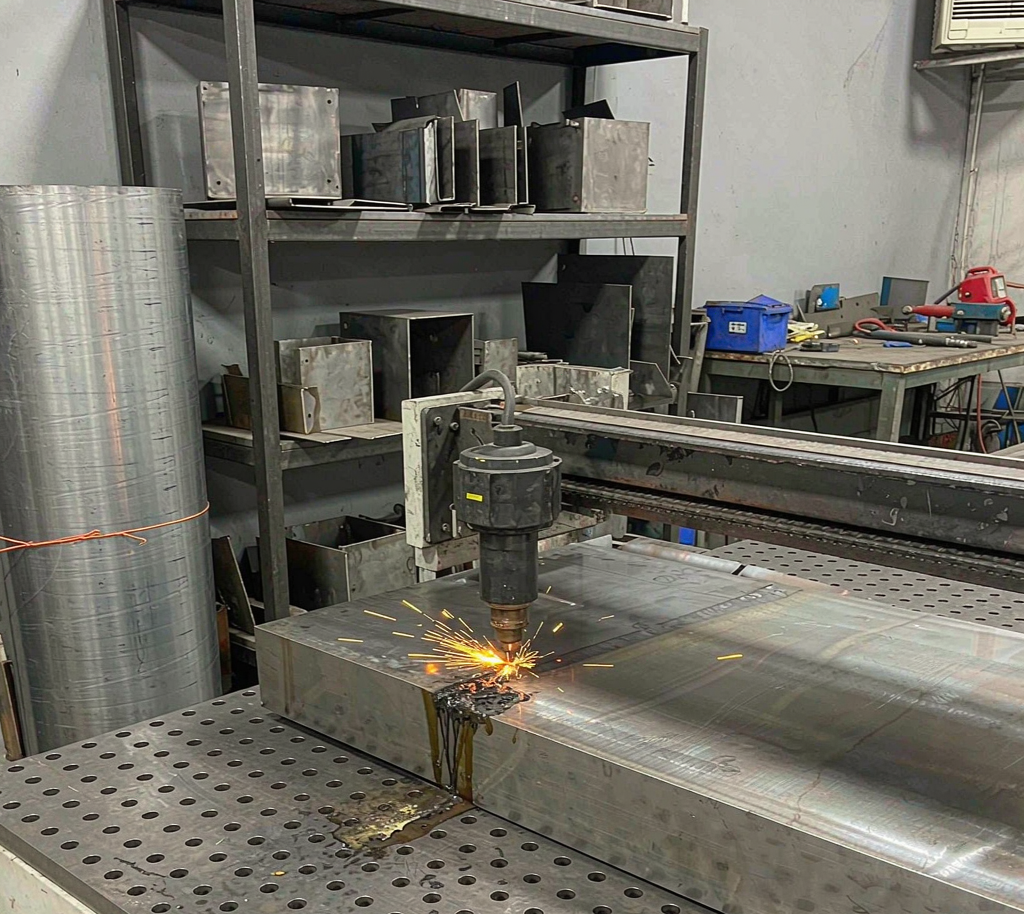
Huaxia-Steel supplies AISI 4140 / 42CrMo4 and AISI 4340 / 34CrNiMo6 in bar, block, and open-die forging forms — Q&T to your hardness spec, UT tested, EN 10204 3.1 certified, exported worldwide.
Request a quote in 24 hours: Contact our sales team with your grade, size, and quantity.