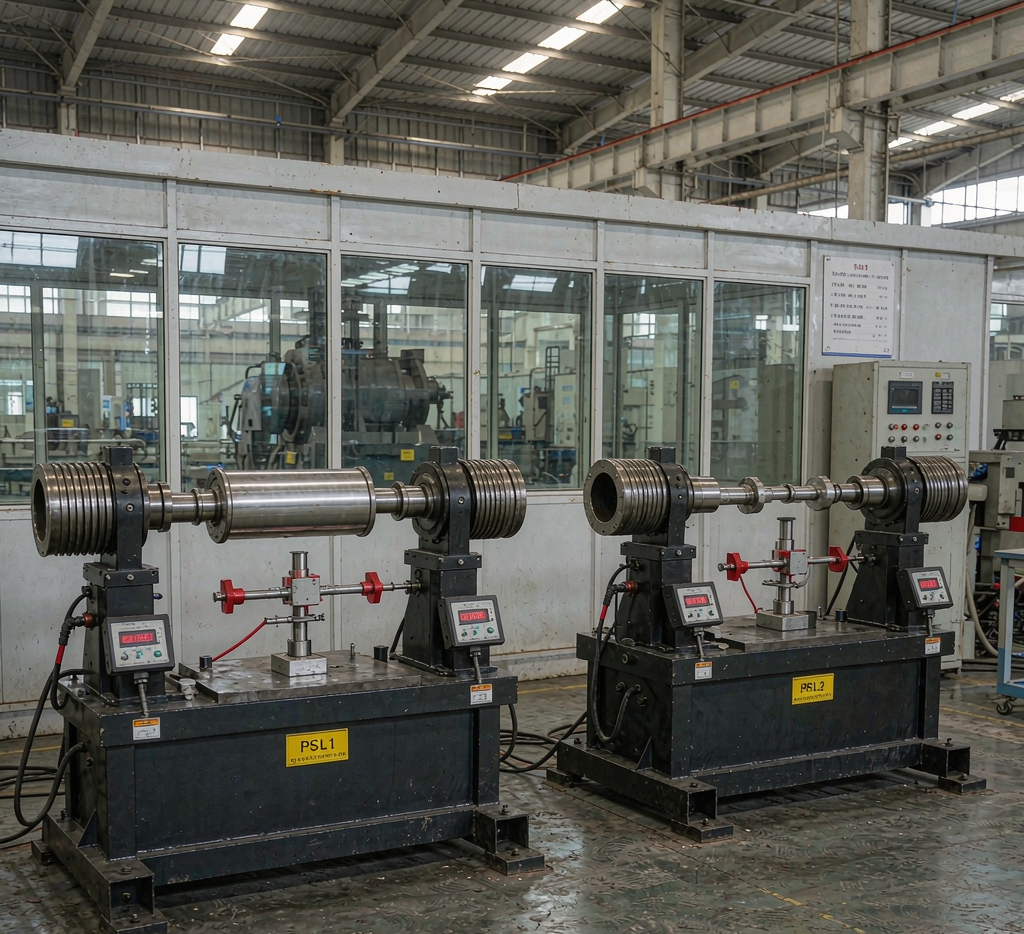
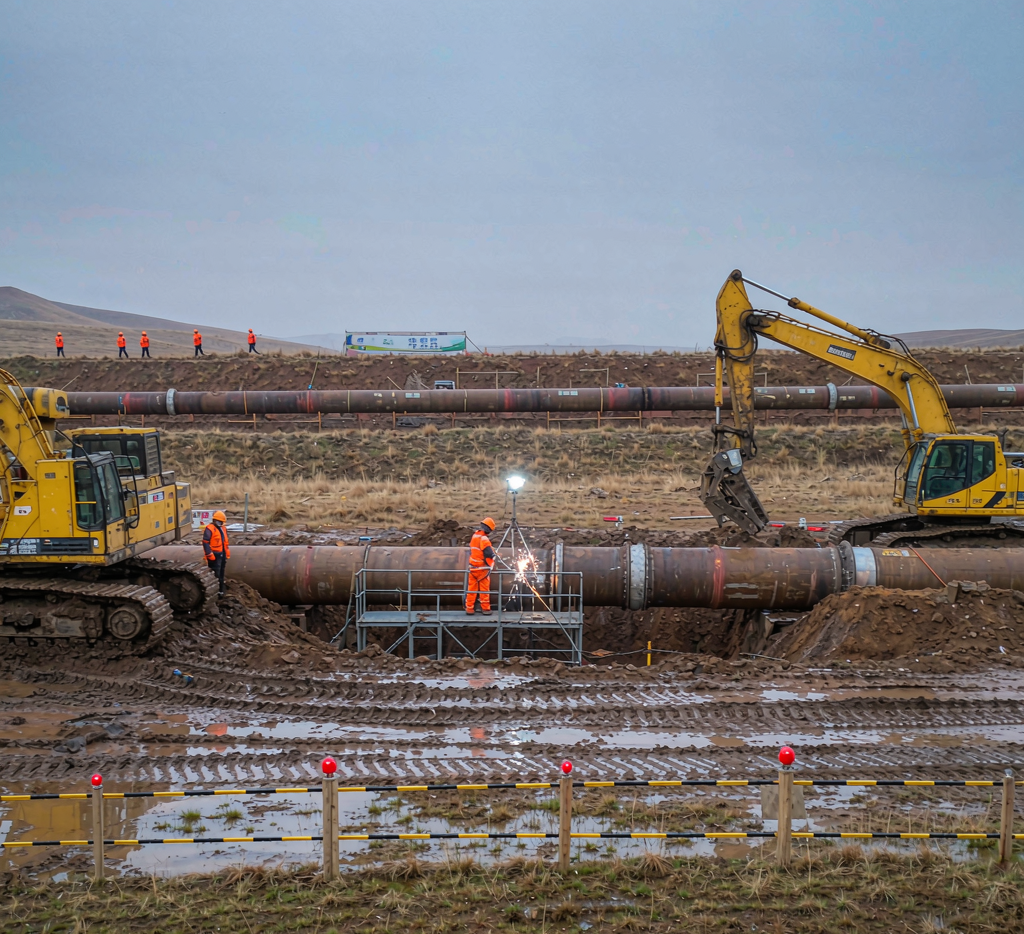
API 5L PSL1 vs PSL2 Line Pipe: Specification Differences and Selection Guide
API 5L PSL1 vs PSL2 Line Pipe: Specification Differences and Selection Guide
API 5L is the workhorse specification for line pipe used in oil and gas transmission, distribution, and gathering systems. Most procurement documents reference “API 5L” as a single standard, but the specification actually defines two product specification levels: PSL1 and PSL2. The differences between them are not cosmetic. They affect chemical composition limits, mandatory mechanical tests, impact requirements, NDE (non-destructive examination) coverage, traceability, and documentation.
PSL1 is the basic commercial grade. PSL2 adds stricter chemical controls, mandatory Charpy impact testing, mandatory NDE on the pipe body, and traceable heat treatment records. PSL2 is the de-facto minimum for sour service (NACE MR0175), offshore, and high-pressure transmission.
This guide compares PSL1 and PSL2 across chemistry, mechanical, NDE, and documentation, then explains when each is appropriate and how to avoid costly mis-procurement.
1. What is API 5L PSL1?
PSL1 (Product Specification Level 1) is the base level of API 5L. It covers the chemical, mechanical, and testing requirements for line pipe that does not require the additional controls of PSL2. PSL1 pipe is commonly used in:
Low-pressure gas distribution.
Water injection and disposal lines.
Process piping in non-sour, low-temperature service.
Pile and structural applications.
Standard A and B grade pipe for general fluid transport.
PSL1 allows a wider chemical envelope than PSL2 (notably higher sulfur and phosphorus) and does not require Charpy impact testing. The manufacturer has flexibility in delivery condition (as-rolled, normalized, quenched and tempered, or thermomechanical).
2. What is API 5L PSL2?
PSL2 (Product Specification Level 2) is the more stringent level. It adds the following requirements beyond PSL1:
Tighter chemical limits: Lower maximum sulfur (0.005% for sour service), lower phosphorus (0.025% max), and controlled carbon equivalent (CEV) for weldability.
Mandatory Charpy impact testing at the agreed test temperature, with minimum absorbed energy dependent on grade and pipe size.
Mandatory NDE on the entire pipe body (typically ultrasonic or electromagnetic inspection) per the agreed acceptance level.
Traceable heat treatment records when the delivery condition is normalized, quenched and tempered, or thermomechanically controlled rolled.
Mandatory CVN impact test report in the MTC.
PSL2 is mandatory for sour service applications (H2S-containing fluids), offshore pipelines, high-pressure transmission (above ~2,000 psi or 14 MPa), low-temperature service (below -20°C), and most international cross-border tenders.
3. Side-by-Side Comparison Table
Item
PSL1
PSL2
Application
General low-pressure service, non-sour, low temperature
0.015% (general); 0.005% (sour service supplement)
Phosphorus (max)
0.030%
0.025%
CEV (max, typical)
No mandatory CEV limit
0.43% for X42-X65; 0.42% for X70; 0.40% for X80
Charpy impact test
Not mandatory (only if agreed)
Mandatory at the agreed test temperature
Impact energy (typical)
No minimum
27 J minimum at 0°C for X42-X65; 40 J at 0°C for X70-X80
NDE (pipe body)
Not mandatory; only hydrostatic test required
Mandatory ultrasonic or electromagnetic inspection per Annex E
Hydrostatic test
Required (every pipe)
Required (every pipe); may replace NDE if agreed
Delivery condition
As-rolled, normalized, Q&T, TMCP (no documentation requirement)
Traceable heat treatment certificate required for N, Q, TMCP
MTC (Mill Test Certificate)
EN 10204 3.1 or API 5L Annex G
EN 10204 3.1 (3.2 if agreed); with full traceability
Sour service compatibility
Not generally suitable
Suitable (with Annex H supplement for H2S service)
4. Chemistry Differences in Detail
Chemistry is the most fundamental difference. For a typical X65 grade:
Element
PSL1 X65 max %
PSL2 X65 max %
C
0.28
0.22
Mn
1.40
1.45 (typical 1.20-1.45)
Si
0.45
0.45
P
0.030
0.025
S
0.030
0.015
V
0.15
0.10
Nb
0.10
0.08
Ti
0.04
0.04
CEV (max)
No formal limit
0.43
The lower carbon and sulfur in PSL2 improves weldability and reduces the risk of hydrogen-induced cracking (HIC) and sulfide stress cracking (SSC) in sour service.
5. Mechanical Properties Compared
Grade
PSL1 Yield (min, MPa)
PSL2 Yield (min, MPa)
PSL1 Tensile (min, MPa)
PSL2 Tensile (min, MPa)
X42
290
290
415
415
X52
360
360
460
460
X60
415
415
520
520
X65
450
450
535
535
X70
485
485
570
570
X80
555
555
625
625
Yield and tensile minima are the same between PSL1 and PSL2 for the same grade. The mechanical difference is in toughness, not strength.
6. Impact Testing Requirements
PSL1 does not require Charpy testing. Some buyers add it as a supplementary requirement (SR), but it is not part of the standard. PSL2 requires:
Three full-size specimens (10 x 10 x 55 mm) per lot at the agreed test temperature.
Minimum average energy of 27 J (X42-X65) or 40 J (X70-X80) at 0°C unless a different temperature is agreed.
For sub-size specimens, the minimum energy is reduced proportionally.
Lot definition: per heat, per pipe size, per delivery condition.
For cold-climate service (Arctic pipelines, winter operation), buyers typically specify impact testing at -20°C, -29°C, -40°C, or -46°C, with corresponding energy values. PSL2 supports this naturally; PSL1 requires it as an SR.
7. NDE (Non-Destructive Examination)
PSL1: Only the hydrostatic test is mandatory. The hydrostatic test is held for 5 seconds minimum at a pressure calculated per the formula in API 5L Section 6.3. Ultrasonic or electromagnetic inspection is optional and only done if agreed.
PSL2: The full pipe body is inspected by either ultrasonic (UT) or electromagnetic (EM) method per Annex E. Acceptance levels:
Level L1: Most lenient – allows larger defects.
Level L2: Standard – acceptable for most transmission service.
Level L3: Most stringent – typically used for offshore or sour service.
L2 is the typical default for onshore transmission. L3 is the default for offshore or high-consequence areas.
8. Delivery Condition and Heat Treatment
Condition
PSL1
PSL2
As-rolled (AR)
Allowed
Allowed for X42-X52 only; not for X60 and above without agreement
Normalized (N)
Allowed
Allowed; heat treatment record required
Quenched and tempered (Q&T)
Allowed
Allowed; heat treatment record required
Thermomechanical rolling (TMCP)
Allowed
Allowed and preferred for X65-X80; record required
For high-grade line pipe (X70, X80), TMCP is the standard delivery condition in PSL2 because it produces fine grain and good toughness at lower CEV.
9. Documentation and Traceability
PSL1: MTC per EN 10204 3.1 with chemical composition, tensile, hydrostatic test result, and dimensional report. Heat numbers are recorded but the heat treatment certificate is not mandatory.
PSL2: MTC per EN 10204 3.1 plus:
Charpy impact test results (mandatory).
NDE test report (mandatory).
Heat treatment record (for N, Q, TMCP conditions).
Traceability of coil or plate to the final pipe.
For cross-border tenders, 3.2 certificates (with independent third-party witness) are common on PSL2 orders.
10. When to Use PSL1 vs PSL2
PSL1 is appropriate when:
The service is non-sour (no H2S).
Operating pressure is below 2,000 psi (14 MPa).
Operating temperature is above -20°C.
The pipeline is gathering, distribution, or low-pressure utility.
No third-party witness is required.
Cost is the dominant consideration.
PSL2 is required when:
The fluid contains H2S (sour service, NACE MR0175).
Operating pressure exceeds 2,000 psi or the pipeline is a long-distance transmission trunk.
Service temperature is below -20°C.
The route is offshore, subsea, or high-consequence area.
Cross-border or international tender with strict documentation.
Buyer or insurer requires full traceability.
11. Cost and Lead Time Impact
PSL2 typically costs 8-15% more than PSL1 for the same grade and size, due to:
Tighter chemistry requires better steelmaking control (more ladle treatment).
Charpy impact testing adds lab time and consumable cost.
NDE equipment time and operator cost.
Additional documentation and traceability.
Lead time can extend by 2-4 weeks compared to PSL1, especially for X70 and X80 PSL2 orders during peak demand.
12. Common Procurement Pitfalls
Stating “API 5L X65” without specifying PSL. The mill will default to PSL1, which may not meet your NDE or impact requirements.
Ordering PSL2 but accepting mill’s PSL1 MTC. Always verify “PSL2” is stamped on the MTC and the test reports include Charpy and NDE data.
Confusing PSL with grade. PSL is the specification level (1 or 2); grade is the strength level (X42, X65, etc.). They are independent.
Not specifying the impact test temperature. If you need -29°C CVN, the order must state “PSL2, impact at -29°C, 27 J min.”
Forgetting sour service supplement. For NACE MR0175, you also need Annex H of API 5L, which adds SSC testing.
13. How to Order Correctly
A complete API 5L order should include:
Specification level: PSL1 or PSL2.
Grade: X42, X52, X60, X65, X70, X80, etc.
Type of pipe: S (seamless) or W (welded, including LFW, ERW, DSAW/LSAW, SSAW/HFW).
Outside diameter and wall thickness (or schedule).
Length: random (RL), single random (SRL), double random (DRL), or specific length.
End finish: plain end, beveled, threaded, coupled.
Delivery condition: AR, N, Q, TMCP.
Test pressure or NDE method and acceptance level.
Impact test temperature and energy requirement (mandatory for PSL2).
PSL2 has stricter requirements and is the safer choice, but for low-pressure non-sour utility service, PSL1 is fully fit-for-purpose and more economical. “Better” depends on your service condition.
Q2: Can PSL1 pipe be upgraded to PSL2 in the field?
No. PSL2 requirements are metallurgical and inspection-based, applied at the mill. Once a pipe is produced as PSL1, it cannot be reclassified. If you need PSL2, you must order PSL2 from the mill.
Q3: Does API 5L PSL2 automatically meet NACE MR0175?
Not automatically. NACE MR0175 (now ISO 15156) requires additional chemistry limits and hardness testing. You must order API 5L PSL2 with Annex H (sour service supplement) to claim NACE compliance.
Q4: What is the difference between X-grade and A/B grade in API 5L?
A25, A, B, X42, X46, X52, X60, X65, X70, X80, X90, X100, X120 are all grades within API 5L. A and B are older lower-strength grades; X-grades use the “minimum yield in ksi x 1000” naming. X65 has 65 ksi (450 MPa) minimum yield. A25, A, and B are typically PSL1; X42 and above can be PSL1 or PSL2.
Q5: How long does API 5L PSL2 line pipe take to deliver?
For X65 PSL2 TMCP delivery in 16-24 inch diameter, typical lead time is 60-90 days from order confirmation. Smaller orders or stock sizes may ship in 30-45 days. Large X80 orders can take 120+ days.
Q6: Is X80 PSL2 suitable for hydrogen service?
API 5L X80 is being evaluated for hydrogen blending and pure hydrogen transport. Current ASME B31.12 limits hydrogen service to specific grades and requires fracture-mechanics-based qualification. Check your project specification.
15. Conclusion
API 5L PSL1 and PSL2 are not interchangeable. PSL2 is the de-facto standard for high-pressure, sour, and offshore service because of mandatory Charpy impact testing, mandatory NDE, and full traceability. PSL1 remains the economical choice for non-critical service. Specifying the right level – and the right impact test temperature, NDE acceptance level, and sour service supplement – avoids costly reorders, project delays, and quality disputes at port.
Huaxia-Steel supplies API 5L PSL1 and PSL2 line pipe in grades X42 through X80, in seamless and welded (ERW, LSAW, SSAW) processes, with optional FBE / 3LPE / 3LPP coating. Send your project specification for a quotation.
Related Images
Figure 2: API 5L PSL1 vs PSL2 Line Pipe: Specification Differences and Selection GuideFigure 3: API 5L PSL1 vs PSL2 Line Pipe: Specification Differences and Selection Guide
If you require further information about our metal sheet products or architectural projects, please don’t hesitate to leave your contact details and message here.
Our team of experts will respond within 24 hours to continue the discussion and provide you with any additional information you requires.