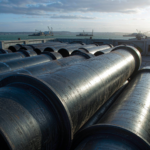
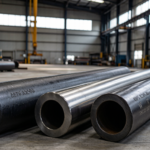
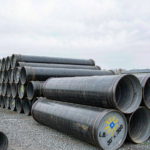
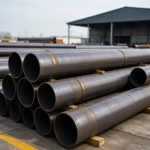
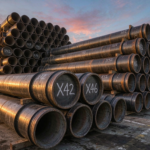
API 5L is the specification that governs almost every line pipe sold internationally, and within it there are two product specification levels — PSL1 and PSL2 — that look similar on a quotation and behave very differently in an inspection. PSL1 is a basic quality level: chemistry and mechanical properties are the only mandatory requirements, and everything else is a matter of agreement between buyer and mill. PSL2 adds mandatory carbon equivalent limits, mandatory charpy impact testing, mandatory non-destructive testing in most cases, tighter dimensional tolerances and full traceability. The price gap between the two is usually 6 to 15 percent, and the reason for that gap is the single most common point of confusion in pipe procurement: buyers order PSL2 because a specification says so, then discover the mill quoted PSL1 with an impact test added, or order PSL1 and find that the impact test they assumed was included was never in scope. This guide breaks down API 5L PSL1 vs PSL2 clause by clause and sets out what to put on the purchase order.
1. Quick Answer: What Actually Changes Between PSL1 and PSL2
PSL2 changes five things that cost money. It caps carbon equivalent and requires reporting of the actual value. It requires charpy V-notch impact testing on the pipe body and, for welded pipe, on the weld seam and heat-affected zone. It requires non-destructive inspection of the weld seam for welded pipe and permits, but does not universally require, full-body NDT. It tightens dimensional tolerances — particularly outside diameter, wall thickness and straightness. And it requires that each length be traceable to its heat and that the mill retain test records. Everything else in the standard — the grade designations X42 through X80, the delivery conditions, the marking rules — is shared.
Put another way: PSL1 answers the question “is this steel strong enough and the right chemistry?” PSL2 answers the question “can I prove it, and will it resist brittle fracture?” For low-pressure, non-hazardous service in moderate climates, PSL1 is often sufficient. For anything buried, pressurized, cold, sour or subject to a design code that references ISO 3183 quality levels, PSL2 is the safe default.
2. Where PSL1 and PSL2 Sit in the Standard
API 5L is technically identical to ISO 3183, and both documents structure requirements in the same way: a set of mandatory clauses that apply to all pipe, plus annexes that apply only when a PSL2 order invokes them. Annex E covers pipes for sour service, Annex G covers pipes for offshore service, Annex H covers pipes for arctic service, Annex J covers pre-production tests, and Annex K covers the NDT methods. The consequence for buyers is that “PSL2” alone is not a complete specification. PSL2 with Annex H and Annex J is a materially different and much more expensive product from base PSL2, and a quotation that says only “PSL2” is ambiguous until the annexes are named.
Grades are designated by a letter and a number: X42, X52, X65, X70, where the number is the minimum yield strength in ksi. API 5L also permits an intermediate grade designation (for example X52N or X60M) where the suffix denotes the delivery condition — as-rolled, normalized, normalized and tempered, quenched and tempered, or thermomechanically rolled. The delivery condition suffix is mandatory for PSL2 and is one of the reasons PSL2 pipe from different mills is not automatically interchangeable.
3. The Clause-by-Clause Table
| Requirement | PSL1 | PSL2 |
|---|---|---|
| Chemistry | Product analysis limits per grade; C, Mn, P, S controlled | Tighter limits; CE (Pcm for ≤ X52) mandatory and reported |
| Yield / tensile testing | One test per test unit | One test per test unit, with defined frequency and retest rules |
| Charpy impact (CVN) | Not required unless agreed | Mandatory — pipe body, weld seam and HAZ for welded pipe |
| Drop weight tear test (DWTT) | Not required | Required by agreement for ≥ X60 in certain sizes |
| Weld seam NDT | Not mandatory | Mandatory for SAW, COW and electric-welded pipe |
| Full-body NDT | Not required | Permitted option; specified for critical lines |
| Outside diameter tolerance | Looser, especially for < 60.3 mm | Tighter, with defined tables by size |
| Wall thickness tolerance | −12.5 % for SAW, −12.5 % for seamless | Same nominal but with additional checks on eccentricity |
| Traceability | Heat number on bundle tag | Heat number marked on each length plus retained records |
| Sour service (Annex E) | Not applicable | Available and heavily specified by chemistry and hardness |
| Repair by welding | Permitted within limits | Restricted; defects generally cut out |
4. Impact Testing: The Biggest Single Cost Driver
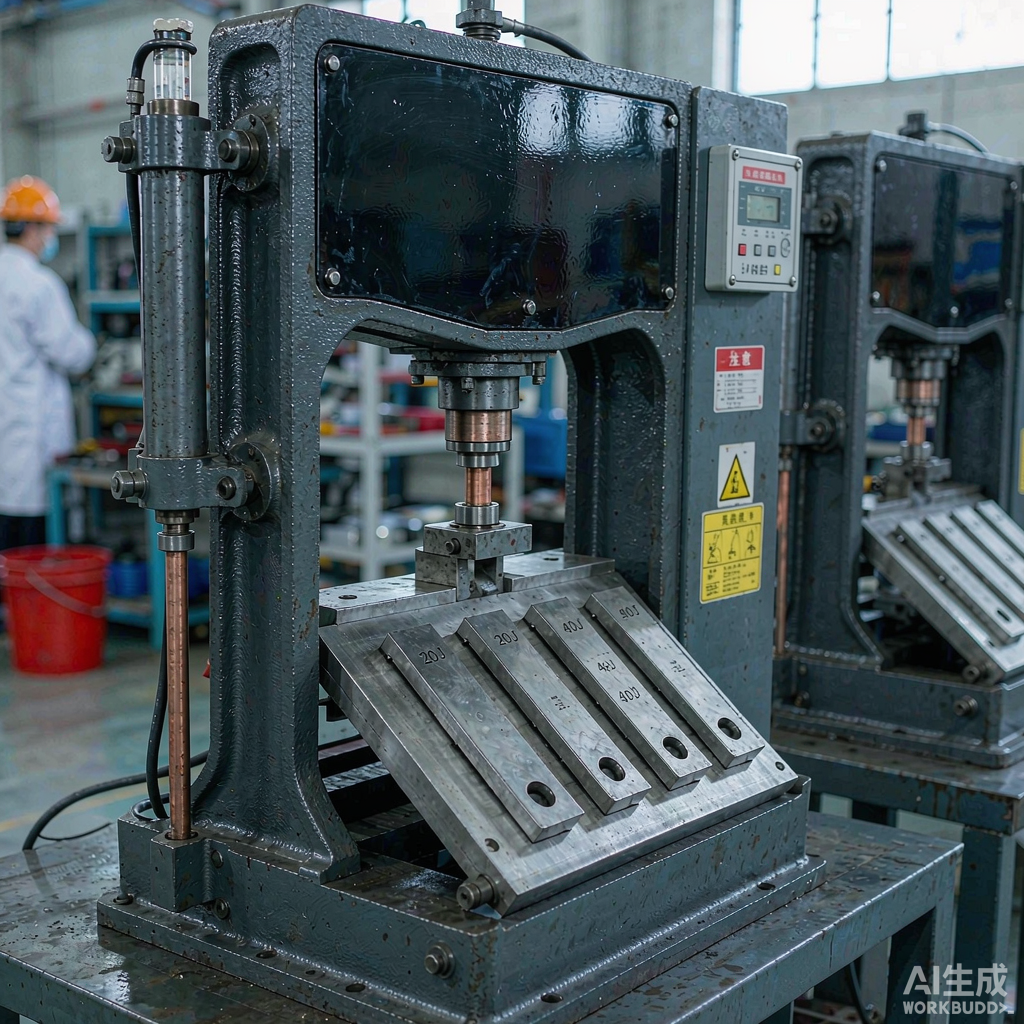
Charpy testing is where PSL2 earns most of its premium. PSL2 requires a minimum average absorbed energy of 27 J for the pipe body at the specified test temperature, with a minimum single value of 20 J, and for welded pipe the same requirement applies to the weld metal and the fusion line. Testing is performed on three specimens per test unit, and a failed set triggers a retest procedure that can lead to rejection of the entire test unit. On a large-diameter, heavy-wall line pipe order, that is a lot of specimens, a lot of machining, and a lot of potential for a batch to fail late in production.
Test temperature is a specification decision, not a standard default. Base PSL2 tests at 0 °C unless the buyer specifies otherwise; Annex H arctic service pushes the test temperature down to −20 °C or lower, and low-temperature service in Canada or northern Europe routinely requires −30 °C or −45 °C. Each step down in temperature raises the alloy cost, because the mill has to reduce carbon, add nickel or use a thermomechanically controlled rolling schedule to keep the ductile-to-brittle transition below the test temperature. A buyer who writes “PSL2, impact tested” without naming a temperature will get 0 °C and may not realize the difference until commissioning.
5. Non-Destructive Testing Rules
PSL2 requires NDT of the weld seam for submerged arc welded, combination welded and electric welded pipe. The permitted methods are radiographic testing, ultrasonic testing, or a combination, and the acceptance criteria reference ISO 10893 or ASTM equivalents depending on the edition invoked. For seamless pipe, PSL2 does not mandate full-body NDT but permits the buyer to require hydrostatic testing plus ultrasonic or electromagnetic inspection; in practice, critical seamless line pipe is almost always ordered with full-body UT and a hydrostatic test at a pressure calculated to a defined hoop stress.
The practical trap is what “NDT included” means in a mill quotation. It can mean seam-only NDT per the base standard, or full-body NDT, or NDT with third-party witness. These are three different prices and three different levels of assurance. Ask for the NDT method, the coverage percentage, the acceptance standard and whether the records will be issued with the pipe. If the answer to any of those is vague, the quotation is not for PSL2 as your specification intends it.
6. Carbon Equivalent and Weldability
PSL2 caps carbon equivalent using one of two formulas depending on grade. For grades up to X52, the Pcm formula applies, with a limit of 0.25 for pipe with a specified minimum yield strength of 290 MPa or less and 0.24 above that. For higher grades, the CE(IIW) formula applies with a limit of 0.43 for grades up to X70 and higher limits or a Pcm route for X80 and above. The numbers matter because a heat that misses the CE limit cannot be shipped as PSL2 regardless of how good its tensile results are — and because CE drives the preheat temperature the field welder must use.
This is also where thermomechanical rolling separates the good mills from the rest. To reach X65 or X70 with a CE under 0.43, a mill must control rolling temperature and cooling rate precisely rather than adding alloy. The result is a pipe with good toughness and excellent field weldability — and a pipe that behaves very differently from a normalized X65 made twenty years ago. If your welding procedure was qualified on older pipe, verify the CE on the new MTC before mobilizing a crew.
7. Traceability and Documentation
PSL2 requires that each length carry a marking that identifies the manufacturer, the grade, the outside diameter, the wall thickness, the specification level and the heat number. That is a real difference from PSL1, where heat traceability can stop at the bundle tag. The practical value appears during a third-party inspection or a failure investigation: with PSL2 marking, an inspector can pull a specific joint, read its heat number, and match it to the charpy and tensile records for that heat. With PSL1, the same joint may be traceable only to a bundle.
Documentation expectations follow the same logic. A PSL2 order should arrive with an EN 10204 3.1 mill test certificate showing heat number, product analysis, tensile results, charpy results with test temperature, CE value, NDT method and acceptance, hydrostatic test pressure and, where applicable, the annex invoked. A certificate that shows only tensile results is a PSL1 certificate with a PSL2 heading, and an experienced inspector will catch it in the first minute.
8. Price and Lead Time Implications
In normal market conditions, PSL2 pipe carries a premium of roughly 6 to 15 percent over PSL1 for the same grade and size, and the premium widens at low impact test temperatures, at large diameters, and where full-body NDT with third-party witness is required. Lead time also extends: PSL2 heats are usually scheduled rather than pulled from stock, charpy testing adds days to the release cycle, and NDT with witness inspection adds inspection windows that must be booked.
There is a second-order cost that buyers often miss. PSL2 chemistry limits can force a mill to use a different, more expensive heat for a grade it would otherwise produce from a standard sequence. On small quantities, that switching cost can dominate the price, which is why a 30-tonne PSL2 X52 order sometimes quotes at a premium far above the headline 10 percent. If the quantity is small and the application is not critical, a PSL1 pipe with a supplementary impact test can be the rational choice — but the supplementary test must be written into the order, not assumed.
9. Five Mistakes Buyers Make
- Ordering “PSL2” without a test temperature. The default is 0 °C. If the line runs cold, say −20 °C or −45 °C explicitly.
- Assuming impact testing is included in PSL1. It is not. PSL1 plus a negotiated charpy requirement is a legitimate and often cheaper route, but only if it is written down.
- Confusing PSL2 with sour service. Sour service needs Annex E, which adds hardness caps, sulphur control and specific chemistry rules. PSL2 alone does not qualify a pipe for wet H2S.
- Accepting a certificate without charpy data. If the impact results are missing, the pipe is not PSL2 in any meaningful sense, whatever the invoice says.
- Overlooking the delivery condition suffix. X65N and X65Q are different products. If the design assumes normalized pipe, a quenched and tempered substitute changes the welding procedure.
10. Choosing Between Them
| Service condition | Recommended level | Notes |
|---|---|---|
| Low-pressure water or slurry, above ground, mild climate | PSL1 | Add hydrostatic test and a dimensional check |
| Buried gas or oil line, design code references ISO 3183 | PSL2 | Impact temperature per design code, typically 0 °C |
| Cold climate, −20 °C or below | PSL2 + Annex H | Higher alloy cost, verify DWTT requirement |
| Wet H2S, sour service | PSL2 + Annex E | Hardness cap 250 HV10, sulphur ≤ 0.002 % |
| Offshore riser or critical tie-in | PSL2 + Annex G/J | Pre-production qualification testing required |
| Structural piling or casing-off application | PSL1 acceptable | Impact test optional; watch for mill “line pipe” grade substitutions |
11. Writing the Purchase Order So the Mill Cannot Misread It
Most PSL1/PSL2 disputes trace back to a purchase order that named the level but not the annexes, the test temperature or the documentation. A clean line pipe order states the standard edition, the grade with delivery condition suffix, the product specification level, the dimensions with tolerances, the pipe end finish (plain, bevelled or threaded), the length range, the test requirements, the inspection regime, the marking requirements and the documentation package. The table below shows what a complete line looks like against a typical incomplete one.
| PO item | Incomplete wording | Complete wording |
|---|---|---|
| Standard | API 5L | API 5L 46th edition / ISO 3183:2019 |
| Grade | X52 | X52N, PSL2 |
| Size | 12 inch | 323.9 mm OD x 9.53 mm WT, plain end |
| Length | 12 m | 11.8 – 12.0 m random, +0/−50 mm |
| Impact | impact tested | CVN 27 J average at −20 °C, pipe body and weld seam |
| NDT | tested | Seam UT 100 %, full-body UT per Annex K, buyer witness |
| Hydro | as standard | Hydrostatic to 90 % SMYS, 10 s hold, records issued |
| Documents | MTC | EN 10204 3.1, English, heat by heat, with NDT records |
The difference between the two columns is not pedantry; each of the missing items maps to a specific cost or a specific risk. A missing test temperature is a pipe that may fail in service. A missing witness clause is an inspection report you cannot use in front of your own customer. A missing document clause is a certificate that arrives with tensile data only, forcing a re-issue that costs a week. Writing the eight lines above takes ten minutes and prevents almost every argument that follows.
One further item worth stating: who performs the third-party inspection, and to what scope. A common and workable arrangement is for the mill to carry out the standard tests, with an independent inspection body witnessing the hydrostatic and NDT stages and issuing its own certificate. That certificate, not the mill’s, is often what the end user’s engineer actually accepts — so agreeing the inspecting body at order stage avoids discovering, at the port, that the wrong agency was used.
12. FAQ
Is PSL2 pipe stronger than PSL1? Not necessarily. Both levels use the same grade designations and the same minimum yield and tensile requirements. PSL2 adds toughness, testing and documentation requirements — a PSL2 X52 is not stronger than a PSL1 X52, it is more thoroughly proven and more resistant to brittle fracture.
Can I buy PSL1 with an impact test? Yes, and it is a common and sensible compromise. The supplementary requirement must appear on the purchase order with a test temperature and an acceptance value, and the certificate must report the results per heat.
Does PSL2 require hydrostatic testing? Hydrostatic testing is required for PSL2 pipe unless the buyer waives it in writing, and it is performed at a pressure calculated from a defined hoop stress or a fixed pressure, whichever the order specifies. For PSL1 pipe it is required for certain sizes and grades only, so state it explicitly.
What does the letter after the grade mean? It is the delivery condition: R as-rolled, N normalized, Q quenched and tempered, M thermomechanically rolled. PSL2 requires the suffix. Matching the suffix to the design’s assumed welding procedure matters more than most buyers expect.
How do I verify PSL2 on arrival? Check four things: heat number marked on each length, charpy results with a stated test temperature on the MTC, CE value reported, and NDT records naming the method and acceptance standard. Any missing item means the pipe should be quarantined pending clarification.
Order Line Pipe With the Specification Level You Actually Need
Huaxia-Steel supplies API 5L line pipe in PSL1 and PSL2, grades X42 to X70, seamless and welded, from 2 inch to 48 inch, with charpy testing at the temperature your design requires, CE reporting, seam and full-body NDT options, hydrostatic testing to your hoop stress, and EN 10204 3.1 certification with third-party witness available. We will tell you honestly when PSL1 with a supplementary test is the better commercial answer, and when only PSL2 will satisfy the design code. Send your line data — grade, size, wall thickness, design pressure, service temperature and quantity — and we will return a specification comparison and a landed-cost quotation within one working day.