API 5L X42 vs X46 vs X52 Line Pipe Specification
For onshore transmission pipelines, gathering lines and distribution networks, API 5L X42, X46 and X52 are the three most specified line-pipe grades in the 42–52 ksi (290–360 MPa) yield-strength range. Each grade offers a different balance of strength, toughness, weldability and availability. Selecting the right grade at the design stage reduces wall thickness, saves tonnage and lowers project cost — but over-specifying wastes money and complicates procurement.
This guide compares X42, X46 and X52 head-to-head on yield strength, chemical composition, Charpy requirements, manufacturing route, dimensional options and field-proven applications. Whether you build gas transmission, oil gathering, water injection or offshore tieback lines, the same selection principles apply: pick the lowest-cost grade that meets your design factor, fracture-control requirement and field weld-procedure qualification.
1. What the "X" Number Means in API 5L
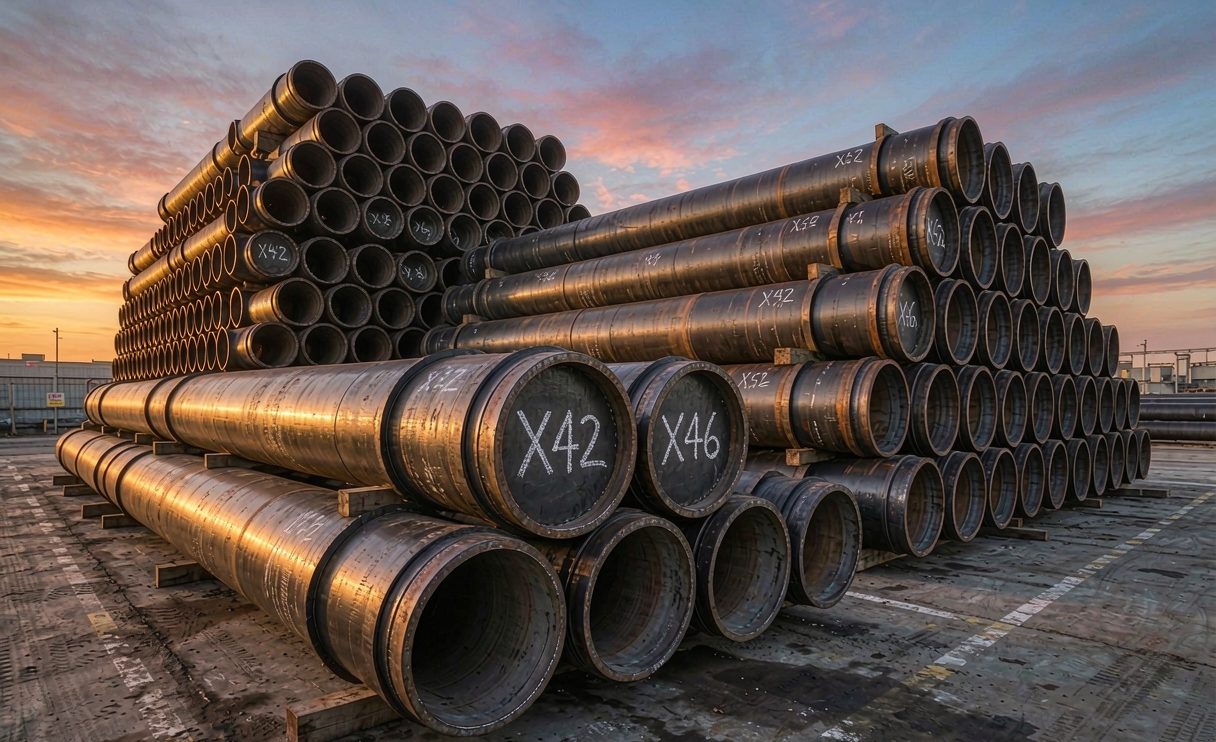
API 5L designates pipe grade by minimum yield strength in ksi multiplied by 1000 psi. X42 means minimum 42,000 psi (290 MPa) yield strength, X46 is 46,000 psi (317 MPa), and X52 is 52,000 psi (359 MPa). The latest 46th edition of API 5L also adds higher grades (X56, X60, X65, X70, X80) for long-distance and high-pressure transmission, but X42 / X46 / X52 remain the most common for gathering networks, distribution lines and moderate-pressure cross-country pipelines.
The grades are available under two product specification levels: PSL1 (basic requirements) and PSL2 (tighter chemistry, mandatory Charpy testing, full traceability). For modern pipeline projects, PSL2 is the de-facto standard even when PSL1 is technically permitted.
2. Strength Comparison
The table below compares minimum yield strength, minimum tensile strength and minimum elongation per API 5L PSL2 for the three grades.
| Property | X42 PSL2 | X46 PSL2 | X52 PSL2 |
|---|---|---|---|
| Minimum yield strength | 42 ksi (290 MPa) | 46 ksi (317 MPa) | 52 ksi (359 MPa) |
| Minimum tensile strength | 60 ksi (414 MPa) | 63 ksi (434 MPa) | 66 ksi (455 MPa) |
| Yield-to-tensile ratio, max | 0.93 | 0.93 | 0.93 |
| Minimum elongation in 2 in. | 25% | 23% | 21% |
| Maximum permissible hardness | 22 HRC / 250 HV | 22 HRC / 250 HV | 22 HRC / 250 HV |
Note that moving from X42 to X52 gains 24% in yield strength with only modest changes in tensile strength and elongation. In practice, X52 is the most cost-effective grade for high-pressure gas transmission because higher strength allows thinner wall — saving pipe tonnage, handling weight and welding time. X42 remains the preferred grade for low-pressure distribution and water lines.
3. Chemical Composition Comparison (PSL2)
PSL2 imposes much tighter chemistry limits than PSL1, particularly on carbon equivalent (CE) to ensure weldability. The table below shows typical PSL2 chemistry limits.
| Element | X42 (%) | X46 (%) | X52 (%) |
|---|---|---|---|
| Carbon (C), max | 0.24 | 0.24 | 0.24 |
| Manganese (Mn), max | 1.40 | 1.40 | 1.40 |
| Phosphorus (P), max | 0.025 | 0.025 | 0.025 |
| Sulfur (S), max | 0.015 | 0.015 | 0.015 |
| CE (IIW), max | 0.43 | 0.43 | 0.43 |
| CE (Pcm), max | 0.25 | 0.25 | 0.25 |
| Microalloying (Nb, V, Ti) | Optional | Optional | Optional |
All three grades share essentially the same chemical limits because the strength difference is achieved through thermomechanical rolling and optional microalloying (Nb, V, Ti) rather than higher carbon. This keeps weldability consistent across the three grades — field welding procedures qualified for X42 will normally transfer to X46 and X52 with little or no requalification.
4. Charpy Impact and Toughness Requirements
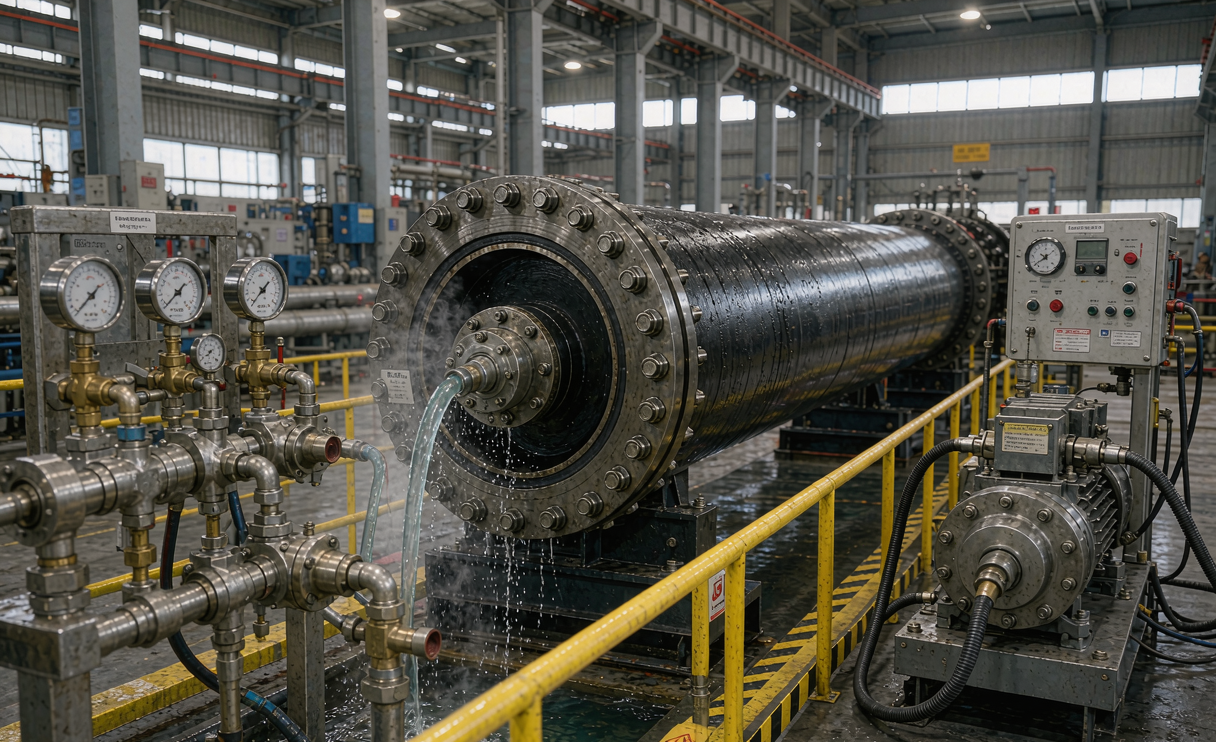
PSL1 has no mandatory Charpy test — the manufacturer may test or skip. PSL2 requires full-size Charpy V-notch testing at a specified test temperature and absorbed energy. The values are usually agreed between buyer and manufacturer per the project specification; a typical onshore gas line requires 27 J (20 ft·lbf) full-size at 0°C, while arctic lines may require 40–60 J at −30°C or lower.
For fracture-control pipelines (Class 1 location per ASME B31.8 or Category A per EN 12732), additional drop-weight tear testing (DWTT) may be required to verify crack-arrest properties. Huaxia Steel can provide both Charpy and DWTT data on request.
5. Manufacturing Routes and Available Sizes
API 5L X42 / X46 / X52 line pipe can be supplied as seamless, ERW, LSAW (DSAW) or SSAW (helical) pipe. The manufacturing route is dictated by size, grade and project requirements.
| Route | Typical Size Range (OD) | Best Suited For |
|---|---|---|
| Seamless | 1/2" to 26" | High-pressure, sour service, hot pipelines |
| ERW | 1/2" to 24" | Distribution, low-to-medium pressure |
| LSAW / DSAW | 18" to 56" | Long-distance transmission, high-pressure |
| SSAW / Helical | 16" to 100" | Piling, low-pressure water, cost-driven projects |
Most X42 / X46 / X52 transmission line pipe supplied to ASME B31.8 projects is LSAW in diameters 20–48", with wall thickness 0.250–0.500" (6.4–12.7 mm). Smaller diameter X42 for distribution and gathering is usually ERW in 6–16" OD.
6. Price-Performance Considerations
The price premium for higher grade is usually 5–12% per ton between adjacent grades, but the total project cost can drop significantly because of reduced pipe tonnage. Example for a 100 km, 36" OD natural gas line at design pressure 9.8 MPa:
- X42: wall 14.3 mm, pipe weight ~ 3,420 tons
- X46: wall 13.1 mm, pipe weight ~ 3,140 tons (saves ~ 280 tons)
- X52: wall 11.6 mm, pipe weight ~ 2,790 tons (saves ~ 630 tons)
At typical line-pipe prices, the savings on tonnage, freight and welding consumables easily outweigh the small premium on higher-grade pipe. For high-pressure long-distance projects, X52 is almost always the most economical choice.
7. Application Recommendations
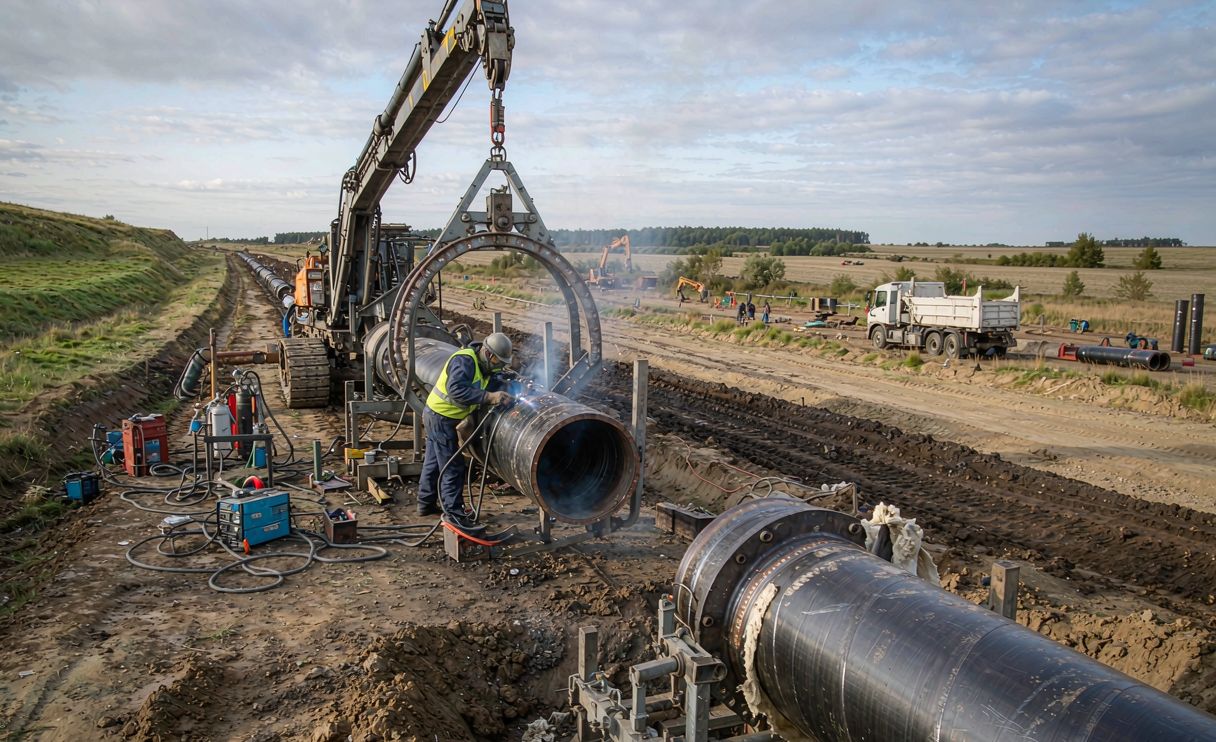
- X42: Low-pressure gas distribution (< 4 MPa), water injection, gathering lines, plant piping
- X46: Medium-pressure gas transmission (4–7 MPa), offshore flowlines, refinery piping
- X52: High-pressure gas transmission (7–10 MPa), long-distance trunk lines, oil & gas cross-country pipelines
- Above X52: Long-distance, ultra-high pressure, deep-water, high-temperature
8. Frequently Asked Questions
Is API 5L X52 PSL2 the most common line-pipe grade?
Yes. X52 PSL2 is the workhorse grade for modern onshore gas and oil transmission pipelines worldwide. It balances strength, weldability and cost. Higher grades (X60, X65, X70) are used for very high-pressure transmission; X42 and X46 are preferred for distribution and gathering.
Can X42 and X52 pipe be welded with the same procedure?
Yes, in most cases. Because all three grades have similar carbon equivalent (CE ≤ 0.43), the same cellulosic or low-hydrogen welding consumables and preheat requirements apply. ASME B31.8 / B31.4 / B31.3 projects typically qualify a WPS that covers the entire X42–X52 range.
Does X46 provide tangible benefits over X42?
X46 is rarely the most economical choice — the strength increment over X42 (5 ksi) is too small to deliver major wall-thickness savings. Most projects skip X46 and go directly from X42 to X52. X46 remains relevant for specific legacy specifications or sour-service applications where its narrow chemistry band is preferred.
What certification do I need for API 5L line pipe?
Request EN 10204 Type 3.1 (mill) or 3.2 (witnessed by third party) mill certificate, full traceability per ISO 10474 / API 5L Annex E, hydrostatic test report, and Charpy / DWTT data if specified. For sour service (NACE MR0175), also request HIC / SSC test data per project requirement.
Need API 5L X42 / X46 / X52 line pipe for a transmission or gathering project? Huaxia Steel supplies seamless, ERW, LSAW and SSAW line pipe in PSL1 / PSL2, sizes 1/2" to 100", with EN 10204 3.1 / 3.2 certification and third-party inspection by SGS / BV / TUV. Email [email protected] with your grade, size, quantity, project specification and delivery location for a mill-direct quote within 24 hours.