Hot-Dip Galvanizing vs Electro-Galvanizing Process for Carbon Steel
Carbon steel rusts. Every buyer knows it. The trick is choosing the right zinc coating to slow that rust down – and the two competing options, hot-dip galvanizing and electro-galvanizing, behave very differently in the field. Pick the wrong one and you pay twice: once for the coating, again for the rework.
This guide compares hot-dip vs electro-galvanizing across coating thickness, adhesion, corrosion life, cost, and typical applications so you can specify the right process for your carbon steel parts.
1. Why Galvanizing Method Matters
Both methods put zinc onto carbon steel, but the way the zinc is applied changes everything downstream:
- Coating thickness differs by an order of magnitude, which changes corrosion life.
- Adhesion strength differs because hot-dip forms a true metallurgical bond.
- Surface appearance differs – spangle vs matte smoothness.
- Formability differs after coating.
- Cost per square metre of protected surface is very different.
2. Hot-Dip Galvanizing (HDG)
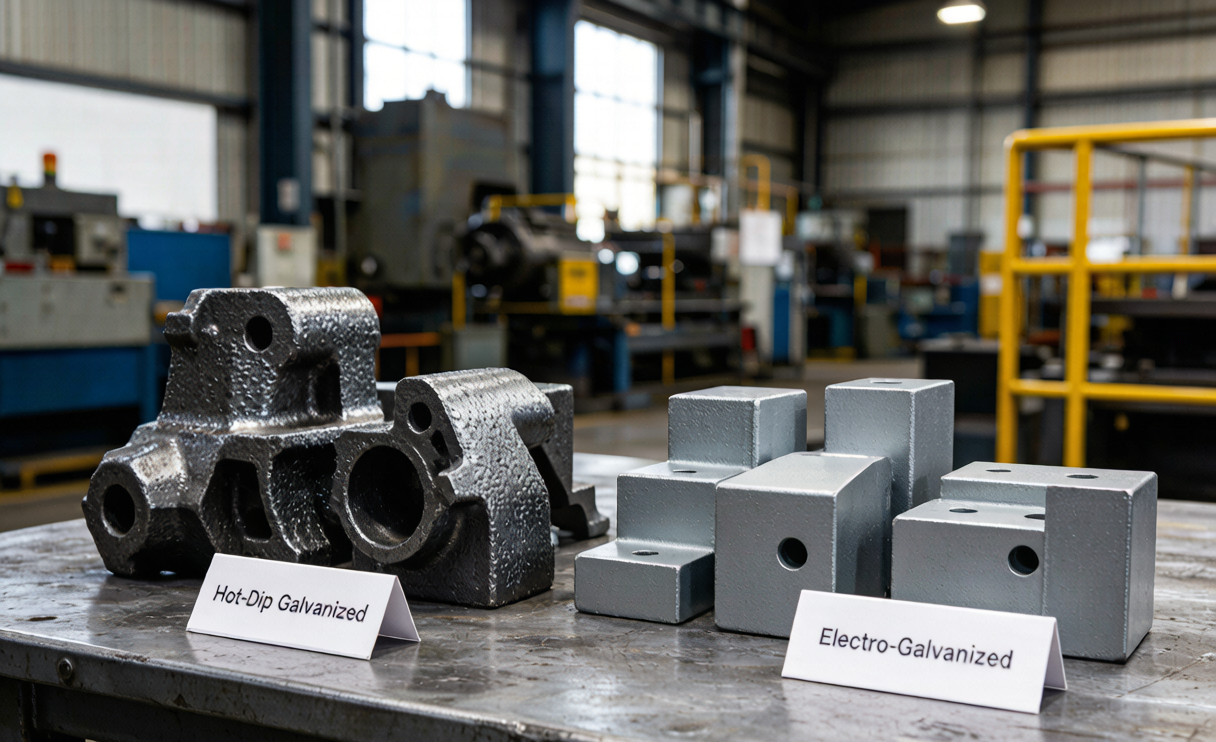
The steel is dipped into a bath of molten zinc at 440-465 degrees C. Zinc reacts with the steel to form a zinc-iron alloy layer (eta, zeta, and delta phases) with a top layer of free zinc (eta phase). The result is a thick, durable, spangled coating bonded to the steel.
- Typical coating thickness: 45-85 microns for batch-galvanized parts; 20-30 microns for continuous-sheet galvanizing.
- Standards: ASTM A123 (iron and steel products), ASTM A153 (fasteners), ISO 1461, EN ISO 1461, JIS H8641.
- Corrosion protection: Cathodic protection plus a barrier effect. Zinc sacrificially corrodes, protecting exposed steel at cut edges and scratches.
- Service life: 30-70 years in rural atmospheres, 20-40 years in marine atmospheres, 10-30 years in industrial atmospheres.
- Advantages: Thick coating, full immersion coverage (inside corners, threads), lowest cost per year of service, long maintenance-free life.
- Limitations: Coarse surface, spangle texture, possible distortion on thin sections, cannot be applied inside very small bore tubes without pre-treatment.
3. Electro-Galvanizing (EG)
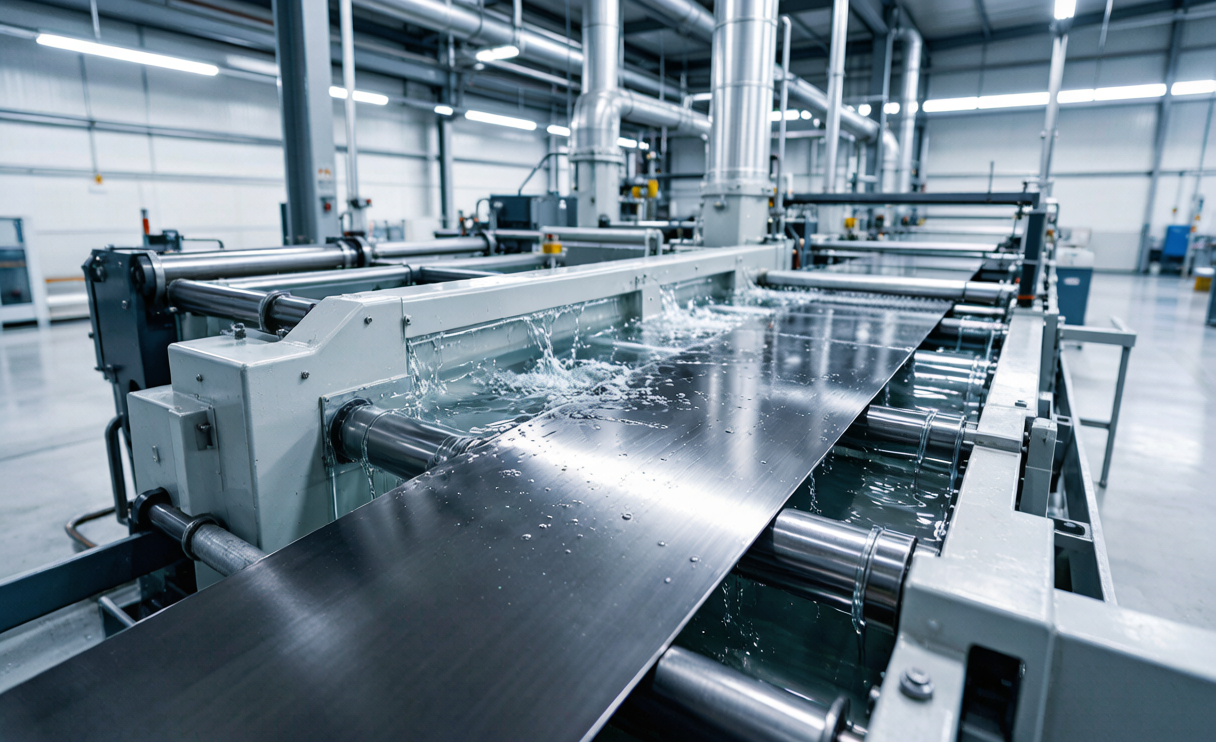
Also called electroplating or cold galvanizing, the steel is immersed in an electrolyte solution containing zinc salts. An electric current deposits pure zinc on the steel surface. The coating is thinner, smoother, and more uniform.
- Typical coating thickness: 5-25 microns; commonly 8-12 microns for sheet and 12-25 microns for formed parts.
- Standards: ASTM B633 (standard specification for electrodeposited coatings), ISO 2081, JIS H8610.
- Corrosion protection: Barrier effect plus weak cathodic protection (thinner layer sacrifices more slowly).
- Service life: 5-20 years depending on coating thickness and environment.
- Advantages: Smooth, paintable surface, uniform thickness on complex shapes, tight thickness tolerance, no heat distortion, suitable for thin sheet and finished components.
- Limitations: Thinner coating means shorter protection, weaker bond than HDG, hydrogen embrittlement risk on high-strength steel if not baked after plating.
4. Process Comparison Table
| Attribute | Hot-dip galvanizing | Electro-galvanizing |
|---|---|---|
| Process temperature | 440-465 degrees C | Room temperature (electrolyte) |
| Typical coating thickness | 45-85 microns | 5-25 microns |
| Bond type | Metallurgical alloy layer | Mechanical / chemical bond |
| Adhesion | Excellent | Good (post-bake required for hard steel) |
| Surface finish | Spangled, matte grey | Smooth, bright to matte |
| Formability after coating | Limited (cracking on bending) | Good (suitable for stamping) |
| Paintability | Requires etching or special primer | Easy with standard primers |
| Hydrogen embrittlement risk | Low | Moderate (must bake high-strength steel) |
| Service life (rural) | 30-70 years | 5-15 years |
| Cost per kg of steel | Lower | Higher |
5. Corrosion Life in Different Environments
| Environment | HDG (85 microns) | EG (12 microns) |
|---|---|---|
| Rural | 60-100 years | 10-20 years |
| Urban / industrial | 30-50 years | 5-10 years |
| Marine (within 1 km of coast) | 15-30 years | 3-7 years |
| Chemical / acidic | Not recommended | Not recommended |
The figures assume typical zinc corrosion rates of 1-2 microns per year inland and up to 5 microns per year in marine atmospheres. HDG lasts 5-7 times longer than EG of a typical commercial thickness.
6. Formability After Coating
HDG forms a brittle alloy layer that cracks under severe bending. For stamped parts, automotive body panels, and deep-drawn components, EG or galvanized-annealed (GA) sheet is the correct choice. Hot-dip sheet with a thin coating (GI) competes with EG on formability but not on corrosion life.
- HDG is the better choice for structural sections, plate, and components fabricated by welding after galvanizing.
- EG is the better choice for formed sheet, deep-drawn parts, and finished assemblies that need a paintable surface.
7. Cost Comparison in 2026
On Chinese export markets in mid-2026, the typical processing cost on carbon steel is:
- Hot-dip galvanizing: USD 80-180 per tonne of part, depending on weight and dip size.
- Electro-galvanizing: USD 100-260 per tonne, depending on coating thickness and complexity.
The annual cost of protection tells a different story. Divide coating cost by typical service years and HDG delivers roughly USD 4-6 per square metre per year while EG delivers USD 15-30 per square metre per year. For 30-year service in industrial atmospheres, hot-dip is by far the better value.
8. Inspection and Quality Checks
- HDG: Coating thickness measured by magnetic gauge or eddy current; uniformity checked per ASTM A123 / A153. Adhesion tested by knife test or impact test.
- EG: Coating thickness by X-ray fluorescence (XRF) or magnetic gauge per ASTM B499 / B568. Adhesion by bend test or heat quench test.
- Both: Salt spray test per ASTM B117 gives comparative corrosion life; chromate conversion coatings can extend life by 30-50%.
9. Common Applications
| Application | Preferred process |
|---|---|
| Transmission towers | HDG |
| Highway guardrails | HDG |
| Steel grating | HDG |
| Building structural sections | HDG |
| Automotive body panels | EG or galvanized-annealed sheet |
| Appliance cabinets | EG sheet |
| Fasteners above 6 mm | HDG to ASTM A153 |
| Fasteners below 6 mm | EG (HDG risk of hydrogen cracking) |
| Pre-painted coil (PPGI) | GI substrate (often hot-dip) |
| Roofing and cladding sheet | HDG or zinc-aluminium (ZAM) |
10. How to Specify in an RFQ
- State the process (HDG or EG) and the standard (ASTM A123, A153, B633, ISO 1461, JIS H8641).
- Define the minimum coating thickness in microns or in coating grade (for example, ASTM A123 Class B for 1.5-2.5 mils).
- Specify whether post-treatment is required (chromate, top-coat paint, oiled finish).
- Mention any thread or tapped-hole areas that must be re-tapped after HDG.
- For high-strength fasteners, add the hydrogen embrittlement relief requirement (bake at 190-220 degrees C for 4+ hours).
- Confirm inspection scope: thickness, adhesion, salt spray, surface appearance.
FAQ
Which is more rust-resistant: HDG or EG?
HDG is significantly more corrosion-resistant because of its thicker coating and metallurgical bond. Service life is typically 5-7 times longer than EG at typical commercial thicknesses.
Can you paint over hot-dip galvanized steel?
Yes. The surface needs etching (sweep blasting or chemical etch primer) and a compatible primer (typically epoxy or vinyl wash primer). Powder coating directly over HDG is common with proper prep.
Is electro-galvanizing suitable for outdoor use?
Only with adequate thickness. For marine or industrial atmospheres, use HDG or zinc-rich primer over EG sheet.
Does HDG cause hydrogen embrittlement?
HDG itself does not introduce hydrogen. However, the pickling step before dipping can. High-strength bolts above 10.9 grade are typically baked after HDG to relieve hydrogen.
Conclusion
The hot-dip vs electro-galvanizing choice is about geometry, environment, and service life. Pick HDG for heavy structural and outdoor service where corrosion life dominates cost. Pick EG for sheet-formed parts, paintable surfaces, and tight tolerance where appearance matters. Always state the standard, the minimum coating thickness, and the inspection scope in the RFQ – and ask the mill to confirm the process before production.
Need galvanized carbon steel from a Chinese mill? Huaxia-Steel supplies hot-dip galvanized and electro-galvanized sheet, plate, sections, and fasteners from mills in Tangshan, Hebei, and Jiangsu with mill certificates and third-party inspection.
Related Images