How Seamless Steel Pipe Is Made: Hot Piercing and Rolling Explained
Seamless pipe commands a 15–40% premium over ERW because it has no weld seam — no HAZ, no flash, no seam-related failure mode. But that premium is only justified if the pipe you receive actually went through the full hot-working route. Understanding the seamless pipe manufacturing process — from round billet through rotary piercing, elongation rolling, sizing, and testing — lets buyers ask the right questions, read mill certs intelligently, and spot the difference between genuine seamless and “seamless-looking” welded pipe. This guide walks through the process step by step with the real numbers.
1. The Process at a Glance
2. Round Billet: Where Quality Is Actually Decided
Most defects in finished seamless pipe trace back to the billet. Continuous-cast round billets must have tight control of center porosity, centerline segregation, and inclusion rating — because piercing magnifies every internal imperfection into a lamination or bore defect. A serious mill buys or casts billet with UT inspection at the billet stage, surface-grinds the round, and controls the diagonal difference of the cast round within a few millimeters. When you audit a seamless supplier, the billet yard tells you more about their quality than the finished-pipe bay.
Chemistry is set at the melt: carbon steels for pipe typically run 0.10–0.30% C (A106 Gr B: 0.30 max), with P and S held to ≤ 0.025–0.030% for pressure grades. For A333 low-temperature pipe, aluminum-killed fine-grain practice is mandatory — that’s a melting decision, not a heat-treatment patch.
3. Rotary Piercing: The Signature Step
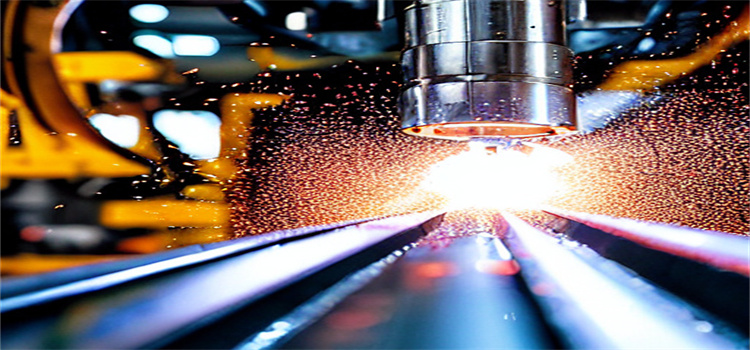
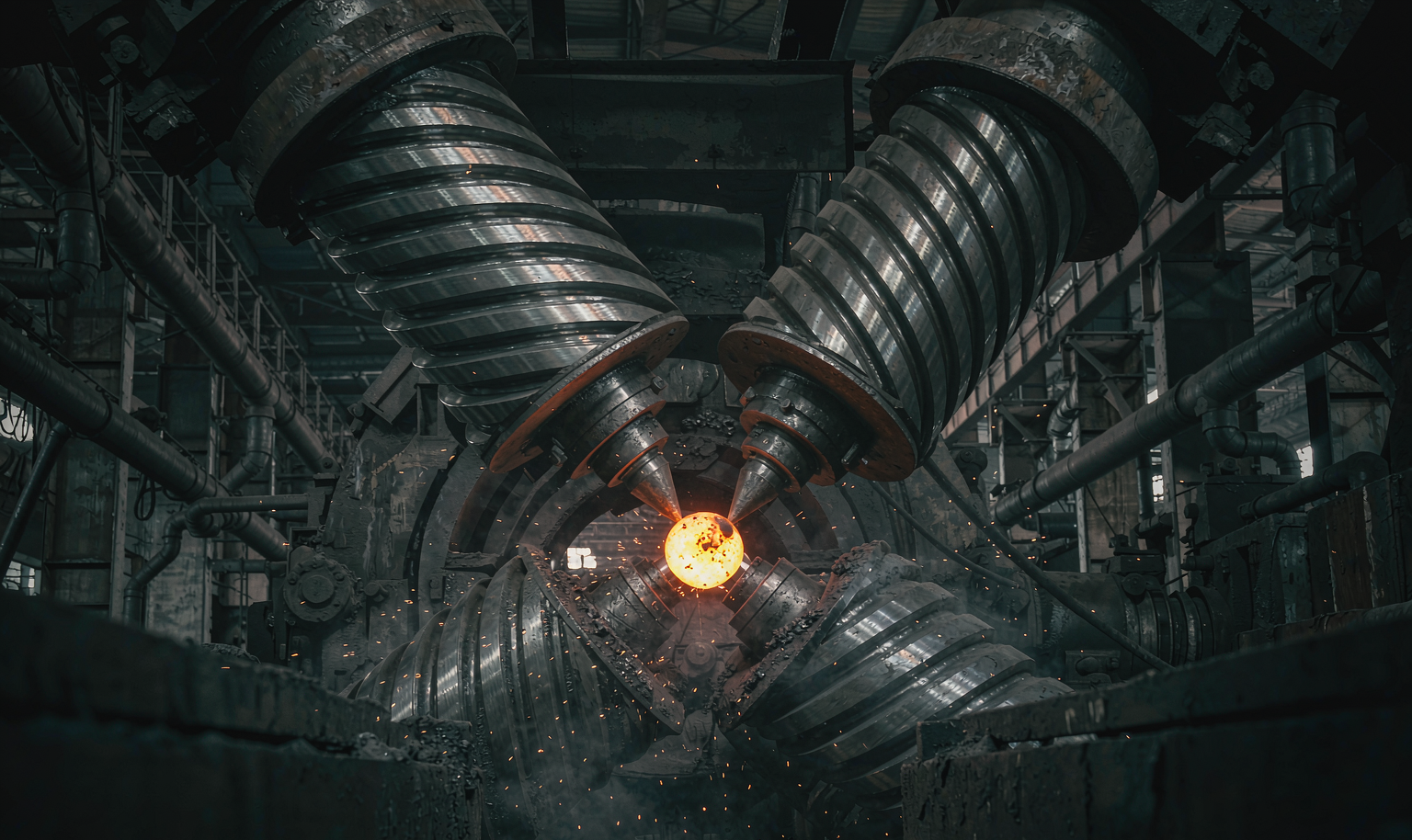
The Mannesmann piercer is the step welded pipe has no equivalent of. The round billet is fed into two large rolls whose axes are tilted 6–12° from the mill axis and crossed so they rotate and advance the billet. The alternating tensile stresses at the billet center open a central cavity, which is immediately shaped over a piercing plug (water-cooled mandrel point) riding on a long bar. In one pass, a solid 300 mm billet becomes a 300–350 mm OD shell with a 60–100 mm bore and a wall around 25–45 mm.
Key control parameters and what they mean for buyers:
| Parameter | Typical Value | Why It Matters |
|---|---|---|
| Billet heating temperature | 1,180–1,280°C | Too hot → inner-surface scab; too cold → heavy piercing load, laminations |
| Roll skew angle | 6–12° | Sets feed speed and rotational component |
| Plug advance | Set per size | Controls bore concentricity and wall eccentricity |
| Piercing cycle time | 10–30 s per billet | Drives mill capacity and price at volume |
| Resulting eccentricity | e/t ≈ 8–15% before elongation | Improved by downstream rolling; final spec often ±10% wall |
4. Elongation Rolling: Pilger vs Mandrel Mill vs Plug Mill
The pierced shell is far too thick for sale, so it goes through an elongation mill. Which mill type a plant runs determines the size range and the unit economics:
| Mill Type | Size Range (OD) | Wall Range | Best For |
|---|---|---|---|
| Pilger (cold pilger on hot mill) | 25–720 mm | 2.5–100 mm+ | Wide mix, thick-wall, alloy grades, small batches |
| Mandrel (MPM/limited-roll) | 114–426 mm | 4–40 mm | High-volume oil & gas line pipe, tight tolerance |
| Plug mill | 114–660 mm | 5–60 mm | Mid-range sizes, moderate volumes |
| Assel (3-roll) | 70–250 mm | 4–35 mm | Bearing tubes, mechanical tubes |
| Stretch-reducing + mandrel | 21–168 mm | 2.3–25 mm | Small-diameter boiler/pressure tube in volume |
For a buyer, the practical translation: a plant with pilger mills can flex across odd sizes and heavy walls (common in Chinese specialty plants), while mandrel-mill plants quote aggressively on standard API 5L and boiler sizes but are weak outside their rolling program. If your project needs 3 m of 610 × 40 mm A106, the pilger plant is the realistic source; if you need 20 km of 219 × 6.5 mm PSL2, the mandrel mill wins on price and lead time.
5. Heat Treatment and Finishing
6. Testing: What Should Be on the Mill Certificate
For pressure-duty grades (A106, A333, API 5L PSL2), the cert should evidence: chemical analysis per heat; tensile (yield, UTS, elongation) per lot; flattening test for sizes ≤ 508 mm where applicable; hydrostatic test pressure computed per standard; and 100% UT or eddy current with the reference notch depth stated (typically 5% of wall for PSL2). Hydro pressures for A106 Gr B are computed from S = 60% of specified minimum yield, so a 219 × 8 mm pipe sees ~12.3 MPa test pressure. If a supplier’s cert shows no NDT line item on pressure-grade pipe, treat the whole document with suspicion.
7. Buying Checklist for Seamless Pipe
8. FAQ
Is hot-expanded seamless pipe still “seamless”?
Yes — hot expansion stretches genuine seamless above its original size, but wall eccentricity and mechanicals degrade slightly. Standards like API 5L permit it with restrictions; always ask whether your pipe is “as-rolled” or “hot-expanded.”
Why is small OD seamless harder to source?
Below ~25 mm OD, mills need stretch-reducing or cold-drawing routes with longer setup per size — expect longer lead times and higher minimums than mid-range sizes.
How do I verify pipe is truly seamless?
Check the bore surface (no weld bead), review UT records, and if in doubt, order third-party inspection with bore-surface examination and hardness mapping along the pipe.
Source Seamless Pipe From a Mill That Knows the Process
A106/A333/API 5L seamless carbon steel pipe, as-rolled or heat treated, full EN 10204 3.1 certification and third-party inspection welcome. Send your size and quantity — response within 24 hours.
Request a quote: Contact Huaxia-Steel.