Steel Coil Rust Prevention During Shipping: Practical Guide
Rust is the single most common complaint in carbon steel export. Importers receive a container, cut the strapping, and find brown staining along the edges of cold rolled coil or full-blown oxide bloom across hot rolled surfaces. The result is a quality claim, a payment dispute, and a relationship damaged before the steel is even processed. For a buyer paying ocean freight on 20-tonne coils, a single rusted shipment can mean thousands of dollars in reconditioning, downgrading, or rejection.
Industry loss data shows that corrosion-related claims account for a large share of all steel cargo disputes. A mid-size distributor moving 5,000 tonnes per year can realistically face 2–4 rust claims annually, each costing between USD 1,500 and USD 12,000 once you add re-grinding, pickling, or resale at a discount. The good news: the majority of transit rust is preventable with disciplined packaging, humidity control, and correct loading. This guide explains exactly how to keep coils clean from mill to port to customer.
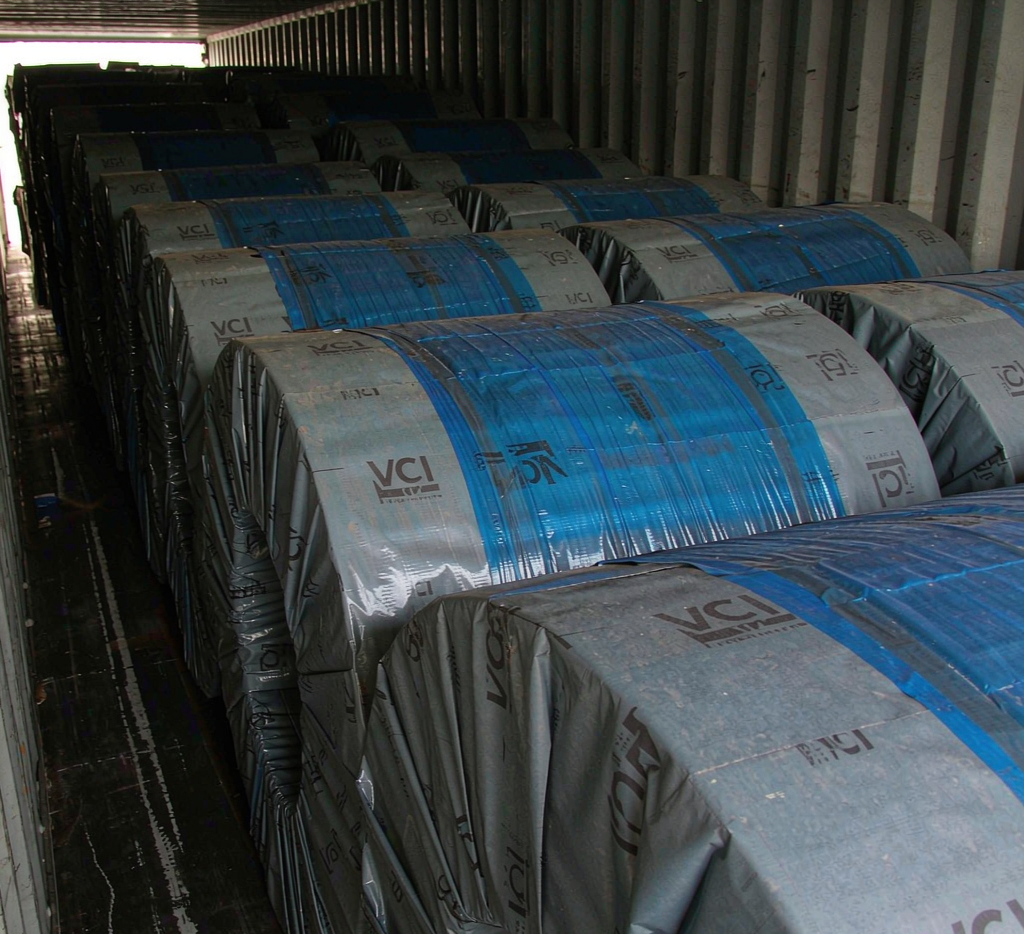
Throughout this article we use the phrase steel coil rust prevention shipping as the core concern because that is precisely what exporters must engineer for — not just “good packaging” but a system that survives 30–45 days at sea.
1. Why Steel Coils Rust in Transit
Steel does not rust on its own. It needs an electrolyte — water — and an electron pathway. During ocean shipping, all the ingredients are present. Understanding the mechanism is the first step in steel coil rust prevention shipping.
1.1 Container Rain and Container Sweat
A standard 20ft dry container holds roughly 33 m³ of air. At 30°C and 80% relative humidity, that air carries about 0.8 litres of invisible water vapour. When the container wall cools at night or near cold currents, the air’s dew point is crossed and condensation forms on the ceiling and walls. This is “container rain” — droplets fall directly onto the cargo. The same effect, “container sweat,” forms when warm moist air meets a cold steel wall and condenses.
1.2 Salt Spray and Chloride Contamination
Sea air contains chloride ions that are intensely corrosive. Even a thin film of salt on a coil edge accelerates rust by breaking the passive layer. Coils loaded near a ship’s hull or in vessels with poor ventilation pick up more chloride exposure.
1.3 Temperature Cycling
Transit through tropical, temperate, and cold zones causes daily expansion and contraction. This cycling pumps moist air in and out of micro-gaps in wrapping and breaks seals. A coil that was dry at loading can be wet by week three.
1.4 Edge Exposure
The cut edges of a slit coil are the most vulnerable area. They expose fresh, reactive steel with no scale protection. Edge rust is the most frequent claim type because edges are hardest to seal perfectly.
1.5 Moisture Trapped at Source
If a coil leaves the mill with surface moisture, residual rolling emulsion, or high humidity in the wrapping, no amount of ocean packaging fully compensates. Pre-shipment dryness is non-negotiable.
2. Pre-Shipment Preparation
The cleanest defense is to start with a dry, stable coil. These steps should happen before any packaging material touches the steel.
2.1 Verify the Coil Is Dry
Use a surface moisture meter or simple dew-point check. The coil surface temperature must be at least 3°C above the dew point of the surrounding air before wrapping. Wrap only in a controlled area where relative humidity is below 60% RH. If the mill floor reads 70% RH, delay packaging or move to a dehumidified zone.
2.2 Apply VCI Oil or Solvent-Based Coating
For cold rolled and galvanized products, a thin volatile corrosion inhibitor (VCI) oil film or a dry VCI vapor-phase treatment protects surfaces for months. Typical application rates are 0.5–2.0 g/m² depending on storage duration. For hot rolled products destined for pickling anyway, a heavier rust-preventive oil may be used at 3–5 g/m².
2.3 Edge Protection
Install edge protectors on both inner and outer diameters. UseVCI-impregnated paper or plastic edge boards at minimum 3 mm thickness. Edges should never contact bare wood or steel.
2.4 Humidity Check Before Sealing
Measure the humidity inside the wrapping using a strip indicator or data logger. Acceptable target: below 40% RH inside the package, never above 60%. Record the reading on the packing list.
2.5 Surface Cleaning
Remove fingerprints, marking ink residues, and chloride-containing handling fluids. Even a sweaty glove print can bloom into a rust spot within days at sea.
3. Packaging Materials
Choosing the right combination of barriers decides whether your shipment arrives clean. The table below maps each material to its best use case.
| Material | Protection Type | Best For | Typical Spec / Quantity | When to Use |
|---|---|---|---|---|
| VCI Paper | Vapor-phase inhibitor | Cold rolled, galvanized, slit coil | 60–120 g/m², wrap 2 layers | Long transit (30+ days), high humidity routes |
| Stretch Film (PE) | Physical moisture barrier | All coil types as outer wrap | 50–100 micron, min 3 wraps | Always as outer sealing layer |
| Rust-Preventive Oil | Surface film barrier | Hot rolled, non-pickled coil | 3–5 g/m² | When customer accepts oily surface |
| Desiccant (Clay/Calcium Chloride) | Humidity absorption | Container-level moisture control | 1 bag per ~1 m³; 4–6 bags/20ft | Tropical routes, 40+ day transit |
| VCI Emitters / Diffusers | Vapor-phase, enclosed spaces | Inside coil eye or small voids | 1 unit per 0.5–1 m³ | Supplement to paper for edges |
| Corrugated + Anti-Abrasion Paper | Mechanical + minor barrier | Outer cushioning layer | 200–300 g/m² board | All export coils |
Material selection is not one-size-fits-all. A cold rolled coil going to Germany in winter needs less desiccant than the same coil going to Mumbai in monsoon season. Match the package to the route and transit length.
4. Container Loading Best Practices
Even perfect packaging fails if loading is sloppy. Follow these rules for every container.
4.1 Pallets and Cribbing
Never place coils directly on the container floor. Use wooden dunnage, steel cradles, or pallets at least 50 mm thick to lift the coil off the deck and allow airflow underneath. For eye-to-sky coils, use V-shaped cradles. For eye-to-wall coils, use at least two transverse timber blocks per coil.
4.2 Airflow and Spacing
Leave a 50–100 mm channel along the floor and between coil stacks. Stagnant air pockets trap humidity. Do not overpack the container to the point that desiccant bags are crushed.
4.3 Desiccant Bag Count
A practical rule for steel coil rust prevention shipping: place 1 desiccant bag (typically 500 g–1 kg absorptive capacity) per cubic metre of container volume, with a floor of 4–6 bags in a 20ft container and 8–12 bags in a 40ft container. For high-humidity monsoon routes, double the count.
4.4 Avoid Wall Contact
Keep all coils at least 75 mm from side and front walls. Wall condensation is the wettest surface in the box. Use airbags or timber spacers to hold coils centered.
4.5 Strapping and Securing
Secure coils with a minimum of 4 vertical and 2 horizontal lashings using 32 mm polyester or steel strapping rated above the coil weight. Loose cargo shifts, rubs, and breaks its own protective wrap.
4.6 Pre-Loading Container Check
Inspect the container for holes, rust streaks, damp flooring, and smell of mould. Reject any container with visible water. Sprinkle a desiccant layer on the floor before loading as a safety buffer.
5. Ocean Transit Considerations
Once the ship sails, you lose direct control, but the right setup keeps the environment hostile to rust.
5.1 Transit Time vs Humidity Risk
Short routes under 15 days carry lower risk. Routes of 30–45 days through the Indian Ocean or South China Sea in summer are high risk and need maximum desiccant and double VCI layering. Plan the package for the worst week of the voyage, not the average.
5.2 Ventilation Settings
For dry containers, keep vents closed to stop humid outside air entering. For ventilated or open-top configurations, balance airflow against rain exposure. Most corrosion losses in dry boxes happen because vents were left open near the equator. Closed, desiccant-filled boxes outperform vented boxes for steel.
5.3 Temperature Monitoring
Consider a single-use temperature and humidity data logger inside one container per shipment. At arrival you get a 30-day curve proving the environment stayed within spec — useful if a dispute arises.
6. Inspection on Arrival
The buyer’s first 30 minutes after opening the container determine whether a claim succeeds.
6.1 How Buyers Should Check
- Photograph the sealed container door and floor before opening — note any water stains.
- Open and immediately photograph desiccant bags; saturated or liquid-filled bags signal overload.
- Cut wrapping and inspect coil edges first — edges show rust before flat surfaces.
- Use a flashlight at a low angle to spot early bloom invisible to the naked eye.
- Measure any affected area and compare to contract tolerance (often max 5% edge staining).
6.2 Documenting Rust
Take dated, geotagged photos with a scale reference. Record relative humidity at the warehouse. Keep the desiccant bags as evidence. Without documentation within 48 hours of arrival, most claims are rejected.
6.3 Claim and File Process
- Notify the supplier and carrier in writing within the contract window (commonly 3–7 days).
- Submit a survey report from a third-party inspector if value exceeds USD 5,000.
- Attach photos, packing list, bill of lading, and humidity logs.
- Request remediation: discount, replacement, or shared cost per Incoterms.
7. Choosing a Reliable Supplier
Packaging discipline reflects a mill’s export maturity. Before placing an order, request these items in your purchase order so steel coil rust prevention shipping is contractually defined.
7.1 Packaging Checklist to Put in the PO
- Maximum 60% RH at packaging, with recorded reading on the packing list.
- Minimum 2 layers VCI paper (60 g/m²+) for cold rolled; rust oil for hot rolled.
- Minimum 3 wraps of 50+ micron stretch film on outer surface.
- VCI edge protectors on both inner and outer diameters.
- Desiccant: 4–6 bags (1 kg each) in 20ft, 8–12 in 40ft, doubled for monsoon routes.
- Coils on dunnage, min 50 mm off floor, 75 mm off walls.
- Seaworthy export container, pre-inspected dry, vents closed.
- Optional: humidity data logger returned with shipment records.
A supplier who accepts this checklist in writing is far more likely to deliver clean coil. One who pushes back or offers vague “standard export packing” language should raise a flag.
8. FAQ
8.1 How long can steel coils stay rust-free with proper packaging?
With VCI paper, stretch film, and correct desiccant, cold rolled coils typically remain rust-free for 6–12 months in storage and 30–45 days in transit. Hot rolled with rust oil lasts 3–6 months. Beyond that, re-inspection and possible re-oiling are recommended.
8.2 VCI paper or rust-preventive oil — which is better?
VCI paper is cleaner, leaves no residue, and suits coils going straight to stamping or painting. Rust oil gives stronger protection for long, harsh transit but requires degreasing on arrival. Many exporters use both: VCI paper wrap plus a light oil film for maximum safety.
8.3 How much desiccant do I actually need?
Rule of thumb: 1 bag (1 kg absorptive) per cubic metre of container volume. That means 4–6 bags for a 20ft box and 8–12 for a 40ft box. For tropical or 40+ day routes, double it. Underestimating desiccant is the most common and cheapest-to-fix mistake.
8.4 Can I reuse desiccant bags across shipments?
No. Once a desiccant bag has absorbed moisture it is spent. Reuse risks sudden release of trapped water back into the container. Always use fresh, sealed bags and verify the indicator window is blue (dry) before loading.
8.5 Does container insurance cover rust claims?
Standard marine cargo insurance often excludes “inherent vice” and gradual deterioration, which carriers argue includes poor packaging rust. Coverage usually applies only if you can prove external water ingress from container failure. This is why prevention beats claims every time.
9. Get Rust-Proof Export Packaging From Huaxia-Steel
Rust claims are expensive, slow, and damaging to trust — but they are avoidable. At Huaxia-Steel we engineer every export coil for the realities of ocean transit: dry pre-shipment inspection below 60% RH, double VCI wrapping, edge protectors on both diameters, calibrated desiccant counts, and dunnage-loaded containers with closed vents. Our packing list records the humidity reading so you have proof from mill to port.
If you import carbon steel coils and have been burned by transit rust, talk to our export team. Tell us your route, transit time, and product type, and we will specify a packaging plan built around reliable steel coil rust prevention shipping rather than guesswork. Contact Huaxia-Steel today to request a rust-proof export packaging quote and a copy of our standard PO packaging checklist.