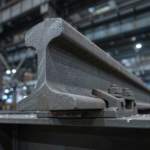
The carbon steel fish plate — also called a rail joint bar or splice bar — is the bolted component that joins two rail ends into a continuous track, transferring wheel loads across the joint while allowing thermal expansion and easy track maintenance. Forged or rolled to standard rail profiles (UIC, AREMA, BS, GB), fish plates pair with four or six track bolts and spring washers to make the joint that still dominates main lines, industrial sidings, crane rails and mine tracks worldwide. We supply carbon steel fish plates for rail sections from light 8 kg rails to heavy QU120 crane rails and UIC 54/60 mainline rails, hot forged or rolled in Q235B/45#/A36 carbon steel with quench and temper or normalized condition, drilled to match your rail section, with EN 10204 3.1 certification and factory-direct pricing for track builders, crane rail installers and mining contractors.
Product Overview
A fish plate is a flat bar with a cross-section that mirrors the rail’s working face: a central web section matching the rail web, and upper and lower wings that clamp against the railhead underside and the rail foot top. The bar is drilled — typically 4 holes for light rail and crane rails, 6 for mainline sections — and bolted so the two bars grip the paired rail ends like a splint, carrying the vertical wheel load and the lateral guide force across the gap. The joint is deliberately not rigid: a few millimetres of expansion gap between rail ends is preserved at installation, and the fish plate’s controlled flexure accommodates passage while the joint keeps the running surfaces aligned.
Material selection is the whole engineering story of a fish plate. The bar takes cyclic bending loads with stress concentration at bolt holes, so plain low carbon steel works loose and cracks; the standard practice is medium carbon steel (45#, C45 equivalent) quenched and tempered to roughly 22–30 HRC, or high strength low alloy bar for heavy axle load lines. Hardness that is too high trades away ductility and invites brittle fracture in cold weather; too low and the bar bends permanently and the joint drops. The Q&T 45# supply we stock most is the balance point that mining, port and crane track operators re-order year after year.
Specifications
| Parameter | Range / value |
|---|---|
| Product standard | Per rail section profile: UIC 864-3, AREMA, BS 47-1, GB/T 11265 (light rail joints), TB/T 2345 |
| Matched rail sections | GB light rail 8–30 kg/m; QU70–QU120 crane rail; UIC 54/60; ASCE/AREMA 40–115 lb/yd |
| Material | Q235B (light duty), 45# / C45 Q&T (standard duty), 40Cr Q&T (heavy duty) |
| Hardness (45# Q&T) | 22 – 30 HRC (265–300 HB) |
| Tensile (45# Q&T) | ≥ 700 MPa |
| Manufacturing | Hot rolled profile or die forged, normalized or quenched and tempered |
| Holes | 4 or 6 per bar, drilled per rail section drilling pattern; oval slots on request |
| Hole tolerance | ±0.5 mm, burr-free, chamfered |
| Length tolerance | ±2 mm; end faces square |
| Surface | Shot blasted / oil blackened; hot dip galvanized on request |
| Certificate | EN 10204 3.1 standard; 3.2 on request |
Fish Plates for Common Rail Sections
| Rail section | Standard | Typical use | Bar spec (typical) |
|---|---|---|---|
| QU70 / QU80 / QU100 / QU120 | GB crane rail | Overhead crane runways, port cranes | 45# Q&T, 4-hole, ~26 HRC |
| UIC 54 / UIC 60 | UIC 864-3 | Mainline, industrial sidings | 45# or low alloy Q&T, 6-hole |
| 8–15 kg/m light rail | GB/T 11265 | Mine cart, light trolley track | Q235B, 4-hole |
| 22–30 kg/m light rail | GB/T 11265 | Mining haulage, temporary track | 45# Q&T, 4-hole |
| ASCE 60–85 lb | AREMA profile | Industrial tracks (Americas) | Q235B/A36 or 45# Q&T |
| BS 75A / 90A | BS 47-1 | Legacy Commonwealth tracks | 45# Q&T, 6-hole |
The drilling pattern is the detail that decides whether a fish plate fits: hole count, hole spacing, end distances and hole diameter all follow the rail section’s standard, and mixing standards (for example, drilling a UIC 60 bar with AREMA spacing) produces a joint that bolts up but loads the bolt eccentrically. Send us the rail section name and drawing if you have it; we drill to the section standard and confirm the pattern on the shop drawing before production.
Manufacturing Standards and Heat Treatment
Bars are produced two ways: hot rolled on profile mills from medium carbon billet for high-volume standard sections, and die forged for heavy or non-standard sections where the forge route gives better grain flow through the web-to-wing transitions. Heat treatment follows the duty class: Q235B light-duty bars are normalized or supplied as-rolled; 45# bars are quenched in water or polymer and tempered at 550–620 °C to the 22–30 HRC band, with hardness sampled per lot and tensile tests on representative coupons. The UIC 864-3 acceptance route — the one most European-connected projects quote — specifies minimum tensile, elongation and hardness for joint bars, and our UIC-profile production is certified against it. Marking per the standard (rail section, manufacturer mark and cast/batch number) is rolled or stamped on the bar web.
Applications
- Crane rail systems: joint bars for QU70–QU120 rails on runway beams, plus welded rail alternatives where joint-free runways are specified.
- Port and mining track: heavy axle load joints with Q&T bars and clip or bolt fastenings.
- Industrial sidings and workshop tracks: light and medium rail joints for in-plant logistics lines.
- Mainline and regional rail maintenance: UIC/BS profile joint bars as temporary or permanent joints alongside welded rail.
- Rail fastening supply packages: fish plates paired with track bolts, nuts, spring washers and elastic clips per project BOM.
Quality Assurance
- Heat chemistry and mechanical test results on EN 10204 3.1 certificate for every lot.
- Hardness sampled per heat treatment lot and recorded; target band stated on the certificate.
- Tensile and (where the standard requires) elongation tests on representative coupons per lot.
- Drilling pattern checked with a go/no-go gauge against the rail section standard drawing.
- Flatness inspection: bar faces free of lipping that would hold the bar off the rail web.
- Surface inspection per lot; shot blast and coating thickness checks on coated orders.
- Third-party inspection (SGS, BV, TUV) and EN 10204 3.2 available; witness of hardness and tensile testing arranged at the works.
Packaging and Shipping
Fish plates ship in steel-strapped bundles of 100–500 pieces by size, on timber pallets or in plywood crates for container loading, with size tags per bundle and drill-pattern identification stenciled on the pack. Machined or galvanized bars are packed with face separators to prevent marking. Bolts, nuts and washers can be shipped in the same container, packed separately per the fastening BOM. All timber is ISPM 15 heat-treated and marked. We ship FOB, CFR and CIF from Shanghai, Qingdao and Tianjin; standard crane rail (QU series) and light rail plates are usually in stock with 10–15 day dispatch, UIC and AREMA profile bars made to order in 25–40 days including heat treatment and drilling.
FAQ
Why not just weld the rails together? Welded joints are superior on mainline track, but they cost a trained crew, specialized equipment and longer possession time. Fish plated joints install with hand tools in minutes, allow the rail to be lifted for maintenance, and are the only practical answer on temporary track, mine haulage and light industrial lines. Many crane runway specifications now weld the rail and use fish plates only at expansion joints — both products exist for a reason, and we supply both markets.
How do I know which material class to order? Match the bar to the duty: Q235B for light rail and temporary track where loads are small; 45# quenched and tempered for crane rails, mining haulage and anything with real axle loads. If a bar has ever bent permanently under a wheel, the previous bar was too soft — that is the symptom of as-rolled mild steel specified where Q&T medium carbon was needed.
What bolt torque should the joint use? Follow the track authority’s standard for the bolt size and fastening system; the joint relies on bolt clamping through spring washers or clip systems, and undertorqued joints loosen while overtightened bolts lose elasticity. We supply matched bolt and washer sets with the bars so the fastening system is consistent with the drilling pattern.
The new bars do not fit my rail — what went wrong? Nine times out of ten the drilling pattern does not match the rail section standard, usually because the rail is a mixed-standard import or the old bars were made for a modified section. Identify the rail by measuring head width, height and foot width, or send a photo of the old bar with a ruler across the holes — our team identifies the section and quotes the correct pattern before production.
Do you supply galvanized or coated bars? Yes — hot dip galvanized bars for outdoor and humid mine environments, black oxide or oil-blackened as standard for dry storage. Coating adds roughly 3–7 days to lead time and the zinc thickness is reported on request.
Request a Quotation
Send us the rail section (QU, UIC, AREMA, GB light rail, BS), the quantity of joints, the material class you need (Q235B standard duty or 45# Q&T heavy duty) and whether you want bolts and washers included, and we will confirm the drilling pattern, quote the bars and return the lead time. If you are replacing worn bars on an existing crane runway, send one photo of the old bar with a ruler across the holes — our engineering team will identify the section and quote from it. Email our export team for a quotation within one working day.