Steel H-Pile Carbon Steel — Factory Direct Supplier | Huaxia-Steel
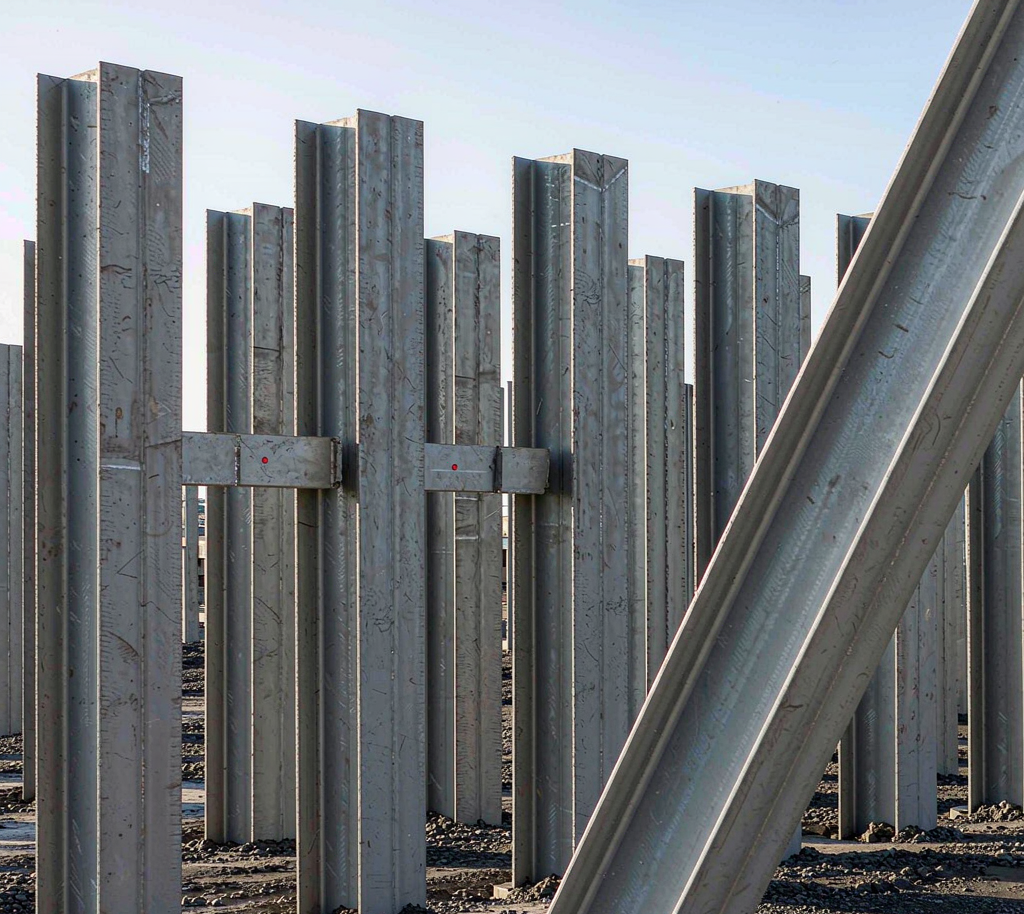
Carbon steel H-pile is a hot-rolled structural section with an H-shaped cross section used for deep foundation piling, retaining walls, bridge foundations and marine structures. Unlike a wide-flange beam, an H-pile has equal flange and web thickness so it can be driven into the ground and carry load in both directions.
Huaxia-Steel supplies carbon steel H-pile in HP8x36 to HP14x117 sections, in lengths up to 24 metres, in grades such as A36, A572 Gr50 and S355JR, with mill test certificates and export packing.
Product Overview
H-pile is designed to be driven, so its geometry differs from a beam. The flange and web are nominally the same thickness, and the section is proportioned to resist driving stresses as well as axial and lateral loads. It is used as a displacement pile in soil and as a bearing pile where it reaches a competent stratum.
Because H-pile is often exposed to groundwater and marine environments, it is frequently supplied with a protective coating or in a weathering grade. We can supply plain, primed or coated sections, and cut-to-length with spliced joints if required.
Specifications
| Parameter | Range / Standard |
|---|---|
| Section | HP8x36 to HP14x117 (and metric equivalents) |
| Depth | 200 mm – 360 mm |
| Flange width | 200 mm – 370 mm |
| Length | up to 24 m, or cut to length |
| Grade | A36, A572 Gr50, S355JR, Q345B |
| Tolerance | per ASTM A6 / EN 10034 |
| Surface | As rolled, primed, or coated on request |
Section properties and tolerances follow ASTM A6 or EN 10034, and we confirm the driving length and splice detail against your foundation drawing. For long piles, we can supply mill lengths and splice them on site or in the fabrication yard.
Available Grades
| Grade | Yield strength (min) | Typical use |
|---|---|---|
| ASTM A36 | 250 MPa | General foundation piling |
| ASTM A572 Gr50 | 345 MPa | Higher-capacity piles, bridges |
| S355JR | 355 MPa | European projects, structural piling |
| Q345B | 345 MPa | Domestic and export projects |
Grade selection depends on the required axial capacity and the driving conditions. Higher-strength grades allow a smaller section for the same load but may be less forgiving during driving in hard ground, so the geotechnical engineer should confirm the choice.
Manufacturing Standards
- ASTM A6 / A6M – general requirements for rolled structural steel
- ASTM A572 / A572M – high-strength low-alloy structural steel
- EN 10034 – tolerances for structural steel I and H sections
- EN 10204 3.1 – inspection certificate for export projects
Each heat is certified for chemistry and mechanical properties, and sections are marked with heat number, section designation and length. For projects requiring EN 10204 3.1 certification, we provide full traceability from heat to delivered pile.
Applications
Carbon steel H-pile is used for building foundations, bridge abutments and piers, retaining walls, marine jetties, cofferdams and slope stabilization. It is also used as a soldier pile in temporary and permanent excavation support, and as a bearing pile where driven to rock or a dense stratum.
In marine and aggressive soil conditions, H-pile is often combined with a protective coating or cathodic protection. We can advise on coating systems and supply primed or coated sections to suit the exposure.
Quality Assurance
Chemistry and mechanical properties are verified per heat, and dimensions, straightness and camber are checked before shipment. Each pile is marked for traceability, and we can arrange ultrasonic or magnetic particle testing of welds if splicing is performed in our yard.
Third-party inspection by SGS, BV, Intertek or TUV is available for export projects, including dimensional checks and witness of mechanical testing. We can also coordinate pile driving records if the project requires installation support.
Packaging and Shipping
H-pile is shipped in bundles secured with steel strapping, with timber dunnage between layers to prevent abrasion. For long piles, we use break-bulk vessels or flat racks, and we confirm lifting points and stacking limits before loading. We ship from Tianjin, Qingdao and Shanghai on FOB, CFR, CIF or DAP terms.
Lead time is typically 15 to 25 days for stock sections and 30 to 45 days for mill rolling. Coating and splicing add time depending on the specification and quantity.
H-Pile vs Wide-Flange Beam
| Feature | H-Pile (HP) | Wide-Flange Beam (W) |
|---|---|---|
| Flange and web thickness | Nominally equal | Flange thicker than web |
| Driving suitability | Designed for driving | Not designed for driving |
| Bearing area | Good in both axes | Better in one axis |
| Typical use | Deep foundations | Building frames, bridges |
The equal-thickness geometry of an H-pile makes it better suited to driving than a wide-flange beam, because it resists driving stresses more uniformly and provides bearing area in both directions. A wide-flange beam is optimized for bending in one direction and is not intended to be driven, so substituting one for the other in a foundation is an engineering error.
Driving, Splicing and Installation
H-piles are driven with a diesel, hydraulic or vibratory hammer, depending on the ground conditions and the specified bearing stratum. The pile tip may be supplied with a flat end, a point, or a rock shoe for hard strata. Driving stresses should be checked against the section capacity, and the hammer energy should be matched to the pile and soil.
Splicing is common when the required length exceeds the mill length. Splices are usually full-penetration welds with backing, or mechanical couplers, and they must develop the full section capacity. We can supply splice details and, where splicing is done in our yard, arrange weld testing to the project specification.
Corrosion Protection for Marine and Soil Exposure
H-pile in soil and marine environments is exposed to corrosion, particularly in the splash zone and in aggressive soils. Protection options include epoxy or polyurethane coatings, galvanizing for suitable sections, and cathodic protection for immersed marine structures. The choice depends on the exposure, design life and cost.
Coating must survive driving, so it is usually applied thicker than for static structures and inspected for damage after installation. Where coating is damaged during driving, touch-up is performed above ground and, for immersed sections, cathodic protection provides backup. We can supply primed or coated sections and advise on coating systems for the exposure.
How to Order H-Pile
- Confirm the section designation and grade against the foundation drawing.
- State the required length and whether splicing is included.
- Specify the pile tip type and any rock shoe requirement.
- State the coating or protection system, if any.
- Require a mill test certificate and agree marking, packing and shipping terms.
Because H-pile is often a long-lead item on a foundation program, ordering early and confirming the section and grade avoids delays. For export projects, confirm transport method for long piles, since they may require break-bulk vessels or flat racks rather than standard containers.
Section Selection Guidance
Section selection is driven by the required axial capacity, the driving conditions and the available hammer. A larger section provides more capacity but requires more hammer energy and may be harder to drive in dense ground. The geotechnical engineer should confirm the section based on the soil profile and the design load.
As a supplier, we can provide section properties, mill certificates and coating options, but we do not replace the foundation engineer. The best outcomes come when the engineer selects the section, the contractor confirms the driving method, and the supplier delivers certified material to the agreed schedule.
Pile Tip Options and Accessories
H-piles can be supplied with a flat end, a chamfered tip, or a cast steel rock shoe for driving into hard strata. The tip type affects driving performance and should be selected with the contractor based on the ground conditions. Rock shoes are common where the pile must penetrate weathered rock or dense glacial till.
Accessories such as splice plates, lifting holes and coating touch-up kits can be supplied with the piles. For projects with a defined installation sequence, we can mark piles with an identification number so they can be tracked from delivery to driving.
Transport and Site Handling
Long H-piles require special transport arrangements. Standard containers cannot carry piles longer than about 12 metres, so longer lengths are shipped break-bulk or on flat racks. We confirm the transport method and lifting points before loading, and we provide a packing list that matches the pile markings.
On site, piles should be stored on timber bearers to keep them off the ground and to prevent distortion. Lifting should use slings at the designated points to avoid bending the section. Proper handling protects the coating and keeps the pile straight for driving.
Frequently Asked Questions
What is the difference between H-pile and an H-beam?
An H-pile has nominally equal flange and web thickness so it can be driven and carry load in both directions, while an H-beam (wide-flange) has a thicker flange and is optimized for bending. They are not interchangeable in foundation work.
What lengths can you supply?
We supply H-pile in mill lengths up to about 24 metres, or cut to your required length with splicing if needed. Long piles are shipped break-bulk or on flat racks rather than in standard containers.
Can H-pile be supplied with a protective coating?
Yes. We can supply primed or coated sections for soil and marine exposure, and we advise on coating systems that will survive driving. Touch-up after installation is recommended for any coating damaged during driving.
Get a Quote from Huaxia-Steel
Factory-direct carbon steel with MTR, third-party inspection and fast export shipping. Send your grade, size, quantity and destination — we return a firm quote within 24 hours.