PPGI (pre-painted galvanized iron) steel coil is hot-dip galvanized carbon steel coil that has been chemically treated, primed and painted on a continuous coil coating line before any cutting or forming — delivering a finished, colored, corrosion-protected surface straight off the reel. Huaxia-Steel supplies PPGI coil and slit strip factory direct: 0.12 to 1.5 mm thickness, 600 to 1,250 mm width, RAL color matching, polyester, SMP, HDP and PVDF paint systems, with zinc coating from Z40 to Z180 g/m². Roofing, cladding, appliance and profiling customers receive per-coil MTCs, color retention warranties and export-ready packing.
Product Overview
A PPGI coil is a five-layer system on one side: steel substrate, hot-dip zinc coating, chemical conversion layer, epoxy or polyester primer (typically 5 to 8 μm), and topcoat (12 to 20 μm for polyester, up to 27 μm for high-durability systems), with a backer coat on the reverse. Because painting happens while the steel is flat and under controlled tension, the finish is uniform, adhesion is measurable and bendable — qualities impossible to achieve by painting formed parts. Profiled roofing sheets, sandwich panel facings, roller shutters, ceiling T-grids, appliance cabinets and ducting all start as PPGI coil, and the coil’s paint system determines the product’s service life.
We stock the high-turn configurations (0.3 to 0.6 mm, 914/1,000/1,200 mm widths, RAL 9002/9010/7016, Z60 coating) for immediate slitting and ship made-to-order coils from prime mills with 20 to 35 day lead times. Whether you run a profiling line for corrugated roofing or feed a sandwich panel line with 0.5 mm facings, we match the paint system and zinc class to your environment — coastal, industrial, or standard inland service — and document the match on the certificate.
Specification Table
| Parameter | Range | Notes |
|---|---|---|
| Substrate thickness | 0.12 – 1.5 mm | 0.13–0.8 mm covers most roofing and panel work; below 0.25 mm quote on strip grades |
| Width | 600 – 1,250 mm | slit strip from 30 mm; standard coil 914 / 1,000 / 1,200 / 1,219 / 1,250 mm |
| Zinc coating | Z40 – Z180 g/m² (total both sides) | Z60–Z100 standard roofing; Z150–Z180 for coastal and industrial |
| Yield strength | 230 – 550 MPa | CS/FS/DDS drawing grades to full-hard structural grades |
| Paint systems | PE, SMP, HDP, PVDF | topcoat 12–20 / 20 / 25–30 / 27 μm; primer 5–8 μm epoxy |
| Color | RAL / custom match | Delta E ≤ 1.0 within a production batch on request |
| Gloss | 20 – 90 GU at 60° | matt, semi-matt, high gloss selectable |
| Coil weight | 3 – 10 tons | custom coil weights and ID 508/610 mm |
| Package | eye to sky / eye to wall | VCI paper, waterproof film, steel banding on wooden cradles |
Paint Systems and Corrosion Performance
Choosing the paint system is the single most consequential decision in a PPGI order, because it sets both price and service life:
| System | Thickness | Expected life (inland) | Typical use |
|---|---|---|---|
| PE (polyester) | 12–20 μm | 8 – 12 years | standard roofing, interior panels, ducting — best price/performance |
| SMP (silicone modified polyester) | 20 μm | 12 – 18 years | mid-range roofing with better chalk resistance than PE |
| HDP (high durable polyester) | 25–30 μm | 15 – 20 years | industrial and coastal roofing, appliance outdoor panels |
| PVDF (polyvinylidene fluoride) | 27 μm | 20 – 25+ years | architectural cladding, premium facade — best color retention |
Zinc layer thickness works together with paint: the metallic coating provides sacrificial protection at cut edges and scratches, while the paint shields the zinc from the atmosphere. For aggressive environments, Z150 to Z180 with SMP or HDP is the economical combination; PVDF at Z180 is reserved for architectural work where color fastness is contractual. Salt-spray performance per ASTM B117 on our standard systems: PE reaches 500 hours without blistering, SMP and HDP 750 to 1,000 hours, PVDF beyond 1,000 hours, all measured on cross-scribed panels with adhesive-tape pull at the scribe.
Substrate Grades and Mechanical Properties
PPGI substrate follows ASTM A653 / A755 (coated, coil-coated) or EN 10346 / EN 10169, with common grades:
- CS / FS / DDS (drawing grades): yield 140 to 210 MPa with high elongation for deep-formed appliance parts and stampings.
- Commercial / forming grades (JIS G3302 SGC equivalents): the general roofing and profiling workhorse with 230 to 270 MPa yield.
- Structural grades Gr 340 / Gr 550 (A653 SS) or S280GD–S550GD (EN 10346): full-hard and structural tempers for purlins, sandwich panel facings and load-bearing cladding; S550GD full-hard is the standard for high-span trapezoidal roofing.
Formability note: paint does not stretch like steel. Bending radii, lock-forming and roll-forming pass designs must respect the paint system’s T-bend capability — PE typically allows 2T to 3T bends, SMP 3T, HDP and PVDF 2T to 3T depending on gauge. Tell us your tightest bend and we will confirm the T-bend rating on the specific paint/gauge combination before you commit the order, which prevents the classic problem of hairline cracking at bend lines discovered after a full container has been profiled.
Applications
- Profiled roofing and wall cladding: corrugated and trapezoidal sheets for industrial buildings, warehouses and prefabricated housing.
- Sandwich panels: PPGI facings bonded to PU, EPS or rockwool cores for cold rooms and clean walls.
- Appliances: washing machine cabinets, refrigerator backs, microwave housings — usually HDP or PE on drawing-grade substrate.
- Rolling shutters, doors and window frames: high-gloss PE with good bend performance.
- HVAC ducting and ceiling systems: light-gauge coil with backer coat for interior service.
Quality Assurance and Testing
Every PPGI shipment carries the coil-coating line’s own quality file: substrate MTC with zinc weight, paint batch traceability, and the applied tests for that batch — coating thickness by magnetic gauge (per ASTM D1186/ISO 2808), T-bend adhesion (ASTM D4145), impact adhesion (ASTM D2794), pencil hardness (ASTM D3363), gloss measurement (ASTM D523) and salt spray where the system standard requires it. Incoming checks at your factory take minutes: color against the agreed standard panel under D65 light, coating thickness with a gauge, T-bend on a hand sample. For recurring programs we archive a signed color standard panel per color per quarter, so batch-to-batch drift stays measurable — the difference between a repeat order that blends in and one that shows as two-tone on a finished roof.
Packing and Shipping
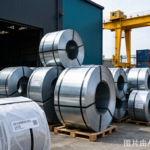
PPGI is surface cargo: the paint is the product, and packing discipline decides whether it arrives that way. Coils ship eye-to-sky on wooden cradles or eye-to-wall, each coil wrapped in VCI-impregnated paper, then waterproof plastic film, then galvanized or fiberboard outer wrap, steel-banded to the cradle. Container interiors get desiccant and paper-lined walls to block condensation during ocean transit — the number-one cause of edge white rust claims on coated coils. Slit strip ships in oscillator or shippable loose packs with paper interleaving. Every coil carries a tag with grade, size, zinc class, paint batch and color code, matched one-to-one to the MTC and packing list before container closing.
Why Buy PPGI From Huaxia-Steel
- Prime-mill sourcing with per-coil MTCs — no seconds or off-grade material in export contracts.
- RAL color matching with archived standard panels per program quarter.
- Paint system consultation: we confirm T-bend, salt spray and zinc class against your environment before order confirmation.
- Slitting to your profiling line widths with tight width tolerance (±0.5 mm on request).
- Mixed-container loads: combine PPGI with galvanized, Aluzinc and black annealed coils in one shipment.
PPGI vs PPGL: Choosing the Right Substrate
PPGI uses a pure zinc (galvanized) substrate; PPGL uses 55% aluminum-zinc (galvalume, ASTM A792). Each has a loyal following: galvalume resists atmospheric corrosion 2 to 4 times longer at equal coating weight and reflects heat better, which is why it dominates standalone roofing in hot climates. Galvanized wins where parts are bent, punched and fastened, because zinc’s sacrificial action at cut edges and drill holes is more aggressive than aluminum-zinc’s barrier protection — appliance makers and sandwich panel plants mostly stay with PPGI for exactly this reason. Our practical recommendation: roofing sheets with few fastener holes and long exposed life lean PPGL; profiled parts, purlins-adjacent applications and anything with many cut edges lean PPGI at heavier zinc. We supply both, and the mixed-container option lets you hold one supplier for the full coated range.
Frequently Asked Questions
What is the difference between PPGI and color coated steel coil?
They are the same product family: PPGI is pre-painted galvanized iron, where the substrate is hot-dip galvanized steel. “Color coated coil” is the broader term that also includes PPGL (pre-painted galvalume, aluminum-zinc substrate) and pre-painted aluminum. If your supplier’s quote does not state the substrate, ask — zinc and galvalume substrates behave very differently at cut edges.
Which zinc coating should I choose for roofing?
Inland standard service: Z60 to Z100 g/m². Coastal, industrial or high-humidity tropical sites: Z150 to Z180. Remember the zinc protects cut edges and scratches sacrificially, so heavier zinc also reduces red rust at screw holes and cut ends during the roof’s life.
Can you match a specific RAL color?
Yes. We produce to RAL codes and match physical samples with Delta E ≤ 1.0 within a batch on request. For repeat programs we archive a signed color standard panel per color per quarter, which keeps later deliveries visually consistent with earlier ones — critical for phased construction projects.
What is the MOQ and lead time?
Stock configurations (common colors, Z60–Z100, 0.3–0.6 mm) ship within 7 days from slitting. Made-to-order colors and gauges run 20 to 35 days depending on the coil coating line schedule; MOQ is typically 15 to 25 tons per color per gauge.
Need PPGI coil with the right paint system for your climate and profiling line? Send thickness, width, color code and destination — factory-direct quote with T-bend and salt-spray confirmation within 24 hours.