Unequal Angle Steel — Factory Direct Supplier | Huaxia-Steel
Unequal angle steel — the L-shaped section with two different leg lengths, such as L100×63×8 — solves a problem equal angles cannot: it puts metal where the load is when bending is one-sided. Racking beams, bridge bracing, tower cross-arms, ship frames and machinery bases all specify unequal angles because they deliver directional stiffness at minimum weight. Huaxia-Steel supplies carbon steel unequal angles from L25×15 to L250×150 in hot rolled, equal-angle-pair and welded configurations, to EN 10025-2, JIS G3192 and GB/T 706, factory direct with export packing.
Hot rolled unequal angle steel — asymmetric L-sections for one-sided loading
Product Overview
An unequal angle has a longer leg (A), a shorter leg (B) and a shared thickness (t). The asymmetry shifts the section’s principal axes, so unlike equal angles it must be oriented deliberately: the long leg resists bending about the stronger axis, and connection detailing usually attaches the long leg to the primary member. Grades follow the same structural carbon steel families as other sections — S235JR, S275JR and S355JR under EN 10025-2, A36/A572 under ASTM, SS400 under JIS G3101, and Q235B/Q355B under GB/T. The most commonly exported sizes run L40×25 through L200×125, with L100×63, L125×80 and L150×90 the workhorses for racking and bracing.
Specifications: Standard Size Range
Size A×B (mm)
Thickness range (mm)
Weight range (kg/m)
Typical application
25×16 – 45×28
3 – 5
0.91 – 2.20
Light frames, brackets
50×32 – 63×40
4 – 6
2.43 – 4.79
Racking beams, fencing
75×50 – 90×56
5 – 8
4.79 – 8.79
Bracing, equipment bases
100×63 – 125×80
6 – 12
7.53 – 19.1
Racking uprights, towers
140×90 – 180×110
8 – 16
14.2 – 34.1
Bridge bracing, ship frames
200×125 – 250×150
12 – 20
29.8 – 61.5
Heavy structures, crane ways
Standard lengths are 6 m, 9 m and 12 m; cut-to-length to ±2 mm and punching (bolt holes to your pattern) are available. Weight per meter varies with thickness — full section tables per EN 10056-1 / GB/T 706 are provided with every quotation.
Grades and Standards
Standard
Grades
Yield (typ.)
Notes
EN 10025-2
S235JR / S275JR / S355JR (+J0, J2)
235–355 MPa
Europe; impact classes available
ASTM A36 / A572
A36 / A572 Gr50
250 / 345 MPa
Americas
JIS G3101
SS400 (and SM400)
≥ 245 MPa
Japan / SE Asia
GB/T 706 / GB/T 1591
Q235B / Q355B
235 / 355 MPa
China production standard
Dimensional standard: EN 10056-1 (hot rolled equal and unequal angles — dimensions) and EN 10056-2 (tolerances); JIS G3192 and GB/T 706 in their regions. Tolerances per EN 10056-2: leg length ±1.5 % (min value depends on size), thickness −0.5/+0.8 mm typical, straightness ≤ 0.4 % of length, and squareness of legs 90° ± 1°.
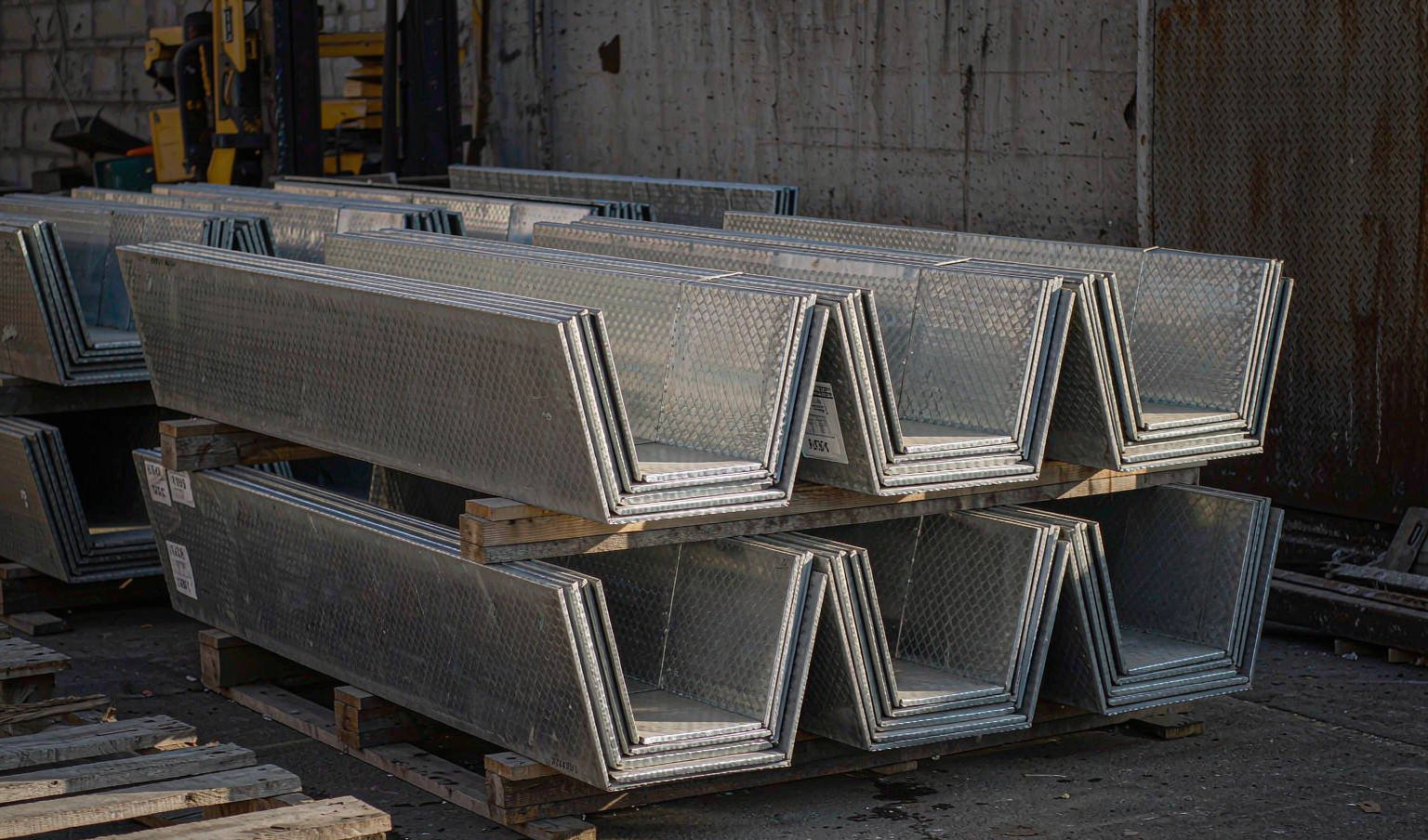
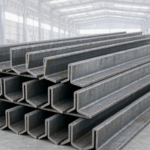
Hot rolled L-sections off the mill and stacked for inspection
Applications
Storage racking: beam profiles and bracing where the load is one-sided
Transmission and telecom tower cross-arms and diagonal bracing
Bridge structures: lateral bracing and connection angles
Shipbuilding: frames, stiffeners and hull secondary structure
Machinery bases, conveyor frames and equipment skids
Truck and trailer body cross members
Quality Assurance
Each heat is certified for chemistry and tensile properties under EN 10204 3.1 (3.2 with third-party witness on request). Charpy impact testing at 0 °C, −20 °C or −40 °C is supplied for JR/J0/J2 subgrades as applicable. Dimensional checks cover leg lengths, thickness, squareness and straightness against the applicable tolerance standard before loading. Galvanizing to ASTM A123 or EN ISO 1461 can be arranged as a one-stop service for tower and racking projects, and ultrasonic or dye-penetrant checks are available for welded-angle configurations.
Packing and Shipping
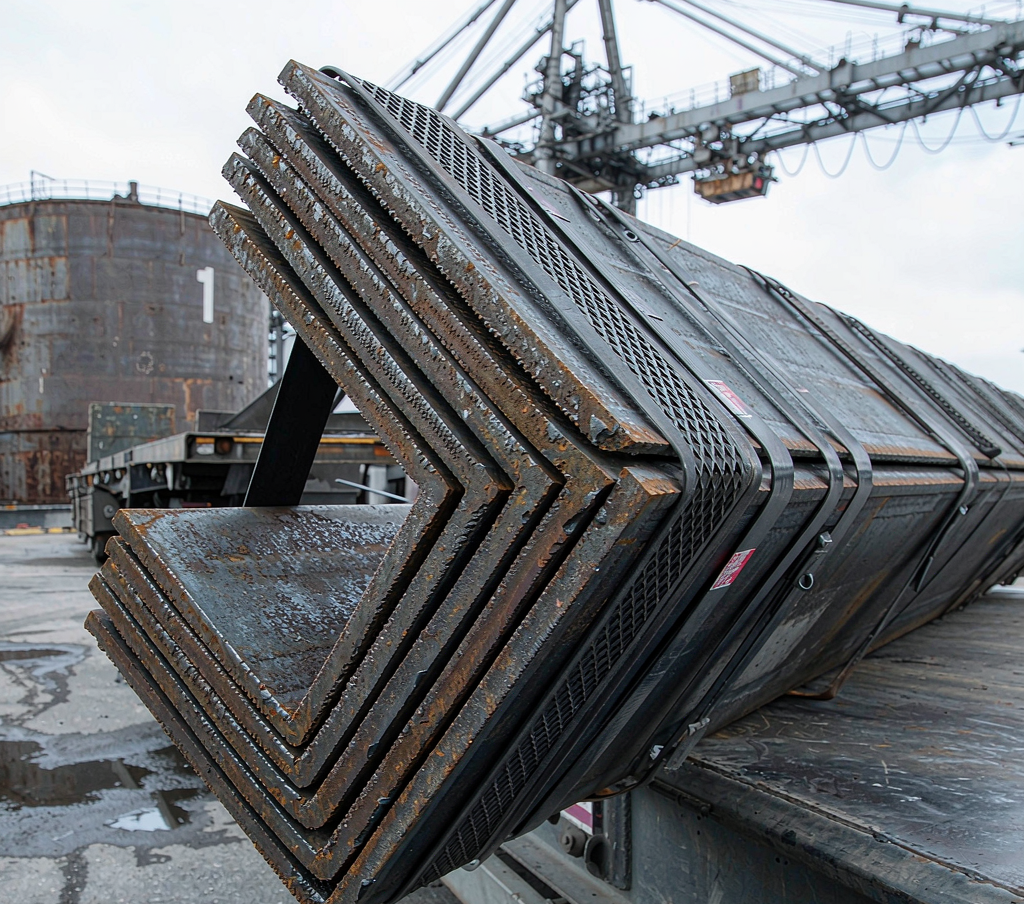
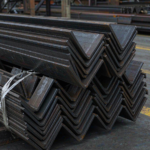
Bundles of 2–5 t, steel-strapped on timber bearers, with leg-face nesting to prevent transit damage to the toe edges. Container loading up to ~26 t with dunnage; breakbulk or bulk carrier for full project volumes. Mill certificates, packing lists and marking (bundle tags with size, grade, heat number and PO reference) are prepared to match your clearance documents — L/C compliant by default.
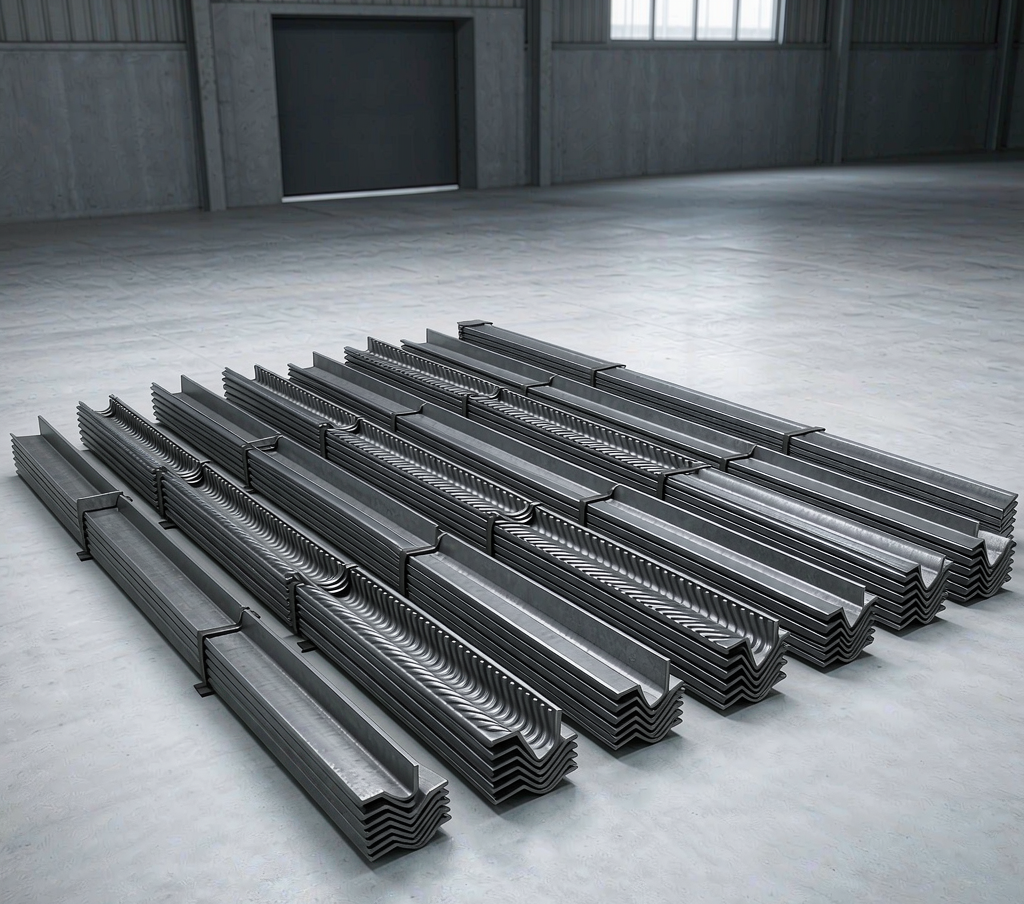
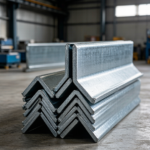
Mixed structural sections — angles bundled and ready for loading
Design Notes: Orientation, Connections and Stability
Because unequal angles have unsymmetric principal axes, three design details determine whether they perform as intended. First, orientation: the long leg should face the direction of primary bending — in racking, the long leg typically sits vertical against the upright; in bracing, it lies along the brace axis. A common site error is installing bracing angles with legs swapped, which halves the effective section modulus in the governing direction. Second, connection eccentricity: single angles bolted through one leg carry load eccentrically, and codes require either reducing allowable stress or providing double-angle paired connections back-to-back with gussets — state which your design assumes when ordering, since hole gauges differ. Third, lateral-torsional stability: unsupported unequal angles in compression or bending can buckle about the minor principal axis well before their nominal capacity; spans above roughly 60× the short leg dimension need intermediate restraint or a design check.
For buyers standardizing on a rack or tower product family, it pays to order the full bill of unequal angles from one mill run: mixed heats within one structure mean mixed galvanizing reactions and slight dimensional spread, while a single heat batch gives uniform coating appearance and tighter fit-up across connections.
Coating Options Beyond Bare Steel
Hot-dip galvanizing to ASTM A123 / EN ISO 1461 — the default for outdoor racking, towers and marine exposure; vent/drain hole drilling is arranged before galvanizing.
Pre-galvanized (zinc coating from coil) — only available where angles are formed from strip; lower coating mass, cut edges unprotected.
Primer shop coating (red oxide or zinc phosphate epoxy, 40–60 μm DFT) for members to be painted on site — masks bare steel during storage and transit.
Duplex systems (galvanizing plus powder or paint topcoat) for coastal and industrial atmospheres requiring extended service life.
Ordering Checklist for Unequal Angle
Size schedule: A×B×t per line item, with grades and impact class (JR/J0/J2) per project specification
Lengths: standard 6/9/12 m or fixed cut lengths with tolerance class
Fabrication: hole punching (diameter, gauge, pitch per your drawing), notching, miter cuts
Coating: bare, galvanized (specify standard and minimum grade) or primed
Documentation: EN 10204 3.1 per heat, packing list mapped to heat numbers, optional third-party inspection
Packing: bundle weight limits and marking format for your site’s receiving process
Weight and Section Property Quick Reference
Weights below cover the sizes most often exported; full section property tables (area, moments of inertia, radii of gyration about both principal axes) are issued with every quotation so your design office can verify capacity without re-deriving geometry.
Size A×B×t (mm)
Weight (kg/m)
Area (cm²)
Common use
L40×25×4
1.94
2.47
Light brackets, fencing
L50×32×4
2.43
3.09
Racking beams
L63×40×5
3.92
4.99
Bracing members
L75×50×6
5.68
7.24
Equipment bases
L100×63×8
9.94
12.66
Racking uprights
L125×80×8
12.6
16.00
Tower cross-arms
L150×90×10
18.4
23.47
Bridge bracing
L200×125×14
34.4
43.86
Heavy structures
Order weight is calculated on nominal dimensions per the standard’s section tables; invoicing on actual weighed bundle weight (±0.5 % scale accuracy, weighbridge ticket per truck or container) is standard practice and should be stated in the quotation basis to avoid the classic “theoretical vs actual” invoice dispute.
Production Route: How Hot Rolled Unequal Angles Are Made
Unequal angles are rolled on universal or continuous mills from blooms or billets heated to roughly 1,200 °C, passed through cascading stands that progressively form the L-profile, with the two legs formed at different rates because of their unequal lengths — one reason unequal angle dimensional control is slightly more demanding than equal angle. After the final pass, bars are hot sawn to length, cooled on racks (controlled cooling where impact properties at J0/J2 are required), straightened in roller straighteners, and inspected. The rolling direction aligns the grain along the bar, so impact and fatigue properties are best along the length — relevant when angles are flame-cut into short brackets, where cutting across the grain plus work-hardened sheared edges can lower performance and J0/J2 grades should carry certified test results rather than mill assumptions. For export, material is supplied with heat numbers stenciled along the bar at defined intervals, so certificates map to the physical goods through transit and site fabrication.
Lead times are predictable: standard sizes in S235JR/S355JR or Q235B roll on scheduled campaigns, so stock sizes ship within days while specific thickness/grade combinations align to the next rolling window — typically one to three weeks. Project consolidations (several sizes, one shipment, one certificate set) price better than spot lots and simplify site receiving; that is the configuration most of our racking, tower and bridge customers settle on.
Why Buy Unequal Angle From Huaxia-Steel
Full size range L25×15 to L250×150 from mill direct, mixed sizes in one shipment
S235JR to S355JR and Q235B/Q355B with heat-specific 3.1 certificates
Cut-to-length, hole punching and hot-dip galvanizing as one-stop service
Export packing engineered for toe-edge protection on long sea routes
Request an unequal angle quotation — send your size list (A×B×t), grade and tonnage for factory direct pricing with current lead time.
If you require further information about our metal sheet products or architectural projects, please don’t hesitate to leave your contact details and message here.
Our team of experts will respond within 24 hours to continue the discussion and provide you with any additional information you requires.