Steel Coating Standards Guide: ISO, ASTM & EN Requirements Explained
Carbon steel’s greatest weakness is its susceptibility to corrosion. Without proper protective coatings, even the highest-quality structural steel will degrade within years of exposure to moisture, chemicals, or marine environments. For importers and procurement professionals, understanding international coating standards is essential — not just for product longevity, but for regulatory compliance, warranty validity, and project acceptance. This guide covers the major steel coating standards from ISO, ASTM, and EN that govern protective coating systems for carbon steel products.
Why Steel Coating Standards Matter for International Trade
Coating standards serve three critical functions in international steel procurement:
- Quality assurance: Standards define minimum coating thickness, adhesion requirements, application methods, and inspection criteria. Without a standard reference, coating quality is subjective and unenforceable.
- Regulatory compliance: Many jurisdictions mandate specific coating standards for infrastructure, marine, and construction projects. Non-compliance can result in project rejection or legal liability.
- Cost control: Over-specifying coatings wastes money; under-specifying leads to premature failure. Standards provide the technical basis for matching the coating system to the service environment.
ISO Coating Standards for Carbon Steel
ISO 12944 — Corrosion Protection of Steel Structures by Protective Paint Systems
ISO 12944 is the most comprehensive international standard for protective paint coatings on steel structures. It consists of 9 parts covering all aspects from environmental classification to inspection and maintenance.
| Part | Scope |
|---|---|
| ISO 12944-1 | General introduction |
| ISO 12944-2 | Classification of environments (C1–C5, Im1–Im4) |
| ISO 12944-3 | Design considerations for corrosion protection |
| ISO 12944-4 | Types of surface and surface preparation |
| ISO 12944-5 | Protective paint systems — selection tables |
| ISO 12944-6 | Laboratory performance test methods |
| ISO 12944-7 | Execution and supervision of paint work |
| ISO 12944-8 | Development of specifications for new work and maintenance |
| ISO 12944-9 | Protective paint systems for offshore and related structures |
Environmental categories (ISO 12944-2):
- C1 (Very low): Heated buildings with clean atmospheres (offices, shops, schools)
- C2 (Low): Unheated buildings, rural areas with low pollution
- C3 (Medium): Urban and industrial atmospheres, moderate SO₂ pollution, coastal areas with low salinity
- C4 (High): Industrial areas and coastal areas with moderate salinity
- C5 (Very high): Industrial areas with high humidity and aggressive atmosphere, coastal and offshore with high salinity
- Im1–Im4: Immersion in fresh water, sea water, or soil
Key takeaway: When specifying coating for carbon steel, always reference the ISO 12944-2 environmental category. This gives the coating supplier clear guidance on the required durability (low: 2–5 years, medium: 5–15 years, high: >15 years) and the appropriate paint system.

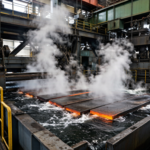
ISO 1461 — Hot-Dip Galvanized Coatings on Fabricated Iron and Steel Articles
ISO 1461 is the global standard for hot-dip galvanizing. It specifies minimum coating thickness based on steel thickness:
| Steel Thickness (mm) | Minimum Coating Thickness (μm) | Minimum Coating Mass (g/m²) |
|---|---|---|
| ≥ 6.0 | 85 | 610 |
| 3.0 – <6.0 | 70 | 505 |
| 1.5 – <3.0 | 55 | 395 |
| < 1.5 | 45 | 325 |
For carbon steel products like structural beams, grating, fasteners, and pipe fittings, ISO 1461 compliance ensures a service life of 20–50+ years in atmospheric environments (C3) and 15–25 years in coastal environments (C4) without maintenance.
ISO 2063 — Thermal Spraying (Metallizing)
ISO 2063 covers zinc, aluminum, and zinc-aluminum alloy coatings applied by thermal spraying. These coatings are specified for long-life corrosion protection (25+ years) in aggressive environments. Typical applications include bridge structures, offshore platforms, and marine steelwork.
ASTM Coating Standards for Carbon Steel
ASTM A123/A123M — Zinc (Hot-Dip Galvanized) Coatings on Iron and Steel Products
ASTM A123 is the North American equivalent of ISO 1461. Coating thickness requirements are similar but categorized differently:
| Material Category | Steel Thickness | Min Coating (μm) |
|---|---|---|
| Structural Shapes & Plate | ≥ 6.4mm (1/4″) | 85 |
| Structural Shapes & Plate | < 6.4mm | 65 |
| Pipe & Tubing | All | 45–55 |
| Wire | All | 35–45 |
| Fasteners | ≥ 9.5mm (3/8″) | 55 |
| Fasteners | < 9.5mm | 45 |
ASTM D3359 — Standard Test Methods for Rating Adhesion by Tape Test
This widely-used standard evaluates coating adhesion using a cross-hatch cutter and pressure-sensitive tape. Results are rated on a 0B–5B scale, with 5B (no coating removal) being the best. This test is essential for quality verification of painted carbon steel surfaces.
ASTM B117 — Standard Practice for Operating Salt Spray (Fog) Apparatus
ASTM B117 defines the standard salt spray test used to evaluate coating corrosion resistance. While it does not set pass/fail criteria itself, most coating specifications reference B117 exposure duration (e.g., “500 hours salt spray per ASTM B117 with no more than 3mm creep from scribe”). For carbon steel coatings, typical requirements range from 240 hours (indoor) to 3,000+ hours (offshore/marine).
ASTM D4541 — Pull-Off Strength of Coatings Using Portable Adhesion Testers
This standard measures the force required to pull a coating off the substrate. For carbon steel industrial coatings, minimum values typically range from 3 MPa (structural steel primers) to 7+ MPa (high-performance epoxy and polyurethane systems).

EN (European) Coating Standards
EN ISO 12944 (Adopted from ISO)
Europe has adopted ISO 12944 as EN ISO 12944. The requirements are identical, but European projects typically reference the EN prefix. This is the primary standard for protective paint systems on structural carbon steel in EU projects.
EN ISO 1461 (Adopted from ISO)
Similarly adopted as the European hot-dip galvanizing standard. The coating thickness requirements match ISO 1461 exactly.
EN 1090-2 — Execution of Steel Structures — Technical Requirements
While not exclusively a coating standard, EN 1090-2 is critical for European structural steel fabrication. It specifies surface preparation grades (P1, P2, P3) and references EN ISO 12944 for coating system selection. CE marking under EN 1090-1 requires compliance with EN 1090-2, which means your coating system must meet the referenced standards.
Surface Preparation Standards: The Foundation of Coating Performance
Coating failure is most frequently caused by inadequate surface preparation, not coating material defects. Three key standards govern surface preparation:
| Standard | Grade | Description |
|---|---|---|
| ISO 8501-1 / SSPC | Sa 2.5 (Near White Blast) | Very thorough blast cleaning. 95%+ of surface free of visible contamination. The most common specification for industrial carbon steel coatings. |
| ISO 8501-1 / SSPC | Sa 2 (Thorough Blast) | Thorough blast cleaning. Most mill scale, rust, and foreign matter removed. Acceptable for less demanding environments. |
| ISO 8501-1 / SSPC | Sa 3 (White Metal Blast) | Blast cleaning to visually clean steel. 100% free of contamination. Required for immersion service and critical applications. |
| ISO 8501-1 | St 2 / St 3 | Hand/power tool cleaning. Loose mill scale and rust removed. Acceptable for maintenance and touch-up only. |
| ISO 8503-1 | Fine/Medium/Coarse | Surface roughness (profile) comparator grades. For carbon steel coatings, medium (G) profile is standard, corresponding to Rz 50–75 μm. |
How to Specify Coating Requirements in a Purchase Order
A clear coating specification prevents disputes and ensures you receive product that meets project requirements. Include the following in your PO:
- Surface preparation standard and grade: e.g., “Blast clean to ISO 8501-1 Sa 2.5, surface profile Rz 50–75 μm per ISO 8503-1”
- Coating system: e.g., “Per ISO 12944-5, system A3.08: zinc-rich epoxy primer (60 μm) + high-build epoxy MIO (150 μm) + polyurethane topcoat (50 μm)”
- Environmental category: e.g., “ISO 12944-2 Category C4, high durability (15+ years)”
- Color and gloss: Use RAL, NCS, or specified color code. Gloss level per ISO 2813 (e.g., “RAL 7016, semi-gloss 60±10 GU at 60°”)
- Inspection and testing: e.g., “DFT measurement per ISO 2808, adhesion per ISO 4624 (min 5 MPa), holiday detection per ISO 29601 for immersion areas.”
- Applicable project standard: e.g., “Coating to comply with EN 1090-2 for execution class EXC3.”
FAQ: Steel Coating Standards
What is the difference between ISO 12944 and NACE/SSPC standards?
ISO 12944 is the international standard, dominant in Europe, the Middle East, and Asia-Pacific. NACE/SSPC standards (now under AMPP — Association for Materials Protection and Performance) are the American equivalents. The technical requirements overlap significantly, but the structure and terminology differ. Many international projects now reference ISO 12944 even in regions that historically used NACE/SSPC.

How often should coating thickness be measured during inspection?
ISO 19840 specifies measurement procedures: take at least 3 readings per measurement point, with measurement points spaced approximately 1 per m² on large surfaces. For structural steel, measure every accessible surface on each member. The 80/20 rule applies: 80% of all readings must equal or exceed the nominal dry film thickness (DFT), and no single reading may be below 80% of nominal DFT.
Can carbon steel be painted without blasting?
For non-critical indoor applications (C1–C2 environments), power tool cleaning to St 2 or St 3 may be acceptable, especially for maintenance painting. For new construction in C3 or higher environments, blast cleaning (Sa 2.5 minimum) is strongly recommended. Hand-tool cleaning does not provide adequate surface profile for coating adhesion on carbon steel in any exterior or industrial application.
What coating standard applies to galvanized carbon steel fasteners?
For hot-dip galvanized fasteners: ISO 10684 (fasteners — hot-dip galvanized coatings) or ASTM A153/A153M (zinc coating on iron and steel hardware). Note that galvanized fastener threads require oversize tapping (the nut is tapped oversize to accommodate the zinc thickness). For electroplated fasteners: ISO 4042 or ASTM B633.
Source Coated Carbon Steel from Huaxia-Steel
Huaxia-Steel supplies carbon steel products with protective coatings to international standards. Our coating capabilities include hot-dip galvanizing (ISO 1461 / ASTM A123), industrial painting systems (ISO 12944), and thermal spray metallizing (ISO 2063). All coated products are supplied with inspection documentation including DFT measurements, adhesion test results, and surface preparation records.
Specify your coating requirements with your inquiry — our technical team will recommend the appropriate system for your service environment and confirm compliance with the required standards.