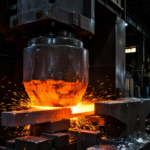
Carbon Steel Forging vs Casting Process Comparison
Forging and casting are two primary ways to shape carbon steel into industrial components. Each method offers distinct advantages in strength, dimensional accuracy, surface finish and cost. Understanding the difference helps buyers choose the most economical process for gears, flanges, crankshafts, valves and structural fittings. This article compares forging and casting for carbon steel parts used in machinery, automotive, oil and gas, and general engineering.
1. How Forging Works
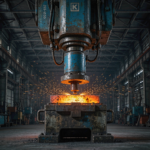
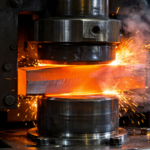
Forging shapes carbon steel by applying compressive force while the material is hot or warm. Common processes include open-die forging, closed-die forging and roll forging. The repeated deformation refines the grain structure, aligns grains with the part geometry, and removes internal voids such as porosity or shrinkage cavities.
- Open-die forging: Used for large bars, shafts and rings; flexible but less precise.
- Closed-die forging: Produces near-net-shape parts with better dimensional control.
- Roll forging: Reduces cross-section and elongates bars for long products.
2. How Casting Works
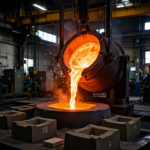
Casting pours molten carbon steel into a mold cavity and allows it to solidify. Common methods include sand casting, investment casting and die casting. Casting can produce complex geometries, internal cavities and thin walls that would be difficult or impossible to forge. However, the cooling process can create porosity, coarse grains and shrinkage defects if not controlled.
3. Mechanical Properties: Forged vs Cast Carbon Steel
Forged carbon steel generally outperforms cast steel in tensile strength, fatigue resistance and impact toughness. The aligned grain structure and elimination of porosity give forged parts higher reliability under cyclic loads. Cast steel offers good compressive strength and design flexibility but may require non-destructive testing to verify internal soundness.
| Property | Forged | Cast |
|---|---|---|
| Grain structure | Refined and aligned | Random/coarse |
| Tensile strength | Higher | Moderate |
| Fatigue resistance | Excellent | Good with testing |
| Impact toughness | Higher | Variable |
| Internal defects | Rare | Possible porosity |
4. Dimensional Accuracy and Surface Finish
Closed-die forging achieves tighter tolerances than sand casting but usually requires secondary machining for precise features. Investment casting can match or exceed forging accuracy for small, intricate parts. Sand casting leaves rougher surfaces and requires more machining stock. Die casting offers excellent surface finish but is limited to smaller parts and lower melting-point alloys, so it is rarely used for carbon steel.
5. Cost Comparison
Casting often has lower tooling cost for small quantities and complex shapes, especially with sand molds. Forging becomes more cost-effective at higher volumes because cycle times are shorter and material yield is higher for simple, repeatable shapes. Tooling for closed-die forging is more expensive upfront, but per-part cost drops significantly above 1,000–5,000 pieces depending on part size.
6. Typical Applications
Forging is preferred for crankshafts, connecting rods, gears, flanges, valve bodies, hammer unions, and high-load fasteners. Casting is chosen for pump housings, large valve bodies, engine blocks, complex manifolds, and decorative or architectural components where shape complexity is more important than ultimate strength.
7. Quality Control Differences
Forged parts are typically inspected by dimensional checks, hardness testing and ultrasonic testing for internal soundness. Cast parts often require radiographic or ultrasonic testing, dye penetrant inspection, and pressure testing to detect shrinkage or gas porosity. Both processes benefit from mill test certificates and third-party inspection for critical applications.
Frequently Asked Questions
Is forged carbon steel stronger than cast carbon steel?
Yes. Forging refines grain structure and removes porosity, resulting in higher strength, toughness and fatigue resistance.
When should I choose casting over forging?
Choose casting for complex geometries, hollow sections, thin walls, or low-volume production where forging tooling would be too expensive.
Can cast carbon steel be heat treated?
Yes. Cast carbon steel can be normalized, annealed, quenched and tempered to improve mechanical properties.
What defects are common in cast steel?
Porosity, shrinkage cavities, inclusions and coarse grains are the most common concerns, controlled through gating design and cooling rates.
Do Chinese suppliers offer both forging and casting?
Yes. Many Chinese steel foundries and forges produce carbon steel parts to ASTM, JIS, DIN and EN standards with export certification.
Ready to Source Carbon Steel?
Get a Quote — contact Huaxia-Steel today for factory-direct pricing, mill test certificates, and reliable export delivery.