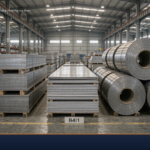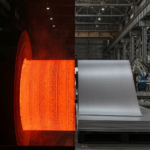
When sourcing carbon steel coil, the first technical decision you face is whether to specify hot-rolled (HR) or cold-rolled (CR) coil. While both deliver usable flat-rolled carbon steel, they are produced through fundamentally different processes that determine surface finish, mechanical properties, dimensional tolerance, and cost. Mis-specifying one for the other creates scrap, processing delays, and unhappy customers.
This guide explains how each is manufactured, where their properties differ, and how to choose the right form for your end application.
What Is Hot-Rolled Carbon Steel Coil?
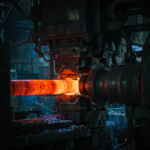
Hot-rolled coil is produced by heating a continuously-cast slab above its recrystallization temperature (typically 1,100-1,250°C) and passing it through a series of roughing and finishing rolling stands. The austenite recrystallizes during deformation, which means very low work hardening and high formability. The hot strip exits the last stand at 800-900°C and is cooled on the run-out table before being coiled at 550-700°C.
Defining Characteristics of Hot-Rolled Coil
- Mill scale surface: The dark blue-grey oxide layer formed during high-temperature processing
- Looser dimensional tolerance: ±0.15-0.50mm thickness, depending on gauge
- Slight thickness taper: Common in heavy gauges due to thermal contraction
- Lower yield and tensile than CR: Soft condition, high elongation
- Lower cost: 30-50% cheaper per ton than cold-rolled in most markets
What Is Cold-Rolled Carbon Steel Coil?
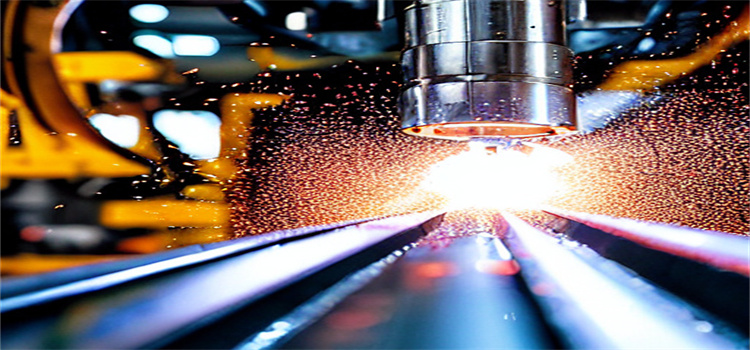
Cold-rolled coil is produced by pickling hot-rolled coil in acid to remove mill scale, then cold-reducing the strip through a tandem rolling mill at room temperature. The total reduction is typically 50-90% (e.g., a 3mm hot-rolled feed becomes 0.5-1.2mm cold-rolled output). The cold work hardens the steel substantially, and the result is then annealed (continuous annealing or batch annealing) and temper-rolled to restore formability and improve surface finish.
Defining Characteristics of Cold-Rolled Coil
- Bright, smooth surface: Suitable for painting, plating, enameling without further finishing
- Tight dimensional tolerance: ±0.02-0.10mm on thickness
- Higher strength as-rolled: Hard, fully work-hardened condition
- Annealed for formability: Typical commercial CR (DC01 / SPCE / CS Type B) supplied in dead-soft condition
- Higher cost: Pickling, cold reduction, annealing all add cost
Head-to-Head Comparison Table
| Property | Hot-Rolled Coil (HR) | Cold-Rolled Coil (CR) |
|---|---|---|
| Manufacturing temperature | 1,100-1,250°C (above recrystallization) | Room temperature (~20-50°C) |
| Surface finish | Dark blue-grey mill scale (oxide) | Bright, smooth, oily (residual cold-rolling lubricant) |
| Thickness tolerance | ±0.15-0.50mm | ±0.02-0.10mm |
| Typical thickness range | 1.2-25mm | 0.3-3.5mm |
| Width range (typical) | 1,000-2,000mm | 600-1,850mm |
| Yield strength (SPHC / DC01) | ≥235 MPa (SPHC typical 270) | 140-280 MPa (DC01: 140-280) |
| Tensile strength | 410-510 MPa | 270-410 MPa (CR) or 410-590 MPa (CR hardened) |
| Elongation (50mm) | 25-35% | 30-40% (annealed) |
| Formability | Good (work hardening low) | Excellent (annealed), limited (hard temper) |
| Weldability | Good — decarburized surface layer near edges | Excellent — clean surface, tight chemistry control |
| Relative cost (per ton) | 1.0 (baseline) | 1.30-1.50 (1.4× average) |
| Common standards | ASTM A1011, EN 10051, JIS G3131, GB/T 3274 | ASTM A1008, EN 10130, JIS G3141, GB/T 5213 |
| Typical grades | SPHC, SPHD, SS400, A36, A1011 CS Type A | DC01, SPCE, DC04, CS Type B, A1008 DDS |
Mechanical Properties in Detail
Common Hot-Rolled Mild Steel Grades (per JIS / EN)
| Grade | Yield (MPa, min) | Tensile (MPa) | Elongation (% min) | Typical Use |
|---|---|---|---|---|
| SPHC (JIS G3131) | — (typical 270) | ≥270 | 27-32 | General forming |
| SPHD (JIS G3131) | — (typical 235) | ≥270 | 30-35 | Deep drawing (HR) |
| SPHE (JIS G3131) | — (typical 210) | ≥260 | 32-38 | Extra-deep drawing |
| SS400 (JIS G3101) | 245 | 400-510 | 23 | Structural |
| S235JR (EN 10025) | 235 | 360-510 | 26 | Structural |
Common Cold-Rolled Steel Grades (per EN 10130)
| Grade | Yield (MPa, max) | Tensile (MPa) | Elongation (% min) | Application |
|---|---|---|---|---|
| DC01 | 280 | 270-410 | 28 | General cold forming |
| DC03 | 240 | 270-370 | 32 | Drawing |
| DC04 | 210 | 270-350 | 36 | Deep drawing |
| DC05 | 180 | 270-330 | 38 | Extra-deep drawing |
| DC06 | 170 | 270-330 | 40 | Ultra-deep drawing (appliance) |
Surface Finish and Preparation for Coating
The biggest practical difference between hot and cold-rolled coil is surface finish, and this drives most downstream processing decisions:
Hot-Rolled Coil Surface
- Mill scale: Black-grey Fe3O4 / FeO layer, 5-30 microns thick, tightly adherent
- Acid pickling required before cold forming, galvanizing, painting, or enameling
- Sandblasting or shot blasting also acceptable for scale removal in structural applications
- Acceptable as-is for hot-rolled structural sections, plates for fabrication, and parts that will not be painted
Cold-Rolled Coil Surface
- Oiled finish: Standard shipping protection (0.5-2.5 g/m² rust preventive oil)
- Dry finish available: For clean room or electroplating use
- Ready for painting, plating, enameling, laminating without further surface preparation
- Surface roughness (Ra): 0.4-1.6 μm typical for matte finish; 0.2-0.6 μm for smooth (cold-rolled and skin-passed)
Dimensional and Flatness Differences
| Feature | Hot-Rolled | Cold-Rolled |
|---|---|---|
| Thickness tolerance (1mm gauge) | ±0.12 mm | ±0.04 mm |
| Width tolerance | +5/-0 mm (typical) | +2/-0 mm |
| Flatness (I-unit, per 1m) | 20-40 I | 2-10 I |
| Camber (per 1m) | ≤5 mm | ≤1 mm |
| Coil ID | 760 / 610 mm | 508 / 610 mm |
| Maximum coil weight | Up to 35 tonnes | Up to 25 tonnes (limited by line) |
Procurement impact: The 3-10x tighter thickness tolerance of CR means customers can specify nominal gauge with high confidence and avoid the over-thickness that drives up the weight bill. CR is mandatory for stamping, precision roll forming, and appliance applications where flatness and surface quality affect downstream yield.
Application: Where Each Form Is Used
Hot-Rolled Coil — Typical Applications
- Structural sections (cutting and re-rolling into I-beams, channels, angles)
- Welded pipe and tube feedstock (slitting and forming)
- Heavy plate for shipbuilding, bridges, construction
- Pressure vessel shells and tank heads
- Hot-rolled plate for general fabrication
- Galvanizing feedstock (after pickling)
Cold-Rolled Coil — Typical Applications
- Automotive body panels and structural reinforcements
- White goods — refrigerator, washing machine, oven housings
- Electrical enclosures and cabinets
- Roofing and wall cladding (painted or galvanized CR)
- Furniture and office equipment (desk drawers, filing cabinets)
- Drum and pail stock
- Precision roll-formed profiles
- Pre-painted steel strip (after CR + galvanizing + painting lines)
The Cost Equation
The price differential between HR and CR coil depends on market conditions, but on average expect:
- HR coil: 100% baseline
- Pickled & Oiled (HRPO): 110-115% (added value of acid cleaning + oiling)
- CR full hard: 115-125% (no annealing)
- CR annealed (CRCA): 130-150% (full processing)
- CR pre-painted (PPGI): 180-220% (additional coating line)
The pricing differential reflects the processing chain. Cold rolling requires pickling, cold reduction, annealing, and temper rolling — each step adds cost. For applications where HR properties are acceptable, the 30-50% cost premium for CR can be eliminated by selecting HR with appropriate downstream processing.
Hot-Dip Galvanizing: Which Form Should You Specify?
For galvanized coil production, both HR and CR can be used as feedstock, but the decision depends on the end product:
| Application | Preferred Feedstock | Reason |
|---|---|---|
| Structural decking | HR (pickled before galvanizing) | Cost-effective, sufficient formability |
| Appliance panels | CR annealed | Surface quality, flatness, paintability |
| Auto body stampings | CR (extra-deep drawing) | Formability and finish |
| Agriculture / silo | HR (pickled) | Cost, gauge range to 6mm |
| Roofing sheets | CR annealed | Paint adhesion, surface quality |
Selection Checklist for Procurement
- Define the end application — structural, automotive, appliance, fabrication, etc.
- Specify the required surface condition — pickled, oiled, skin-passed (rolled for flatness)
- Set dimensional tolerance — confirm tolerance class per ASTM A1008 / EN 10130 / GB/T 5213
- Confirm mechanical property requirements — yield, tensile, elongation
- Identify post-processing — galvanizing, painting, stamping, forming
- Specify MTC requirements — EN 10204 3.1 with chemical analysis and mechanicals
- Confirm packaging & shipping — coil orientation, protective wrap, ocean export packaging
FAQ
Can hot-rolled coil be painted without pickling?
Painting over mill scale is unreliable: the scale is brittle, flakes off under mechanical stress or thermal cycling, and causes premature paint failure. For most painting applications, the hot-rolled surface must be acid pickled (HRPO) or shot-blasted before primer. For structural coatings that tolerate the oxide layer (e.g., certain shop primers), mill scale may be acceptable, but always verify coating manufacturer recommendations and project specifications.
Is cold-rolled coil always harder than hot-rolled?
Not always. Cold-rolled full-hard coil is significantly stronger and harder than hot-rolled — yield strength can reach 600-800 MPa with minimal elongation. However, cold-rolled coil is almost always subsequently annealed and temper-rolled, which restores formability and lowers yield strength. The result is cold-rolled annealed (CRCA / DC01) with yield of 140-280 MPa, similar to or slightly lower than hot-rolled mild steel. The difference between cold-rolled and hot-rolled at the point of delivery is more about tolerance, surface, and consistency than strength.
Can HR coil be cold-formed without annealing?
For light cold-forming operations (bending, light stamping), hot-rolled coil can be used as-is with acceptable results. For deep drawing or severe forming operations, the variability in grain size and the heavy mill scale on hot-rolled coil create issues. Pickled hot-rolled (SPHD, SPHE) is suitable for moderate drawing. For deep draws and precision stampings, specify cold-rolled DC04, DC05, or DC06 — the fine grain size and uniform recrystallized structure deliver the formability and surface finish needed.
What thickness range is available for each?
Hot-rolled coil is typically available from 1.2mm to 25mm thickness, with the heavy end dominated by plate-mill production. Cold-rolled coil is usually available from 0.3mm to 3.5mm. Below 0.3mm, you enter tinplate / chrome-plate territory with electrolytic processes. Above 4mm, cold rolling becomes uneconomical and hot-rolled is the only practical option.
How is cold-rolled coil delivered — annealed or full-hard?
Most commercial cold-rolled coil is supplied in the fully annealed condition (CRCA / DC01-DC04) because this is the form used by stamping, drawing, and roll-forming operations. Full-hard cold-rolled is supplied only when the customer has annealing capability — typically large tube mills and roll-form lines that want to control their own annealing parameters. When ordering CR coil, specify “annealed” and skin-pass if the operation is downstream of stamping or forming.
Conclusion
Hot-rolled and cold-rolled coil are not interchangeable — they serve different markets at different price points. Hot-rolled is the cost-effective workhorse for structural, plate, and pipe applications. Cold-rolled is the precision-grade input for stamping, drawing, and finishing operations. Selecting the correct form upfront avoids processing costs and product quality issues downstream. When the application allows, specify hot-rolled to save 30-50% per ton. When surface, dimensional tolerance, or formability matters, the premium for cold-rolled is money well spent.
Need hot-rolled or cold-rolled carbon steel coil for your project? Contact Huaxia-Steel for mill-direct HR coil, pickled & oiled (HRPO), full-hard CR, or CR annealed coil in any commercial grade and gauge. Full EN 10204 3.1 mill certification, third-party inspection, and global shipping from our ISO-certified Chinese mills.