Drop Forging vs Press Forging vs Rolling for Carbon Steel Parts
A carbon steel gear, flange, or axle never starts its life as a finished shape. It begins as a billet, bloom, or bar, then it gets squeezed, hammered, or rolled into something closer to the final geometry. The way that metal is shaped – in a forge hammer, a hydraulic press, or a rolling mill – decides almost everything downstream: grain flow, mechanical strength, machining allowance, and unit price.
This guide compares drop forging vs press forging vs rolling for carbon steel parts so buyers can choose the most economical forming route and write precise RFQs for Chinese mills.
1. Why Forming Method Matters
Forged and rolled carbon steel parts share the same chemistry but differ fundamentally inside:
- Grain flow follows the contour of the part in forging, giving higher impact resistance in the load direction.
- Tolerance and surface differ sharply between hammer forging (looser, scale-covered) and press forging or rolling (tighter, smoother).
- Mechanical strength rises with the degree of plastic strain and the rate of cooling after forming.
- Cost is dominated by tooling, lot size, and the post-forming machining allowance.
2. Drop Forging (Hammer Forging)
Drop forging uses a board hammer or counterblow hammer to deliver rapid blows to a heated billet held in closed dies. Strain rates are very high (typically 100-1000 s-1), and the bulk of the deformation happens in a few strokes.
- Pros: Excellent grain refinement, high production rate for small to medium parts, low die cost relative to press tooling, ability to forge thin webs and tall ribs.
- Cons: Coarser dimensional tolerance (typically +/- 0.5-1.5 mm), heavy scale layer requiring deeper machining, draft angles of 5-7 degrees, and limited ability to forge thin webs in large plan area.
- Typical parts: Connecting rods, crankshafts, gear blanks, flanges under 50 kg, hand-tool bodies, valve bodies, gears and pinions.
- Press size: 1-16 tonnes board hammers cover most small-batch parts; 16-50 tonne hammers handle medium-size components.
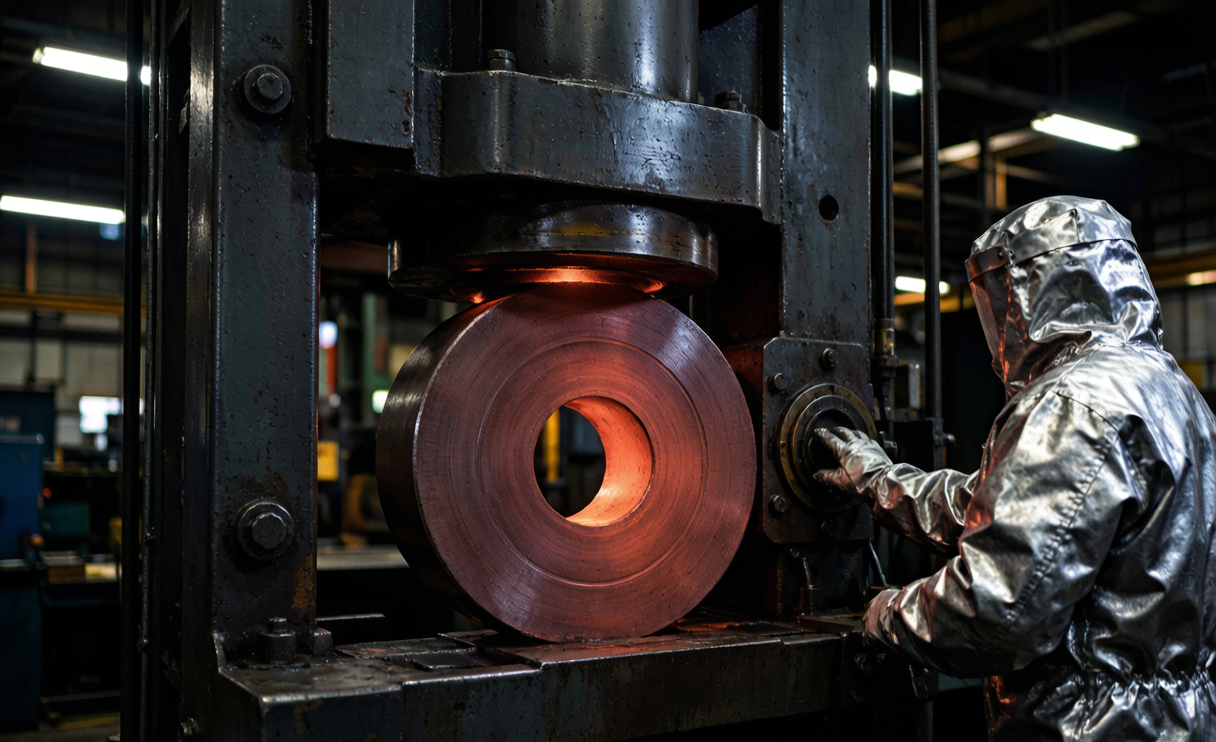
3. Press Forging (Upset Forging or Hot Press)
Press forging applies continuous pressure through a hydraulic or mechanical press, typically at strain rates of 0.5-50 s-1. The metal flows more gradually, fills complex cavities more completely, and produces parts with finer detail.
- Pros: Tighter tolerances (down to +/- 0.2-0.5 mm), thinner draft angles (1-3 degrees), better die filling, less scale, finer grain direction. Excellent for thick shafts and large-diameter rings.
- Cons: Higher die cost than hammer forging, slower cycle time, can be limited by press tonnage on larger plan areas.
- Typical parts: Large flanges, rolled rings, gear hubs, axle shafts, ring-rolling preforms, valve bodies, mining components.
- Press size: 500-10,000 tonne hydraulic presses are common at heavy-forging shops in China; 200-1,500 tonne mechanical presses for smaller parts.
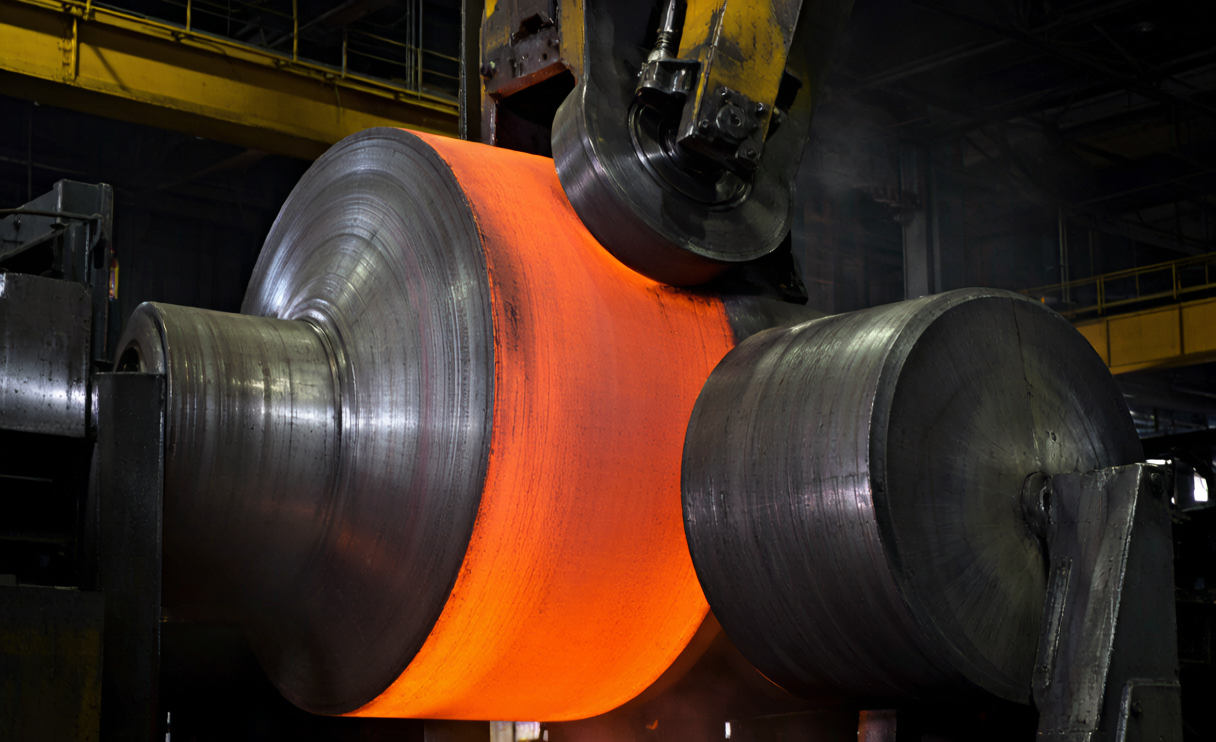
4. Rolling (Ring Rolling or Section Rolling)
Rolling is a continuous forming process where a billet passes between rotating rolls. For carbon steel parts, the relevant variants are ring rolling (for circular blanks), section rolling (for H-beams, channels, and rails), and cross-rolling (for shafts and axles).
- Pros: Tightest tolerance of the three processes, smooth surface, near-net shape that minimizes machining, excellent grain flow in the circumferential direction, very high material utilization.
- Cons: Limited to axisymmetric or section-type parts, requires significant capital, less flexibility for asymmetric shapes.
- Typical parts: Rolled rings for flanges and bearings, gear blanks, railway axles, ship propeller shafts, mill rolls, industrial crane wheels.
- Tooling: Rolling mills, ring-rolling mills (radial-axial type), and section mills.
5. Process Comparison Table
| Aspect | Drop forging | Press forging | Rolling |
|---|---|---|---|
| Strain rate | 100-1000 s-1 | 0.5-50 s-1 | 5-40 s-1 |
| Dimensional tolerance | +/- 0.5-1.5 mm | +/- 0.2-0.5 mm | +/- 0.1-0.3 mm |
| Surface finish Ra | 12-25 microns | 6-12 microns | 3-6 microns |
| Draft angle | 5-7 degrees | 1-3 degrees | 0-1 degrees |
| Typical part weight | 0.5-100 kg | 5-5000 kg | 10-50,000 kg |
| Lot size economy | 500-100,000 pcs | 50-5,000 pcs | 200-20,000 pcs |
| Tooling cost | Low | Medium-high | Medium |
| Post-form machining | Heavy | Light | Minimal |
6. Mechanical Property Differences
| Property | Drop forged AISI 1045 | Press forged AISI 1045 | Rolled AISI 1045 |
|---|---|---|---|
| Tensile strength | 660 MPa typical | 690 MPa typical | 625 MPa typical |
| Yield strength | 370 MPa | 395 MPa | 355 MPa |
| Elongation | 20% | 22% | 25% |
| Charpy impact | 32 J at 20 degrees C | 38 J at 20 degrees C | 30 J at 20 degrees C |
| Grain flow | Strong directional | Strong directional | Axial or circumferential |
Press forged and drop forged parts develop higher strength than rolled stock because of more intense deformation. The benefit is most visible in fatigue and impact performance along the grain direction.
7. Standards and Specifications
- ASTM A788 – General requirements for steel forgings (covers all three routes).
- ASTM A266 – Carbon steel forgings for pressure vessel components.
- ASTM A541 – Quenched and tempered carbon and alloy steel forgings (large sections).
- EN 10250 – Open-die steel forgings for general engineering.
- SA-105 / SA-181 – ASME code forgings for pipe flanges and fittings.
- GB/T 700 – Hot rolled carbon steel plate feedstock.
8. Cost Comparison Example
Take a 5 kg carbon steel flange blank of grade S355J2:
- Drop forging: Roughly USD 4-7 per piece at 5,000 pcs/lot, plus USD 0.80-1.20 per piece in machining and surface grinding.
- Press forging: USD 5-9 per piece at 1,000 pcs/lot, plus USD 0.40-0.80 per piece in machining.
- Ring rolling: USD 6-11 per piece at 5,000 pcs/lot, with minimal post-machining (USD 0.20-0.50 per piece).
For high-volume small parts, drop forging wins on raw cost. For low-volume heavy parts with tight tolerance, press forging wins on machining saving. For very large rings or shafts, rolling is almost always the cheapest route.
9. How to Choose the Right Process
- Choose drop forging for small to medium parts under 100 kg, where tight tolerance is not critical and unit cost dominates.
- Choose press forging for thick-section parts, complex cavities, or when fatigue strength matters more than raw cost.
- Choose rolling for axisymmetric parts (rings, shafts) or very large parts where forging capacity is limited.
- Choose open-die forging for one-off heavy components (turbine rotors, large shafts) where closed-die tooling is uneconomic.
10. RFQ Tips for Chinese Mills
- Specify the process you want, or list the part geometry and ask the mill to recommend.
- State the material grade with standard reference (ASTM AISI 1045, EN C45, JIS S45C).
- Define required forging ratio (typically 3:1 to 5:1 in the main direction).
- List post-forging operations: heat treatment, machining, surface finish, NDT scope.
- Include mechanical test requirements and the test location relative to forging direction.
- Ask for a forging drawing with draft angles, parting line, and machining allowance marked.
FAQ
Which is cheapest for 5 kg carbon steel flanges?
Drop forging at 5,000-piece lots is the lowest unit-cost option. Ring rolling wins if the lot is larger or if the part is larger than 15 kg.
Can rolled parts be heat-treated?
Yes. Rolled stock can be quenched and tempered after forming. The resulting strength matches forged-and-heat-treated stock in many applications.
Which process gives the best grain flow?
Press forging and drop forging both align the grain along the part contour. Ring rolling aligns the grain circumferentially – excellent for rings but not for non-axisymmetric shapes.
Is drop forging environmentally friendly?
All three methods consume similar energy per tonne. Drop forging produces more scale and noise but remains the lowest-carbon option for high-volume parts.
Conclusion
The drop forging vs press forging vs rolling decision hinges on part size, tolerance, lot volume, and grain-flow requirements. Drop forging rules small-batch high-volume parts. Press forging carries the day for thick and complex shapes. Rolling takes over for rings, shafts, and very large parts. State the geometry and quantity clearly, and a competent mill will recommend the most economical process for your project.
Need carbon steel flanges, gears, or shafts from China? Huaxia-Steel sources drop-forged, press-forged, and rolled carbon steel parts from mills in Tangshan, Wuxi, and Laiwu with MTC to EN 10204 3.1 and full machining capability.
Related Images