Closed-Die vs Open-Die Forging Carbon Steel: Process Comparison
Forging is one of the oldest and most reliable metal forming processes for carbon steel. It refines the grain structure, eliminates internal porosity, and produces parts with directional strength that cast or machined parts cannot match. But when buyers specify forged carbon steel components, they face a critical choice: closed-die (impression-die) forging or open-die (flat-die) forging.
The wrong choice can double your tooling cost, add weeks to delivery, or leave you with parts that fail in service. This guide compares the two methods across process mechanics, tolerances, batch size, cost, material options, and applications so you can specify the right forging process for your carbon steel parts.
1. Process Fundamentals
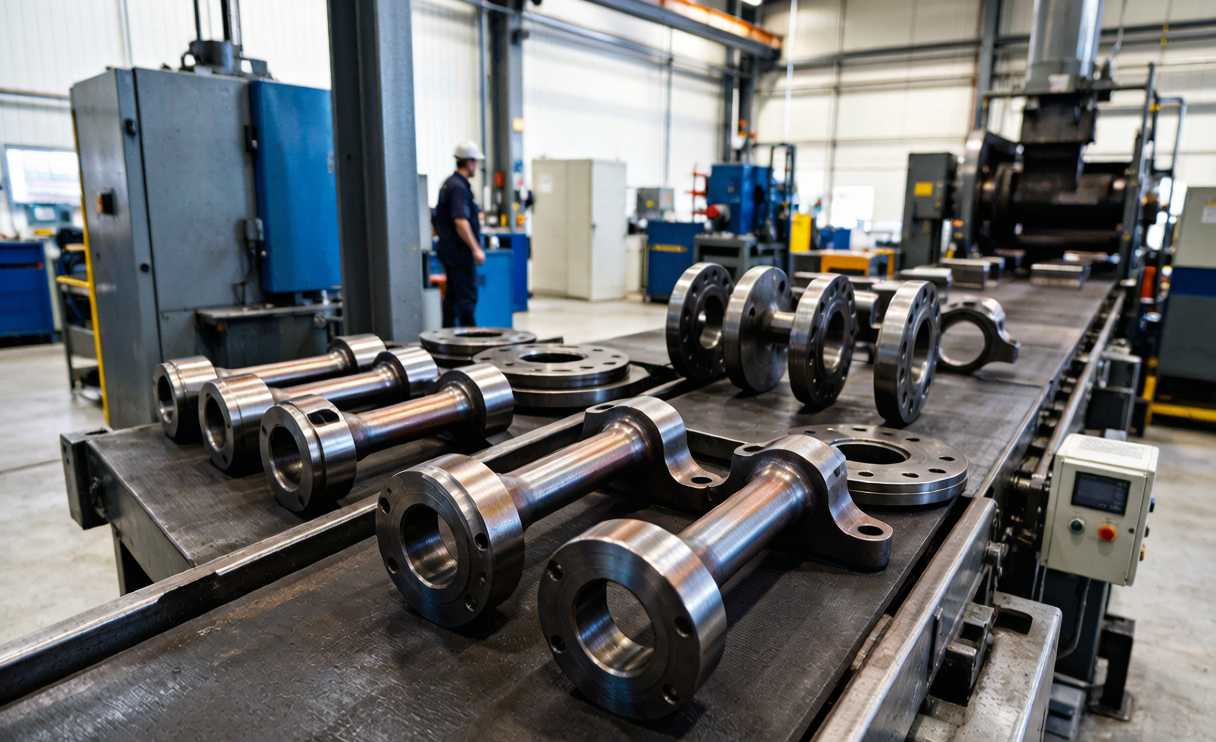
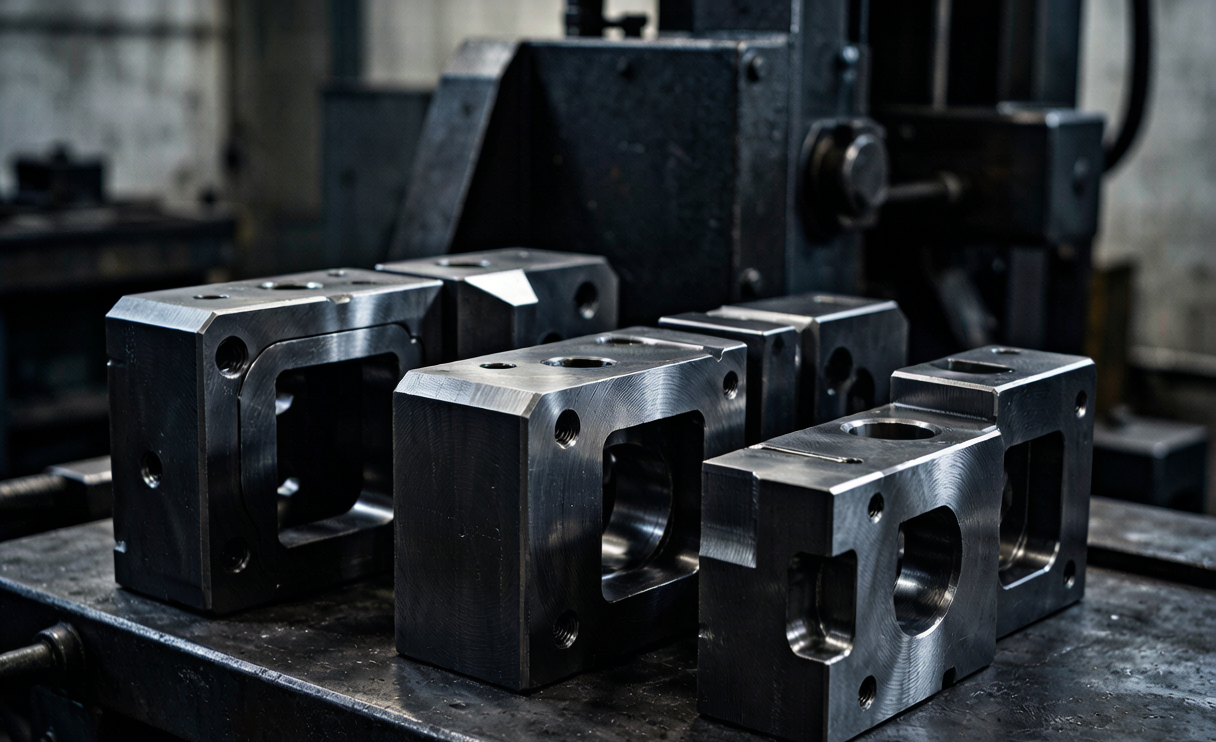
Closed-die forging (also called impression-die forging) compresses a heated billet between two shaped dies that contain a mirror-image impression of the final part. The metal flows under pressure to fill the die cavity, producing a near-net-shape component with flash (excess metal) that is trimmed off. Typical temperature range for carbon steel: 1100-1250 degrees C.
Open-die forging compresses heated stock between flat or simple-shaped dies that do not fully enclose the metal. The forging operator manipulates the workpiece between repeated press strokes, gradually shaping it by drawing, upsetting, piercing, and bending. The metal flows freely in all directions except where constrained by the dies.
| Parameter | Closed-Die Forging | Open-Die Forging |
|---|---|---|
| Die type | Shaped cavity (upper + lower) | Flat or simple V/swage |
| Metal confinement | Fully enclosed in cavity | Free flow in most directions |
| Flash generation | Yes (trimmed off) | No flash |
| Typical part complexity | Complex 3D shapes | Simple shapes (rounds, squares, rings, blocks) |
| Operator skill | Die design + setup | Highly skilled manipulation |
| Forging temperature | 1100-1250 degrees C | 1100-1250 degrees C |
2. Tolerances and Surface Finish
Tolerances are one of the biggest differentiators between the two processes.
| Tolerance type | Closed-Die | Open-Die |
|---|---|---|
| Length tolerance | +/- 0.5 to 1.5 mm | +/- 2 to 8 mm |
| Diameter tolerance | +/- 0.3 to 1.0 mm | +/- 1.5 to 5 mm |
| Wall thickness (rings) | +/- 0.5 to 1.5 mm | +/- 2 to 6 mm |
| Surface roughness Ra | 3.2-12.5 micrometers | 12.5-50 micrometers |
| Concentricity | 0.2-1.0 mm | 1-5 mm |
| Draft angle | 3-7 degrees required | Not applicable |
Closed-die forgings typically require 0.5-3.0 mm of machining stock, while open-die forgings need 3-15 mm depending on size and complexity. This machining stock difference directly affects material yield and machining cost.
3. Batch Size and Economic Order Quantity
The break-even point between closed-die and open-die is primarily driven by tooling cost versus per-piece savings.
| Factor | Closed-Die | Open-Die |
|---|---|---|
| Tooling cost | $3,000-$50,000+ per die set | $0 (uses standard flat/V dies) |
| Per-piece cost (small parts) | $2-50 | $10-100 |
| Per-piece cost (large parts) | $50-500 | $200-2,000 |
| Break-even batch size (small parts) | 200-500 pieces | N/A (no tooling) |
| Break-even batch size (medium parts) | 100-300 pieces | N/A |
| Lead time (no tooling) | 3-5 days | 1-3 days |
| Lead time (with new tooling) | 4-8 weeks (die design + manufacture) | N/A |
Rule of thumb: If your annual quantity is below 100 pieces and the part is simple (round, square, ring, or disc), use open-die. If annual quantity exceeds 500 pieces and the part has a complex 3D shape (flange, gear blank, connecting rod), closed-die is more economical.
4. Material Options and Carbon Steel Grades
Both processes can forge the full range of carbon steel grades. Common grades for forged carbon steel parts:
| Grade | C % | Typical Use | Closed-Die | Open-Die |
|---|---|---|---|---|
| SAE 1018 / C15 | 0.15-0.20 | General purpose, low strength | Common | Common |
| SAE 1020 / C20 | 0.18-0.23 | Welded structures, shafts | Common | Common |
| SAE 1045 / C45 | 0.43-0.50 | Shafts, gears, flanges (Q&T) | Very common | Common |
| SAE 4140 / 42CrMo | 0.38-0.43 | High-strength shafts, crankshafts | Common | Common |
| A105 | 0.35 max | Flanges, fittings (ASME B16.5) | Very common | Less common |
| F11 / F22 | 1.0-1.25 Cr | High-temperature flanges | Common | Common |
Carbon steel forgings are typically supplied to ASTM A668 (carbon and alloy steel forgings for general industrial use) or ASTM A105/A105M (carbon steel forgings for piping applications).
5. Mechanical Properties Comparison
Forging refines grain structure and produces directional fiber flow aligned with the part’s principal stress direction. The mechanical advantage of forging over casting is significant:
| Property | Closed-Die (C45, Q&T) | Open-Die (C45, Q&T) | Cast equivalent |
|---|---|---|---|
| Yield strength | 490 MPa | 470 MPa | 360 MPa |
| Tensile strength | 690 MPa | 670 MPa | 520 MPa |
| Elongation | 18% | 17% | 12% |
| Reduction of area | 45% | 40% | 25% |
| Charpy V-notch at 20C | 35 J | 30 J | 15 J |
| Fatigue strength (10^7 cycles) | 300 MPa | 280 MPa | 180 MPa |
Closed-die forgings typically show 3-5 percent higher strength and 10-15 percent better toughness than open-die forgings of the same grade, because the die confinement produces more uniform grain refinement and fiber alignment.
6. Size and Weight Limitations
| Dimension | Closed-Die | Open-Die |
|---|---|---|
| Maximum weight per piece | 10-250 kg (typical), up to 1,000 kg (large press) | 50-10,000 kg, up to 100,000 kg (heavy forge) |
| Maximum diameter (disc) | 500 mm | 3,000 mm |
| Maximum length (shaft) | 1,500 mm | 18,000 mm |
| Maximum ring OD | 800 mm | 8,000 mm |
| Minimum wall (ring) | 5 mm | 15 mm |
| Typical press capacity | 400-6,300 tons | 800-12,000 tons |
Open-die forging can produce parts far larger than closed-die. For components over 250 kg or 1,500 mm in any dimension, open-die is usually the only practical forging option.
7. Applications: Which Process for Which Part?
Closed-Die Forging Applications
- Flanges: Weld-neck, slip-on, blind flanges per ASME B16.5 (A105 grade)
- Gear blanks: Spur, helical, bevel gear forgings (SAE 1045, 4140)
- Automotive parts: Connecting rods, steering arms, axle shafts
- Valve bodies: Forged steel gate/globe/check valve bodies (A105, F11)
- Fittings: ASME B16.11 forged steel socket-weld and threaded fittings
- Crankshafts: Marine and industrial engine crankshafts (4140, 4340)
Open-Die Forging Applications
- Large shafts: Turbine shafts, generator rotors, propeller shafts (up to 18 m)
- Rings: Seamless rolled rings for wind turbine flanges, bearings (up to 8 m OD)
- Blocks: Die blocks, anvil blocks, machinery bases (up to 10 tons)
- Discs: Pressure vessel heads, large gear blanks, valve discs (up to 3 m)
- Bars: Forged bars and step shafts with varying diameters
- Custom shapes: Hooks, lifting eyes, forged weldments for cranes
8. Cost Comparison: Total Cost of Ownership
| Cost factor | Closed-Die (500 pcs) | Open-Die (500 pcs) |
|---|---|---|
| Tooling (one-time) | $8,000-$25,000 | $0 |
| Per-piece forging cost | $15-80 | $30-150 |
| Machining allowance | 0.5-3.0 mm | 3-15 mm |
| Machining cost per piece | $5-30 | $15-80 |
| Material yield | 75-90% | 60-80% |
| Inspection cost | $2-10/piece | $5-20/piece |
| Total cost per piece | $22-120 | $50-250 |
| Total (500 pieces) | $19,000-$85,000 | $25,000-$125,000 |
At 500 pieces, closed-die is cheaper due to lower per-piece cost despite tooling investment. Below 100 pieces, open-die wins because there is no tooling to amortize.
9. Quality Control and Inspection
Both processes require similar QC steps, but acceptance criteria differ:
- Dimensional inspection: Closed-die parts are checked against the forging drawing tolerances. Open-die parts have wider tolerances and are often supplied “rough forged to sketch” for subsequent machining.
- UT examination: ASTM A388 is the standard UT method for large open-die forgings. Closed-die forgings for critical applications (aerospace, oil and gas) use ASTM E2225.
- Magnetic particle inspection (MT): ASTM E709 for surface and near-surface discontinuities. Required for all forgings in pressure-retaining service.
- Hardness testing: Brinell (ASTM E10) for forgings over 6 mm. Typical range for C45 Q&T: 200-280 HB.
- Grain flow verification: Macro-etch test per ASTM E340 to confirm directional fiber alignment. Closed-die forgings show well-defined grain flow following the die impression.
FAQ
When should I choose open-die over closed-die forging?
Choose open-die when: the part is larger than 1,500 mm or heavier than 250 kg; the annual quantity is below 100 pieces; the part shape is simple (round, square, ring, disc, block); or you need quick turnaround without waiting for die manufacture.
What is the minimum order quantity for closed-die forging?
Most Chinese forging shops accept closed-die orders starting at 100-200 pieces. Below that, tooling cost per piece is prohibitive. For 50-100 pieces, some shops offer “near-net-shape” open-die forging as a middle ground.
Can closed-die forgings achieve the same strength as open-die?
Closed-die forgings typically achieve 3-5 percent higher strength and 10-15 percent better toughness than open-die forgings of the same grade, because die confinement produces more uniform grain refinement. Both are significantly stronger than castings.
How long does die manufacturing take?
For a standard carbon steel part, die design takes 1-2 weeks, die machining (CNC + EDM) takes 2-4 weeks, and tryout/qualification takes 1 week. Total: 4-8 weeks from PO to first article. Rush projects can compress this to 3 weeks with premium pricing.
What certifications are available for forged carbon steel parts?
EN 10204 3.1 MTC is standard. For pressure-retaining applications (A105 flanges, fittings), ASME B16.5/B16.11 certification is required. Third-party witnessing by SGS, BV, or Intertek is available for EN 10204 3.2 certificates. NACE MR0175 certification is available for sour service.
Conclusion
Choosing between closed-die and open-die forging comes down to three factors: part complexity, annual quantity, and part size. For complex shapes in quantities above 500 per year, closed-die delivers better tolerances, lower per-piece cost, and superior mechanical properties. For large or simple parts in low quantities, open-die is the practical and economical choice. Both processes produce forged carbon steel components that outperform castings in strength, toughness, and fatigue resistance.
Contact Huaxia-Steel for closed-die and open-die forged carbon steel components. We supply A105 flanges, C45 shafts, forged rings, and custom forgings with EN 10204 3.1 MTC, UT examination, and third-party inspection options.
Related Images