
JIS G3101 SS400 vs JIS G3106 SM490: Japanese Structural Steel Comparison
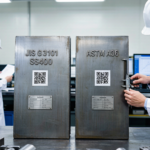
JIS G3101 SS400 and JIS G3106 SM490 are two Japanese Industrial Standard hot-rolled carbon steel specifications widely used for structural applications in Japan, Southeast Asia, the Middle East and Latin America. Although both appear in bridges, buildings and industrial frames, they belong to different standard families and carry different chemistry, mechanical and testing requirements. Specifying the wrong one results in over-engineering and cost, or under-engineering with fitness-for-service risk. This guide explains the metallurgical differences, ASTM / EN cross-references, fabrication considerations, and how to choose correctly when sourcing Japanese-origin or Japanese-spec structural steel.
1. Standard Scope and History
JIS G3101 “Rolled Steel for General Structure” was first issued in 1952 and covers the SS-series general structural plates and sections: SS330, SS400, SS490, SS540. The designation SS followed by three digits indicates the lower bound of tensile strength: SS400 has 400 to 510 MPa tensile strength. The standard is intended for buildings, bridges, ships, vehicles, towers and other structural applications where moderate strength is adequate.
JIS G3106 “Rolled Steel for Welded Structure” was first issued in 1953 as a higher-performance complement to G3101. It covers SM-series welding-grade structural plates: SM400A, SM400B, SM400C, SM490A, SM490B, SM490C, SM490YA, SM490YB, SM520B, SM520C, SM570. The grade designation indicates yield strength to the first two digits (in MPa) and the suffix A / B / C indicates impact testing level: A = no impact test, B = 0 deg;C Charpy, C = -5 deg;C Charpy. The “Y” sub-grades (SM490YA, SM490YB) have thinner section thickness transition for yield strength.
2. Chemical Composition Compared
| Element (percent) | SS400 | SM490A | SM490B | SM490C | SM490YA | SM490YB |
|---|---|---|---|---|---|---|
| Carbon (C, max) | not specified | 0.20 (16 mm) / 0.22 (over) | 0.20 / 0.22 | 0.18 / 0.20 | 0.20 / 0.22 | 0.18 / 0.20 |
| Silicon (Si) | not specified | 0.35 max | 0.35 max | 0.35 max | 0.55 max | 0.55 max |
| Manganese (Mn) | not specified | 0.60 to 1.60 | 0.60 to 1.60 | 0.60 to 1.60 | 1.20 to 1.60 | 1.20 to 1.60 |
| Phosphorus (P, max) | 0.050 | 0.035 | 0.035 | 0.035 | 0.035 | 0.035 |
| Sulfur (S, max) | 0.050 | 0.035 | 0.035 | 0.035 | 0.035 | 0.035 |
The key compositional difference is that SS400 has no explicit chemistry control beyond P and S, while SM490 imposes upper limits on carbon, controlled Mn range, and lower P/S for weldability. SM490YA and YB add higher Mn and Si levels for improved strength without carbon raise.
3. Mechanical Properties Compared
| Property | SS400 (16-40 mm) | SM490A | SM490B | SM490C | SM490YA | SM490YB |
|---|---|---|---|---|---|---|
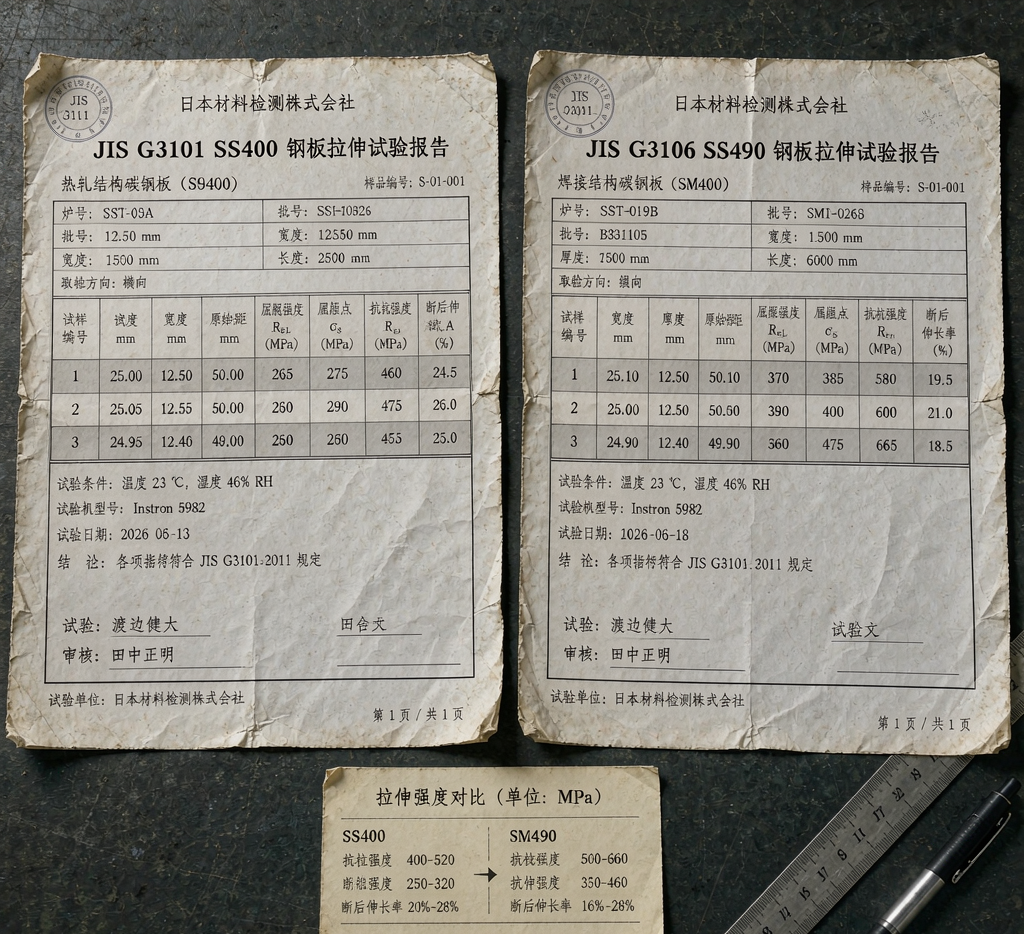
| Yield Strength, min (MPa) | 245 | 315 | 315 | 315 | 365 | 365 |
| Tensile Strength (MPa) | 400 to 510 | 490 to 610 | 490 to 610 | 490 to 610 | 490 to 610 | 490 to 610 |
| Elongation, min (percent) | 21 (t = 16), 23 (t = 40) | 19 | 19 | 19 | 19 | 19 |
| Charpy @ 0 deg;C (J, min) | not required | not required | 27 | 47 | not required | 27 (at 0 deg;C) |
| Charpy @ -5 deg;C | n/a | n/a | n/a | 27 | n/a | n/a |
SM490 has a minimum yield of 315 MPa (about 30 percent higher than SS400’s 245 MPa) for the same thickness range. The “C” sub-grade carries -5 deg;C Charpy testing at 47 J for cold-climate applications such as Hokkaido bridges or cold-storage facilities.
4. Thickness Transition
Both SS400 and SM490 lose yield strength as plate thickness increases. The transition points per JIS:
- SS400: t <= 16 mm: 245 MPa; 16 to 40 mm: 235 MPa; 40 to 100 mm: 215 MPa
- SM490: t <= 16 mm: 315 MPa; 16 to 40 mm: 295 MPa; 40 to 100 mm: 295 MPa
- SM490YA: t <= 16 mm: 365 MPa; 16 to 25 mm: 355 MPa; 25 to 38 mm: 345 MPa; 38 to 50 mm: 335 MPa
YA sub-grades are recommended for structural applications with controlled thickness, such as welded moment frames or low-rise buildings where the engineer wants to use thinner plates at higher strength.
5. Welding and Fabrication
SS400 plate has very wide weldability tolerance because the chemistry is not constrained. E4301, E4311, E4313, E5015, E5016 stick electrodes and ER70S-6 wire are typically used. No preheat is required for thicknesses up to 25 mm with low-hydrogen consumables for low-temperature work.
SM490 plate requires more attention to welding because the higher yield is achieved through carbon + manganese chemistry plus thermomechanical processing. Recommended practice:
- Low-hydrogen SMAW consumables E5016, E5018, E5516, E5518
- GMAW wire: ER70S-G (matching), with Ar/CO2 shielding gas
- FCAW wire: E71T-1, E81T1-Ni1 for high-impact seams
- Preheat 50 to 100 deg;C for thickness above 25 mm or low ambient temperature
- Interpass temperature not exceeding 250 deg;C
- PWHT rarely required for SM490 unless specified by calc
6. Application Domains
6.1 SS400 Typical Uses
- General building frames, beams, columns, base plates
- Bridge girders and deck plates (non-seismic zones)
- Container frames, trailer chassis, racking systems
- Light industrial equipment, brackets, guards
- Architectural features, signage frames
- Low-pressure storage tank shells
6.2 SM490A / SM490B Typical Uses
- High-rise steel building frames (Tokyo Metropolitan area)
- Long-span bridges and cable-stayed bridges
- Industrial crane girders and runways
- Offshore jacket members (low- to medium-stress)
- Pressure vessel nozzle reinforcement
- Railway car chassis
6.3 SM490C / SM490YB Typical Uses
- Northern-region bridges with low minimum design temperature
- Cryogenic LNG terminal structures (with downstream 9 percent Ni tank)
- Cold-storage warehouses operating at -20 deg;C
- Arctic or sub-arctic infrastructure
- Offshore platforms in cold-climate seas (North Sea, Bering Sea)
7. Cross Reference to Other Standards
| JIS Grade | ASTM | EN 10025-2 | GB/T 1591 (Chinese HSLA) |
|---|---|---|---|
| SS400 | A36 | S275JR (close, slightly lower C) | Q235B |
| SM490A | A572 Gr.50 / A709 Gr.50 | S355JR | Q345B |
| SM490B | A572 Gr.50 | S355J0 | Q345C |
| SM490C | A572 Gr.50 with -5 deg;C Charpy | S355J2 | Q345D |
| SM490YB | A913 Gr.50 (close) | S355ML | Q355MD |
8. Section Availability
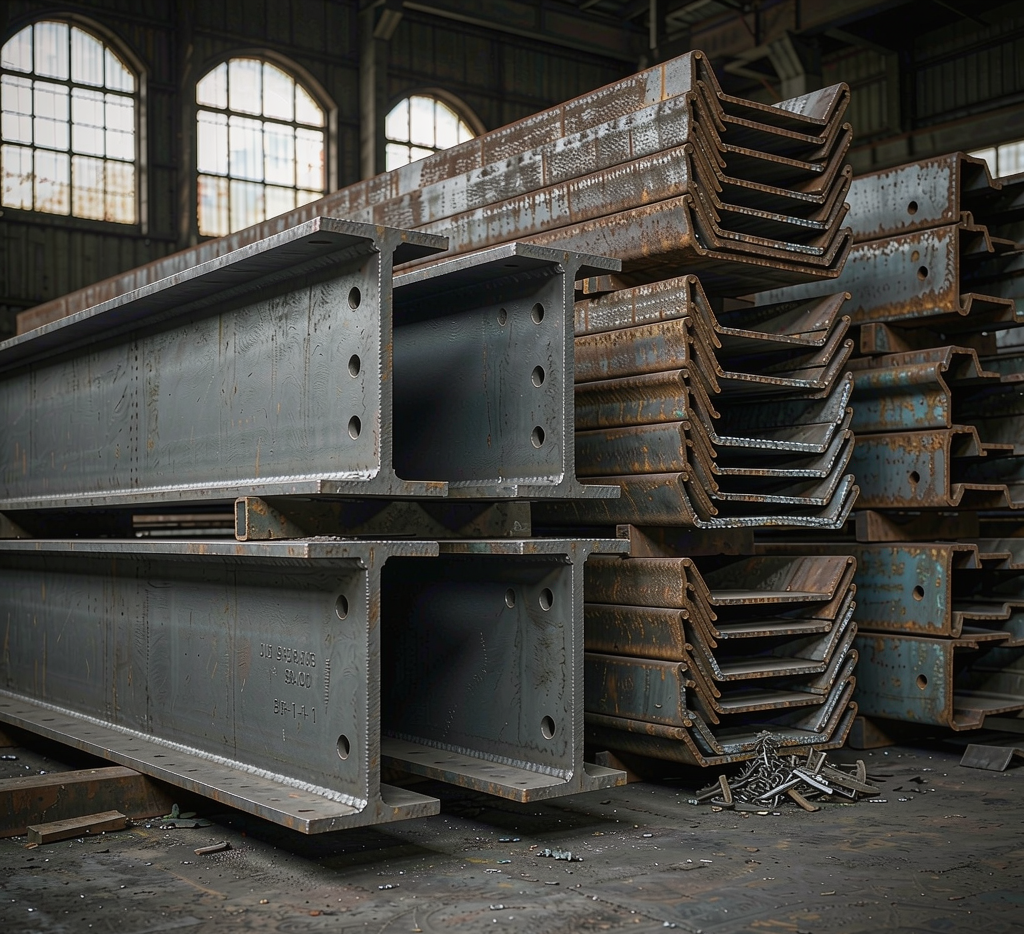
Both SS400 and SM490 are stocked by Japanese mills in a wide range of hot-rolled sections:
- H-section beams: H100 to H900 mm
- I-section beams: I100 to I600 mm
- Channels: C75 to C380 mm
- Equal and unequal angles: 20 x 20 to 250 x 250 mm
- Flat bars: 4.5 mm thick to 250 mm wide, length to 12 m
- Universal plates: 4.5 mm to 100 mm thick
For SM490 sections, availability narrows for heavy sections above H500 because the mill counts of heavy SM490 are limited. Confirm with the mill or service center before placing large structural orders.
9. Selection Decision Flow
- Is minimum design temperature below 0 deg;C? Use SM490C or SM490YB – mandatory Charpy requirement.
- Is high-strength required for weight saving? Use SM490A or SM490YA (315 to 365 MPa yield).
- Is general fabrication in mild climate? SS400 is fine and cheapest.
- Is the project under JIS-codes (e.g., Japan domestic, JIS BPR or BCJ)? Match the spec to the code requirement, typically SM grades.
- Are you exporting to a non-JIS region? Specify cross-reference grade plus JIS for dual certification. Mills typically deliver to both.
10. Frequently Asked Questions
Q1: Is SS400 equivalent to ASTM A36?
SS400 and A36 are very close in chemistry and tensile strength, and most cross-references treat them as interchangeable. SS400 has slightly less restrictive Mn range and is the default cross in many Japanese bridges. Be aware that A36 has Charpy testing at ambient (optional) plus tougher acceptance to 250 mm thickness, while SS400 does not require Charpy in the spec.
Q2: Can SM490 plate be supplied with a CEV declaration?
Yes. SM490 typical CEV is 0.38 to 0.45. Mill can report per heat. For critical welding procedures (offshore, bridges), request a CEV cap of 0.45 in the purchase order.
Q3: Is SM490C mandatory for cold-storage warehouses?
Yes if MDMT is below -5 deg;C. JIS BPR or FRC code may also call for it. Otherwise SM490B is sufficient for indoor cold-storage with no direct cold exposure.
Q4: How is SS400 tested for weldability?
SS400 has no formal weldability testing in the spec. The plate is weldable in practice because of its low carbon-equivalent. For fitness-for-service verification, the buyer can order a CEV report and standard welding procedure qualification per JIS Z3041.
Q5: What is the typical price premium for SM490 over SS400?
SM490 plate carries a 12 to 22 percent premium over SS400 plate of the same thickness and size. The premium increases to 25 to 35 percent for heavy sections because of limited mill capacity.
11. Conclusion
SS400 and SM490 both serve structural roles in Japan and abroad. SS400 covers the bulk of general building and bridge work; SM490B and SM490C provide higher yield and mandatory Charpy testing for demanding and cold-climate applications. Identify the MDMT and the design code before ordering, then select the matching JIS sub-grade. Confirm section availability with the mill for sections above H500.
12. Get a Quote from Huaxia-Steel
Huaxia-Steel supplies factory-direct JIS G3101 SS400 and JIS G3106 SM490 plate, H-beams, I-beams, channels and angle sections from Japanese-spec mills with EN 10204 3.1 MTC. Thickness 4.5 to 100 mm, plate width to 4,000 mm, length to 18,000 mm. Cross-reference delivery (e.g., SS400 / A36, SM490B / A572 Gr.50) available on request. Send your drawing and design code to our export team for a quotation within 24 hours.