Shipping Mark and Packing List for Carbon Steel Export: Documentation Guide
Incorrect shipping marks (stencil marks, drum marks) and inaccurate packing lists are among the most common reasons for customs delays, port handling disputes and shortage claims on international carbon steel shipments. A clear, durable shipping mark helps the buyer identify each bundle at destination; an accurate packing list lets customs assess HS code, the inspector trace the heat, and the surveyor calculate shortage or damage. This guide explains industry-standard shipping mark conventions, packing list structure, and documentation alignment to ensure your carbon steel shipment clears customs and reaches the buyer’s site without dispute.
1. What is a Shipping Mark?
A shipping mark (also called a stencil mark, drum mark, bundle mark or package mark) is the alphanumeric identification stencilled, painted or affixed to the outside of each shipping unit – whether that unit is a bundle, a piece, a coil, a reel, a wooden case, a pallet or an export crate. For carbon steel export, the shipping mark typically includes:
- Buyer’s name, abbreviation or customer code
- Purchase order number
- Item number or product number
- Heat number (the steel mill’s traceability code)
- Bundle or piece number, with total quantity
- Net weight and gross weight (in kg or the buyer’s unit system)
- Country of origin (often as “Product of China”)
- Carton / crate number when shipment is split across containers
2. Standard Shipping Mark Layout
A widely-used two-line stencil format reads:
HUAXIA STEEL / 2026-PO-A1234
BUNDLE 12/240  NET 1,520 KG  GROSS 1,560 KG  HEAT B5K2907
The top line identifies the buyer or project code and contract reference. The second line carries the running count (bundle 12 of 240), weights and the heat number. Some buyers prefer three lines, particularly when item numbers are required:
ABC STEEL CORP
ITEM A1 / BUNDLE 12-240
HT B5K2907  NET 1520 KG  GR 1560 KG
MADE IN CHINA
For shipments to European or North American buyers, mark the dimensions, certifications and HS code in addition to the basic identification, especially when the same goods will be redistributed from a port warehouse.
3. Stencil Application Method
Stencils are applied to plate, sheet and large sections using one of four methods, depending on environment and durability:
- Stencil paint – quick-dry industrial paint applied with a stencil plate; the most common method for plate and section bundles.
- Stencil ink pen – water-resistant marker; used for small items or supplementary information.
- Self-adhesive label – paper or vinyl label fixed under clear poly wrap; common for coils and reels.
- Embossed metal tag – aluminum or galvanized steel tag wired through bundle strapping; used for heavy plate or long-term outdoor storage.
The mark should remain legible after the conventional 6 to 12 month transit, handling and storage period. Paint should overlap by at least 50 mm on the bundle strap. Tags should be riveted to avoid loose loss.
4. Heat Number and Traceability
Each heat of carbon steel carries a unique heat number issued by the mill, e.g. “B5K2907”, “Y25-3097” or “2102A123”. The heat number ties the steel back to:
- Ladle chemical analysis
- Continuous cast or ingot cast number
- Plate or coil production date
- Heat treatment lot
- Mechanical test specimens and results
- Mill test certificate (MTC) per EN 10204 3.1 or 3.2
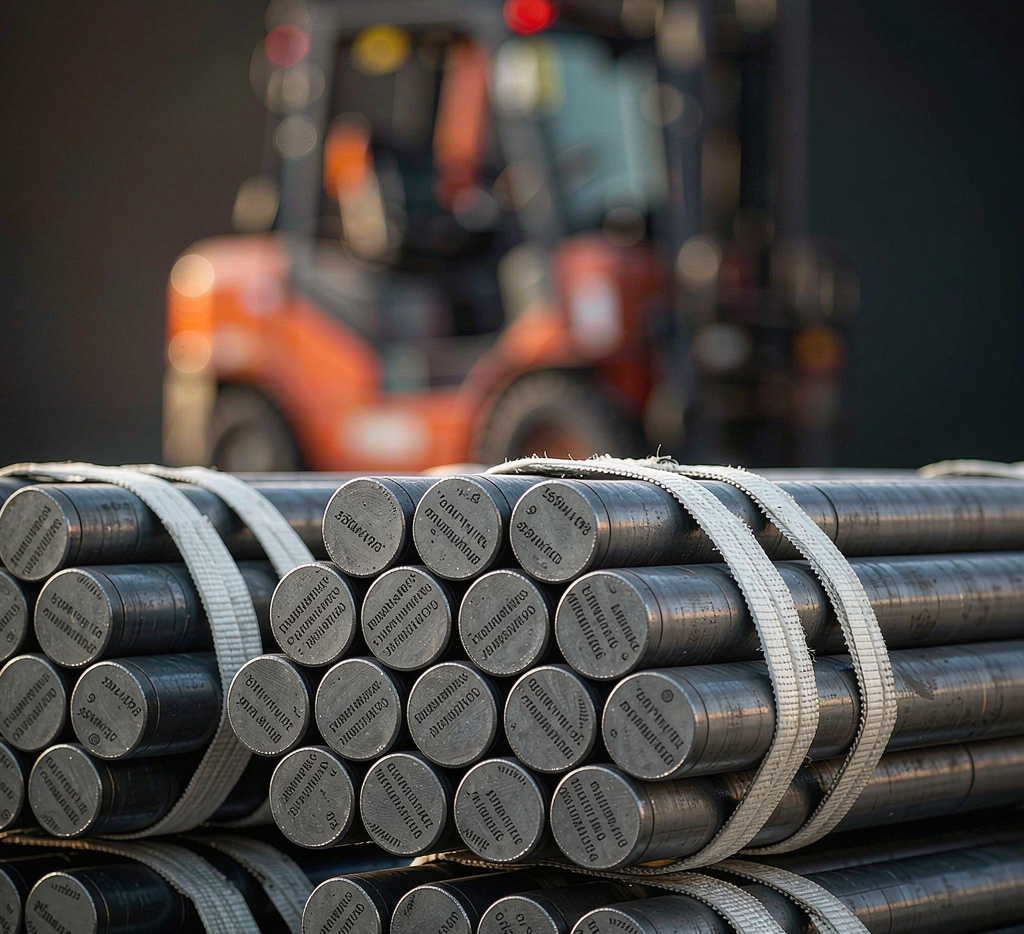
The shipping mark should reproduce the heat number in legible characters at least 50 mm high. When multiple heats are bundled together (typical for small-section bundles), each individual piece should bear the heat number on its end face or side. Long products and pipes normally receive stamp marking on the inside surface.
5. Packing List Format
The packing list is a single page or multi-page document attached to the shipment in a waterproof envelope, faxed or emailed in advance to the buyer. For a typical carbon steel export, the packing list carries the following columns:
| Bundle No | Item | Description | Size (mm) | Length (m) | Pieces | Net Weight (kg) | Gross Weight (kg) | Heat No |
|---|---|---|---|---|---|---|---|---|
| 1 / 240 | A1 | H-beam 200×200 | 200 x 200 x 8 x 12 | 12.000 | 10 | 1,790 | 1,830 | B5K2907 |
| 2 / 240 | A1 | H-beam 200×200 | 200 x 200 x 8 x 12 | 12.000 | 10 | 1,790 | 1,830 | B5K2908 |
| … | … | … | … | … | … | … | … | … |
| 240 / 240 | A12 | Plate 12 mm | 12 x 1500 x 6000 | 6.000 | 25 | 3,250 | 3,280 | B5K3401 |
The summary on the first page totals quantities, net weight, gross weight, container count and HS code. Marks on the actual bundles must match the packing list item by item.
6. Required Accompanying Documents
Exported carbon steel must be supported by:
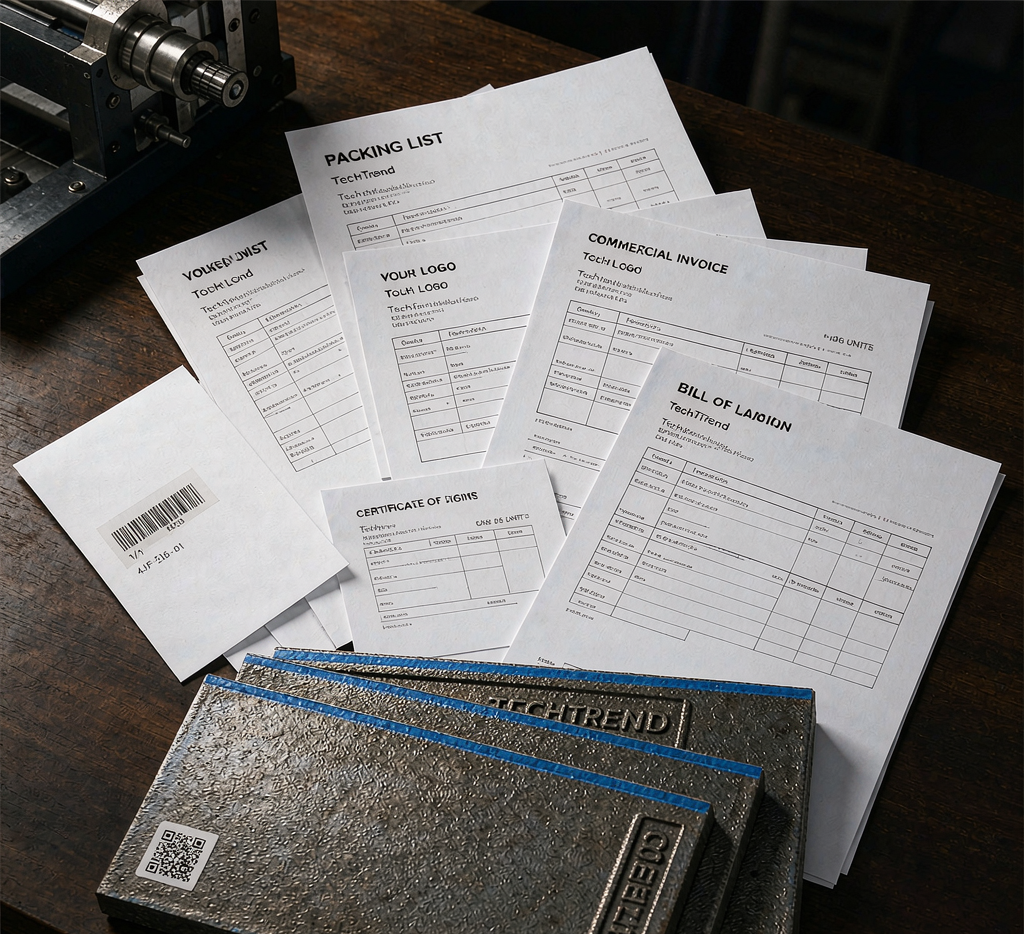
- Commercial Invoice – buyer and seller detail, goods description, unit prices, total value, payment terms, Incoterm.
- Packing List – per shipment weight and dimensions, totals, marks.
- Mill Test Certificate (EN 10204 3.1 or 3.2) – per heat. Required for most engineering grades. May be rolled together with the packing list or issued separately.
- Certificate of Origin – issued by China Council for the Promotion of International Trade (CCPIT) or chamber of commerce. Required for tariff preference (e.g., Form E for ASEAN, Form F for Chile, RCEP).
- Bill of Lading (B/L) – master or house, sea waybill, or CMR for overland transport.
- Insurance Certificate – when Incoterm is CIF or CIP.
- Inspection Certificate – when third-party inspection is specified (BV, SGS, Intertek, TUV).
- Fumigation Certificate – required by Australia, New Zealand, Brazil and many others; wooden packaging must be ISPM 15 compliant.
- HS Code Statement – declared HS code and origin criterion.
7. Container Loading and Packing Types
Carbon steel ships in five main packaging styles:
7.1 Bulk in 20’GP / 40’GP Container
Loose plates, beams, sections stacked with longitudinal spreaders, lash belts and timber blocking. Maximum load about 28 to 30 metric tons in 20’GP, 26 to 28 mt in 40’GP due to weight distribution. Typical for plate, sheet, sections.
7.2 Bundled and Strapped on Flat Bed
Wires, straps or steel bands around plate bundles, pipe bundles or section bundles. Each bundle is wrapped in kraft paper and steel banded. Lifting eyes or slings pre-fitted for crane handling.
7.3 Wooden Case / Crate
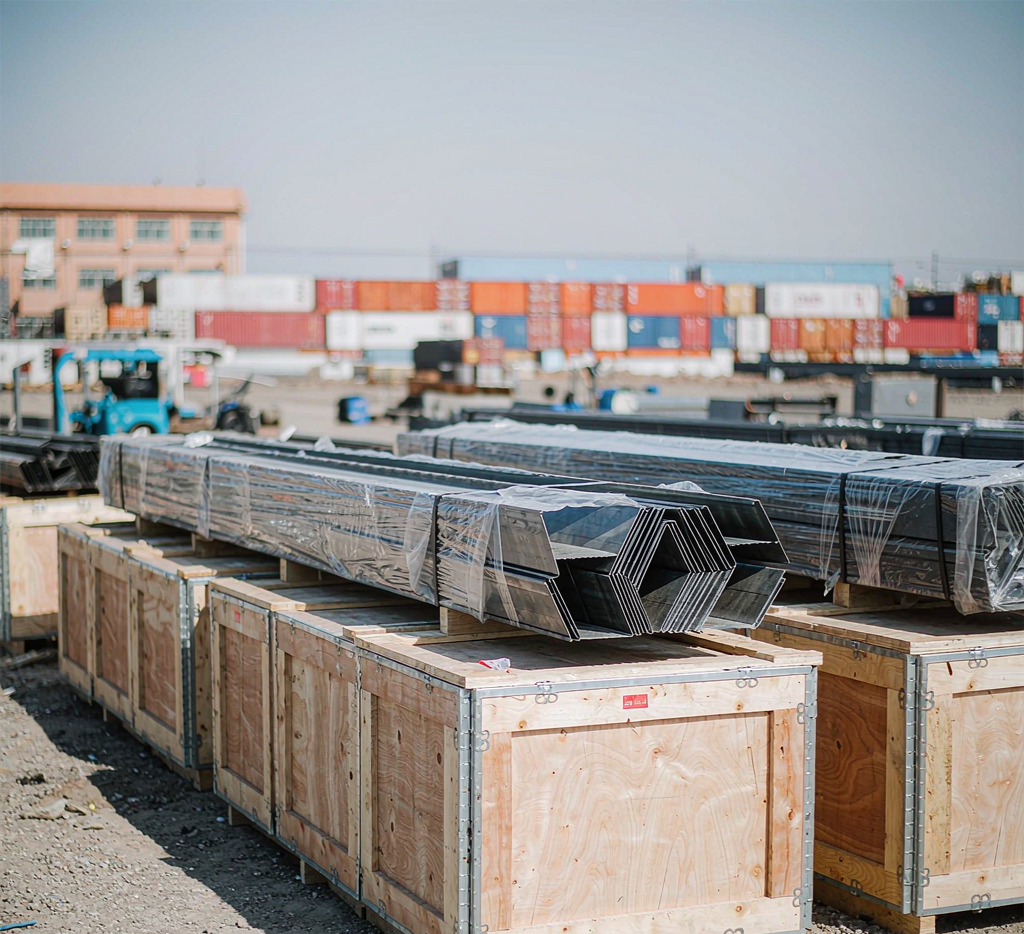
For high-value items, machined parts, fittings, or small precision bars. ISPM 15 heat-treated wood, with plywood lining and steel bands outside the case.
7.4 Steel Frame Skid
For heavy or un-bundled items like large-diameter pipe, long sections, or machine bases. Welded steel frame with fork-lift pockets and sling attachments.
7.5 Coil on Eye (Coil Carriers)
Hot-rolled coil ships on coil-eyes with steel core shaft, vertically or horizontally loaded depending on the carrier. Coils requiring anti-corrosion protection use VCI paper inside the wrap.
8. Common Mistakes
- Heat number mismatch between plate and MTC. When one heat is split across several bundles, every bundle needs the heat number stamped on each piece. Missing this leads to mill-of-origin dispute at customs.
- Gross weight underestimated. Wooden crating weight is often ignored, leading to overweight container charges or load shifting in transit.
- Stencilling on the unwrapped surface. Paint without primer peels off after one sea voyage in tropical sun. Use high-quality industrial enamel.
- Mismatched marks between bundle and packing list. The buyer counts bundles on receipt and recounts the packing list. Any mismatch triggers a shortage claim.
- Missing dimensions on the mark. Customs needs the size to validate HS code. A bundle marked only with “steel” can be reclassified at higher or lower duty.
9. EORI / Customer Code Conventions
Large European and North American buyers require EORI or internal vendor code on the shipping mark for customs automation:
- EORI number for EU destinations (Economic Operators Registration and Identification)
- Manufacturer code per buyer’s vendor list
- Country of dispatch origin (e.g. “MADE IN CHINA”)
- Country of destination code (e.g. “FOR USA”)
- CE or UKCA marking for items sold into regulated markets
Always request the customer’s mark layout guide in advance. Many large EPCs and stockists have very specific mark conventions and will reject shipments that do not comply.
10. Digital Integration and E-Documents
Modern exporters are increasingly adopting electronic packing lists and shipping marks for digital customs declarations and tracking platforms:
- ISO 28000 supply chain security integration
- GS1 bar code at the bundle level
- XML or JSON packing list (BAPLIE, IFTMIN, DESADV)
- Blockchain-verified MTC for high-end carbon steel
- Digital twin of bundle for steel mill traceability from mill to final installation
Even on paper documents, include the heat-number QR code so the buyer can scan and pull the original MTC directly from the mill’s portal. This dramatically reduces shortage and quality claim processing time.
11. Frequently Asked Questions
Q1: Who pays for stencilling and the packing list?
Stencilling is part of the mill production cost. Packing list is part of the exporter’s documentation. Both are typically included in the unit price unless the buyer specifies special packaging such as ISPM 15 wood case with export markings.
Q2: Can the heat number be applied with a paper label?
Paper labels are acceptable for coils, reels and boxed items, but for plate, sections and pipes the heat number must be painted or stamped directly on the steel surface. Labels are not considered proof of traceability at customs inspections or surveyor surveys.
Q3: What size font is required for shipping marks?
Industry convention is minimum 50 mm character height for bundle marks, with character stroke width of at least 5 mm. Smaller marks are illegible from the standard 1.5 m survey distance. For very small items, use metal tags welded or wired to the bundle.
Q4: When is fumigation certificate required?
Fumigation / ISPM 15 compliance is required for all wood packaging material entering Australia, New Zealand, Brazil, Mexico, the EU, China (when importing), Canada, USA (for many destinations) and most countries. The certificate must accompany the shipping documents.
Q5: Can the shipping mark be removed after delivery?
Yes, the buyer may sandblast or grind the marks off the steel after inventory and quality control. The marks are intended only for transit. Heat numbers punched into the steel end face remain for product traceability.
12. Conclusion
Shipping marks and packing lists are not cosmetic – they are the buyer’s primary identification and customs tool for clearing your carbon steel shipment. Apply marks with durable paint and metal tags; back them up with an accurate packing list; align MTC, certificate of origin and B/L; and request the customer’s specific mark guide before the first shipment. Doing so eliminates shortages, customs disputes and quality claims.
13. Get a Quote from Huaxia-Steel
Huaxia-Steel exports carbon steel with proper shipping marks, MTC 3.1 / 3.2, ISPM 15 wood packaging, BV / SGS inspection, and full digital documentation. We dispatch within 30 days from order confirmation, including heat-number stamping, MTC issuance and packing list formatting per your specific buyer guide. Contact our export desk for a quotation including packaging terms.