
SMAW vs GMAW vs TIG vs SAW: Welding Carbon Steel Pipe & Plate
Selecting the right welding process for carbon steel fabrication directly affects production speed, defect rates, distortion, and total welding cost. Four processes dominate industrial carbon steel welding: Shielded Metal Arc Welding (SMAW / stick), Gas Metal Arc Welding (GMAW / MIG-MAG), Gas Tungsten Arc Welding (GTAW / TIG), and Submerged Arc Welding (SAW). This article compares each process across seven practical dimensions to help welding engineers and procurement teams make informed decisions.
1. Process Overview and Working Principle
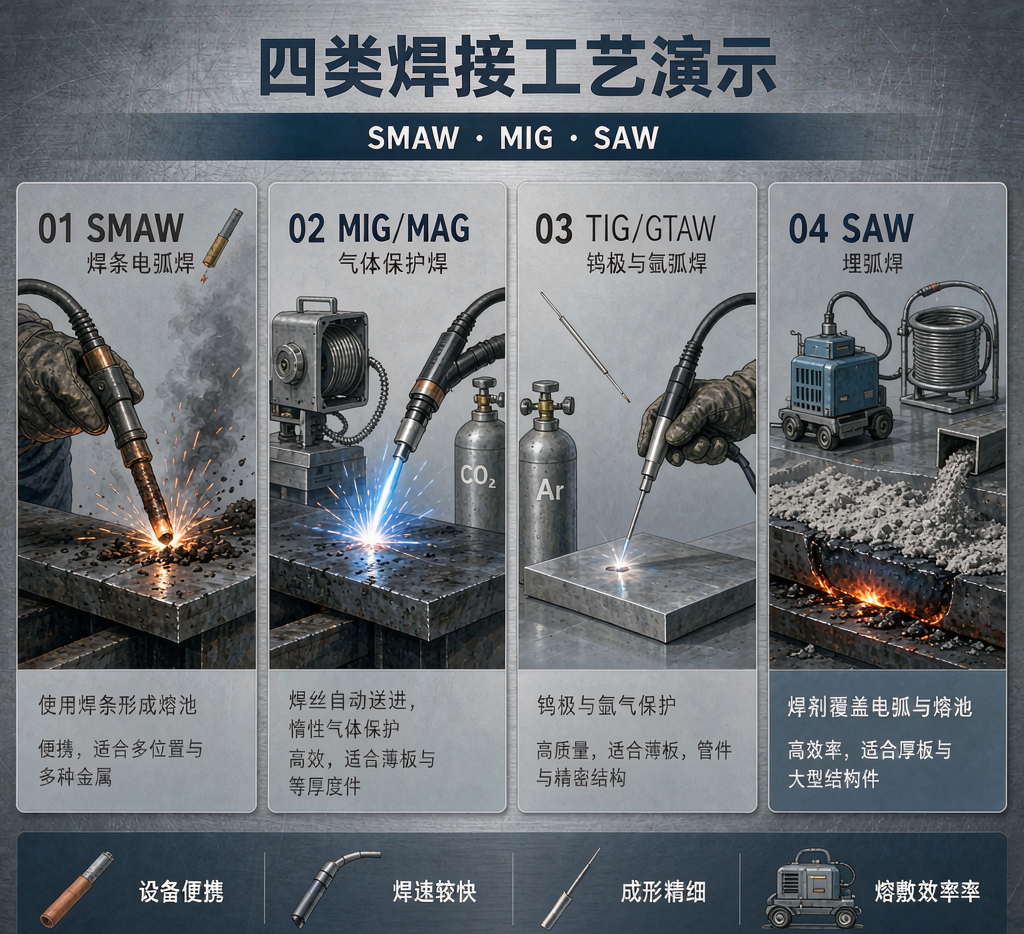
SMAW (Stick Welding): A consumable flux-coated electrode melts under the heat of an electric arc between the electrode tip and the base metal. The flux generates shielding gas and slag that protect the weld pool from atmospheric contamination. No external shielding gas is required.
GMAW (MIG/MAG Welding): A continuously fed solid wire electrode melts under the arc. Shielding gas—typically argon-CO2 or pure CO2 for carbon steel—flows through the nozzle to protect the molten pool. Short-circuit, globular, spray, and pulsed-spray metal transfer modes are available.
GTAW (TIG Welding): A non-consumable tungsten electrode establishes the arc while filler wire is fed manually or automatically into the weld pool. Inert argon shielding gas protects the tungsten and the pool. No flux or slag is produced.
SAW (Submerged Arc Welding): A continuous wire arc is completely submerged under a blanket of granular flux. The flux melts to form slag and protective gas, enabling very high currents without spatter or arc radiation.
2. Deposition Rate and Productivity Comparison
| Process | Typical Deposition Rate (kg/h) | Duty Cycle Factor | Relative Productivity |
|---|---|---|---|
| SMAW | 1.0 – 2.5 | ~30 % (electrode change + slag removal) | Baseline (1x) |
| GMAW | 2.5 – 8.0 | ~50 – 60 % | 2 – 4x |
| GTAW | 0.5 – 1.5 | ~40 % (tungsten grind + wire feed) | 0.3 – 0.6x |
| SAW | 8.0 – 25.0 | ~80 – 90 % | 5 – 12x |
For high-volume longitudinal seam welding on carbon steel pipe, SAW is the clear productivity leader. For field repair and maintenance where portability matters, SMAW remains the default despite lower deposition.
3. Heat Input and Distortion Control
Heat input (kJ/mm) is calculated as (Voltage × Current × 60) / (Travel Speed × 1000). Higher heat input increases the heat-affected zone (HAZ) width and raises distortion risk.
- GTAW: Lowest heat input (0.5 – 1.2 kJ/mm). Excellent for thin-wall pipe (< 6 mm) and root passes where burn-through is a concern. Minimal distortion.
- GMAW (short-circuit): Low to moderate heat input (0.6 – 1.5 kJ/mm). Good for sheet metal and light structural.
- SMAW: Moderate heat input (1.0 – 2.5 kJ/mm). Depends on electrode diameter and technique. Stringer beads reduce heat input compared to weave patterns.
- SAW: High heat input (1.5 – 4.0 kJ/mm). The deep penetration and wide HAZ can reduce toughness in the HAZ of normalized or thermomechanical steels. Preheat and interpass temperature control are critical for grades with CE > 0.45.
4. Defect Rates and Quality Levels
| Process | Typical Defect Sources | Radiographic Pass Rate (typical) |
|---|---|---|
| SMAW | Slag inclusion, porosity, lack of fusion, undercut | 85 – 92 % |
| GMAW | Porosity (wind), lack of fusion (wrong parameters), spatter | 88 – 95 % |
| GTAW | Tungsten inclusion, lack of fusion, oxidation (poor gas coverage) | 95 – 98 % |
| SAW | Slag inclusion (trap), centerline cracking (high restraint), lack of fusion | 92 – 97 % |
GTAW produces the cleanest welds with no slag and minimal spatter, making it the preferred choice for root passes on high-pressure pipe and for joints requiring 100 % radiography. SMAW has the highest defect rate due to operator variability and slag-removal dependency.
5. Equipment Cost and Operating Economics
- SMAW: Lowest capital cost ($300–800 for a basic inverter). Operating cost is moderate—electrodes are inexpensive but stub loss and low duty cycle reduce efficiency.
- GMAW: Medium capital cost ($1,500–4,000 with wire feeder and gas regulator). Wire and gas costs are higher, but the 2–4x productivity gain usually offsets the consumable premium on jobs over 50 meters of weld.
- GTAW: Medium to high capital cost ($2,000–6,000 for AC/DC inverter with pulse). Tungsten electrodes, argon gas, and slow travel speed make it the most expensive per meter of weld. Justified only for quality-critical or exotic-material applications.
- SAW: High capital cost ($15,000–80,000 for automated tractor or column-boom manipulator). Consumables (wire + flux) are cheap, and the extreme deposition rate makes it the lowest cost per kilogram of deposited metal on long, repetitive seams.
6. Code Qualification and Certification Requirements
All four processes are codified under ASME IX, ISO 9606, AWS D1.1, and API 1104. Key differences:
- SMAW: Widest global availability of qualified welders. Almost every certified welder holds SMAW qualification.
- GMAW: Growing preference in structural and pipeline sectors. Qualification tests now outnumber SMAW in some European fabricators.
- GTAW: Mandatory for root passes on Category III and IV pressure piping under EN 13480 and ASME B31.3. Often combined with SMAW or GMAW fill/cap.
- SAW: Requires separate qualification for each flux-wire combination. Automated SAW procedures under ASME IX must also qualify the welding operator for machine settings.
7. Selection Guide by Application
| Application | Recommended Process | Reason |
|---|---|---|
| Field pipeline construction (API 5L X42–X65) | SMAW + SAW | SMAW for tie-ins and repairs; SAW for mainline double-jointing |
| Storage tank shell rings (API 650) | SAW | Long horizontal seams, high deposition, low distortion with proper sequencing |
| Pressure vessel nozzles and attachments | GMAW or SMAW | Versatility for varying thickness and position |
| Root pass on high-pressure pipe | GTAW | Clean, full-penetration root with no slag inclusions |
| Thin sheet metal (< 3 mm) | GMAW (short-circuit) | Low heat input, no burn-through |
| Structural steel (buildings, bridges) | GMAW or SMAW | Speed vs. portability trade-off |
| Offshore jacket nodes | SMAW + GTAW root | Toughness requirements favor low-hydrogen SMAW; GTAW root for NDT confidence |
FAQ
Can I weld high-carbon steel (e.g., 1050) with the same parameters as mild steel?
No. Higher carbon increases hardenability and cracking risk. Increase preheat to 200–300 °C, use low-hydrogen consumables, and control interpass temperature.
Which process produces the least weld spatter?
GTAW produces virtually zero spatter. Pulsed GMAW and spray-transfer GMAW also minimize spatter compared to short-circuit or globular transfer.
Is SAW suitable for all positions?
No. SAW is restricted to flat (1G/1F) and horizontal (2F) positions because the granular flux flows under gravity. For vertical or overhead joints, use GMAW or SMAW.
What shielding gas is best for carbon steel GMAW?
For short-circuit transfer on thin sections, 75–80 % Ar + balance CO2 gives smooth arc and low spatter. For spray transfer on thicker plate, 90–95 % Ar + 5–10 % CO2 improves penetration and sidewall fusion.
Do I need post-weld heat treatment after welding carbon steel?
Post-weld heat treatment (PWHT) at 595–675 °C is required by ASME VIII Div.1 for carbon steels above 38 mm thickness or when the nominal thickness of butt welds exceeds 32 mm. It is also recommended when the carbon equivalent exceeds 0.45 to prevent hydrogen-induced cracking.
Need certified carbon steel plate and pipe for your welding projects? Huaxia-Steel supplies ASTM A36, A283, A516, A572, API 5L Gr.B/X52/X65, and EN 10025 S235/S355 plate and pipe with mill test certificates and third-party inspection. Request a quote with your welding code and PWHT requirements.