ASTM A283 Grade A vs B vs C vs D: Carbon Steel Plate Comparison
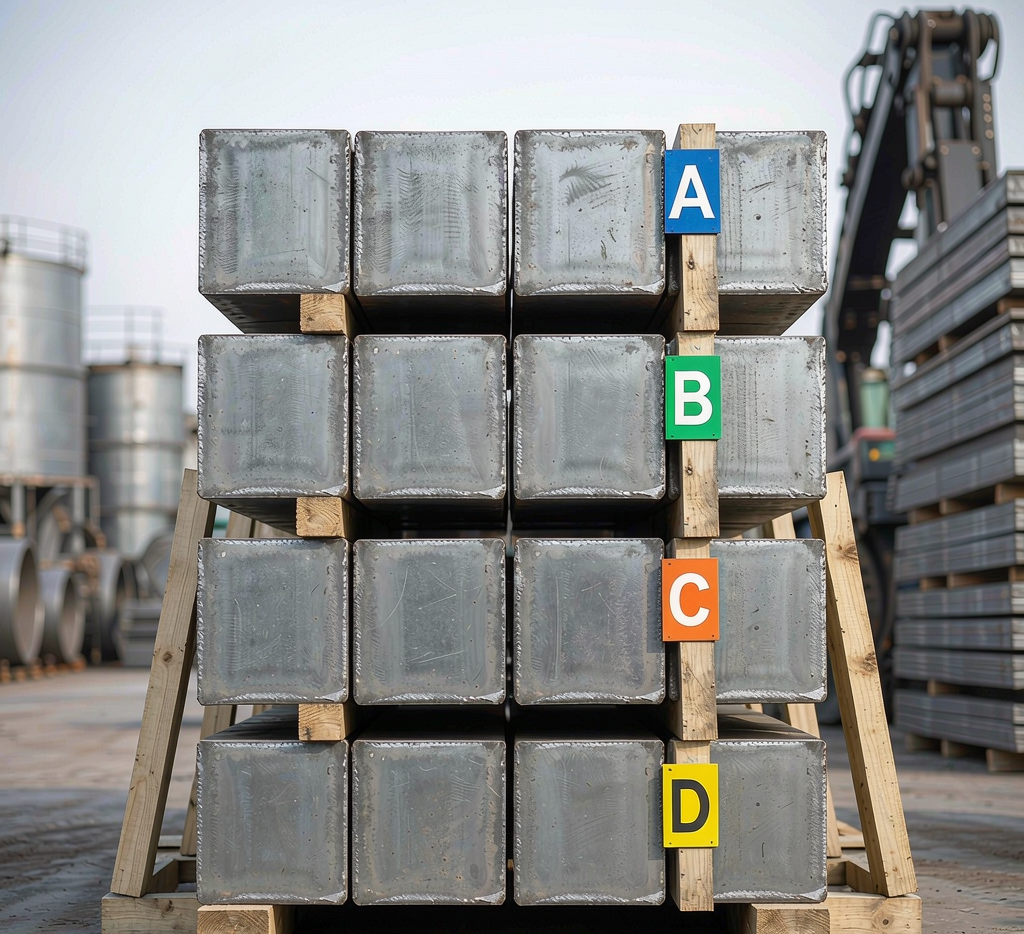
ASTM A283 is the most widely specified low-to-intermediate tensile strength carbon steel plate standard for general structural and pressure-retaining applications. Four grades—A, B, C, and D—offer progressively higher strength and slightly different chemistry limits. Choosing the wrong grade can lead to over-engineering and unnecessary cost, or under-specification and structural risk. This guide breaks down each grade so buyers, engineers, and quality managers can specify with precision.
1. Chemical Composition by Grade
ASTM A283 controls carbon, manganese, phosphorus, and sulfur more tightly as the grade letter advances. Silicon is specified only when required for rimmed or semi-killed practice.
| Element | Grade A | Grade B | Grade C | Grade D |
|---|---|---|---|---|
| C (max) | 0.14 | 0.17 | 0.24 | 0.27 |
| Mn (max) | 0.90 | 0.90 | 0.90 | 0.90 |
| P (max) | 0.035 | 0.035 | 0.035 | 0.035 |
| S (max) | 0.040 | 0.040 | 0.040 | 0.040 |
| Cu (min, when specified) | 0.20 | 0.20 | 0.20 | 0.20 |
| Si (when required, max) | 0.40 | 0.40 | 0.40 | 0.40 |
Grade A is the most weldable due to its very low carbon content (0.14 % max). Grade D, with carbon up to 0.27 %, offers the highest strength but requires more careful welding procedures.
2. Mechanical Properties and Tensile Strength
Mechanical properties are specified at two thickness ranges: up to 50 mm and 50–200 mm. The values below apply to plates 20–50 mm thick in the as-rolled condition.
| Property | Grade A | Grade B | Grade C | Grade D |
|---|---|---|---|---|
| Yield strength (min, MPa) | 165 | 185 | 205 | 230 |
| Tensile strength (MPa) | 310 – 415 | 345 – 450 | 380 – 515 | 415 – 550 |
| Elongation in 200 mm (min, %) | 27 | 25 | 22 | 20 |
| Elongation in 50 mm (min, %) | 30 | 28 | 25 | 23 |
The strength increments between grades are roughly 20 MPa in yield and 35–50 MPa in tensile strength per grade step. Grade C is the most commonly stocked grade because it balances adequate strength with good availability and competitive pricing.
3. Application Temperature Limits
ASTM A283 is not intended for high-temperature service. The standard does not specify impact test requirements, which limits use in sub-zero or dynamically loaded environments unless supplementary testing is ordered.
- Maximum design temperature: Approximately 340 °C (650 °F) for long-term service under ASME Section VIII Division 1.
- Minimum design temperature: Without Charpy testing, –29 °C (–20 °F) is the conventional lower limit for static loads. For lower temperatures, specify Grade C or D with longitudinal Charpy V-notch testing at the design temperature.
For pressure vessels operating below –29 °C, ASME VIII UG-20(f) exemption does not apply, and impact-tested SA-283 Gr.C or Gr.D must be used with certified toughness values.
4. Weldability and Formability
All four grades are readily weldable by SMAW, GMAW, GTAW, and SAW processes. Carbon equivalent (CE = C + Mn/6) increases with grade:
- Grade A: CE ≈ 0.29 (excellent weldability, no preheat required for most thicknesses)
- Grade B: CE ≈ 0.32 (good weldability, preheat optional above 25 mm)
- Grade C: CE ≈ 0.39 (fair weldability, preheat 75–125 °C above 20 mm recommended)
- Grade D: CE ≈ 0.42 (fair weldability, preheat 100–150 °C above 16 mm recommended)
Formability in the as-rolled condition is excellent for Grades A and B. Grade C and D plates can be cold-formed to bend radii of 2–3 times plate thickness without cracking, provided edges are prepared free of notches.
5. Equivalent Standards (EN, JIS, GB)
| ASTM A283 | EN 10025-2 | JIS G3101 | GB/T 700 / GB/T 1591 |
|---|---|---|---|
| Grade A | S185 (1.0035) | — | Q195 |
| Grade B | S235JR (1.0038) | SS400 | Q235B |
| Grade C | S235JR / S275JR* | SS400 / SM400A* | Q235B / Q275* |
| Grade D | S275JR (1.0044) | SM400A / SM400B | Q275 |
*Exact equivalence depends on thickness and delivery condition. Always verify chemistry and mechanical properties on the mill test certificate rather than relying solely on grade cross-reference tables.
6. Grade Selection Matrix
| Application Scenario | Recommended Grade | Rationale |
|---|---|---|
| Storage tanks, non-pressure roofs and bottoms | A or B | Lowest cost, adequate strength, excellent weldability |
| General building frames, platforms, walkways | B or C | Good availability, balanced strength-to-cost ratio |
| Pressure vessels (low pressure, ambient temp) | C | Higher tensile strength allows thinner wall design |
| Boiler supports, stack bases, ducting | C or D | Higher yield reduces section size and dead load |
| Flanges and fittings for piping systems | C | Most common grade for ASME B16.5 plate flanges |
| Heavy structural gussets and splice plates | D | Maximum strength within the A283 family |
7. Common Applications and Industry Usage
Grade A: Used primarily for tanks, hoppers, chutes, and architectural cladding where strength is secondary to formability and corrosion resistance (when coupled with protective coating). The low carbon content makes it ideal for galvanizing because silicon content can be controlled to avoid excessive zinc layer growth.
Grade B: The workhorse of light structural fabrication. Used in building frames, conveyor structures, support skids, and machinery bases. It is the closest ASTM equivalent to the globally ubiquitous S235JR and Q235B grades.
Grade C: The most widely produced grade in the A283 family. Found in pressure vessels, heat exchanger shells, API 650 storage tanks, and ASME B16.5 flanges. When normalized, Grade C can meet tougher notch-toughness requirements for low-temperature service.
Grade D: Specified when higher strength is needed without moving to normalized or TMCP grades like A516 or A572. Common in heavy industrial platforms, crane runway beams, and offshore module secondary structures.
FAQ
Is ASTM A283 the same as A36?
No. A36 is a higher-strength structural steel with minimum yield of 250 MPa and stricter chemistry controls. A283 Grade C is roughly equivalent to S235JR, while A36 is closer to S275JR in strength. A36 also has mandatory tensile testing and tighter dimensional tolerances under ASTM A6.
Can A283 plate be used for pressure vessels?
Yes, but only for low-pressure, ambient-temperature vessels under ASME VIII Division 1 with design stress values taken from Section II Part D. For elevated temperature or sub-zero service, use SA-516 Gr.70 or normalized SA-283 with impact testing.
What is the difference between A283 and A285?
A285 is also a low-intermediate strength carbon steel plate, but it is specifically oriented toward pressure vessel service with slightly different chemistry (lower carbon, higher manganese) and tighter silicon controls for improved weldability in pressure-boundary applications.
Does A283 require normalization?
Normalization is not required by the standard. As-rolled plates are the default supply condition. Normalization can be ordered as a supplementary requirement to improve toughness and homogeneity, especially for Grade C and D plates over 40 mm thickness.
What thicknesses are readily available?
Chinese mills stock A283 in thicknesses from 3 mm to 150 mm, widths 1,500–2,500 mm, and lengths 6,000–12,000 mm. Mill MOQ is typically 25–50 metric tons per size for ex-mill delivery, though distributors can supply single-plate quantities at a premium.
Need ASTM A283 Grade A, B, C, or D plate with EN 10204 3.1 MTC? Huaxia-Steel supplies cut-to-length A283 plate from 3 mm to 150 mm thickness with ultrasonic testing, normalizing, and third-party inspection available. Request a quote with your grade, thickness, and quantity.