Carbon Steel Forged Block — Factory Direct Supplier | Huaxia-Steel
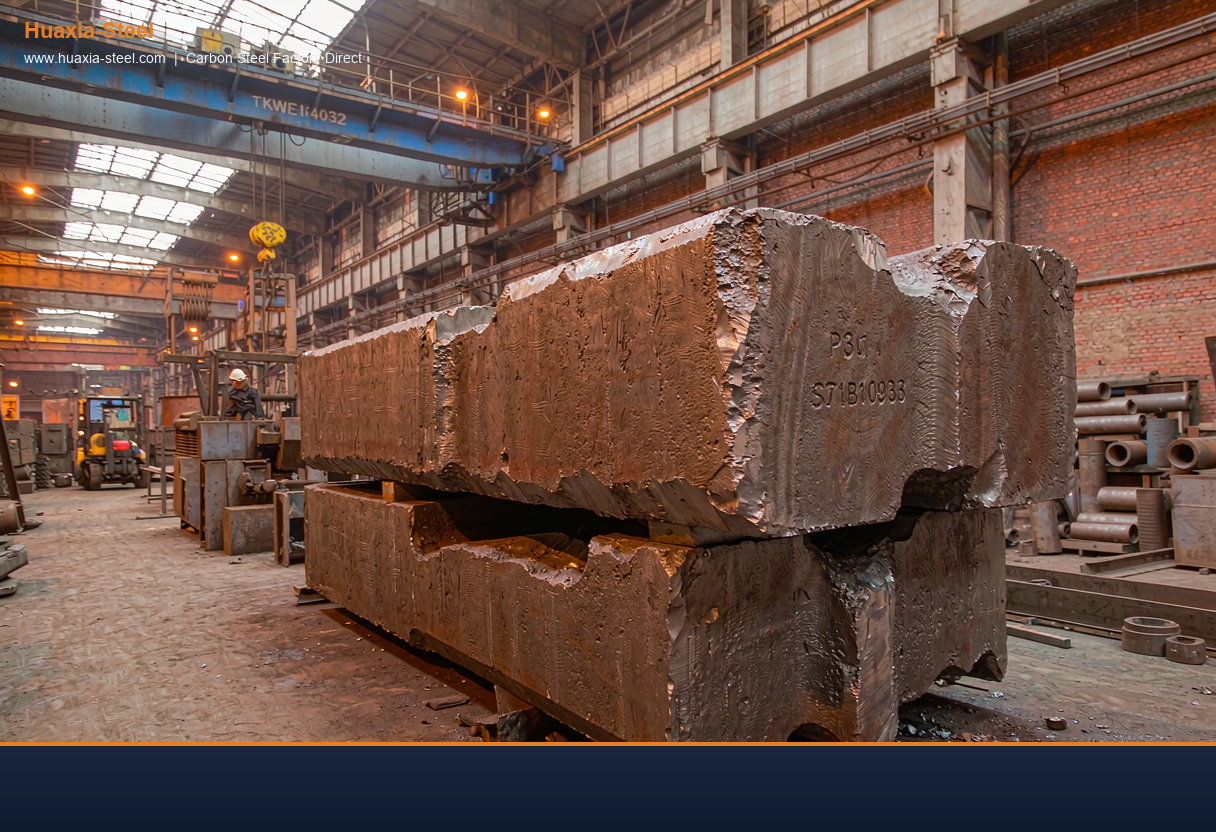
Carbon steel forged blocks are the high-strength raw stock for machining heavy-duty components like valve bodies, gear blanks, hydraulic cylinder ends, mill rolls, marine shafting, and large flanges. They offer superior mechanical properties and grain-flow integrity compared to cast or rolled plate, especially for parts with heavy cross-sections and demanding service conditions.
Huaxia Steel supplies factory-direct carbon steel forged blocks in ASTM A105, A350 LF2, A266 Class 1 / 2 / 3, A765 Class 1 / 2 / 3 and equivalent EN grades, with full MTC 3.1 / 3.2 certification, normalised or quenched-and-tempered delivery condition, and ultrasonic testing per ASTM A388.
1. Product Overview
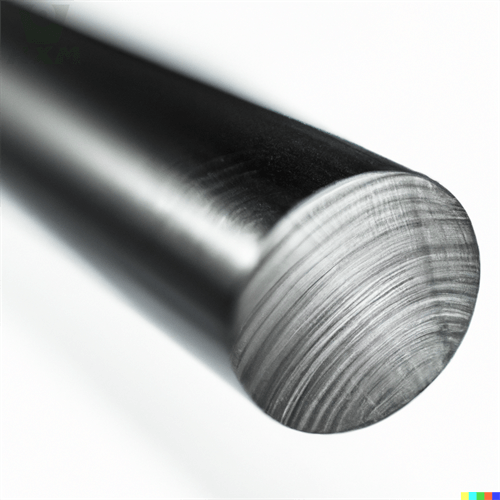
Carbon steel forged blocks (also called forged billets, forged rounds, or die forgings) are forged from ingots or continuous-cast billets, then heat-treated and rough-machined to the customer’s drawing. They are used as the starting stock for:
- Large valve bodies (gate, globe, check, ball) for oil and gas, power, chemical
- Pressure vessel heads and nozzle reinforcements
- Gear blanks for wind turbine, mining, marine gearboxes
- Mill rolls for steel mills, paper mills, plastic film lines
- Marine propeller shafts and rudder horns
- Hydraulic cylinder ends and piston rods
- Heavy-duty bearing housings and journal sleeves
- Crankshafts for diesel engines and compressors
Forging is preferred over casting for these applications because the forging process refines the grain structure, eliminates porosity, and aligns the grain flow with the part geometry — resulting in superior fatigue life, impact toughness and strength-to-weight ratio.
2. Specifications and Dimensional Range
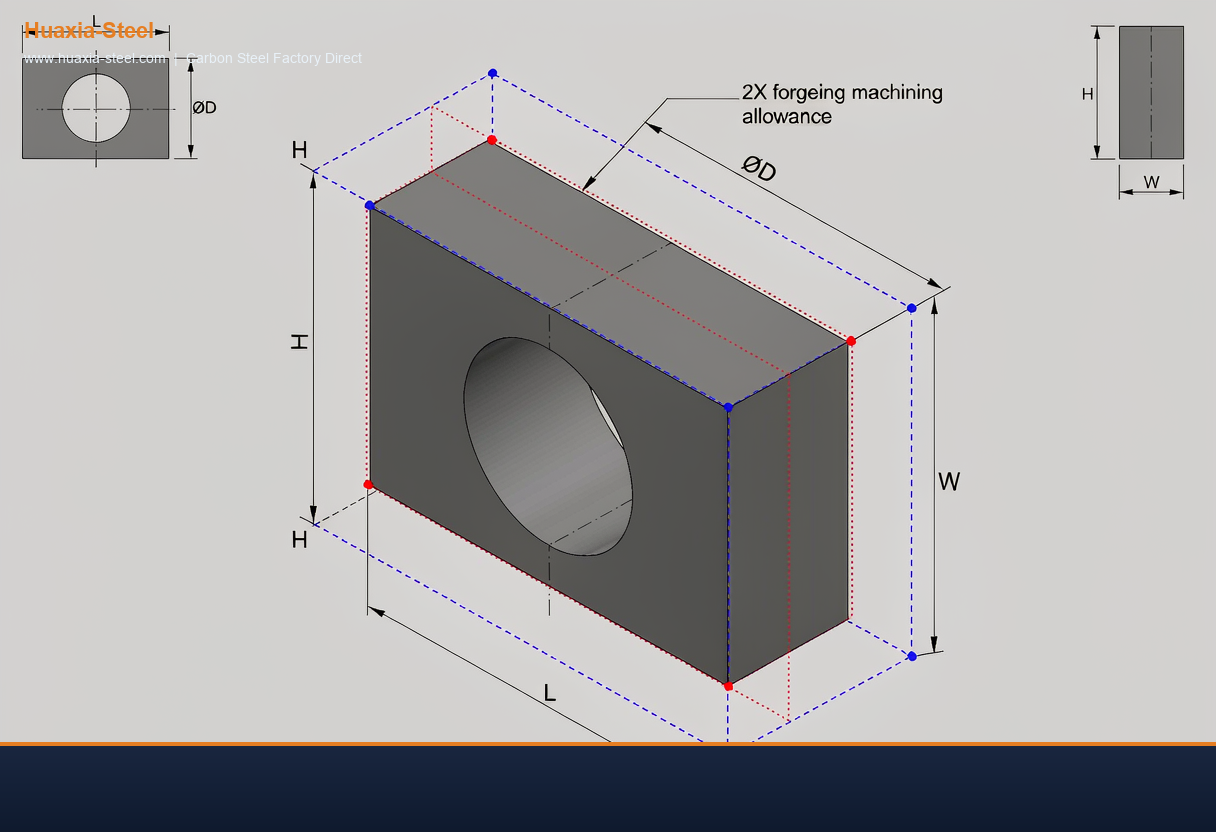
Carbon steel forged blocks are supplied in the following dimensional range:
| Parameter | Range |
|---|---|
| Block weight (single piece) | 50 kg to 50,000 kg |
| Maximum diameter / thickness | 100 mm to 2,500 mm |
| Maximum length / height | 200 mm to 6,000 mm |
| Tolerance on dimensions | ±1% to ±3% (per drawing or standard) |
| Surface roughness | Ra 6.3 to 25 µm (rough forged) or per customer |
| UT inspection | Per ASTM A388 or EN 12680 |
3. Available Grades
Carbon steel forged blocks are supplied in the following grades:
| Grade | Standard | Typical Application |
|---|---|---|
| ASTM A105 / A105N | Forgings, carbon steel | General pressure service, −20°F to 800°F |
| ASTM A350 LF2 | Low-temp forgings | Low-temp service to −50°F |
| ASTM A350 LF6 | Low-temp forgings, higher Ni | Low-temp service to −60°F |
| ASTM A266 Class 1 | Carbon steel forgings | Pressure vessel components |
| ASTM A266 Class 2 | Carbon-moly forgings | Higher temperature pressure |
| ASTM A266 Class 3 | Mn-Mo-Ni forgings | Higher strength pressure |
| ASTM A765 Class 1 | Carbon steel, low-temp | Piping components, low-temp |
| ASTM A765 Class 2 | Carbon steel, low-temp | Lower hardness, low-temp |
| EN 10222-2 P245GH | European pressure vessel steel | Pressure vessel nozzles |
| EN 10222-2 P280GH | European pressure vessel steel | Higher strength pressure |
| EN 10222-2 P355GH | European pressure vessel steel | Highest strength, normalised |
4. Mechanical Properties Comparison
The table below summarises typical mechanical properties for the most common grades:
| Grade | Tensile (ksi) | Yield (ksi) | Elongation (%) | Charpy Temperature |
|---|---|---|---|---|
| A105 / A105N | 70–95 | 36 min | 22 min | — |
| A350 LF2 | 60–85 | 36 min | 22 min | −50°F (18 J) |
| A350 LF6 | 66–91 | 52 min | 22 min | −60°F (20 J) |
| A266 Cl.1 | 60–85 | 30 min | 25 min | — |
| A266 Cl.2 | 70–95 | 36 min | 20 min | — |
| A266 Cl.3 | 75–100 | 45 min | 18 min | — |
| A765 Cl.1 | 60–85 | 36 min | 25 min | −50°F (18 J) |
| EN P355GH | 68–92 | 50 min | 20 min | 0°C (27 J) |
5. Manufacturing Process
Carbon steel forged blocks are produced by the following route:
- Steelmaking — electric arc furnace (EAF) melting with ladle furnace (LF) refining and vacuum tank degassing (VD) for low-hydrogen, low-sulphur steel
- Casting — ingot casting or continuous casting into billets
- Heating — forge furnace heating to 1180–1260°C (2160–2300°F)
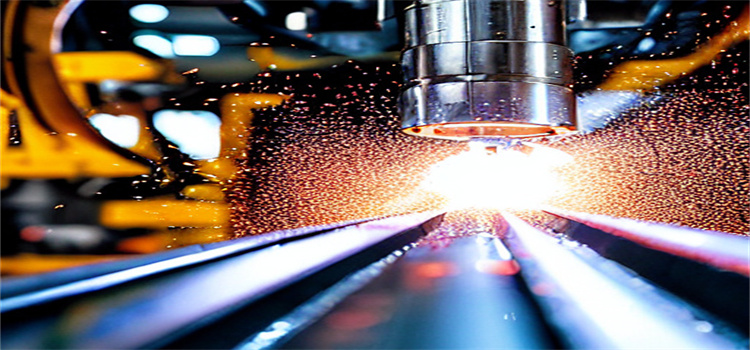
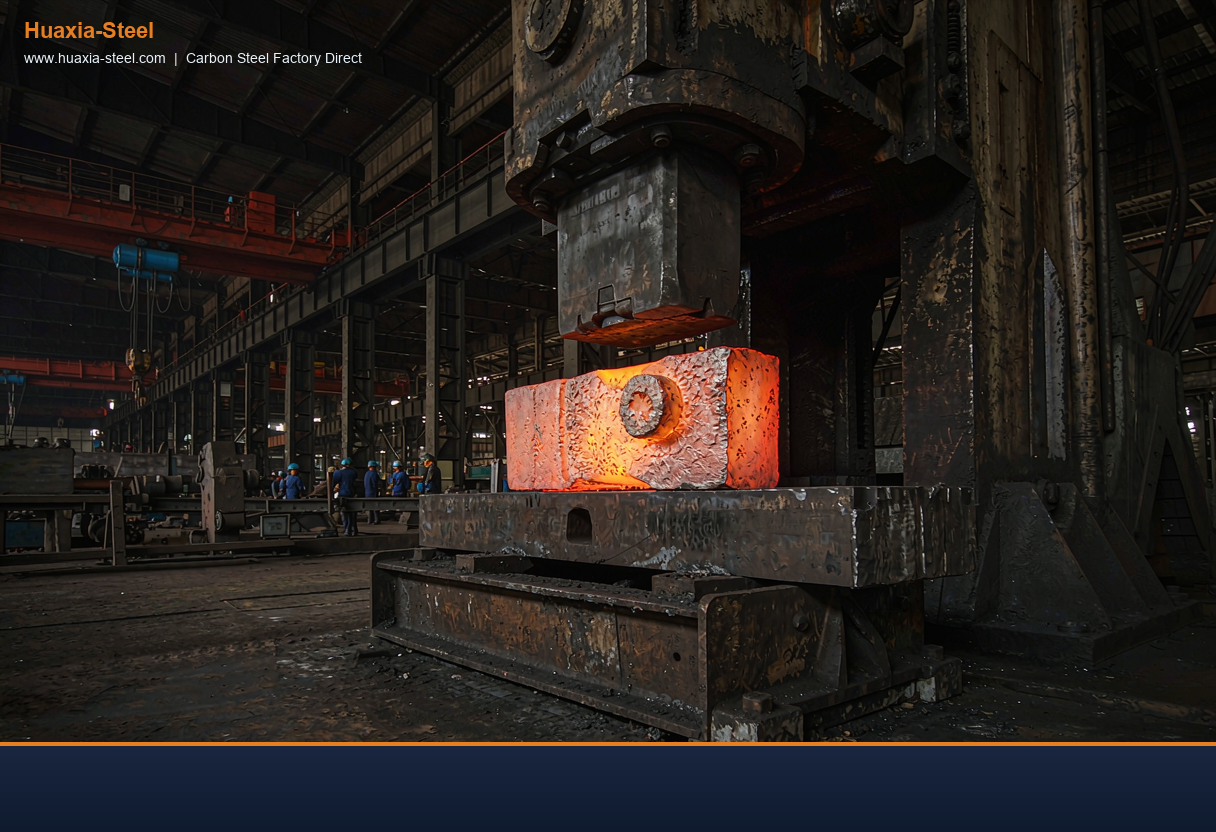
- Forging — open-die forging on hydraulic press or hammer, with upsetting and drawing to develop grain flow
- Cooling — controlled cooling in still air or pit
- Heat treatment — normalising or quenching-and-tempering per specification
- Rough machining — optional CNC machining to customer drawing with stock allowance
- Inspection — UT per ASTM A388, dimensional, visual, mechanical testing
6. Heat Treatment and Delivery Condition
Heat treatment is critical for forged block mechanical properties:
- Normalising — heating to 870–925°C, holding for 1 hour per 25 mm thickness, then air cooling. Refines grain structure, relieves residual stress.
- Normalising + Tempering — normalising followed by tempering at 595–675°C. Used for A266 / A765 / P355GH grades.
- Quenching + Tempering — heating to 870–925°C, water or oil quenching, then tempering. Used for high-strength AISI 4140 / 4340 grades or for impact-critical applications.
- Stress Relief Annealing — 595–650°C for 1 hour per 25 mm. Used for rough-machined blocks to relieve machining stress before finish machining.
7. Inspection and Testing
Every batch of carbon steel forged blocks from Huaxia Steel is supplied with:
- EN 10204 Type 3.1 / 3.2 mill test certificate
- Heat analysis with actual C, Mn, P, S, Si values (and Cr, Mo, Ni, V for alloy grades)
- Product analysis (check analysis) for critical elements
- Tensile test per ASTM A370
- Charpy V-notch test at the specified temperature (full-size specimen)
- Hardness test on multiple locations (surface, mid-thickness, core)
- Ultrasonic examination per ASTM A388 / EN 12680 (Class 1 / 2 / 3)
- Magnetic particle examination on machined surfaces (per drawing)
- Visual and dimensional inspection per customer drawing
8. Applications
Carbon steel forged blocks are used in:
- Valve manufacturing — body, bonnet, cover for gate / globe / check / ball valves
- Pressure vessel components — nozzle reinforcement, head centre disc, flange rings
- Wind turbine gearboxes — gear blank, shaft, bearing housing
- Marine shafting — intermediate shaft, propeller shaft, rudder stock
- Mill rolls — backup roll, work roll for steel, paper and aluminium mills
- Hydraulic systems — cylinder end, piston, gland
- Heavy machinery — crusher shaft, mill trunnion, mining equipment
- Power generation — turbine rotor, generator shaft, coupling
9. Packaging and Shipping
Standard packaging for carbon steel forged blocks:
- Small blocks (<1 t): wooden crates with internal bracing
- Medium blocks (1–10 t): wooden pallets with steel banding
- Large blocks (10–50 t): bare load on flatbed truck / 40 ft flat rack container
- All forged surfaces coated with anti-rust oil or VCI for 6–12 months sea-freight protection
- Machined surfaces protected by hardboard, plywood, or wooden covers
- Marking: manufacturer, grade, heat number, weight, dimensions, project number
- UT report and dimensional report attached to shipping documents
Standard lead time is 30–60 days for production, heat treatment and inspection. Rough machining adds 15–30 days. Express lead time available on request.
10. Cost and Lead Time Considerations
Carbon steel forged block pricing depends on the grade, weight, complexity, heat treatment and inspection requirements. As a rule of thumb:
- Small blocks (50–500 kg) in standard grades have a base price of approximately USD 2,000–4,000 per tonne
- Medium blocks (500–5,000 kg) add 10–15% over the small-block baseline
- Large blocks (5,000–50,000 kg) add 20–40% over the small-block baseline for specialised forging equipment
- A350 LF2 / LF6 adds 15–30% over A105 for low-temperature forging
- Quenched-and-tempered (Q&T) adds 25–50% over normalised for the heat-treatment process
- Rough machining adds USD 500–1,500 per tonne depending on complexity
- EN 10204 3.2 adds 3–5% over 3.1 for witnessed inspection
- Enhanced UT (Class 1 vs Class 2) adds 5–10% for tighter acceptance
Standard lead time is 30–60 days for production, heat treatment and inspection. Rough machining adds 15–30 days. Custom drawings or large blocks above 10 tonnes can extend lead time to 90–120 days due to forging pattern preparation, melt-shop scheduling and inspection time.
11. Forged vs Cast Block Comparison
Choosing between forged and cast blocks depends on the application:
| Aspect | Forged Block | Cast Block |
|---|---|---|
| Strength | 20–40% higher | Lower, with casting defects |
| Toughness | Excellent, refined grain | Lower, may have porosity |
| Cost per kg | Higher | Lower for complex shapes |
| Lead time | 30–60 days | 20–45 days |
| Weight limit | Unlimited (open die) | Limited by casting facility |
| Machinability | Better (no hard spots) | Variable (may have hard spots) |
| UT quality | Consistent | Variable |
| Typical applications | Pressure, structural, fatigue | Static, low-stress components |
For pressure-bearing or fatigue-loaded components, always specify forged blocks. For static, low-stress components, cast blocks may be acceptable and cost less. Verify with your engineer which form is appropriate for the design.
Need carbon steel forged blocks for your project? Huaxia Steel supplies A105, A350 LF2 / LF6, A266, A765 and EN P355GH forged blocks in custom dimensions, with full MTC 3.1 / 3.2 and SGS / BV / TUV witnessed inspection. Email [email protected] with your drawing, grade, weight, quantity and delivery destination, and we will respond with a mill-direct quotation within 24 hours.