8620 vs 4140 Steel: Carburizing Grade or Through-Hardening Alloy?
8620 and 4140 both carry chromium and molybdenum, both heat treat well, and both show up constantly in export RFQs — yet they solve completely different engineering problems. 8620 is a low-carbon case-hardening steel: it stays soft and tough at the core while a thin, high-hardness case is created by carburizing. 4140 is a medium-carbon through-hardening steel: the whole cross-section hardens when quenched and tempered. Choosing the wrong one is one of the most expensive specification errors in custom machinery sourcing. This guide compares 8620 vs 4140 steel across chemistry, hardening behavior, core toughness, fatigue, weldability, cost, and typical applications.
1. Quick Answer: When to Use Each Grade
2. Chemical Composition Compared
| Element | 8620 (%) | 4140 (%) |
|---|---|---|
| Carbon | 0.18–0.23 | 0.38–0.43 |
| Manganese | 0.70–0.90 | 0.75–1.00 |
| Silicon | 0.15–0.35 | 0.15–0.35 |
| Chromium | 0.40–0.60 | 0.80–1.10 |
| Nickel | 0.40–0.70 | — |
| Molybdenum | 0.15–0.25 | 0.15–0.25 |
| Phosphorus max | 0.035 | 0.035 |
| Sulfur max | 0.040 | 0.040 |
The nickel is the signature addition in 8620. Nickel does not harden steel much on its own, but it dramatically raises core toughness in the carburized condition and lowers the transition temperature — exactly what a gear tooth needs when a shock load passes through a hard case into a softer core. Chromium in 8620 is reduced to 0.40–0.60% (against 0.80–1.10% in 4140) to keep the case from becoming excessively hard relative to the core, which would promote case crushing or spalling under heavy contact loads. In 4140, the full chromium complement drives deep through-hardening and adds a useful measure of wear resistance in the tempered condition.
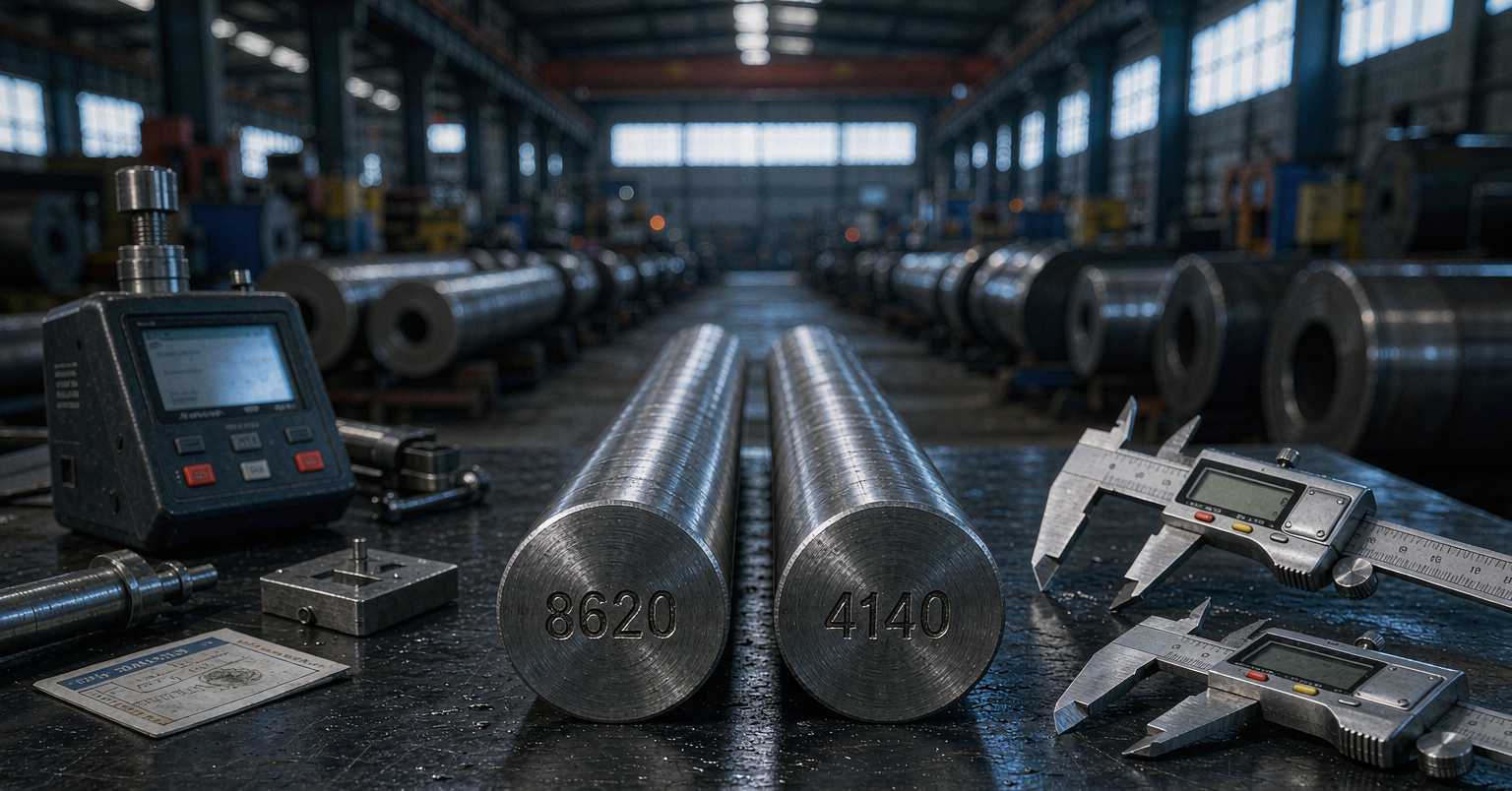
3. Mechanical Properties: Different Parts of the Hardness Map
| Condition | Property | 8620 (typ.) | 4140 (typ.) |
|---|---|---|---|
| Normalized / as-supplied | Tensile strength | 500–600 MPa | 950–1020 MPa |
| As-supplied | Yield strength | 300–400 MPa | 655–680 MPa |
| After final heat treatment | Surface hardness | 58–62 HRC (carburized case) | 28–38 HRC (Q&T bulk) |
| After final heat treatment | Core hardness | 25–40 HRC | = surface (28–38 HRC) |
| Core tensile (carburized / Q&T) | Tensile strength | 900–1200 MPa | 1000–1200 MPa |
| Case depth range | Effective case depth | 0.5–1.5 mm typical | Not applicable |
| Charpy V-notch, core/room temp | Impact energy | 60–100 J | 30–60 J |
Read the table as two different design philosophies. 8620 buys a hardness gradient: 58–62 HRC where the surface rolls or slides against another part, dropping to a 25–40 HRC core with 60–100 J of impact energy so that shock loads do not initiate cracks. 4140 buys uniform strength: the same 28–32 HRC from surface to center, tensile in the 1000–1200 MPa band, with fatigue performance governed by the whole section rather than a thin case. Neither grade “wins” — a gear made from Q&T 4140 with 30 HRC surface would wear out several times faster than a carburized 8620 gear, while a shaft made from carburized 8620 would be over-processed and weaker in bending than the same shaft in 4140.
4. Case Hardening vs Through Hardening: The Process Consequences
8620 processing route: normalize or machine in the soft condition → carburize at 900–930°C in endothermic atmosphere (or vacuum) to build carbon at the surface → oil quench → temper at 150–200°C. Total cycle time for a 1.0 mm effective case runs 8–15 hours in a pit or batch furnace. The buyer-visible consequences: the parts arrive hard only at the surface, case depth must be verified by hardness traverse on a sacrificial sample, and grain control during carburizing matters — a sloppy furnace shop delivers coarse-grained cases that spall.
4140 processing route: austenitize at 830–850°C → oil quench → temper at 540–680°C for the standard 28–32 HRC supply condition (or 200–450°C for higher hardness, avoiding the 250–400°C embrittlement trough). Cycle time is dramatically shorter and no carbon potential control is needed. The buyer-visible consequences: hardness is uniform, so verification is a simple hardness test on the actual part, but hardenability limits apply — full property 4140 tops out around 80–100 mm section size in oil, beyond which the core falls short of the specified band.
5. Fatigue, Wear and Contact Stress: Where Each Grade Earns Its Keep
Rolling contact and sliding wear favor 8620. A carburized case in the 58–62 HRC range with compressive residual stress resists pitting and wear far better than a 30 HRC through-hardened surface. This is why virtually every automotive and industrial gearbox in the world uses carburized 8620-class steel (or 20MnCr5 in Europe) for gears. The compressive stress profile left by carburizing also lifts bending fatigue strength at the tooth root by 20–40% over a non-carburized surface of equal hardness.
Bending, torsion and tensile loads favor 4140. Because the entire section shares the load, a 4140 shaft in the 28–32 HRC condition out-performs a carburized 8620 shaft of the same diameter in rotating bending fatigue once section sizes exceed the case depth by more than roughly ten times. 4140 also handles sustained elevated temperature (up to ~400°C service) without softening, which matters for fasteners, dies, and power transmission components near heat sources.
6. Weldability and Machinability
Weldability: 8620 is clearly better, 4140 is challenging. With only 0.20% carbon, 8620 has a carbon equivalent around 0.45–0.55 and welds with modest preheat (100–150°C) and no post-weld heat treatment in most fabrications. 4140’s carbon equivalent of 0.75–0.85 makes it one of the more weld-resistant-to-forgiving grades: welding requires 250–300°C preheat, low-hydrogen electrodes, slow cooling, and an immediate 600–650°C stress relief to avoid hydrogen-induced cracking in the HAZ. If your design welds the part after final heat treatment, do not specify 4140 in a hardened condition — you will destroy the temper.
Machinability: both machine well in the soft condition — 8620 at roughly 65% of B1112 reference, 4140 annealed at roughly 65–70%. The difference appears after heat treatment: carburized 8620 cases must be finish-ground (hard turning above 55 HRC is possible but hard on tooling), while Q&T 4140 at 28–32 HRC is still machinable with carbide for final sizing. Plan your process accordingly: with 8620, leave 0.15–0.25 mm per surface grinding stock on case-hardened features; with 4140, complete rough machining before hardening and finish with light cuts or grinding.
7. Applications and Cross-Reference Table
| Application | Recommended grade | Why |
|---|---|---|
| Gears, pinions, sprockets | 8620 carburized | Hard case for contact stress, tough core for shock |
| Camshafts, crankshafts | 8620 (or induction-hardened 1045) | Local surface hardening with fatigue benefit |
| Transmission shafts, spindles | 4140 Q&T | Uniform strength in bending/torsion |
| Hydraulic cylinders, rods | 4140 Q&T (+ chrome plate) | Strength plus platable surface |
| High-strength bolts > 8.8 | 4140 (or 42CrMo4) | Through-hardened strength, temper resistant |
| Heavy-duty bearings/bushings | 8620 carburized | Case crushing resistance |
| Dies, tooling plates | 4140 pre-hard | Machinable, stable, 28–32 HRC |
When importing from China, note that 8620 (GB 20CrNiMo) is stocked less widely than 4140 (GB 42CrMo4). Many mills produce 8620 to order with minimum quantities in the 2–5 t range, while 4140 is available from stock in peeled, cold-drawn, and pre-hardened conditions. If your RFQ asks for 8620, expect the supplier to quote a carburizing + quench + temper route as a packaged service, and confirm whether the carburizing is done in-house or subcontracted — subcontracted heat treatment adds a hand-off point where traceability can be lost.
8. Cost and Sourcing Considerations
Material cost per tonne: 4140 typically carries a 10–20% premium over plain 1045-class carbon steel, while 8620’s nickel content pushes it 25–40% above 4140 at the billet level. But total part cost tells a different story: 8620 parts carry an added carburizing cycle (often USD 300–600/t of processed weight for a 1 mm case), grinding allowance, and longer lead time, while 4140 parts often ship in pre-hardened condition with minimal downstream processing. The right comparison is not price per tonne — it is landed cost per finished, inspected part. Ask suppliers to quote both routes when a drawing permits either interpretation, and require the MTC to state the actual heat treatment temperatures and case depth results, not just “carburized, hardened and tempered”.
Can 8620 be through-hardened instead of carburized?
It can be quenched and tempered, but with 0.20% carbon the achievable strength is limited — roughly 800–900 MPa tensile at best, well below what 4140 delivers. Using 8620 as a through-hardening grade wastes its nickel-toughness advantage and its higher price. If you do not need a case, specify 4140 or 4340.
What happens if a supplier substitutes 20MnCr5 for 8620?
20MnCr5 (1.7147) is the common European case-hardening alternative and is often substituted for 8620 in Chinese production because it contains no nickel. It works for most gear applications but has lower core impact toughness, which matters in shock-loaded or sub-zero service. If your specification says 8620, any substitution must be approved in writing, with Charpy data at the relevant temperature.
How is carburized case depth verified on incoming inspection?
Effective case depth (ECD) is measured by microhardness traverse on a cross-sectioned sample — hardness 50 HRC equivalent defines the effective case. Surface hardness by Rockwell C, core hardness at mid-radius, and a case microstructure check complete a proper verification. Every production lot should have a case depth report; first articles should include the traverse plot, not just the ECD number.
Which grade is cheaper for a 50 mm shaft, 4140 or carburized 8620?
4140, decisively. At 50 mm, 4140 through-hardens fully in oil and needs only Q&T. Carburizing a 50 mm section to a meaningful case adds a 10+ hour furnace cycle and grinding — with no benefit, since a shaft in bending does not need a hard case. Case hardening earns its cost only in contact/wear applications.
9. Heat Treatment Verification: What to Demand From the Mill
Heat treatment is the least visible step in the supply chain and the easiest to fake on paper, so the verification burden sits on the buyer. For 4140 Q&T, require: hardness test on the supplied bar (surface and, for critical parts, mid-radius), the tempering temperature stated on the certificate, and microstructure confirmation on first-article lots (tempered martensite, no untempered martensite, no decarburized skin beyond agreed limits). A bar delivered at 30 HRC surface but 20 HRC at mid-radius means the section exceeded the mill’s effective hardenability — common on 150 mm+ bar quenched too gently.
For 8620 carburized parts, the verification set is bigger because two heat treatments stack: the carburize-quench-temper for the case plus the core properties. Demand: effective case depth by microhardness traverse (state the 50 HRC criterion explicitly — 550 HV1 is the common equivalent and differs slightly), surface hardness band, core hardness band at mid-radius, Charpy energy on core samples where toughness is design-critical, and a metallurgical report confirming the case microstructure is fine martensite with no carbide network at the case-core transition. Carbide networks at the transition are the classic carburizing defect: invisible on hardness plots, catastrophic in service, and only caught by metallography. Budget for sacrificial sample parts — one per heat-treatment lot — because these measurements destroy the specimen.
Documentation-wise, both grades should ship with EN 10204 3.1 certificates covering the base material, plus a heat-treatment record (furnace ID, charge number, temperatures, times, quench medium). If the heat treater is a subcontractor — common even for good mills — insist the record identifies the treater by name. Traceability that stops at the mill gate protects nobody when a batch of gears fails in the field at 200 hours.
10. RFQ Checklist: Getting 8620 and 4140 Quoted Correctly
11. Failure Modes From Grade Confusion: Field Cases
The specification errors behind most grade-confusion failures follow a small number of patterns, and each leaves a characteristic signature. Case one — 4130/4140 substitution written up as 8620: a gearbox pinion specified in carburized 8620 arrives as Q&T 4140 “equivalent”. Hardness across the tooth flank reads 30 HRC instead of 60, and the pitting failure appears within weeks of ramp-up — long before the design fatigue life. The MTC showed correct chemistry for 4140, but nobody cross-checked the case-depth callout on the drawing against the delivered material.
Case two — carburized 8620 where the drawing meant induction-hardened 1045: a roller pin designed for a 2 mm ECD on cheap feedstock gets quoted in 8620 with full carburizing — functionally correct, but the part price doubles and the schedule slips a heat-treatment cycle. Reverse confusion is less dramatic but equally real: over-specification costs quietly accumulate across thousands of parts. The discipline that prevents both: the RFQ states the functional requirement (surface hardness, case depth, core hardness, section size) alongside the grade, so the supplier can flag mismatches instead of quoting silently.
Case three — the unloaded hardenability miss: 4140 specified in 120 mm sections, quenched in still oil at a mill whose agitation is poor, delivers 24 HRC at mid-radius against a 28–32 HRC drawing. Every piece is within the hardness band at the surface; the core is out. The lesson generalizes: for alloy bar above ~80 mm, add a mid-radius hardness or ultrasonic requirement to the PO, and accept only mills who can document their quench practice. These checks cost a fraction of one field failure.
Source 8620 and 4140 With Verified Heat Treatment
Huaxia-Steel supplies 8620 (20CrNiMo) bar for carburizing and 4140 (42CrMo4) in annealed, quenched-tempered and pre-hard conditions — with EN 10204 3.1 certificates, case-depth reporting and cut-to-length service.
Request a quote: Contact Huaxia-Steel.