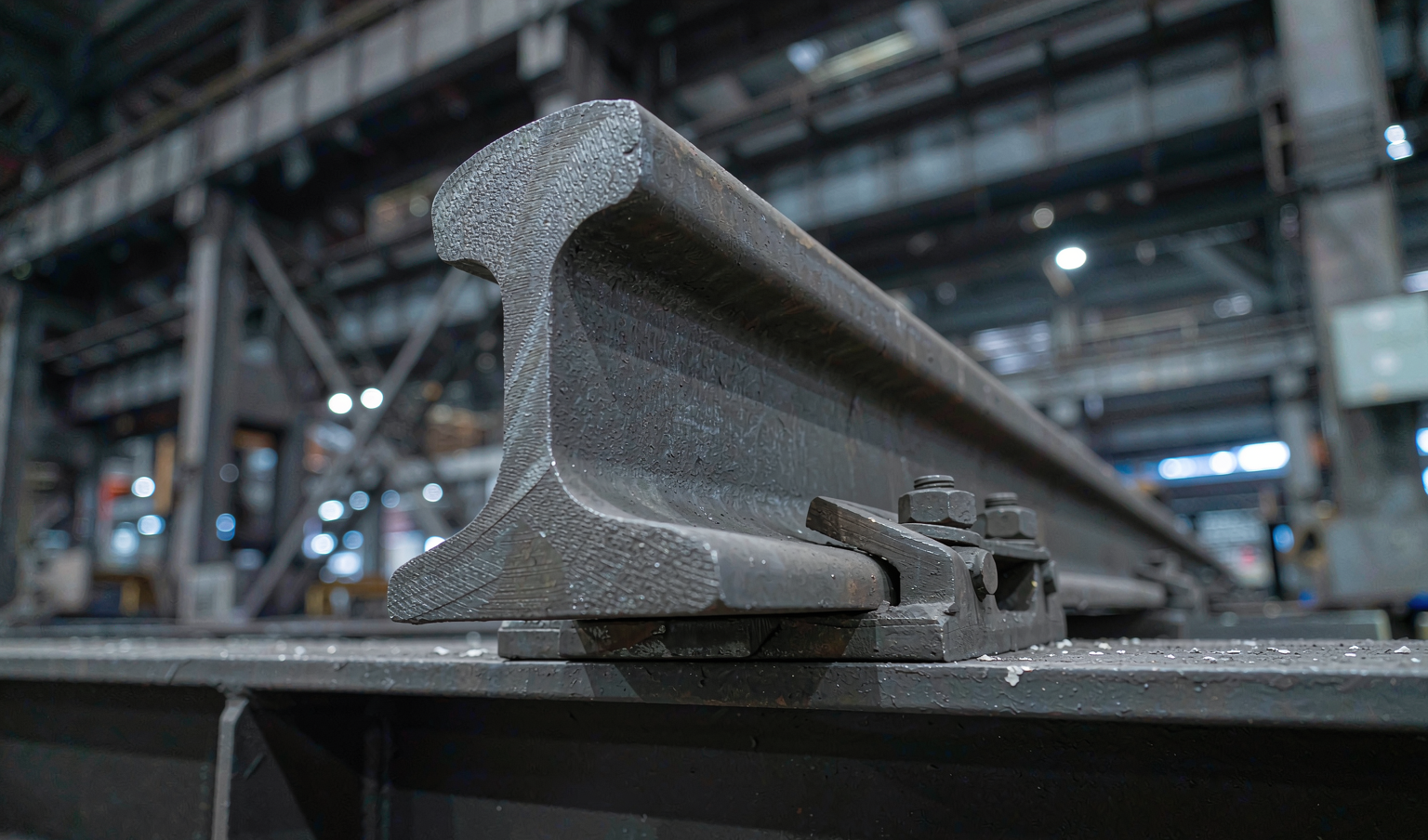
Light steel rail and crane rail from Huaxia-Steel covers the full industrial rail range: light rails from 8 to 30 kg/m for mining, tunneling and industrial track, and crane rails QU70/QU80/QU100/QU120 for overhead traveling cranes, gantries and port equipment. Supplied in U71Mn and related rail steels with controlled chemistry, hardness and straightness, every bar ships heat-certified with dimensional reports — factory direct for EPC track projects, crane OEMs and industrial plant operators.
Product Overview
Industrial rail differs from mainline railway rail in profile and duty: light rails (8–30 kg/m) carry low-speed mining, industrial and temporary track loads, while crane rails (QU series) are flat-footed sections engineered for wheel loads that can exceed 40 tonnes per wheel on heavy gantry cranes. The QU profile — wider foot, thicker head and web than equivalent-weight railway rail — distributes the concentrated wheel pressure onto the runway beam without special sole plates. Rail steel uses high-manganese eutectoid compositions (U71Mn: 0.65–0.77 % C, 0.70–1.00 % Mn) that develop 300+ HB hardness as-rolled and work-harden in service, resisting wear without heat treatment.
Specifications: Section Range
| Type | Section | Weight (kg/m) | Standard length (m) |
|---|---|---|---|
| Light rail | 8 kg/m | 8.42 | 6 |
| Light rail | 12 kg/m | 12.20 | 6 – 10 |
| Light rail | 15 kg/m | 15.20 | 6 – 10 |
| Light rail | 22 kg/m | 22.30 | 6 – 12 |
| Light rail | 30 kg/m | 30.10 | 6 – 12 |
| Crane rail | QU70 | 52.80 | 9 – 12 |
| Crane rail | QU80 | 63.49 | 9 – 12 |
| Crane rail | QU100 | 88.96 | 9 – 12 |
| Crane rail | QU120 | 118.10 | 9 – 12 |
Drilled bars (fishplate holes to your joint pattern), 45° miter cuts and bend-to-radius service for curved runway ends are available. Matching fishplates, clips, rubber pads and anchor bolts are supplied with the rail as a package for EPC sites.
Grades and Standards
| Parameter | Light rail | Crane rail (QU) |
|---|---|---|
| Chinese standard | GB 11264 (light rail) | GB/T 3426 / YB/T 5055 (QU crane rail) |
| Steel grade | U71Mn / 55Q | U71Mn |
| Carbon % | 0.60–0.75 (55Q) / 0.65–0.77 (U71Mn) | 0.65–0.77 |
| Tensile strength | ≥ 680–850 MPa by grade | ≥ 880 MPa |
| Hardness (head) | ≥ 260–300 HB by grade | ≥ 300 HB |
| Drop weight test | per standard sample interval | per standard sample interval |
For projects specified to international practice, rails can be supplied with EN 13674-1 comparison data or third-party inspection against the project’s rail specification — confirm at RFQ stage so the certificate set matches your tender documents.
Applications
- Overhead traveling crane runways in steel mills, foundries and workshops (QU70–QU120)
- Gantry cranes, container yard rails and port equipment runways
- Mining and tunneling track (8–30 kg/m light rail)
- Industrial sidings, warehouse transfer lines and amusement/monorail track
- Slipper guides and wear tracks where rail sections serve as sliding bearings
Quality Assurance
Every heat is certified for chemistry and tensile properties; head hardness and drop-weight test results are reported at the sampling frequency of the applicable standard. Straightness, twist, end squareness and section dimensions are checked before packing, and fishplate hole patterns are gauge-verified when bars are drilled. EN 10204 3.1 certificates are issued per heat; third-party inspection (SGS/BV/TUV) and pre-shipment loading supervision are available for EPC projects.
Packing and Shipping
Rails are bundled in 3–8 t units, strapped at defined intervals with timber separation to protect the rail head, and loaded in containers (up to 12 m lengths in 40 ft open tops) or breakbulk for project volumes. End marking identifies section, grade, heat and standard; bundle tags carry PO references for site traceability. A U71Mn rail is a high-carbon steel — cutting and welding on site require preheat and slow cooling; we supply the recommended procedures with each shipment.
Selecting the Crane Rail Section: Wheel Load to Profile
Crane rail selection starts from maximum wheel load, not crane capacity. Working rule: QU70 serves wheel loads up to roughly 20–25 t on a properly prepared runway beam; QU80 covers 25–35 t; QU100 covers 35–45 t; and QU120 handles 45 t and above, including ladle cranes and heavy port equipment. The other inputs are wheel diameter (hardness mismatch between wheel tread and rail head accelerates wear on whichever is softer — match hardened wheels to 300 HB rail heads), duty class of the crane (ISO M5–M8 duty demands the heavier sections with hardened heads), and the runway beam’s ability to distribute the concentrated load. Undersized rails on adequate beams fail in the head by shelling and spalling; oversized rails on flexible beams fail the beam. When sending an RFQ, state the crane duty class and maximum wheel load — we will propose the section and confirm availability before quoting.
Fastening Systems and Installation Practice
Crane rails are held by one of three systems: welded clips (pad-welded to the beam flange, clamp the rail foot without drilling — the modern default for QU rails), bolted clips into pre-drilled or clamp-plate beams, and the legacy hook-bolt method for lighter duty. A resilient pad (rubber or polyurethane, 6–10 mm) between rail foot and beam reduces impact transmission, extends rail and wheel life, and is standard practice for duty-class M6 and above. Rail joints are typically welded (thermite or flash butt) on continuous runways to eliminate the hammer-blow effect of fishplated joints on fast-moving cranes; where fishplates are used, joints should be staggered relative to beam splices. Light rail track uses standard sleepers, clips and gauges per the applicable track standard — our supply can include the full fastening bill matched to the rail section.
Maintenance and Wear Limits
Rail wear concentrates in the head. Practical maintenance limits: re-profile or replace when head height loss reaches 10–15 % of the original head dimension, when side wear on the gauge face exceeds about 8 mm on QU sections, or when shelling/spalling covers more than a quarter of the contact band. Monthly visual inspection plus quarterly straightedge and wear-gauge measurement catches most progressive failures; thermal cracking from wheel slip and chipped ends from joint impact are the other two defect families to inspect. Rails work-harden in service — a U71Mn head that started at 300 HB can exceed 360 HB after years of service — which improves wear resistance but makes field welding repairs demanding; keep the recommended preheat and electrode procedures from the shipment documents on file for maintenance crews.
Tolerances and Pre-Shipment Inspection
Rail tolerances concentrate on the dimensions that affect ride and fit: rail height (±0.5 mm typical for QU sections), head width (±1.0 mm), foot width (±2.0 mm), web and foot thickness (−0.5/+1.0 mm), and — the one that causes the most site complaints — straightness, specified as maximum deviation over any 1 m and cumulative over full length (typically ≤ 0.7 mm/m for crane rail, tighter on request). End squareness matters for joint fit-up whether fishplated or welded; mitered and drilled ends are gauge-checked against the order’s hole pattern. Pre-shipment inspection for rail projects typically combines a dimensional audit per size, hardness testing of the rail head per heat, review of heat certificates against the standard’s chemistry window, and loading supervision with photographs of bundle arrangement and end protection — all available as a standard package for EPC shipments.
Why U71Mn: The Rail Steel Behind the Sections
Rail steel is a deliberate compromise: too little carbon and the head wears fast; too much and the rail shatters under impact. U71Mn’s high-carbon, medium-manganese composition lands the balance — as-rolled tensile of 880 MPa and above, head hardness around 300 HB, and a pearlitic microstructure that work-hardens under traffic instead of failing. The manganese raises hardenability just enough to keep the pearlite fine through the heavy rail sections without needing quenching, which keeps production economical and the product straight after rolling. Heat-treated variants (head-hardened U71Mn to higher hardness classes) are produced for heavy-haul and high-duty crane applications, trading some toughness for head hardness in the 340–370 HB range. For buyers, the practical points: U71Mn rails cannot be flame-cut or field-welded casually — cutting needs slow cooling to avoid hairline cracking at the cut face, and welding requires preheat plus controlled cooling procedures that we supply with each shipment. Alloy substitutes (low-alloy rail steels) exist for extreme duty, but for crane runways and industrial track, U71Mn remains the global default.
Whether your need is a single crane rebuild (a few tonnes of QU80) or a full industrial track package, the quotation will state section, grade, lengths, drilling pattern and certification scope explicitly — so what arrives is what the drawing asked for, with the paper to prove it.
Why Buy Rail From Huaxia-Steel
- Complete QU70–QU120 crane rail and 8–30 kg/m light rail range from one supplier
- U71Mn rail steel with certified hardness, tensile and drop-weight results
- Drilled, mitered and bent bars plus clips, pads and fishplates as a site-ready package
- EPC-grade documentation: 3.1 certificates, inspection reports, L/C-ready document sets
Request a rail quotation — send your section list (8–30 kg/m or QU series), lengths and tonnage for factory direct pricing and lead time.