If your production line consumes narrow carbon steel strips — for tube making, roll forming, stamping or hardware — you eventually face the choice of buying slit coil from a service center or slitting master coils in-house. The steel coil slitting process looks simple from the outside: a wide coil goes in, several narrow coils come out. In reality, burr height, camber, strip edge quality and width tolerance make the difference between a strip that runs at 120 m/min on your tube mill and one that stops your line every second coil. This guide explains how slitting lines work, the tolerances you should specify, common quality defects, how pricing is structured, and a checklist for auditing a slitting supplier before you commit volume.
What Is Steel Coil Slitting?
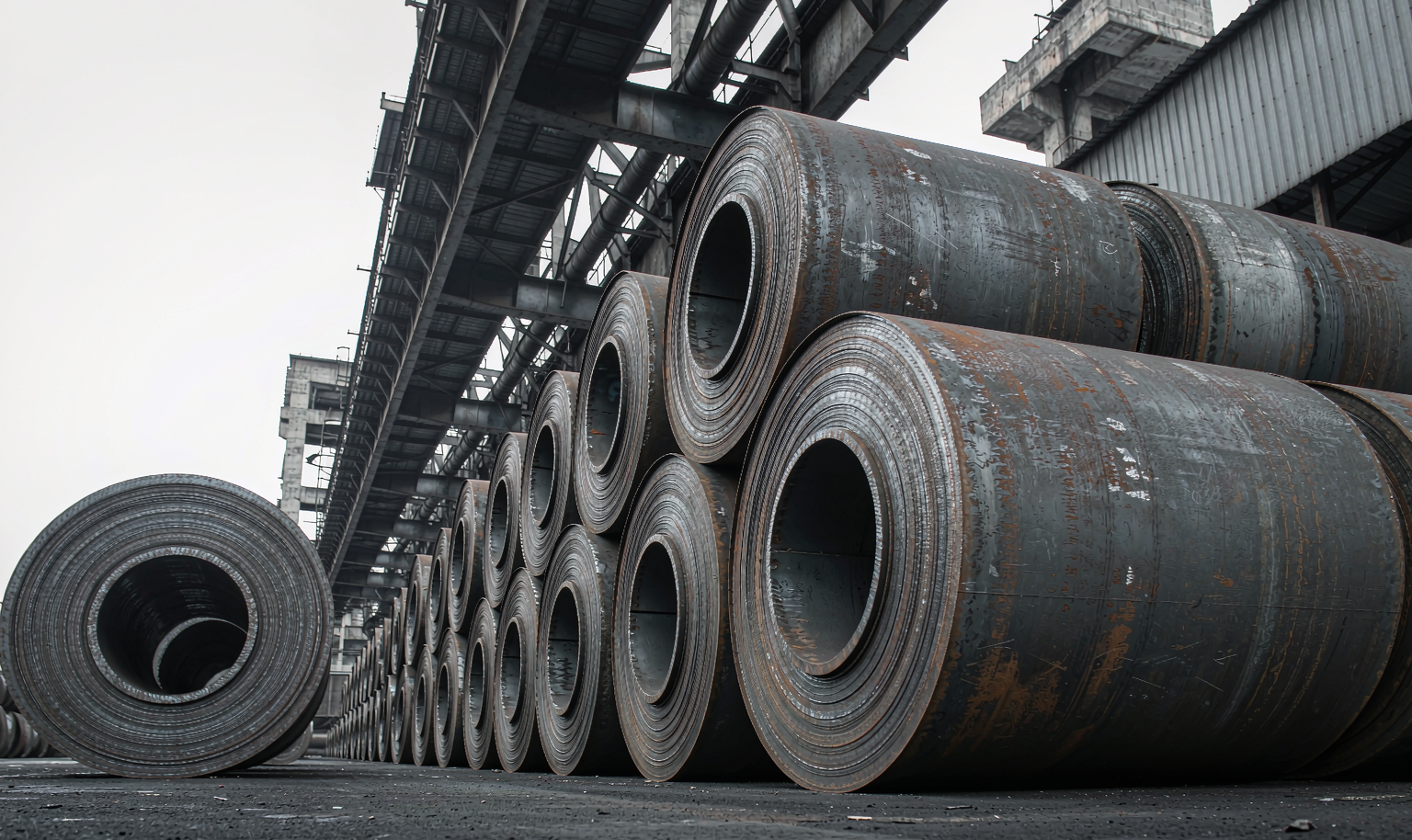
Slitting is a longitudinal cutting operation that splits a wide master coil (typically 1000–2050 mm wide) into several narrower strips in a single continuous pass. Unlike blanking or shearing, the cut runs along — not across — the rolling direction, and the strip is recoiled immediately without stopping the line. Slitting lines come in two families: pull-through lines, where the recoiler pulls the strip through idle knives, and driven lines, where motorized knife shafts actively feed the material. Driven lines handle thicker, higher-strength material (up to 12–16 mm plate) while pull-through lines dominate for thin strip from 0.2 to 4 mm, which is where most carbon steel export trade sits.
Typical line capability for carbon steel strip:
Thickness range: 0.2–6 mm common; heavy lines up to 12.7 mm.
Master coil width: 1000–2050 mm; coil weight up to 30 tonnes.
Line speed: 60–200 m/min depending on thickness and knife setup quality.
Width tolerance: ±0.05 mm on precision lines, ±0.10–0.25 mm on standard lines.
Minimum strip width: 15–20 mm standard; multi-blade setups can produce narrower web widths.
How a Slitting Line Works: Step by Step
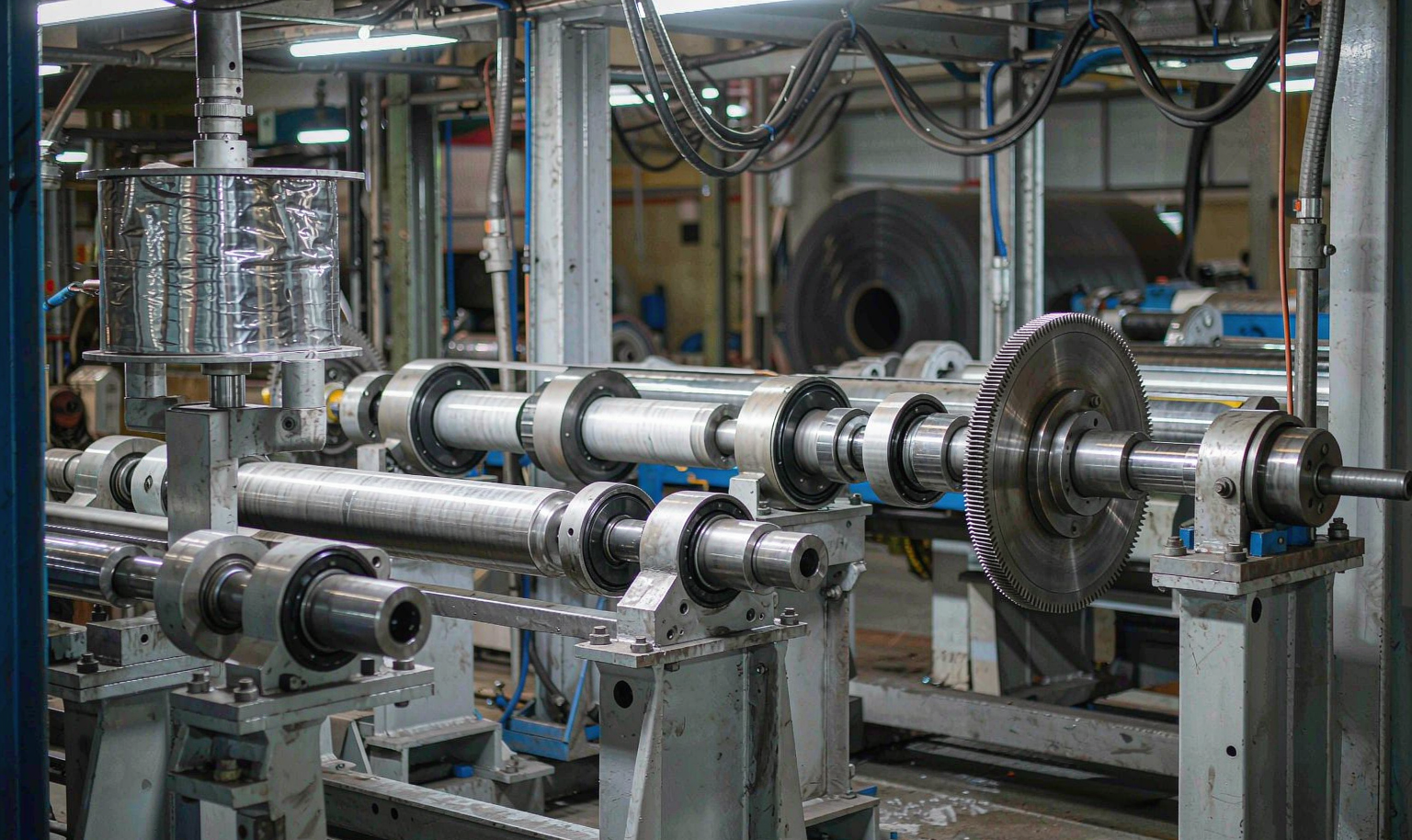
A modern line runs through seven stations. First, the coil car loads the master coil onto an uncoiler (decoiler) with a cone or expanding drum mandrel. Second, a peeler and pinch roll thread the strip head into the line. Third, the strip passes a leveler or flattener — essential for coils stored edge-stacked, because crossbow and twist upstream destroy width accuracy downstream. Fourth, the strip reaches the knife box: circular upper and lower knives mounted on two arbors, shimmed to the job’s strip width with spacers. Knife clearance — the overlap and horizontal gap between upper and lower blades — is set to roughly 5–10% of strip thickness for soft carbon steel; too tight and the blades chip, too loose and you get a heavy burr and ragged edge. Fifth, scrap ballers or scrap choppers collect the slit waste between strips (typically 3–8 mm per cut). Sixth, tension stands ( Separator / tension pads ) keep each strip taut and separated so strips do not wander or overlap on the recoiler. Finally, the recoiler winds the strips into finished slit coils, which are banded, weighed, and packed with the heat number transferred from the master coil.
Two details separate a professional slitter from a cheap one: arbor stiffness and knife maintenance. A long arbor deflecting under load produces width variation from edge to edge of the master coil — the center strips come out wide and the outer strips narrow. And a knife regrind program (blades re-ground every 200–400 tonnes of cutting, edge radius controlled to a few microns) is the difference between a consistent light burr and strips that scratch your tooling.
Slitting Tolerances You Should Specify
Generic “slit to width” means nothing without a tolerance class. The following table reflects achievable values for hot rolled and cold rolled carbon steel strip (thickness 0.5–3.0 mm):
Parameter
Standard slitting
Precision slitting
What it affects
Width tolerance
±0.25 mm
±0.05 mm
Tube mill forming gap, die feed
Burr height
≤ 8% of thickness
≤ 3% of thickness
Welding quality, die wear, safety
Camber
≤ 2 mm/m
≤ 0.5 mm/m
Strip tracking on forming line
Edge camber after recoiling
Telescoping ≤ 10 mm
Telescoping ≤ 3 mm
Uncoiling straightness
Out-of-square (diagonal)
Not controlled
≤ 1 mm/m of width
Feed accuracy for stamping
Burr height deserves special attention because it is the defect most often discovered late — at your tube mill’s welding station or inside your stamping die. Accept a burr of 3% of thickness or less for cold rolled strip destined for high-speed ERW tube lines; above 8% the burr leaves weld inclusions and the strip needs edge milling, which adds cost nobody quoted. Camber — the sideways bow of a strip — under 0.5 mm/m is needed if your roll forming line runs guide-free; standard coils often carry 1–2 mm/m and will wander.
Common Slitting Defects and Their Root Causes
Heavy or wire burr: knife clearance too large, dull blades, or wrong clearance ratio for the grade; fix by re-shimming and regrinding, not by slowing the line.
Edge wave / wavy edge: uneven strip tension or over-thick lubricant film; often shows on the master coil’s loosely wound edges — inspect master coils before slitting.
Camber: unequal reduction across the master coil width from the upstream mill or leveler set wrong; cannot be fixed by slitting itself.
Strap marks: steel banding bites into soft annealed strip edges; ask for paper-interleaved packing or plastic-wrapped coils.
Telescoped coils: insufficient tension stand pressure or recoiling a strip with camber; makes uncoiling dangerous on automated lines.
Rust: slit edges are fresh bare metal and rust first; insist on VCI paper and export-grade packing if coils sit in transit over 30 days.
Inspection tip: burr height is measured with a micrometer as the difference between strip thickness at the edge versus mid-width — do three measurements per strip end and record the maximum. A supplier who hands you a slit coil with no burr measurement data has usually not measured it.
Hot Rolled vs Cold Rolled Strip Before Slitting
Aspect
Hot rolled strip (HR)
Cold rolled strip (CR)
Thickness range
1.5–12 mm
0.2–3 mm
Surface
Mill scale, needs pickling for tube/forming
Bright, oiled
Slitting difficulty
Scale accelerates knife wear 2–3×
Clean cut, long blade life
Best before slitting
Pickled and oiled (P&O) strongly recommended
Usually slit as-is
Typical buyer use
Structural tube, purlins, guard rails
Precision tube, appliance, hardware
Practical rule: slit hot rolled strip after pickling whenever the downstream process is welding or painting. Slitting un-pickled hot rolled coil produces scale-embedded edges that ERW welders reject at rates of 2–5%, and the abrasive scale shortens knife life dramatically — a cost the slitter passes straight into your per-tonne price.
How Slitting Affects Price Per Tonne
Slitting is a conversion cost added on top of the master coil price. On the export market you will typically see the structure below; the exact numbers move with scrap and energy prices, but the ratios stay stable:
Base master coil price (HR P&O or CR), quoted per tonne at FOB.
Slitting conversion: roughly USD 25–45 per tonne for standard tolerances; USD 50–90 per tonne for precision ±0.05 mm with controlled burr.
Material yield loss (edge trim and scrap between strips): 1.5–4% of master coil weight, usually priced into the conversion fee.
Repacking for export (VCI paper, wooden cradles, steel strapping): USD 10–20 per tonne.
Small-width orders (many strips per master coil) cost more per tonne because set-up and knife shimming time dominate.
Volume logic: below about 20 tonnes per width family, slitting at the destination country in a local service center often beats slitting at origin, because you can buy full master coils (best price) and pay local conversion. Above 100 tonnes per month per width, dedicated knife setups at the origin mill give the best combined price and quality — one set-up, one inspection, one certificate per heat.
Auditing a Slitting Supplier: 7-Point Checklist
Ask for a width-tolerance capability study on a recent job (Cp/Cpk data, not just “we can do ±0.05”).
Verify knife regrind records and clearance setting practice per strip thickness.
Inspect edge samples: request a photo of a cut edge at 50× magnification with your RFQ.
Confirm tension stand control — ask how they prevent strip overlap on multi-strip recoils.
Check traceability: each slit coil must carry the master coil heat number on tag and certificate.
Agree rejection criteria in writing: burr limit, camber limit, telescoping limit, and re-slitting remedy.
A capable slitter answers every item with documents within one working day. A supplier who cannot produce a capability study or burr measurements will also not be able to defend quality claims later — treat that as a screening signal.
One of the least exploited cost levers in slitting is width nesting — planning how many strips of each required width can be cut from one master coil with minimum scrap. Suppose you need 145 mm, 210 mm and 260 mm strips from a 1250 mm master coil with 4 mm trim per cut. Three 145 mm strips plus one 210 mm plus one 260 mm plus four edge trims of 4 mm gives 905 mm used and 345 mm left — waste. Re-nesting as two 260 mm, one 210 mm, two 145 mm plus four trims uses 1036 mm and leaves 214 mm, which may suit a second, smaller product line. A good slitter runs this nesting for you and returns a per-width yield report.
Provide your full width schedule before ordering, not per width — nesting across widths cuts scrap by 1–3% of coil weight.
Ask for the yield report per master coil; on a USD 700/t coil, 2% yield recovery is USD 14/t saved, which typically exceeds the entire conversion fee difference between two slitters.
Group widths into families so knife setups repeat: a setup takes 20–60 minutes of shimming, and repeated setups on small lots are billed back into conversion cost.
Keep edge trim within supplier capability — narrower trim lowers scrap but raises burr risk; 3–5 mm per cut is the practical window for carbon steel.
Storage and Rust Prevention for Slit Strip
Slit coils rust faster than master coils for one structural reason: far more exposed edge area per tonne. Every strip edge is fresh bare metal with no scale or oil, and the recoiled strip traps moisture between wraps through capillary action. Practical controls: (1) keep the coil in its original wrapping until the material is staged for production; (2) store indoors with relative humidity below 60% and no direct floor contact — use timber or rubber cradles; (3) rotate stock first-in, first-out, because a coil older than 90 days in humid conditions will show edge rust no matter how good the packing was; (4) for cold rolled slit strip destined for welded tube, light surface rust is removable by the mill’s entry abrasive station but edge rust inside the weld zone is not — that material must be rejected or edge conditioned.
Export packing worth paying for: VCI paper interleave between wraps plus a full plastic shroud with desiccant pouches, and steel strapping over edge protectors so the strapping cannot bite into strip edges. This adds roughly USD 10–18 per tonne and pays for itself the first time a container arrives without rust claims after a 35-day transit through a tropical port.
In-House Slitting vs Buying Slit Coil: A Decision Guide
Buying your own slitting line is a capital decision most buyers overestimate. A mid-range line for 0.5–4 mm carbon steel, 1250 mm entry width, running at 120 m/min, costs roughly USD 0.6–1.2 million installed, plus tooling inventory (arbors, spacers, knife sets per thickness), a trained operator and a maintenance program for re-grinding. It makes sense when you run more than about 2,000–3,000 tonnes per year of slit strip across stable width families, or when your quality requirements (burr under 2%, camber under 0.3 mm/m) are tighter than any local service center will guarantee.
Below 500 t/year: buy slit coil from a service center — conversion is cheaper than capital.
500–2,000 t/year: buy master coils and pay local conversion; you keep coil price leverage and avoid capital.
Above 2,000–3,000 t/year with stable widths: model in-house slitting against a 3–5 year payback.
Variable or one-off widths: stay outsourced; setup time kills in-house economics.
Whichever route you choose, the quality discipline is the same: measure burr, camber and width on every incoming coil, keep the measurements against supplier and heat, and use the data in your next negotiation. Suppliers respond to buyers who can show numbers; buyers who cannot measure end up absorbing defects as “normal”.
Knife Setup: The Part Buyers Never See
The quality of a slit coil is decided before the strip ever moves, during knife setup. The operator builds a “stack” on each arbor: alternating knives and spacers whose combined widths equal the target strip widths, tightened with a hydraulic nut to a specified torque. Clearance — the vertical overlap between upper and lower knife and the horizontal side gap — is set by feeler gauge or dial indicator to a rule of thumb of 5–12% of thickness depending on grade: softer low-carbon steels take the tighter end, higher-strength grades the looser end. A stack assembled with dirty or nicked spacers will produce width drift of 0.1–0.3 mm from coil to coil, which is why professional shops inspect and stone spacers on every setup.
If you are evaluating a new slitter, ask to watch a setup and request three numbers: knife diameter and material (D2 or M2 tool steel is standard), clearance setting for your specific thickness and grade, and the tonnage interval between regrinds. Shops that track regrinds by tonnage — typically every 200–400 t of cutting for carbon steel — deliver consistent burr; shops that regrind “when it looks bad” deliver strips your tube mill will notice.
Frequently Asked Questions
What is the difference between slitting and cut-to-length?
Slitting cuts the coil lengthwise into narrow strips that are recoiled; cut-to-length shears the coil crosswise into flat sheets or plates. If your process feeds a roll former or tube mill, you need slit strip; if you feed a press with discrete blanks, you need cut-to-length sheets.
How narrow can steel strip be slit?
Standard lines slit down to about 15–20 mm strip width. Precision lines with special spacer sets can go below 10 mm, but width tolerance loosens and yield loss rises as web width shrinks — always confirm the minimum width and tolerance class with the supplier before ordering.
Does slitting affect the mechanical properties of the strip?
No, slitting is a pure cutting operation at room temperature with negligible work hardening depth (a few tenths of a millimeter at the edge). The strip’s tensile strength, hardness and formability remain those of the master coil — which is why the mill test certificate of the master coil remains valid for the slit product.
Why is my slit strip rusting faster than the master coil?
Slitting exposes fresh bare metal along every cut edge, and the recoiled slit coil has far more edge surface per tonne than the original wide coil. Edges rust first, so slit strip must be oiled or VCI-packed, especially for ocean transit. This is a packaging issue, not a material defect.
Source Slit Carbon Steel Strip From a Verified Factory
Huaxia-Steel supplies master and slit carbon steel coils (Q195–Q345, S235JR, S355JR, SPHC–SPHD, ASTM A1011/A653) from audited partner mills and precision slitting service centers, with width tolerance to ±0.05 mm, controlled burr, heat-number traceability and export-grade packing. Send your strip schedule — widths, thicknesses, grades and end use — and our engineers will quote master and slit options side by side within 24 hours.
If you require further information about our metal sheet products or architectural projects, please don’t hesitate to leave your contact details and message here.
Our team of experts will respond within 24 hours to continue the discussion and provide you with any additional information you requires.