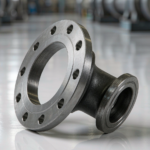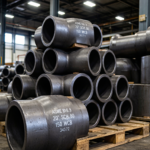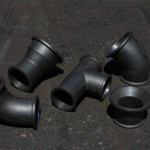
A carbon steel stub end — also called a lap joint stub end or lap joint pipe end — is the short spool piece that is butt welded to the pipe and paired with a loose lap joint flange. The combination lets a piping system be aligned and bolted up even when flange bolt holes do not line up, saves money in corrosive or frequently disassembled lines (only the flange needs to be exotic material, the stub end matches the pipe), and reduces the cost of lined and stainless systems. Getting stub ends right is a dimensional exercise: Type A, B or C geometry, the correct lap thickness matched to the flange radius, and concentric pipe bore. Huaxia-Steel supplies carbon steel stub ends to MSS SP-43 and ASME B16.9 with EN 10204 3.1 certificates, from audited partner forging and forming mills.
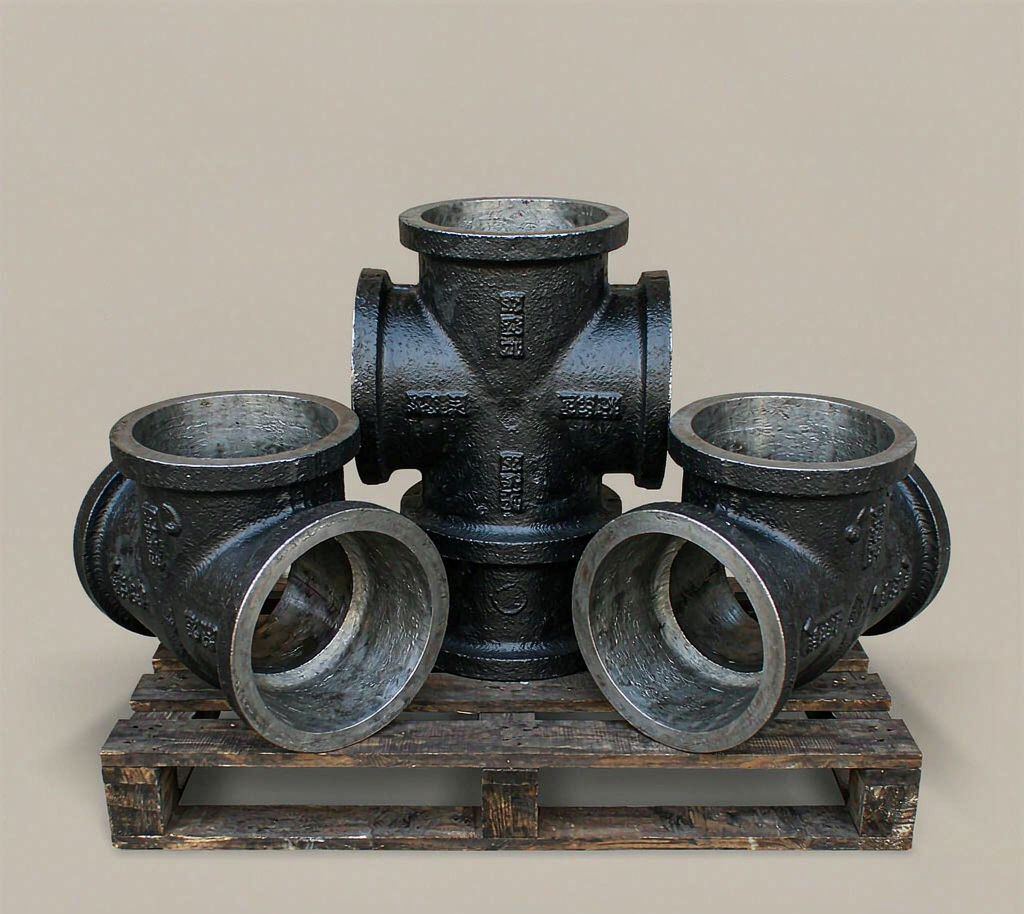
Product Overview
A stub end is a short length of pipe-sized tube with one end flared (lapped) at 90° to form the sealing face, supplied in either long or short pattern. The flare face mates against a lap joint (loose) flange: the flange rotates freely around the pipe, so the bolt circle can be aligned without welding alignment issues, and the flange itself never contacts the process fluid. The stub end is butt welded to the pipe with the same weld procedure as any butt weld fitting. Carbon steel stub ends are supplied in seamless or welded (ERW, seam 100% radiographed when specified) construction, in three geometries:
- Type A (long pattern): machined lap with external radius to match ASME B16.5 lap joint flange radius; used with standard slip-on/lap joint flanges. Most common in export orders.
- Type B (short pattern): shorter overall length, used with B16.5 slip-on flanges or where space is tight; lap thickness is formed to the same standard thickness.
- Type C (short pattern, formed): lap formed by cold forming rather than machining, thinner lap; economical for low-pressure, non-critical service.
Specifications: Dimensions and Weight
| Parameter | Range / Note |
|---|---|
| Size range | NPS 1/2 – NPS 48 (DN 15–1200) |
| Wall schedules | Sch 10S / 40 / 40S / 80 / XS / XXS to match pipe |
| Long pattern length (Type A) | Per MSS SP-43 table; e.g., NPS 4 ≈ 152 mm |
| Short pattern length (Type B/C) | Per MSS SP-43 table; roughly one third of long pattern |
| Lap thickness | Must match mating flange radius and pressure class |
| Face finish | Concentric serrated (serrated finish) or smooth per specification |
| Tolerance source | MSS SP-43 for thin wall; ASME B16.9 for matching-wall geometry |
| Weight reference | Pipe weight × stub length; NPS 4 Sch 40 long ≈ 1.4 kg |
Critical fit-up point: the lap thickness must be thick enough to carry the bolt load without bending, and thin enough that the flange’s radius seats fully. A common field failure is a thin Type C lap paired with a full-pressure lap joint flange in a Class 300 line — the lap deforms and the joint weeps. Match type to pressure class: Type A for ASME Class 150–600 lap joint flange service; Type B for lower pressures and tight layouts; Type C only for light-duty, low-pressure water and air lines.
Available Grades
| Grade | Standard | Typical service |
|---|---|---|
| ASTM A234 WPB | A234 | General carbon steel process piping, up to 425 °C |
| ASTM A105 / A105N | A105 forged | Forged stub ends for higher pressure, normalized for grain control |
| ASTM A420 WPL6 | A420 | Low temperature to −46 °C with Charpy |
| ASTM A860 WPHY 52/60 | A860 | High strength line pipe systems matching API 5L X-grades |
| ASTM A106 Gr.B (pipe stock) | A106 | Economical option where seamless pipe stock is formed |
When the system is stainless or lined, a common cost-saving configuration is a carbon steel lap joint flange (which never touches the fluid) with a stainless stub end. Ask us to quote both configurations; on NPS 6 and above the savings are substantial because the flange is the heavier, more expensive component.
Manufacturing Standards
- MSS SP-43: standard practice for light wall stainless/carbon steel butt weld fittings including stub ends; defines long and short pattern dimensions and tolerances.
- ASME B16.9: dimensional standard for factory-made wrought butt welding fittings; stub ends in matching-wall construction are dimensioned here.
- ASME B16.5: the flange standard that defines the lap joint flange the stub end mates with — always specify the flange class so lap thickness is correct.
- Material standards: ASTM A234 (wrought), A105 (forged), A420 (low temp), A860 (high yield), each with its own heat treatment requirement.
- NDE options: MT or PT of the formed lap radius, RT of weld seams for welded construction, UT of lap thickness on request.
Manufacturing routes: forging from bar or billet followed by machining of the lap (best integrity, higher cost), or forming from seamless pipe stock on a flaring machine (economical, standard for large sizes). Both are acceptable under MSS SP-43; for high-pressure or cyclic service, specify forged-and-machined Type A and require MT of the lap radius after forming.
Applications
- Corrosive and lined piping systems where only the wetted stub end needs exotic material.
- Systems requiring frequent disassembly: the loose flange rotates, so alignment is fast.
- Large-diameter and field-fabricated piping where bolt-hole alignment is difficult.
- Low-pressure water, air and utility lines using economical Type C laps.
- Skid and module fabrication where the flange can be swapped between pressure classes without re-welding.
Quality Assurance and Inspection
Each stub end ships with EN 10204 3.1 certification listing chemistry, mechanical properties and heat treatment, with heat numbers marked on the body per MSS SP-43 marking rules. Our pre-shipment checks cover lap face diameter and concentricity, lap thickness against the mating flange class, overall length and pattern type, end bore and wall against the ordered schedule, and surface condition of the sealing face (no laps, tears or scoring in the sealing zone). Third-party inspection (SGS/BV/TUV) is welcomed and can witness dimensional verification and NDE. Marking photos of the first article are provided before bulk shipment — request them with your order confirmation.
Packing and Shipping
Stub ends are protected with plastic caps on both ends, bundled or crated with lap faces separated by card or foam to prevent face scoring, and packed in seaworthy plywood cases or on pallets for container loading. Small sizes ship in cartons within wooden cases; large sizes are cradled and banded with the faces protected by hardboard. Documents: commercial invoice, packing list, 3.1 material certificates, dimensional report on request, COO and any third-party inspection certificate.
Installation and Welding Notes
Installing a stub end is a two-part operation: butt weld the stub end to the pipe, then slip the lap joint flange over the pipe before the second weld or before bolting. Sequence matters — if the flange is not slipped on before the stub end is welded to both pipe ends of a spool, the assembly cannot be completed. Fit-up and welding guidance:
- Bore alignment: match the stub end bore to the pipe ID within the fitting tolerance; a step of more than 1 mm creates turbulence and a crevice for corrosion in lined systems.
- Weld procedure: use the same WPS as for any butt weld fitting of the same material — GTAW root and SMAW/FCAW fill is typical for carbon steel WPB.
- Keep heat input moderate on the lap side: excessive heat can distort the lap face and break the seal against the flange.
- Do not weld the flange to the stub end — the whole point of the assembly is that the flange stays loose and rotates.
- Verify the stub end lap face sits flat on the flange radius before final bolt-up; a cocked lap is the most common cause of weeping at these joints.
- Gasket selection: use a full-face or ring gasket sized to the stub end lap face diameter, not to the loose flange’s bore — mismatched gaskets are a frequent field error.
Where the system carries abrasive or high-velocity fluid, note that the stub end lap creates a small step at the joint; for slurry service, a full welded neck flange or a raised-face slip-on arrangement is usually preferred over the lap joint.
Ordering Checklist
- Pattern type: A (long, machined), B (short) or C (short, formed) — state it explicitly.
- Size and wall: NPS and schedule, or wall thickness in millimetres for large sizes.
- Material: A234 WPB, A105 forged, A420 WPL6 or A860 WPHY grade with applicable supplementary requirements.
- Mating flange: ASME B16.5 class (150/300/600) so lap thickness is matched correctly.
- Construction: seamless or welded; if welded, state 100% radiography of the seam.
- NDE: MT or PT of the lap radius after forming; UT of lap thickness on request.
- Certification: EN 10204 3.1 with heat treatment condition and heat-to-item traceability matrix.
- Finish: bare, black painted or rust-preventive oiled for export.
- Commercial: Incoterm, port, validity, payment terms, lead time, LD clause and packing specification.
Why Buy Stub Ends From Huaxia-Steel
- Factory-direct supply from audited fitting mills, one certificate chain per heat.
- Type A, B and C in carbon steel grades A234 WPB, A105, A420 WPL6 and A860 WPHY.
- Lap thickness verified against your flange pressure class before shipment.
- EN 10204 3.1 certificates, dimensional reports and third-party inspection support.
- Quotation within 24 hours; FOB/CIF/DDP terms, mixed containers with flanges and fittings accepted.
Send your stub end schedule — sizes, pattern type, wall schedule, material grade and mating flange class — for a same-day quotation, or ask for a dimensional drawing of the exact pattern we will supply before you release the order.