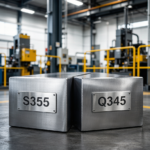
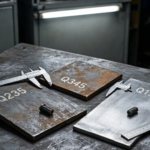
Since GB/T 1591-2018 came into force, Q355 has replaced Q345 as China’s mainstream high-strength low-alloy (HSLA) structural steel — and export buyers worldwide now see “Q355B” on quotations, MTCs and mill certificates where Q345B used to appear. The change is more than a renaming: the 2018 revision tightened chemistry, aligned impact testing with European practice, and created grade variants (Q355B/C/D/E) that map almost one-to-one onto EN 10025-2 S355. This guide explains what Q355 actually is, how it compares with S355JR and ASTM A572 Grade 50, what the grade suffixes mean, and how to order it without ambiguity.
1. What Is GB/T 1591 Q355?
GB/T 1591 is the Chinese national standard for high-strength structural steels delivered in hot-rolled condition. “Q355” means: Q = Qu (屈, yield strength), 355 = minimum yield strength of 355 MPa measured at room temperature for thickness ≤ 16 mm. The letter suffix B, C, D or E defines the Charpy impact test temperature:
Grade
Impact test temp
Min impact energy (longitudinal)
Closest EN grade
Closest ASTM grade
Q355B
+20 °C
34 J
S355JR
A572 Gr 50 (KV exemption)
Q355C
0 °C
34 J
S355J0
A572 Gr 50
Q355D
−20 °C
34 J
S355J2
A572 Gr 50
Q355E
−40 °C
27 J
S355K2
A572 Gr 50
The 2018 edition deliberately moved impact-test rules (test piece orientation, sampling frequency, energy values) into closer alignment with EN 10025 so that cross-ordering is safer than it was under GB/T 1591-2008, when Q345 chemistry allowed higher carbon and residual element contents.
2. Chemical Composition (GB/T 1591-2018, Q355B/C/D/E)
Two chemistry details matter for fabricators. First, carbon drops from 0.20% to 0.18% max for the D and E grades, improving weldability for cold-climate projects. Second, the standard caps the carbon equivalent at CEV 0.45%, which directly controls preheat requirements: at CEV ≤ 0.40-0.45, plate up to about 25 mm can normally be welded without preheat using low-hydrogen consumables — a genuine fabrication cost advantage over older Q345 heats that sometimes ran hotter.
3. Mechanical Properties by Thickness
Yield strength derates with thickness. The GB/T 1591-2018 values for Q355 (transverse tensile test on plate):
Thickness
Min yield (MPa)
Tensile range (MPa)
Min elongation
≤ 16 mm
355
470–630
22%
>16–40 mm
345
470–630
22%
>40–63 mm
335
470–630
21%
>63–80 mm
325
470–630
21%
>80–100 mm
315
470–630
20%
>100–150 mm
295
450–600
20%
For comparison, ASTM A572 Grade 50 holds min yield 345 MPa up to 65 mm (with limits above), and EN S355 holds 355 MPa to 16 mm derating similarly. In practice Q355B and A572 Gr50 are interchangeable for most strength calculations, but they differ in supply form: A572 is commonly specified for plate and shapes, while Q355 covers plate, strip, hollow sections, angles and beams across the Chinese mill system.
4. Q355 vs Q345: What Actually Changed?
Name only? Mostly yes for B grade — many mills’ Q355B output would have passed the old Q345B chemistry. But the standard tightened P/S limits and introduced CEV control, so certificates now carry data old Q345 MTCs never showed.
Impact testing: 2018 edition aligns energy values and sampling with EN 10025, making the S355 equivalence argument defensible in engineering review — useful when a European-designed project must use Chinese steel.
Documentation: since mid-2018, mills no longer certify to Q345; drawings calling for Q345B are executed as Q355B with a certificate note. Buyers should update material callouts to avoid MTC/PO mismatches at customs or third-party inspection.
5. Ordering Q355 Correctly: A Field Checklist
Always write the full grade + standard + edition: “Q355B per GB/T 1591-2018” — never bare “Q355”. The suffix controls impact temperature; omitting it lets the mill pick the cheapest (B).
State thickness range: yield derates with thickness; designs that assume 355 MPa at 80 mm will not verify.
Delivery condition: standard is as-rolled (AR) or normalized (N)/thermo-mechanical (TM) where offered. For D/E grades or thickness above 40 mm, specify N or TM to guarantee impact values.
Z-quality (through-thickness ductility): for welded box girders and heavy T-joints, add Z15/Z25/Z35 per GB/T 5313 to avoid lamellar tearing.
Marking and traceability: require heat number and grade stenciled/painted on plates and bundles; MTC must reference heat numbers you can match at receiving.
Equivalence claims: if the design code is European, ask for dual certification “Q355D / S355J2+N per EN 10025-2” — many large Chinese mills will certify both on one MTC.
6. Where Q355 Fits in Export Supply
Typical export products we ship in Q355 include: structural hollow sections (SHS/RHS) for towers and racking, angles and channels for transmission structures, plate for bridges and machinery chassis, and welded beams where a 355 MPa class replaces S275 to save 10-15% in weight. Compared with buying S355 in Europe or A572 in North America, Chinese Q355 typically prices 15-25% lower ex-works for plate and sections, with lead times of 2-5 weeks. The trade-offs to manage are documentation quality (insist on 3.1 MTC with traceable heat numbers) and dimensional tolerance regimes (GB vs EN 10029 for plate thickness tolerance class — state class B or C if your design assumes it).
7. FAQ: GB/T 1591 Q355
Is Q355B equivalent to S355JR?
For strength and impact requirements, yes — both deliver 355 MPa min yield and 34 J at +20 °C. Chemistry windows differ slightly (Q355 allows more Mn, S355JR has its own P/S limits). For European code projects, request dual certification rather than relying on blanket equivalence.
Can I use Q355 instead of A572 Grade 50?
In most structural applications, yes — strength levels are compatible. A572 Gr50 includes specific requirements for shapes and Cu content for atmospheric corrosion resistance that Q355 does not carry, so check project specs before substitution.
What does the “Q355MC” on some quotes mean?
It indicates thermo-mechanically rolled material (M) with impact class C. TM/TMCP material achieves the same yield with lower carbon and CEV, offering the best weldability — common in heavy plate for offshore and bridge work.
How is Q355 tested on an export order?
Each heat: tensile test (per thickness band), Charpy V-notch at the grade’s temperature (three specimens, longitudinal), chemistry by OES, and visual/dimensional inspection. Third-party witnessed testing (SGS/BV) can be added per PO.
What is the price difference vs Q235?
Q355 typically carries a 8-15% premium over Q235 for plate and sections. Because its higher strength lets designers cut member weight, total fabricated cost is usually lower for load-bearing structures.
8. Welding Q355 in Practice: Parameters Fabricators Ask About
Weldability is one of Q355’s main selling points, but the numbers deserve precision. With CEV capped at 0.45% (and TM-rolled heats typically at 0.38-0.42%), the practical guidance is:
Plate thickness
Preheat (CEV ≤ 0.43)
Preheat (CEV 0.43–0.45)
Recommended consumables
≤ 12 mm
None (ambient > 5 °C)
None to 50 °C
ER50-6 / E7018 / G3Si1
12 – 25 mm
None to 50 °C
50 – 100 °C
E7018 / G42–G46 wire per ISO 14341
25 – 50 mm
50 – 100 °C
100 – 120 °C
E7018 low hydrogen, interpass ≤ 250 °C
> 50 mm
100 – 120 °C
120 – 150 °C
Low hydrogen + controlled cooling, consider UT of HAZ
Additional fabrication notes that save rework:
Hydrogen control: low-hydrogen electrodes must be baked (300-350 °C, 2 h) and held in quivers; Q355’s slightly higher Mn makes it marginally more hydrogen-crack sensitive than Q235 in thick restrained joints.
Hot forming and straightening: temperatures above about 850 °C locally degrade impact properties of the affected zone; flame straightening on impact-critical members should be qualified, not improvised.
Post-weld heat treatment: normally unnecessary below 40 mm. For heavy welded box sections, stress relief at 550-600 °C restores dimensional stability without harming strength.
9. Role of Each Alloying Element in Q355
Q355 is a microalloyed C-Mn steel — understanding what each element contributes explains both its price and its behavior:
Carbon (≤ 0.18-0.20%): provides base strength through pearlite; kept low to preserve weldability and toughness. This is the defining difference from old-fashioned medium-carbon structural steels.
Manganese (up to 1.70%): the main strengthener, solid-solution hardening plus grain refinement during rolling; also binds sulfur into harmless MnS.
Niobium / Vanadium / Titanium (microalloys): form fine carbonitrides that pin grain boundaries during hot rolling, delivering fine-grain structure — the mechanism that lets 355 MPa be reached at low carbon. Vanadium additions also raise strength in heavier sections (V often 0.02-0.10% in plate).
Silicon (≤ 0.50%): deoxidation during steelmaking; contributes modest solid-solution strengthening.
Nitrogen control: Ti additions bind free nitrogen, improving toughness and aging resistance — relevant for parts that are cold formed then stored outdoors.
Because strength comes from microstructure rather than high carbon, Q355 keeps good cold-forming behavior: hollow sections and purlins are roll-formed from Q355 strip routinely, and bends with internal radius ≥ 1.5×thickness need no special measures in the B/C grades.
10. Dimensional Tolerance and Surface Classes to Specify
Strength is only half the story — the tolerances you accept determine downstream fabrication cost. For plate under GB/T 709, specify the tolerance class explicitly:
Plate thickness class: Class B (negative tolerance −0.3 mm fixed) or Class C (−0, positive only) versus default Class A. Structural calculation software often assumes nominal thickness; Class A plate can come in up to ~0.8 mm under nominal on 20 mm plate, eroding design margin.
Flatness: GB/T 709 normal class (N) or special (S) — S class matters for plates fed to automated plasma/laser cutting where head clearance is fixed.
Hollow sections: GB/T 6728 for square/rectangular tube; corner radius and wall eccentricity limits are looser than EN 10219 — check if your design review is European.
Surface: hot rolled plate with scale is standard; shot-blasted and primed (20 μm shop primer) saves blasting at the fabricator for 3-6% extra cost.
11. Price Factors and Import Economics
Export pricing for Q355 moves with several identifiable components. Ballpark structure for plate ex-mill (2026): base Q235 plate price, plus 8-15% for the Q355 grade premium, plus thickness surcharges above 60 mm (5-12%), plus Z-quality surcharge (3-8%), plus normalizing heat treatment (~USD 25-45 per ton) when specified. Container-friendly sizes under 6 m length ship in standard containers; longer plates go break-bulk, adding handling cost that can exceed the grade premium on small orders.
Duties matter too: HS code 7225/7228 (flat products of high-strength alloy steel) attracts different tariff lines than plain carbon 7208/7216 in many markets, and some buyers’ customs brokers misclassify — a pre-shipment classification opinion avoids disputes. Anti-dumping measures on Chinese steel products apply in some jurisdictions (check the specific product category for the destination country); our quotation team flags applicable measures before contract signature.
12. Case Example: Ordering Q355D for a European Bridge Project
A recent order illustrates the documentation chain that makes Q355 acceptable under a European design code: the engineer’s spec called for S355J2+N; the contractor’s procurement allowed Chinese supply with equivalence proof. We supplied 180 tons of 20-60 mm plate certified “Q355D per GB/T 1591-2018 / S355J2+N per EN 10025-2” (dual certification on one MTC), impact tested at −20 °C with results of 60-120 J longitudinal, CEV 0.40-0.42, with 3.2 certification (SGS witness) and UT to EN 10160 S1/E2 level for plates above 30 mm. Fabricator acceptance took one review of the MTC package — because the equivalence argument was built into the certificate rather than negotiated afterward.
The general rule: the extra cost of dual certification and third-party witness on a project-sized order is under 2%, while a rejected material package at site costs weeks. Build the acceptance argument into the purchase order, not the dispute.
13. Impact Testing and Sampling Details That Decide Acceptance
Charpy testing is where most Q355 orders either pass cleanly or generate claims, so the sampling rules deserve attention. Under GB/T 1591-2018: test pieces are taken transverse to the rolling direction for plate (longitudinal for some hollow sections), three specimens per test unit, with the average of three required to meet the minimum energy and at most one specimen allowed below the minimum (but not below 70% of it). Test unit size is heat-based for plate up to defined tonnage per thickness band — a 40-ton heat of 12 mm plate is one or two test units, while heavy plate is tested per 30-40 ton increments. Practical points for buyers:
State test piece orientation if your design code assumed transverse values (EN practice) — GB allows orientation options per product form, and defaults may differ from what your engineer calculated.
Strain-aged impact values: for cold-formed hollow sections, material can lose 10-20 J of impact energy after straining and natural aging; for cold-climate service specify grade E or hot-formed sections.
Re-test rules: if one specimen fails below minimum, one re-test of three additional specimens is allowed only if the failure is not below 70% — otherwise the heat is rejected or re-heat-treated. Make sure the MTC shows final disposition, not intermediate results.
On the fabrication side, cold forming behavior deserves one more paragraph: Q355B strip and plate can be cold bent to an inside radius of 1.0-1.5×thickness without cracking in the common gauges, and roll forming into purlins and hollow sections is standard practice. For bends tighter than that, or for D/E grades in cold service, use hot forming or larger radii — the fine-grain microstructure that gives Q355 its strength does not forgive abuse the way plain Q235 does. Fabricators moving from Q235 to Q355 should review bend allowances and springback (about 10-15% more springback due to higher yield) in their bending programs.
14. Q355 in Hollow Sections, Beams and Strip Products
Q355 is not just plate — it flows through the Chinese mill system in several product families, each with its own standard and ordering nuances:
Hollow sections (SHS/RHS/CHS): produced from Q355B/C strip, welded per GB/T 6728 (cold formed) or hot-finished per GB/T 34201. Hot-finished sections carry better impact and no residual-stress penalty for subsequent welding — worth the 5-8% premium on dynamically loaded structures. Export orders frequently request EN 10219 dual certification for European projects.
Beams and channels: hot rolled I/H-beams and channels in Q355B are widely available from large section mills; note Chinese beam dimensions follow GB/T 11263, which differs from European IPE/HE and American W-shapes — check section property conversion when substituting in a foreign design.
Strip and slit coil: Q355B strip (up to ~12 mm) feeds roll-forming for purlins, racking and cable trays; verify yield in the as-delivered cold-rolled-hard condition versus after skin passing — full-strength certification normally applies to the base material before forming.
Availability is excellent in B grade across all families; C and D grades in heavy sections and large hollow sizes are produced to order with 3-5 week lead times. E grade is plate-mill territory mostly — for hollow sections requiring −40 °C performance, hot-finished Q355E or a seamless equivalent is the realistic sourcing route. When a quotation for an unusual grade/size combination comes back too cheap, treat it as a signal: the most common cause is substitution of a lower impact class in production. Tie the grade suffix to the MTC impact test temperature in your acceptance criteria and the problem disappears.
Finally, keep one eye on the mill certificate itself. A compliant GB/T 1591-2018 MTC shows: standard and edition, grade with suffix, heat number, ladle analysis (all elements), delivery condition, tensile results against the correct thickness band, impact energy at the grade temperature with specimen orientation, and where applicable CEV and Z-quality declaration. Certificates lacking the edition year or listing impact values without temperature are incomplete — ask for corrected documents before shipment rather than negotiating at customs. Buyers who pin down these documentation details at order stage report materially fewer claims than those who treat paper as a formality.
Need Q355B/C/D/E plate, hollow sections or profiles from a certified Chinese mill? Send your grade, sizes and tonnage — we quote firm FOB/CIF prices within 24 hours, with dual EN certification and third-party inspection available.
If you require further information about our metal sheet products or architectural projects, please don’t hesitate to leave your contact details and message here.
Our team of experts will respond within 24 hours to continue the discussion and provide you with any additional information you requires.