ISPM 15 Fumigation for Steel Export: Wood Packaging Rules
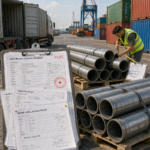
Steel does not rot, does not carry pests, and is not itself subject to any phytosanitary rule — yet steel shipments are rejected at ports every month because of the wood underneath them. ISPM 15, the international standard for phytosanitary measures covering wood packaging material, applies to pallets, crates, dunnage, blocking and bracing made from solid wood, regardless of what they carry. A coil of hot rolled steel is inspected for rust and dimensions; the pine dunnage wedged beside it is inspected for a stamp. If that stamp is missing, illegible, or belongs to a treatment facility that has lost its registration, the container can be refused entry, fumigated at the importer’s expense, or returned at the exporter’s. This guide explains what ISPM 15 fumigation actually requires, how heat treatment replaced methyl bromide in most markets, what each field of the IPPC mark means, where steel exporters most often get it wrong, and how to control a packaging supplier so the problem never reaches the port.
1. What ISPM 15 Actually Covers
ISPM 15 applies to wood packaging material made from solid wood — coniferous and non-coniferous — that is used to support, protect or carry a commodity in international trade. In practice that means pallets, pallet collars, crates, boxes, drums, cable reels, dunnage, bearers, wedges, chocks and any loose piece of sawn timber placed inside a container to stop cargo moving.
It does not apply to processed wood: plywood, oriented strand board, particle board, medium-density fibreboard, veneer, and wood that has been glued, heated or pressed during manufacture to the point where it is no longer raw wood. Nor does it apply to wood under 6 mm in thickness. That exemption is commercially important, because a crate built from plywood needs no mark at all, while an otherwise identical crate built from sawn pine needs two marks — one on each side, in most jurisdictions.
2. Why Steel Exporters Are Exposed
Industrial shippers often assume ISPM 15 is a food and agriculture issue. It is not. Australian and New Zealand border authorities have a long record of intercepting steel and machinery consignments with non-compliant dunnage; the United States requires ISPM 15 marking on all solid wood packaging and can issue a notice of violation and an emergency action order; the European Union requires the mark on all solid wood packaging entering the bloc and has removed hundreds of treatment-provider registrations in the last decade, meaning a mark that was valid two years ago may now be invalid. Because steel is heavy, it typically uses more timber per tonne than general cargo: bearers under every bundle, chocks between coils, and often a full crate for machined or coated parts.
The cost asymmetry is brutal. A compliant pallet costs a few dollars more than an unmarked one. A refused container costs demurrage, a fumigation fee, re-export freight or destruction, and the relationship with the customer — for a completely avoidable reason.
3. The Approved Treatments
ISPM 15 recognises a small number of treatments, each identified by a two-letter code in the mark. Heat treatment (HT) is the dominant route: the wood must reach a minimum of 56 °C at its core for at least 30 continuous minutes, measured by a calibrated probe in the coldest part of the load. Kiln drying (KD) at sufficient temperature can satisfy the same requirement, and heat treatment is often delivered as part of a kiln schedule, which is why many packaging suppliers offer HT and KD as one service. Dielectric heating (DH) achieves the same core temperature using radio-frequency energy and is used where speed matters and capital is available.
Methyl bromide fumigation (MB) was the original ISPM 15 treatment and remains on the standard, but its use has contracted sharply. Methyl bromide is an ozone-depleting substance controlled under the Montreal Protocol, and the European Union has not permitted it for ISPM 15 purposes since 2010. Some destinations still accept MB-marked material, particularly where cold treatment is needed for a specific pest, but the trend is one-directional: if you are choosing a treatment today, choose HT. It has no phase-out risk, no worker exposure issues, and no residue questions from a customer’s compliance team.
Code
Treatment
Key parameters
Status in 2026
HT
Heat treatment
56 °C core, 30 min continuous
Global default, widely available
KD
Kiln drying
Same core temperature profile
Accepted where schedule is documented
DH
Dielectric heating
56 °C core via RF energy
Accepted, less common
MB
Methyl bromide
Dose and duration by schedule
Banned for ISPM 15 in the EU; restricted elsewhere
SF
Sulphuryl fluoride
Specific schedules
Limited acceptance, check destination
4. Reading the IPPC Mark Field by Field
The mark is a stylised wheat ear symbol next to the letters IPPC, followed by four pieces of information: the country code of the country where the treatment was applied (two letters, e.g. CN), a producer or treatment provider registration number (often a four- or five-digit code with a facility suffix such as HT), the treatment code itself (HT, MB, DH), and optionally a “YY” for debarked wood where the destination requires debarking. Every element must be present and legible. A mark applied with a worn branding iron that leaves the registration number unreadable is treated as no mark at all.
Two details cause most arguments. First, the mark must be applied by a facility registered with the national plant protection organisation of the country of treatment — a Chinese supplier cannot apply an “HT” mark to timber treated by an unregistered yard, and inspectors can and do check the registration number against published lists. Second, the mark must be on each piece of wood packaging, or on the packaging unit where the standard permits (for crates, typically two opposite sides). A pallet with one mark on the centre stringer is acceptable in some jurisdictions and not in others; matching the destination’s expectation is the only safe approach.
5. Where Steel Packaging Goes Wrong
Item
ISPM 15 status
Typical failure
Softwood pallet under bundles
Covered — mark required
Reused pallets with faded or foreign marks
Sawn timber dunnage
Covered — mark required on each piece
Unmarked offcuts from a local sawmill
Plywood crate
Exempt — processed wood
Over-marked or, worse, mixed with solid wood frame
Plywood crate with pine frame
Frame covered
Frame left unmarked because “the crate is plywood”
Cable reel / drum
Covered if solid wood
Reel imported years earlier and reused
Engineered wood block
Exempt
Supplier substitutes solid wood block without telling buyer
Wooden cradle for machined parts
Covered
Cradle built on site by fitters
The last row is the most common and the most avoidable. When a crate arrives at the packing line and the fitters realize the load needs extra bracing, someone reaches for whatever timber is in the corner. That piece has no mark, and the whole container’s compliance status is now in question. The fix is procedural: keep a marked-timber rack next to the packing bay and forbid any other timber from entering the container.
6. Cost and Lead Time
Heat-treated softwood packaging typically costs 8 to 20 percent more than untreated timber of the same section, depending on the local kiln capacity and the season. For a 20-foot container of steel bundles using roughly 0.4 to 0.6 cubic metres of dunnage timber, that premium is usually a two- or low-three-figure dollar amount — trivial against the cost of a rejected container. Lead time is the more real constraint: HT slots must be booked, and during peak export months a packaging supplier may need five to seven days. Buyers who place a packaging order the day before loading are the ones who end up accepting unmarked timber.
Reusing packaging is allowed under ISPM 15 provided the mark is still legible and the wood has not been repaired with untreated timber. In practice, reuse is where most compliance failures occur, because marks fade, and because a repaired pallet often contains a new stringer that was never treated. If your operation reuses pallets, inspect every one and reject any with an unreadable mark or a visibly newer component.
7. Destination Rules That Differ
The standard is harmonised, but enforcement and additional requirements are not. The European Union requires ISPM 15 marking on all solid wood packaging and has no tolerance for methyl bromide. The United States accepts HT, DH and, in some cases, MB, and Customs and Border Protection can issue penalties for non-compliant material. Australia and New Zealand are the strictest: they inspect at a high rate, require debarked wood for many categories, and will order onshore treatment or export at the importer’s cost. India, Brazil and several Middle Eastern markets require the mark and, in some cases, an additional phytosanitary certificate or a declaration from the exporter. China, as an exporter, requires its packaging suppliers to be registered with the local customs technical centre, which issues the IPPC mark registration.
The practical rule is to ask the importer, in writing, what they require and what documentation they need at the border. A one-line email at quotation stage avoids a dispute six weeks later, and it also protects you if the destination changes its rules mid-contract.
There is a second layer beyond the ISPM 15 mark itself: some destinations pair the wood requirement with a cargo-specific rule. Steel that has been stored outdoors before loading may need a cleanliness declaration, galvanized or coated cargo may need a rust-free statement, and machinery shipped with residual oil needs a different declaration entirely. These are not ISPM 15 issues, but they arrive in the same border inspection, and the importer who receives a single consolidated document pack is far less likely to hold the container while chasing paperwork. Build the pack once, reuse it for every shipment, and review it whenever a destination changes its import rules.
8. Controlling the Packaging Supplier
Ask for the registration certificate of the treatment facility, with the number that appears in the mark, and check it expires in the future.
Photograph the marks on the first delivery of every new packaging batch and keep the images with the shipping documents.
Write the requirement into the purchase order — “ISPM 15 HT, IPPC marked on each piece, registration number XXXX” — rather than assuming the supplier knows.
Reject repaired pallets that contain untested components, even if the outer mark looks correct.
Keep a marked-timber rack on the packing line and remove all unmarked timber from the area.
Include the mark in your pre-shipment photo set, alongside container number, seal number and cargo condition, so you have evidence if a claim arrives.
9. When to Avoid Wood Entirely
For high-value or dimension-critical steel parts, engineered wood and non-wood packaging remove the compliance question completely. Plywood cases, OSB crates, plastic pallets, steel skids and vacuum-packed bundles with VCI film all fall outside ISPM 15. They cost more per unit than softwood, but they also eliminate moisture uptake, reduce the risk of rust during a long sea voyage, and are usually accepted without inspection. For stainless, cold rolled, coated or machined carbon steel, a plywood case with VCI film is often the cheaper decision once the cost of a border delay is included in the comparison.
10. A Worked Example: Galvanized Pipe to Australia
Consider a 40-foot container of hot dip galvanized steel pipe, 219 mm outside diameter, six-metre lengths, 24 tonnes net. The loading plan uses eight softwood bearers across the container floor, 16 chocks between bundles and a plywood bulkhead at the door end. Under ISPM 15, the bearers and chocks need treatment and marking; the plywood bulkhead does not, but if the bulkhead is framed with pine, that frame does.
Australia’s requirements make this a high-risk shipment in a way that a European shipment is not. Australian border authorities inspect a high proportion of steel consignments, require debarked wood for most categories, and will not accept surface-treated timber as a substitute. The correct preparation is: order 0.55 cubic metres of HT-marked, debarked hardwood or softwood dunnage from a registered supplier, retain the treatment certificate and the supplier invoice, photograph both sides of every bearer and a sample of the chocks, and include those images in the pre-shipment inspection report. If the pipe is also zinc coated, add VCI wrapping and desiccant to the plan, because a container held for inspection in a Queensland summer will sweat.
The total incremental cost of doing this properly is the difference between treated and untreated timber plus the labour to photograph and file — usually under 150 dollars on a shipment of this size, against a demurrage and onshore treatment bill in the thousands if the dunnage is rejected. Framed that way, the decision makes itself.
11. The Document Set That Supports the Mark
A mark on a piece of timber is evidence only if it can be connected to a treatment record. The document set that does that job includes the packaging supplier’s invoice, which should name the treatment code and the registration number; the treatment certificate or kiln record, showing date, duration and core temperature; photographs of the marks in place; and, where the destination requires it, a phytosanitary certificate or an exporter’s declaration referencing ISPM 15 compliance. For containerised steel, these documents travel with the commercial invoice and packing list, and the importer’s broker will look for them if the container is flagged.
Keep the treatment records for at least two years. Claims and audits often arrive months after delivery, and a supplier who can produce a kiln record for the exact batch is in a completely different negotiating position from one who cannot. It is also worth keeping the photographs, because a dispute about whether a mark was present at loading is otherwise impossible to resolve.
12. FAQ
Does a steel coil need ISPM 15 treatment? The coil does not. The wood under and around it does. If you ship coils on softwood pallets or brace them with sawn timber, that wood must be treated and marked.
Is plywood dunnage exempt? Yes, plywood is processed wood and falls outside ISPM 15. Plywood is a practical substitute for sawn dunnage where the load does not require heavy section timber.
Can I use methyl bromide? Some destinations still accept it, but the European Union does not permit it for wood packaging and the trend is toward HT everywhere. Unless a specific destination requires MB for a pest reason, specify HT.
What happens if the mark is missing? The container is held at the port of entry. Depending on the country, the options are onshore fumigation or heat treatment at the importer’s cost, re-export, or destruction. All three are expensive, and the delay alone often costs more than the treatment.
Does stamping the mark myself work? No. The mark is issued to a registered treatment provider, and applying it without treatment is fraud that border authorities actively check against published registration lists. Buy marked timber from a registered supplier instead.
Does the certificate of the treatment facility expire? Registrations are renewed periodically and can be withdrawn for non-compliance. Check the number against the national plant protection organisation’s published list rather than accepting a photocopy of an old certificate.
Ship Steel With Packaging That Clears the Border First Time
Huaxia-Steel packs every export order with ISPM 15 heat-treated, IPPC-marked timber from registered facilities, and photographs the marks as part of the pre-shipment inspection set that goes with your documents. Where the destination is strict — Australia, New Zealand, the EU — we can substitute plywood cases, plastic pallets or VCI-wrapped bundles and issue the corresponding declaration. Tell us the destination country, the cargo form and the loading method, and we will propose a packing specification, including timber quantities, treatment codes and photographic evidence, before the material is boxed. Send your enquiry to our export team for a quotation that includes the packaging, the marking and the documentation, not just the steel.
If you require further information about our metal sheet products or architectural projects, please don’t hesitate to leave your contact details and message here.
Our team of experts will respond within 24 hours to continue the discussion and provide you with any additional information you requires.